Glendale California Utility poles with electric wires against mountains and clear blue sky in suburban landscape on summer day.

Planning Ahead for EV-Ready Grids Without Leaving Ratepayers Behind
As electricity demand grows, customer costs will depend on how utilities plan and time grid investments, and how regulators manage the risks.
This is the third in a series of articles on grid planning resources tailored to utility consumer advocates. Read the first article “Reality Check: More EVs Could Mean Lower Energy Bills” and the second article “Understanding the Grid Impacts of Electric Vehicle Adoption.”
After decades of relatively flat electricity demand, the US power system is entering a new period of growth. Contrary to common belief, this growth is not solely driven by data centers and AI. Transportation and building electrification, industrial growth, and distributed energy resources (DERs) are also changing where, when, and how the grid is used. In the near future, electric vehicles (EVs) are expected to make up the lion’s share of new demand. How well utilities and regulators anticipate and account for this new demand will shape whether the grid can support electrification reliably, affordably, and on timelines that meet customer needs.
How will growth in demand impact electricity costs?
While electricity demand is beginning to grow, electricity prices have also been increasing across the country.
Exhibit 1
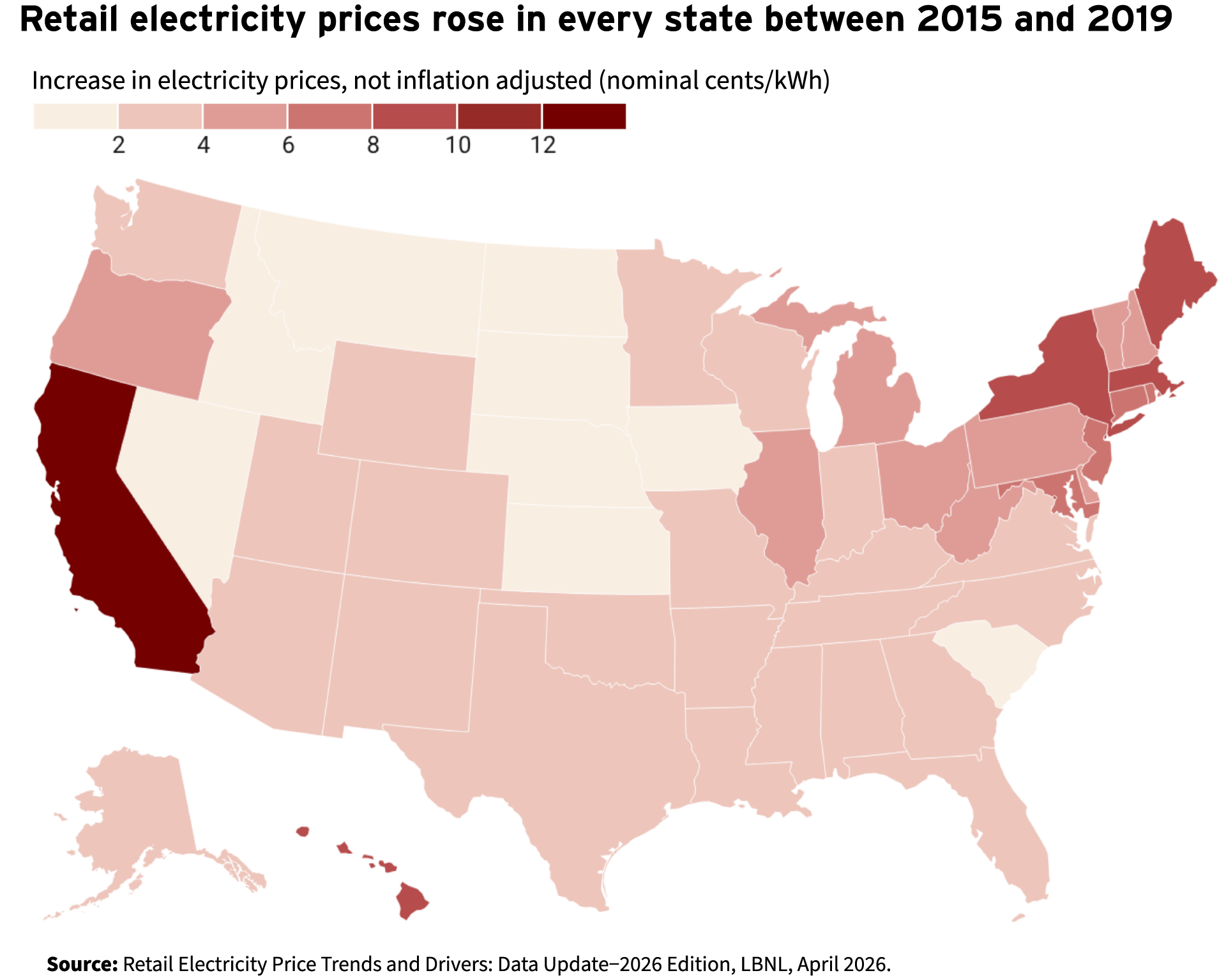
But rising demand alone does not determine what happens to customer bills. The affordability impacts depend heavily on how utilities plan, time, allocate, and recover grid investments. The key question is not simply how much does demand grow, but who pays for the investments needed to serve it and how are the benefits shared? Distribution system spending, in particular, is becoming a larger part of the affordability story. Over the past decade, distribution system investments have risen rapidly, outpacing other power sector investments in transmission and generation.
Exhibit 2
This has been driven by a combination of resilience and reliability investments, replacing aging infrastructure, and preparing for load growth driven in part by electrification. While investments to support electrification are therefore a piece of this story, it’s noteworthy that many utilities plan to spend more capital on replacing existing assets than on building new capacity to support load growth, largely due to the age of many utilities’ distribution systems in the United States.
Decisions on these distribution investments directly shape future electricity costs as they are recovered through customer electricity rates. But the relationship between those distribution investments and affordability is not always straightforward. Four core decisions increasingly shape how distribution system investments ultimately translate into customer bill impacts:
- Scale: how much new infrastructure utilities build, and how much future demand or DER growth they assume will materialize. The same upgrade can lead to very different affordability outcomes depending on when and where demand and DERs actually show up.
- Timing: when investments are made relative to when demand and DERs materialize. This is the core distinction between reactive and proactive grid planning. Building too late can delay electrification and interconnection, while building too early can expose customers to years of carrying costs before benefits materialize.
- Utilization: how effectively grid assets — both existing and newly constructed infrastructure — are used over time. Managed charging, flexible service connections, and other operational tools can reduce or delay infrastructure needs and improve affordability by increasing use of existing assets.
- Cost allocation and recovery: who pays for investments, how those costs are recovered over time, and who bears the risks if forecasts are wrong. This is where many of the core affordability and equity questions ultimately emerge.
As newer technologies — both for load and generation — become increasingly prevalent, utilities have had to contend with new forms of uncertainty. When, where, and to what scale will these resources materialize on the grid? This has made drawing a direct line between individual investments and their eventual rate impacts — whether positive or negative — more challenging.
At the same point, EVs present a key opportunity to help keep electricity rates affordable. Because a large share of utility system costs are fixed, additional electricity sales can help spread those costs over more units, putting downward pressure on average rates over time. How effectively this takes place depends in large part on how much of the new demand occurs at off-peak times, when the system has excess capacity to provide more electricity at relatively low cost. As some EV charging can be extremely flexible — just like other vehicles, EVs sit parked the vast majority of the time, presenting ample opportunity to shift demand to align with low-cost times — they are a great candidate for helping to make the overall system more efficient and therefore support affordable electricity prices. Data from the past 15 years suggests that this dynamic is bearing out, with EVs contributing considerably more to incremental revenue than the costs they impose upon the system.
How we prepare the grid for EVs and other load growth will meaningfully impact electricity rates.
As the speed of load growth has accelerated, many utilities are running into bottlenecks for connecting new customers or expanding service to existing ones. This is driven by several factors, including permitting, zoning, and utility interconnection processes that were not designed to handle a large volume of requests in a short timeframe as well as physical limitations in the amount of capacity available on the distribution system. While some of these factors are related to processes and labor availability, the physical limitations pose a different challenge: EV charging sites can be designed and built in weeks to months, while upstream grid capacity often takes months or years to build, presenting a significant timing mismatch.
Building grid capacity earlier can avoid this bottleneck and also take advantage of economies of scale through less frequent, larger projects intended to meet long-term needs. However, proactive investments also raise legitimate questions about affordability and risk: who should pay, and who bears the cost if the expected electricity demand doesn’t materialize as forecast?
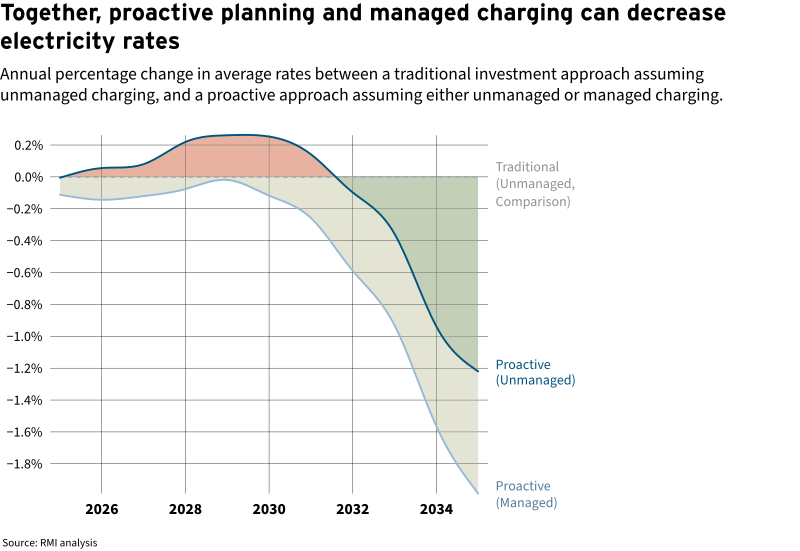
Recent RMI analysis explored the potential rate impacts of investing proactively ahead of EV demand, aiming to understand how the costs and benefits stacked up across traditional versus proactive investment pathways. Our analysis found that proactive investments incur modest near-term rate increases to cover additional upgrade costs but deliver long-term cost savings for ratepayers — even in a scenario where EV load growth was slower than anticipated. The cost savings derive from a combination of more efficient investments and additional revenue generation enabled by serving more EV load more quickly. Effectively leveraging managed charging further expands these benefits (as shown in Exhibit 3), reducing peak impacts and therefore total infrastructure requirements.
RMI’s Ratepayer Lab
RMI supports consumer advocates with tools, research, and direct engagement to address energy affordability challenges in the United States. Our Ratepayer Lab delivers tailored assistance for consumer advocates on issues including return on equity reform, securitization, fuel-cost sharing, integrated resource planning, performance-based regulation, customer safeguards, and effective grid planning practices for electric vehicle infrastructure.
These findings largely mirror those from other analyses of investment timing for EV-supportive grid infrastructure, such as the Proactive Grid Investment Assessment conducted by Black & Veatch and EDF, which also concluded that proactive infrastructure upgrades can provide net benefits for ratepayers. While these analyses are models of how costs could play out in the future, it’s important to acknowledge that the details of a utility’s existing asset base, cost structure, and load growth expectations will play a fundamental role in determining the best investment strategy. Nonetheless, early results are encouraging and indicate the potential to support faster energization for EV charging and other electrification while also providing net benefits to all customers.
Exhibit 3
What could proactive grid planning and investment look like in practice?
While the potential benefits of more proactive approaches to grid planning and investment are becoming clear, the regulatory shifts that may be required to enable these approaches — including implementing key safeguards to ensure accountability from electric utilities — raise a number of important questions.
Through the CHARGED initiative, RMI and partner organizations have explored a number of these questions with stakeholders from across the power sector including utilities, former regulators, consumer advocates, NGOs, national labs, and others. One output of this work is the CHARGED Proactive Investment Framework, an options roadmap for understanding the potential pathways to deploy and regulate proactive investments. The framework covers:
- How to use load forecasting and scenario analysis to identify and assess the appropriateness of proactive investments
- How to ensure that potentially cost-effective alternatives to traditional poles-and-wires investments, such as DERs and load flexibility programs, are fully and fairly evaluated
- Aligning on an equitable cost allocation approach that fairly shares costs, risks, and benefits across customer classes
- Developing processes to engage diverse stakeholders in the development and implementation of new regulatory structures
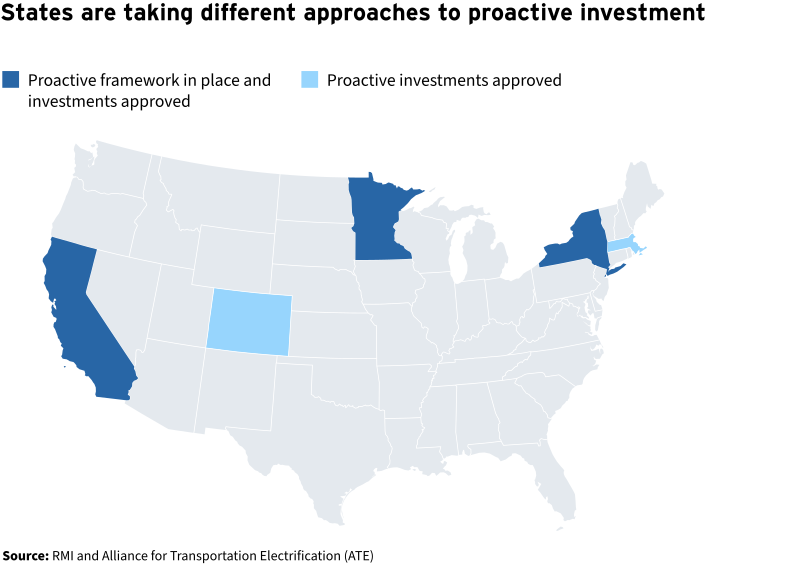
RMI’s recent case study report on cost allocation for proactive distribution investments explores how New York, Minnesota, and Massachusetts are beginning to address these questions in practice. Across the country, states are beginning to address similar questions in different ways:
- New York has developed a dedicated proactive investment process through which utilities are currently proposing specific projects, providing investment-grade analysis as evidence of why it is important to make these investments further in advance and proposals for project-specific cost allocation.
- Minnesota is developing a proactive distribution system upgrade framework through a dedicated stakeholder workgroup, while project-specific proactive investments are expected to be evaluated through the Integrated Distribution Planning (IDP) process. Much of the discussion has focused on cost sharing for both new sources of load growth (like EVs) and new sources of distributed generation.
- Massachusetts is moving from reactive, project-specific grid upgrades toward a proactive planning model through its Electric Sector Modernization Plans and Long-Term System Planning Process. Utilities have proposed a Proactive Hosting Capacity fee to spread common upgrade costs across future DER interconnections, but the proposal remains under Department of Public Utilities review — making Massachusetts a useful example of why proactive planning must be paired with affordability guardrails and protections against overbuilding risks.
Beyond those states, California offers another example of what proactive planning can look like in practice. The state has developed a highly structured new process for admitting additional data sources into the load forecasting and investment portfolio design process, while maintaining the standard rate case proceedings as the venue for determining cost recovery. The new elements include novel “pending load” categories, detailed scenario analysis, and structured decision logic around use of different data sources and scenario outputs to develop a single investment plan.
As these proactive frameworks are developed and implemented, the challenge will be turning better forecasts and planning inputs into investment decisions that remain fair, flexible, and affordable over time.
Exhibit 4
What options exist to manage the risks associated with different investment approaches?
Proactive investment means some grid upgrades are increasingly being built based on forecasts for future load and DER adoption. This creates a new challenge: how should risk be managed if those forecasts are wrong? Designed and implemented thoughtfully, cost allocation and recovery approaches can act as guardrails by setting expectations up-front, shaping incentives, and limiting how much downside exposure customers face when investments do not materialize as planned.
Exhibit 5 below summarizes several categories of guardrails that advocates and regulators can consider when evaluating proactive investment proposals. These tools do not replace prudency reviews or ratemaking processes. Rather, they help connect planning with later cost recovery decisions by clarifying up-front who may pay, how costs may be recovered, and what protections should apply if forecasts are wrong. RMI’s recent article on these tools provides a more in-depth overview of these guardrail approaches.
Exhibit 5
Consumer advocates and other stakeholders can help to shape these guardrails by asking the right questions early enough to influence investment proposals, testing assumptions during planning exercises, and ensuring those expectations carry through to later ratemaking decisions. A recent RMI article provides a fuller playbook for advocates and regulators, including questions to ask before planning proceedings, during planning reviews and in later ratemaking proceedings.
The path forward for affordable grid expansion
Electricity demand is increasing, and a significant amount of that demand will come from EVs. While this presents new challenges for grid planning, it also presents enormous opportunity to harness both the flexibility of these new resources and the new revenue they will contribute to manage costs for all customers. Seizing this opportunity will require new approaches, including programs to tap into load flexibility as well as some level of targeted grid upgrades, made further in advance, where credible data and forecasts make the need clear.
Those investments will not be risk-free, but the risks can be managed. By bringing cost allocation and recovery considerations earlier into planning, regulators and advocates can better understand who benefits, who pays, and who is exposed if reality deviates significantly from forecasts. Paired with clear ratepayer protections and later ratemaking reviews, proactive planning and targeted investments can help ensure EV growth supports a more reliable, affordable, and equitable grid.