Harnessing Carbon Removal Opportunities in Wastewater Treatment
How wastewater treatment and biosolids management can remove carbon pollution from our atmosphere
Introduction
Commercial and climate imperatives for integrating carbon removal activities into existing industrial processes and value chains are becoming ever more apparent. Opportunities to integrate carbon removal can help businesses grow and diversify, increase operational efficiencies, and adhere to evolving regulations. Simultaneously, climate stabilization demands rapid, large-scale carbon removal, positioning established industries as vital contributors. Forward-thinking industry leaders are beginning to strategically invest in a variety of carbon removal methods that align with their operational capabilities.
This series explores the economic and environmental incentives for integrating carbon removal into the wider industrial landscape. Through this series, we examine the potential for carbon removal integration into specific industries, identifying synergies with existing processes, along with the challenges, potential scale, and critical needs to advance opportunities. This report assesses the potential to integrate carbon removal technologies into the wastewater treatment industry.
Municipal wastewater treatment is a multi-stage process that collects sewage and removes harmful contaminants, including disease-causing bacteria, before releasing the wastewater to the environment. Each year, over 380 billion cubic meters of municipal wastewater are produced worldwide, alongside tens to hundreds of billions of cubic meters of wastewater from the pulp and paper industry and food and beverage industry.1
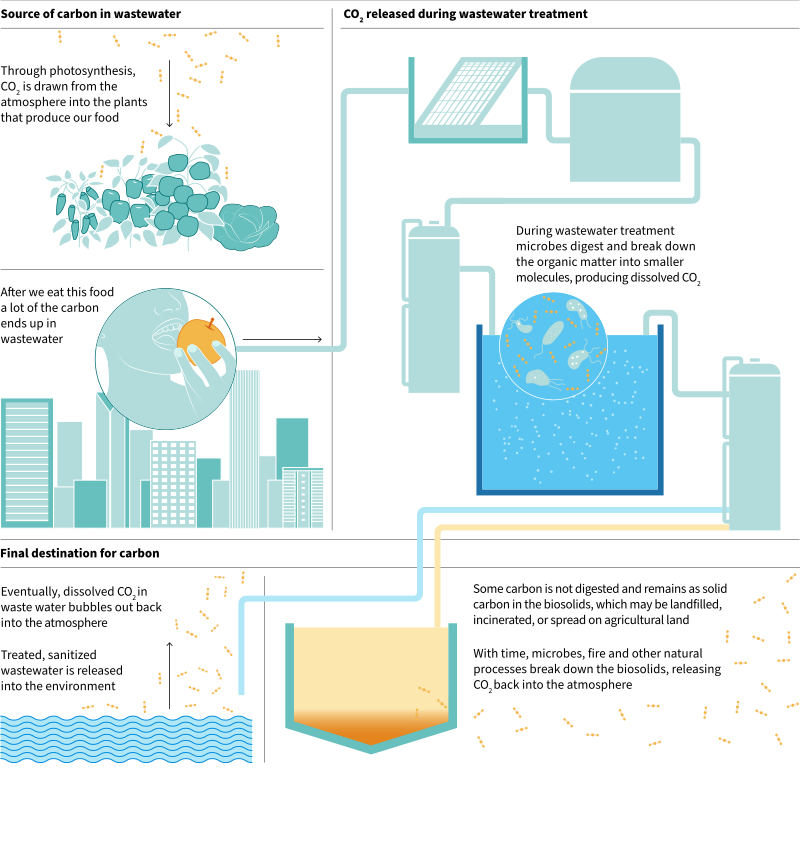
Wastewater treatment plants collect and process water rich in biogenic carbon, referring to carbon-containing molecules making up our food, waste, and any bacteria or other life forms. These molecular building blocks were formed through carbon fixation processes where plants convert carbon dioxide and water into molecules such as carbohydrates and protein in our food. Municipal wastewater treatment includes process steps controlling the pH of wastewater and promoting the digestion of these materials by microbes, breaking down molecules back into small molecules, including greenhouse gases such as carbon dioxide (CO2), methane (CH4), and nitrous oxide (N2O), which bubble out of the water and back into the atmosphere. Some of the biogenic carbon is not digested and remains in the solid phase, settling into sewage sludge which gets sanitized to produce biosolids. If these biosolids are applied to agricultural land as fertilizer, incinerated, or landfilled, the molecules contained within are ultimately also broken down and re-released into the atmosphere. The amount of carbon present in the global volumes of municipal wastewater produced each year is equivalent to hundreds of millions tons of carbon dioxide.
The landfilling or incineration of biosolids can be costly and may result in increased methane and nitrous oxide emissions due to anaerobic decomposition. In some geographies, biosolids are applied to farmland as fertilizer, though concerns about harmful contaminants such as per- and polyfluoroalkyl substances (PFAS, sometimes referred to as “forever chemicals”) in biosolids have resulted in some state- and country-level bans of this option for reuse.
Because the carbon present in municipal wastewater originally came from the atmosphere, capturing it during this phase and preventing it from being re-released as carbon dioxide results in a net removal of carbon dioxide from the atmosphere. This creates opportunities to turn problematic waste streams into valuable resources to use as feedstocks for carbon removal projects. Carbon removal processes provide compelling alternatives for wastewater treatment plants to manage pH levels within the process steps and dispose of the biosolid waste in an environmentally beneficial and profitable way.
In this report, we analyze the potential for carbon removal approaches to integrate into municipal wastewater treatment processes. We also highlight synergies and co-benefits available to wastewater treatment plants integrating these approaches. The integration of carbon dioxide removal (CDR) into the wastewater treatment industry is an area of emerging interest, with several pilot projects already underway. Other groups, including Carbon Gap, have released reports investigating the opportunities and policy recommendations for scaled deployment.2
Though this report is focused on impacts related to carbon dioxide, several approaches mentioned also have the potential to reduce emissions of other greenhouse gases such as methane and nitrous oxide, increasing their impact in reducing atmospheric pollution.
How Wastewater Treatment Can Support Carbon Removal
Carbon removal can be integrated into the treatment of any wastewater containing organic matter, including municipal wastewater (sewage) and biogenic industrial wastes. It can offer alternatives for existing treatment methods without interrupting the wastewater treatment processes themselves. Current methods available to support carbon removal fall into two categories of intervention: alkalinity management during the wastewater treatment process, and the disposal of biosolids remaining after municipal wastewater treatment.
Alkalinity management
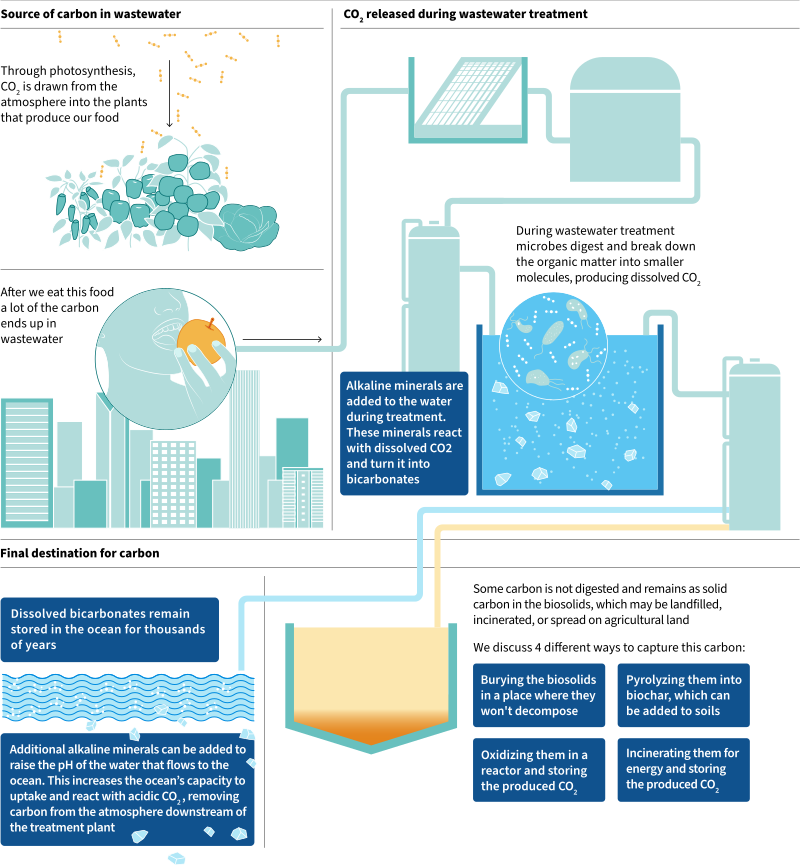
One way to prevent carbon dioxide in water from re-entering the atmosphere is to convert it into long-lived soluble molecules, storing the carbon within the water itself, which is eventually carried out to our rivers and oceans. “Alkalinity” is the opposite of acidity: the pH of wastewater can be increased by adding alkaline (basic) minerals, such as limestone. These basic molecules react with acidic carbon dioxide molecules, converting them into bicarbonates (HCO3-), which can be durably stored in the ocean for thousands of years.3 Modern wastewater treatment processes often already manage the pH by adding bases such as caustic soda, lime, quicklime, or milk of magnesia. Replacing these materials with alternatives that have lower embedded carbon footprints and encourage the formation of more stable bicarbonates results in carbon removal without significantly altering the wastewater treatment process itself or requiring novel infrastructure. The ideal feedstock choice will vary based on local supply, minimizing emissions from transportation, and reactivity considerations specific to plant parameters. Options include calcium- and magnesium-rich minerals, such as limestone, and minerals produced using low-emissions processes, such as low-carbon magnesium oxide.
In the context of wastewater treatment, alkalinity-based carbon removal can be implemented directly by using alkalinity to react with existing biogenic CO2 present in the water, or indirectly by increasing the pH of water outflows, increasing the capacity of rivers and oceans to draw down and react with atmospheric CO2 in the future. This leads to two distinct carbon removal approaches that rely on the addition of alkaline materials but differ in the where and when they affect carbon pollution:
-
Wastewater alkalinity enhancement (WAE)4, also known as engineered or containerized enhanced weathering, is the addition of alkaline feedstocks to CO2-rich water in a closed or semi-closed environment, where reactions are directly measured and monitored. This feedstock naturally reacts with CO2 present in the water and converts it into soluble bicarbonates on-site. In a wastewater treatment plant, WAE installations can use physical infrastructure already in place in wastewater treatment plants. The high concentrations of dissolved biogenic CO2 in the secondary stages of municipal wastewater treatment plants improve the efficiency of the process per ton of feedstock added compared to standalone deployment in other bodies of water.
-
Ocean alkalinity enhancement (OAE) involves raising the pH of seawater to increase the ocean’s capacity to convert dissolved CO2 into bicarbonates. This removes carbon from the atmosphere off-site, allowing the ocean, which has already absorbed a third of human carbon pollution,5 to uptake more CO2 without resulting in an additional increase in ocean acidification. Wastewater outflows with acidic pH levels offer integration points with reliable, permitted infrastructure for OAE projects to mix alkaline minerals into water to benefit the environment and reverse ocean acidification.
Biosolids management
The second category of carbon removal options relevant to wastewater target the carbon present in biosolids, which refers to the product formed by treating sewage sludge remaining at the end of the wastewater treatment process to remove pathogens and other potential sources of harm to humans and the environment. Over 8 million tons of biosolids are produced globally each day.6 Biosolids represent a source of waste biomass with high variance in composition and water content, making it difficult to repurpose for material uses. The carbon within biosolids can be prevented from re-entering the atmosphere by preventing it from burning or decomposing. There are several methods of carbon removal related to biosolids disposal which can each be applied in different cases depending on existing regional waste treatment infrastructure:
-
Biomass burial stores organic matter underground in anoxic environment where it cannot decompose, thus preventing the release of CO2. Organic waste streams that would otherwise be landfilled can instead be buried or injected into underground formations that previously stored hydrocarbons, permanently storing the carbon as well as any pollutants contained within the biosolids.
-
Biochar is a solid form of carbon created by treating biomass, such as biosolids, with a process known as pyrolysis, where matter is heated in an oxygen-free environment to break it down into less reactive compounds. Biomass can stably store carbon for hundreds of years or more,7 and be used as a fertilizer or in other useful material applications. Applying biochar to soils has been shown to increase their capacity to retain water and act as an atmospheric carbon sink.8
-
Supercritical water oxidation is a process being explored to treat biomass, such as biosolids, at high temperature and pressure to break it down into carbon dioxide, water, and potentially valuable inorganic compounds. The reaction conditions of this process also break down complex molecules including harmful perfluoroalkyl substances (PFAS) which are increasingly present in wastewater streams and accumulate in the environment if not removed during conventional wastewater treatment.9
-
Incineration with carbon capture and storage (CCS) can take advantage of existing waste incineration infrastructure by adding on a unit capturing the carbon dioxide formed during incineration. Around one quarter of biosolids produced in the United States and Europe is currently incinerated, which results in the re-release of carbon to the atmosphere as carbon dioxide unless facilities are equipped to capture and store it.
Exhibit 1: Carbon dioxide removal processes considered in this report
Synergies from Integrating Carbon Removal
Key synergies of integrating carbon removal projects into wastewater treatment plants, making projects cheaper or more effective than in standalone CDR projects, include:
-
Safe processing of biosolids: Wastewater treatment plants are under pressure to ensure the safe processing and treatment of biosolids. Hazardous contaminants such as heavy metals or organic compounds including PFAS, pharmaceutical compounds, or microplastics accumulate in our water systems.10 These contaminants are challenging to remove with conventional wastewater treatment practices and present a significant risk to public health if they are released into the environment.11 Regulations are being developed to ensure safe treatment of biosolids, including proposed bans on the direct use of biosolids on farmland in response to concerns of hazardous contaminants entering food supplies.12 Carbon removal approaches focusing on stable storage or hydrothermal conversion of biosolids can help utilities prevent these contaminants from re-entering the environment, with associated carbon credits potentially providing an additional revenue stream to pay for the investment required to implement new treatment steps. Conversion of biosolids into biochar can retain the production of useful fertilizers while destroying organic contaminants contained within.
-
Leveraging or optimizing existing process steps: Many municipal wastewater treatment plants already add alkaline materials to the wastewater during process stages. This addition of alkalinity keeps the pH within the optimal range for microbes to act to decompose organic waste. Replacing the current industry standard choices of alkaline materials, such as caustic soda or lime, with minerals such as limestone which carry lower embodied emissions can maintain pH control while encouraging greater net carbon removals as carbon dioxide in the wastewater is converted into stable bicarbonates. Similarly, wastewater treatment utilities already collect, transport, and store or process biosolids. Carbon removal approaches focused on biosolids processing can leverage existing collection logistics while providing an alternative final waste diversion strategy.
-
Shared infrastructure providing energy and CAPEX savings: WAE and OAE projects rely on minerals being dispersed within water to react with carbon dioxide either within or downstream of the treatment plant. This requires infrastructure and energy expenditure for water pumping through the plant and the dispersal and mixing of added minerals. Every day, wastewater treatment plants around the world are already doing the work of pumping, processing, and releasing over 600 million tons of wastewater. Integrating carbon removal projects into these plants instead of building new facilities dedicated to carbon removal can save the majority of capital equipment and a significant fraction of the total energy needed for each carbon removal project.
Potential Scale of Carbon Dioxide Removal in Wastewater Treatment and Biosolids Management
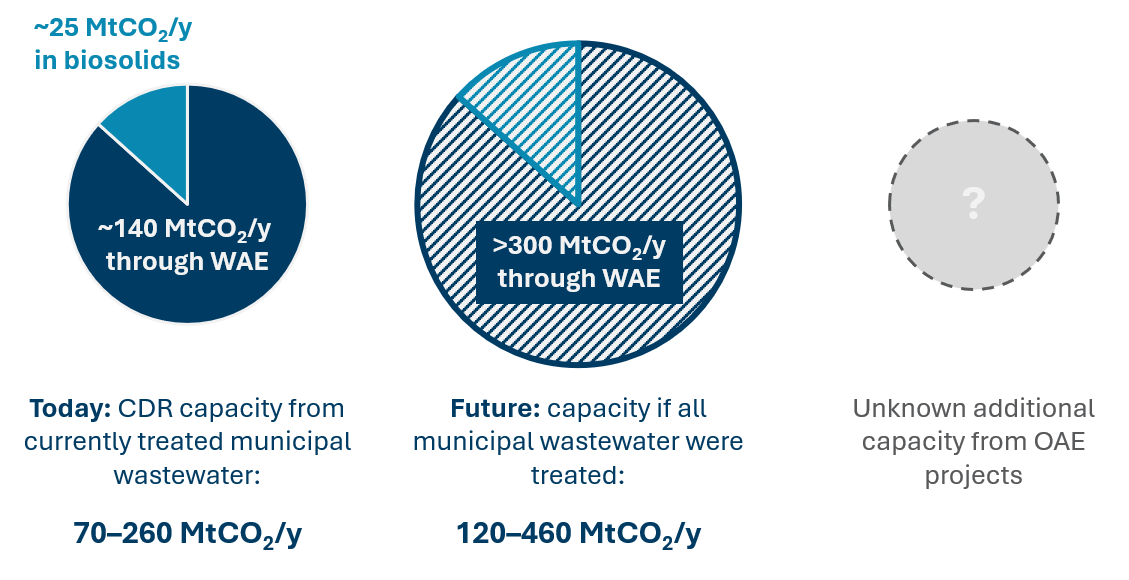
Globally, 380 billion m3 of municipal wastewater is produced annually, estimated to contain approximately 30–130 million tons of biogenic carbon, equivalent to 120–460 MtCO2 (million tons of carbon dioxide) if all contained carbon-based molecules are digested and converted into carbon dioxide. ~85% of this carbon is converted to carbon dioxide in modern treatment plans, while the remainder settles into biosolids.13 This means WAE projects could theoretically capture up to a maximum of 100–400 MtCO2 per year, and biosolids management approaches the remaining 20–70 MtCO2. The capacity of OAE projects is not limited to the amount of biogenic carbon present within the wastewater, but rather by the amount of alkaline minerals that can be added to outflows and effectively dissolved without negatively impacting local ecosystems. This limit varies based on feedstock choice and local conditions, and requires further research to determine a maximum potential from OAE deployed in wastewater treatment plants.
However, today, only 56% of municipal wastewater is treated at all before being released to the environment.14 This means only half of the CDR capacity described above, around 70–260 MtCO2 per year, can be achieved through integration into currently existing wastewater treatment systems. The United Nations’ social development goal (SDG) 6 to “ensure access to water and sanitation for all” includes the specific target 6.3.1 to halve the proportion of untreated wastewater by 2030 relative to a 2015 baseline. As the fraction of untreated wastewater decreases, the potential capacity for integrated carbon removal projects will increase.
Modern wastewater treatment processes, such as activated sludge and electrocoagulation, increase the fraction of carbon that is digested and decreases the quantity of biosolids produced. Such changes redistribute the carbon fates between the two outputs, but do not change the overall amount of biogenic carbon that could be captured in total across all approaches.
Expanding the scale-up of WAE projects to industrial wastewater streams containing biogenic CO2, such as water from the paper and pulp, food, and beverage industries, would present a significant additional carbon removal capacity, though it is difficult to quantify with currently available data.
Exhibit 2: Carbon removal potential based on biogenic carbon content of current municipal wastewater flows
The ratio between WAE and biosolids-based approaches will vary based on local choices of wastewater treatment methods. OAE approaches are not limited by the presence of biogenic carbon in wastewater and are not included in these capacity estimates.
Risks and Constraints
The potential of integrating carbon removal into wastewater treatment plants is significant even beyond its carbon removal impacts. Projects offer environmental and public health co-benefits through safer disposal of biosolids, water pH management, and improvements in microbial efficiency. Successful scale-up will require shifts in practices across many individually managed utilities and establishment of feedstock production and transportation infrastructure. Current key barriers to large-scale deployment include:
-
Quantification challenges when substituting existing feedstocks for alkalinity management (WAE and OAE). In order to verify the additionality of carbon removal required to generate revenue for carbon removal, WAE and OAE projects need to carefully characterize the baseline and new effective carbon removal rates, including the emissions embodied within the existing and replacement feedstocks used for alkalinity management. Protocols specific to implementing such projects within wastewater treatment plants are emerging, offering standardized implementation and carbon accounting practices.15 Alternatively, pay-for-practice models can be used to cover the implementation costs associated with shifting wastewater treatment practices without issuing carbon credits.
-
Visibility within the wastewater treatment industry (all approaches). A large number of projects partnering with treatment plants in many localities and countries are needed for scaled deployment. More visible and successful pilot-scale projects and targeted industry outreach are needed to accelerate the growth and increase awareness of these carbon removal methods.
-
Feedstock supply chain development (WAE and OAE). Deployment of alkalinity-based carbon removal at a scale of 300 MtCO2/y would require the supply of 0.5–1 billion tons of limestone or other alkaline minerals each year. For context, this represents around a tenth of the current global limestone market volume of more than 5 billions tons per year. This market volume typically fluctuates year-on-year in response to changing demand from industries such as construction, suggesting that additional dedicated quarrying for scaled CDR is feasible. Efficient carbon removal projects benefit from local sourcing of feedstock or transportation using carbon-efficient methods such as rail or barge systems. Stakeholders in the quarrying industries and related industries, such as cement production, will become key partners in establishing the feedstock supply chains needed for scaled deployment.
-
Feedstock costs (WAE and OAE). Early-stage carbon removal providers deploying pilot-scale projects use relatively small volumes of minerals compared to typical volumes traded among existing industries. This can significantly increase the cost per ton of mineral, as bespoke small-scale purchasing agreements with unique requirements made with quarries struggle to achieve economies of scale. Ongoing partnerships between carbon removal providers and feedstock suppliers will be needed to generate a continuous demand signal and decrease unit costs. Signals for long-term demand, such as offtake agreements, advanced market commitments, or policy guarantees such as government procurement or pay-for-practice models give feedstock suppliers confidence in future demand for the needed minerals, helping carbon removal providers negotiate lower costs.
-
Ecological risks (all approaches). Though carbon removal projects are expected to overall provide local environmental benefits, more testing and characterization of implementation in real-life conditions to address concerns such as ecosystem impacts of changing carbonate concentrations and pH shifts from WAE or OAE projects, and to confirm the destruction of harmful contaminants from projects based on biosolids management. Standardized effective monitoring, reporting, and verification (MRV) systems incorporating relevant environmental parameters will ensure safe project implementation and support clarified permitting structures for compliance with wastewater treatment standards.
-
Infrastructure for efficient CO2 capture, transportation, and storage (biosolids incineration or supercritical water oxidation). Approaches producing concentrated streams of CO2 need infrastructure to safely transport CO2 products to sites performing permanent geologic storage or utilization in durable materials.
What's Needed Next
Pilot-scale projects applying WAE within municipal wastewater treatment plants are underway, demonstrating the impact and efficacy of integrating carbon removal into the wastewater treatment industry. At larger scales, repeatable project models allowing for rapid, modular deployment will allow for accelerated deployment of pilot projects, providing real-life data from implementation in a range of geographies, plant types, and local contexts. Partnerships with ambitious early adopters can provide success stories, increasing industry-wide confidence in the viability of each approach.
Approaches relying on the management of biosolids are more nascent and require additional lab- and pilot-scale studies. The suitability of these approaches will vary significantly with existing treatment standards in each geography. Biochar may be a desirable substitute fertilizer in areas where biosolids are currently spread on agricultural lands, while biomass burial or incineration with CCS will be easiest to implement where biosolids are currently being landfilled or incinerated. Novel technologies such as supercritical water oxidation will likely be most desirable in geographies facing significant pressure to alter existing treatment processes due to concerns related to hazardous contaminants.
Policies requiring alternative biosolid management practices, as well as long-term demand signals such as pay-for-practice models or long-term offtake agreements will not only provide the investment required for near-term technology development but also increase confidence in the industry among wastewater treatment plant managers and feedstock suppliers, paving the road towards cost-efficient and rapid implementation.
Further analysis may inform the potential to implement carbon removal within other wastewater flows, such as industrial wastewater treatment. Additionally, local and regional analysis of the availability of alkaline materials for large-scale deployment will inform optimized siting of feedstock extraction and transportation infrastructure.
Acknowledgements
RMI would like to thank the following for contributions to this report:
-
Suzy Schadel, RMI
-
CDR providers at several companies working to develop CDR approaches within and related to the wastewater treatment industry, who offered useful insights through RMI surveys and company interviews.
RMI would also like to acknowledge and express gratitude for funding support from the Grantham Foundation for the Protection of the Environment.
Endnotes
- Manzoor Qadir et al., “Global and regional potential of wastewater as a water, nutrient and energy source,” Natural Resources Forum, 2020, https://doi.org/10.1111/1477-8947.12187. Ajay Singh et al., “Environmental pollutants of paper industry wastewater and their toxic effects on human health and ecosystem,” Bioresource Technology Reports, 2022, https://doi.org/10.1016/j.biteb.2022.101250. Mona Abdel-Fatah, “Integrated Management of Industrial Wastewater in the Food Sector,” Sustainability, 2023, https://doi.org/10.3390/su152316193. ↩︎
- “No wasted opportunities: Embedding carbon removal in the management of wastewater, concrete, and mining waste,” Carbon Gap and Deloitte, 2025, https://carbongap.org/no-wasted-opportunities-paper/. ↩︎
- Matthew Eisaman et al., “Assessing the technical aspects of ocean-alkalinity-enhancement approaches,” State of the Planet, 2023, https://doi.org/10.5194/sp-2-oae2023-3-2023. ↩︎
- Note: For more details on approaches relying on the storage of carbon in the form of dissolved bicarbonates, including risk assessments and near-term RD&D objectives, see Section 5 of RMI’s Applied Innovation Roadmap for CDR. Examples of project developers deploying engineered enhanced weathering projects include CREW, focused on integration into wastewater treatment plants, and Vycarb, focused on biogenic carbon present in river outflows and coastal waters. ↩︎
- “Understanding Ocean Acidification,” NOAA Fisheries, accessed March 2026, https://www.fisheries.noaa.gov/insight/understanding-ocean-acidification. ↩︎
- K. Rathika et al., “From pollutant to powerhouse: the untapped potential of sewage sludge and wastewater,” EMBO Reports, 2023, https://doi.org/10.15252/embr.202358201. ↩︎
- “Biochar’s long game: Unraveling the science of carbon permanence,” Carbon Direct, 2025, https://www.carbon-direct.com/research-and-reports/biochars-long-game-unraveling-the-science-of-carbon-permanence. ↩︎
- Maria-Elena Vorrath et al., “Pyrogenic carbon and carbonating minerals for carbon capture and storage (PyMiCCS) part II: organic and inorganic carbon dioxide removal in an Oxisol,” Frontiers in Climate, 2025, https://doi.org/10.3389/fclim.2025.1592454. ↩︎
- David Zgonc et al., “Hot topic: thermal treatment of per- and polyfluoroalkyl substances,” Current Opinion in Chemical Engineering, 2023, https://doi.org/10.1016/j.coche.2023.100976. ↩︎
- “Tap water study detects PFAS ‘forever chemicals’ across the US,” US Geological Survey, 2023, https://www.usgs.gov/news/national-news-release/tap-water-study-detects-pfas-forever-chemicals-across-us. ↩︎
- “Long-term impacts of sludge spreading on agricultural land,” European Environment Agency, 2024, https://www.eea.europa.eu/en/european-zero-pollution-dashboards/indicators/long-term-impacts-of-sludge-spreading-on-agricultural-land. ↩︎
- “The UK research exploring how to make sewage sludge safer and more sustainable,” Chartered Institution of Water and Environmental Management, 2025, https://www.ciwem.org/news/uk-research-exploring-how-to-make-sewage-sludge-safer. ↩︎
- Note: This can be approximated using average values of the chemical oxygen demand (COD) of wastewater. Ranges of global average COD values in municipal wastewater vary between 250 and 1,000 mg/L depending on source and geography (M. Maktabifard et al., “Achieving energy neutrality in wastewater treatment plants through energy savings and enhancing renewable energy production,” Reviews in Environmental Science and Bio/Technology, 2018, https://doi.org/10.1007/s11157-018-9478-x). Around 15–20%, or 100 mg/L, remains as undigested after treatment, though this fraction can decrease to as little as 3% (20 mg/L) using modern treatment methods such as activated sludge and electrocoagulation processes (“Global perspectives on industrial wastewater management: A bibliometric analysis of research output,” Journal of Hazardous Materials Advances, 2025, https://doi.org/10.1016/j.hazadv.2024.100567). Converting these values to an average TOC (total organic carbon) content using a typical COD:TOC ratio of 3 means the 80–330 mg/L of TOC contained in 380 billion m3 of wastewater represents a total of 32–130 million tons of carbon, equivalent to or 120–460 million tons of CO2. The fraction remaining in biosolids shown in Exhibit 2 is based on an average value of 15% left undigested in biosolids, though this varies by treatment plant and may decrease in the future with the adoption of more sophisticated treatment technologies. ↩︎
- “Progress on the Safe Treatment of Domestic Wastewater,” United Nations SDG 6 Progress Reports, 2025, https://www.unwater.org/publications/domestic-wastewater-treatment-briefing-note-2025. ↩︎
- “Certified protocol for carbon removal via wastewater,” Isometric, 2025, https://isometric.com/writing-articles/certified-protocol-for-carbon-removal-via-wastewater. ↩︎