

Learn how we are working to transform how we use and produce energy.
Managing Risks in an Era of Surging Distribution Costs
Regulators and advocates can use cost allocation and recovery guardrails to manage ratepayer risk as distribution costs rise.
Why we share this work for free
RMI is an independent nonprofit working to accelerate the clean energy transition. We publish research like this to inform decision-makers and drive real-world impact.
Our work is supported by philanthropy as well as partnerships, including fee-for-service engagements. This support makes it possible for us to share our independent insights for free.
If you find this work valuable, you can support it anytime.
Get more insights like this
Stay up to date with the latest research, analysis, and tools from RMI by opting in to receive occasional emails below. You’ll get new reports, event invitations, and practical insights to help us all accelerate the clean energy transition.
Loading form...
Your download should start automatically. If it doesn’t, click the download button below.
This work is made possible by philanthropy
RMI is a nonprofit supported by donors and partners. Philanthropy enables us to produce independent research and make resources like this freely available.
If you find this report valuable, please consider supporting our work. You can also explore how we partner with organizations to drive impact.
Jump to Section
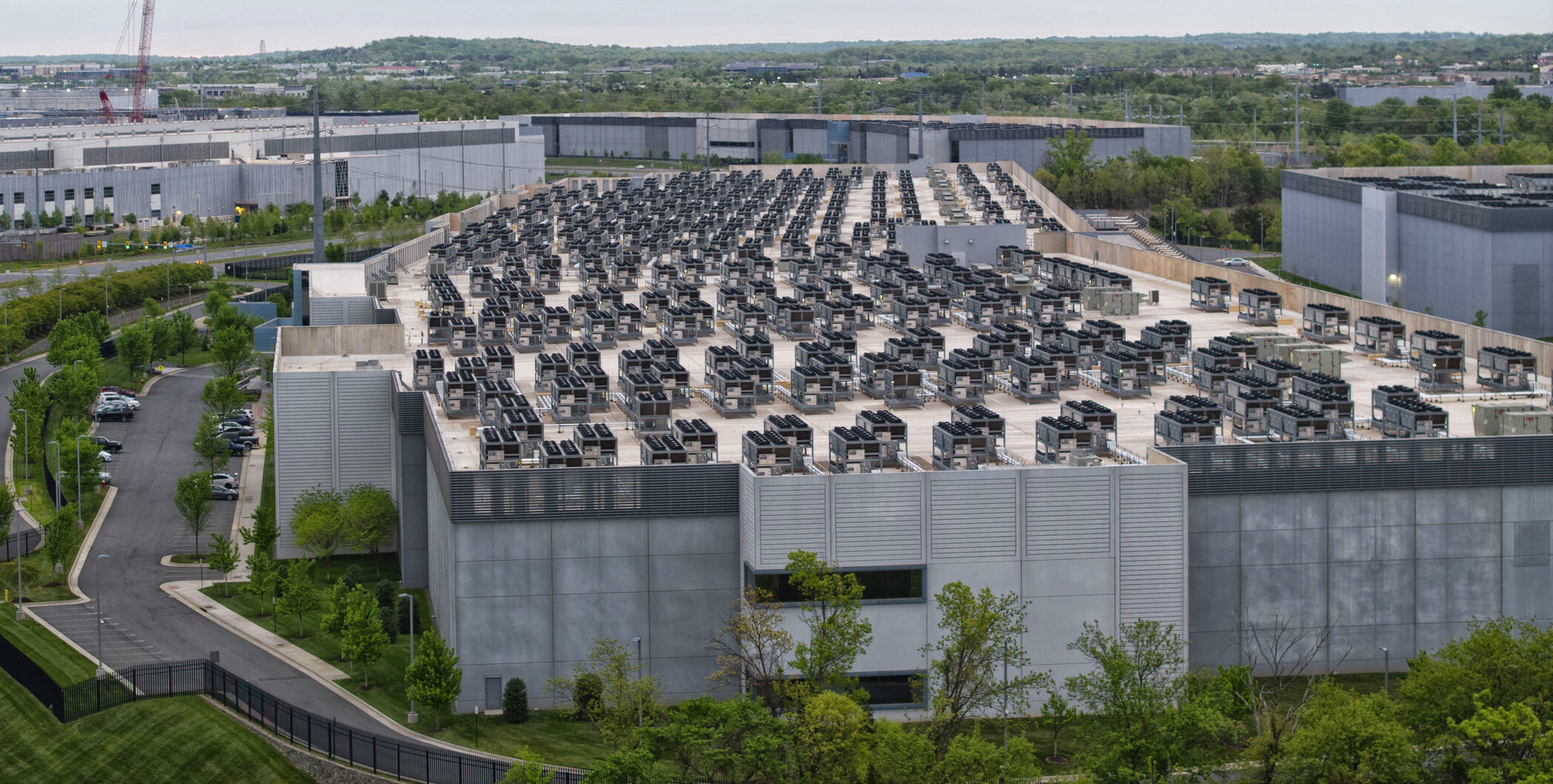
As electricity demand grows and distribution spending rises, regulators and consumer advocates are increasingly being asked to evaluate not just whether grid investments are needed, but also how the risks of those investments should be managed. That means utility distribution planning increasingly needs to account for new assumptions and risk factors as utilities identify the local grid upgrades needed to serve new load, connect distributed energy resources, and maintain reliability.
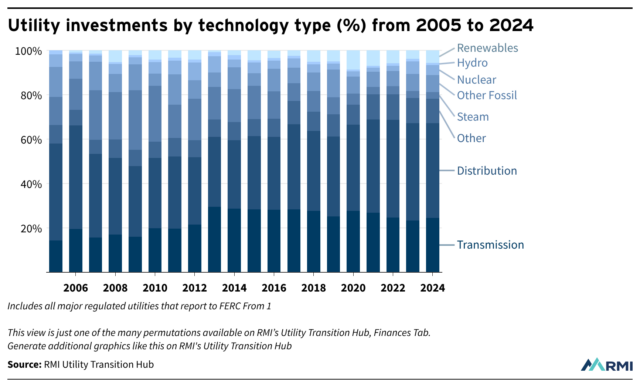
Several overlapping trends are reshaping that task: Electrification from EVs and buildings is increasing demand quickly and unevenly; distributed energy resources (DERs), such as virtual power plants or VPPs, are making the grid more dynamic; and in the meantime, utilities are replacing aging infrastructure and spending to increase grid resilience against extreme weather. Together, these forces are driving rapid growth in distribution spending and creating a more uncertain planning environment.
This creates challenges for the existing approach to upgrading the distribution system. When the grid doesn’t have sufficient capacity, customers trying to electrify or connect DERs can face long wait times and unpredictable upgrade costs, as infrastructure upgrades can take years to plan and build. Reactive, piecemeal investments can leave other customers exposed to higher than necessary system costs without experiencing the benefits of electrification or connected DERs. A growing body of work suggests there is an alternative path: targeted proactive upgrades can improve customer timelines and, under the right conditions, reduce long-run costs. That is why states such as Minnesota, Massachusetts, and New York are already exploring proactive planning frameworks that aim to do both: enable electrifying loads and DERs and protect customers from unpredictable cost exposure.
All of these proactive approaches rely on forecasts: how much load or DER uptake will materialize, where it will show up, and when. That is where the real challenge emerges. As utilities plan for future load and DERs that are not fully realized yet, it becomes harder to draw a direct and immediate line between investments and how the costs are distributed among customers. The same upgrade can lead to very different bill impacts depending on when and where load/DERs materialize. Proactive investments can lower costs, but if mistimed or mislocated, they can leave ratepayers, especially those already energy-burdened, paying for underused assets.
This is a core challenge to managing risk: not eliminating uncertainty but rather deciding up front how much risk utilities and customers should face when reality diverges from the plan. Without clear guardrails, forecast error can translate directly into inequitable bill impacts.
This is where cost allocation and cost recovery come in. Used well, these processes can balance risks and set the right incentives for utilities when making investment decisions. Used poorly, they can amplify cost shifts and affordability challenges. We are not suggesting integrating comprehensive cost-of-service analysis into planning, but to use planning to identify risk, test how it is distributed, and establish guardrails before investments are made and costs hit bills.
Why the rate case alone isn’t enough
Traditionally, cost recovery and cost allocation are resolved in rate cases after an investment has been made. This timing makes sense when investments are made in a more reactive fashion. However, this approach creates challenges when investments are made proactively to enable electrification and DERs, where the uncertainty is not just about the scale, but also where, when, and from which customers that load (or DERs) materializes. As a result, the distribution of costs and risks can diverge meaningfully from the original plan. Even where rate cases use forward-looking test years or are paired with multi-year plans, the basic challenge remains: if the planning record is weak, risk can still be misallocated.
To appropriately manage risk, the discussion needs to happen earlier. This doesn’t mean planning should replace ratemaking. Rather, planning can be a venue to identify which proposed investments are most sensitive to forecast error, who is expected to benefit, and what information and guardrails should carry forward into later cost recovery and cost allocation decisions. By doing this, regulators and stakeholders can better understand the full impact of an investment and have opportunities to think through guardrails that could mitigate risks posed by investments with higher levels of uncertainty.
How allocation and recovery shape risk
There is no single right approach to integrating cost allocation and recovery considerations into planning. But the key design choices and risk implications are becoming clearer as leading states explore different frameworks.
Regarding cost allocation, the spectrum runs from more targeted approaches, where costs are assigned based on “cost causers pay” or “beneficiaries pay” principles, to approaches where costs are mostly socialized, with most jurisdictions landing somewhere in between. The core question is not which allocation approach is theoretically most precise. But whether it keeps customer exposure to costs and risks within a reasonable boundary if the actual load and DERs diverge from the forecast.
Cost recovery mechanisms create incentives for utilities, and understanding the potential impacts of those incentives during the planning process can better allow stakeholders to design guardrails and shape effective cost recovery mechanisms. The planning process can help identify appropriate investments for cost recovery mechanisms (such as a rider or cost tracker), establish guardrails to mitigate the risk of inaccurate forecasts (such as mechanisms to refund customers if investments aren’t made), and identify how to track investment performance as a part of the cost recovery process.
Depending on the nature of the cost recovery mechanism, planning can be used to inform how cost recovery is established on a forward-looking basis or can inform what information is included on a backward-looking basis when reviewing investments.
Four guardrail strategies that help manage risks
When planning is used to surface investments that are sensitive to forecasts and potential risk exposure associated with the uncertainties, cost allocation and cost recovery approaches can act as guardrails: setting clear expectations, shaping incentives, and limiting who gets stuck with the downside when forecasts miss. Four broad strategies can help manage the uncertainty embedded in proactive planning.
- Set up protections in advance.
For investments that are highly sensitive to load and DER forecasts, utilitihttps://datawrapper.dwcdn.net/Y9DGv/1/es should identify up front which costs are assigned to direct beneficiaries, which would be socialized, and what happens if expected load or DER uptake falls short. Where broader cost sharing is appropriate, commissions should set clear limits on cost and risk exposure.
Minnesota’s proactive planning framework points in this direction by pairing beneficiary cost-share fees with a cap on how much proactive upgrade cost can be socialized through the general rate base if forecasts are missed. When identifiable customers are driving costs of upgrades, ex ante protections such as minimum commitments, minimum billing demand, collateral requirements and exit fees can also make those customers more accountable for the risks they create. These do more than protect ratepayers after the fact. They also encourage more realistic forecasts, coordination with grid planners, and clearer decisions up front.
- Design cost recovery to incentivize investment performance and mitigate risk.
Planning is an opportunity for stakeholders to understand what investments are required to achieve targeted outcomes, such as grid electrification, interconnection, utilization, or reliability targets. Commissions and stakeholders can establish targeted outcomes during the planning process and set expectations around cost recovery eligibility for investments, such as requirements for forecasting and data sharing during the planning process for investments to be eligible for cost trackers. Planning can also help establish guardrails on cost recovery to mitigate risk if forecasts are incorrect.
For example, in the UK, the regulatory framework for distribution utilities, RIIO, used “price control deliverables” (PCDs) to tie grid investment to specific outputs agreed at the start of the MRP. Detailed annual reporting guidelines provide progress insight for the regulator, Ofgem. An example of a PCD is grid reinforcement to meet EV-driven load growth. The utility forecasts a need for grid reinforcement and agrees to a targeted outcome (in the form of a targeted number of EVs and associated charging infrastructure), and the PCD funds this reinforcement. PCDs also have clear guardrails – the investment is non-fungible, so the funds cannot be used for other investments, and disallowances may be exercised if PCDs are not met.
- Build in flexibility and adaptive triggers.
Utilities and regulators shouldn’t use only a load forecast at one point in time to make investment decisions. That also doesn’t mean cost allocation and recovery need to be revisited frequently outside a formal ratemaking proceeding whenever conditions change. Instead, commissions can build in checkpoints that require utilities to update assumptions, compare actual outcomes to forecasts, and justify continued recovery if conditions diverge materially from what was approved. These triggers can take the form of staged approvals, period reconciliations, or follow-on proceedings to adjust depreciation or recovery assumptions based on how the actual materialization of load/DER deviates from forecasts.
For example, the UK’s latest decision on RIIO — which is designed to be more encouraging of proactive investments — has built in “uncertainty mechanisms” in the form of re-openers that adjust funding mid-period for costs that cannot be accurately forecasted five years in advance. It also includes Real Price Effects (RPEs), which automatically adjust allowances based on input price indices for labor and materials.
- Use back-end tools to manage residual risk.
Even with stronger ex ante protections and adaptive triggers, some distribution investments may still face challenges if utilization is significantly delayed or does not materialize as expected. In practice, however, true “stranding” of distribution assets is relatively limited, as most investments have long operating lives and can be repurposed or eventually utilized. The most common issue is a timing mismatch.
In those cases, back-end tools such as depreciation adjustments and deferred accounting can help manage bill impacts and lower the cost of recovery. While these mechanisms can be extended to stranded distribution investments, they should be applied selectively. And these tools are best reserved for the low-probability “downside” cases when assets are unlikely to be used over their remaining life or cannot be repurposed or deferred to future needs, rather than situations where utilization is simply delayed or shifted. And they should complement, not substitute for, stronger up-front guardrails and planning practices as recommended above.
A better way to manage risk
As with most regulatory decisions that balance multiple policy objectives, there is no perfect solution. But there is a better way to manage the tradeoffs: set the rules for risk early, keep ratepayer exposure bounded, and make sure cost allocation and recovery reflect how benefits are realized.
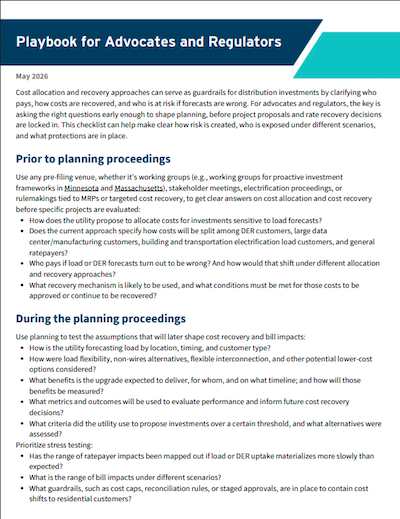
Download our checklist that offers a practical starting point for those conversations. Regulators, consumer advocates, and other stakeholders can use it to ask targeted questions before, during, and after planning proceedings, helping ensure that proactive grid investments are paired with clear expectations, bounded ratepayer exposure, and cost recovery that reflects how benefits are realized.
Download the checklist:
The authors wish to thank Cara Goldenberg for contributing to this article.


Related Insights


Help build the clean energy future. Donate today.
Independent research. Real-world solutions. Supported by donors.
RMI can pursue the highest-impact climate and energy solutions because we’re supported by people who believe change is possible. Every gift helps advance the work needed to make clean energy the default choice worldwide.
For other ways to give to RMI, including checks or gifts of stock, please visit Other Ways to Give.
