

Learn how we are working to transform how we use and produce energy.
Powering New Loads and Lowering Electricity Costs with Connect-and-Manage Interconnection
Texas shows how a streamlined interconnection option can speed new generation, promote affordability, and keep the electricity grid reliable
Why we share this work for free
RMI is an independent nonprofit working to accelerate the clean energy transition. We publish research like this to inform decision-makers and drive real-world impact.
Our work is supported by philanthropy as well as partnerships, including fee-for-service engagements. This support makes it possible for us to share our independent insights for free.
If you find this work valuable, you can support it anytime.
Get more insights like this
Stay up to date with the latest research, analysis, and tools from RMI by opting in to receive occasional emails below. You’ll get new reports, event invitations, and practical insights to help us all accelerate the clean energy transition.
Loading form...
Your download should start automatically. If it doesn’t, click the download button below.
This work is made possible by philanthropy
RMI is a nonprofit supported by donors and partners. Philanthropy enables us to produce independent research and make resources like this freely available.
If you find this report valuable, please consider supporting our work. You can also explore how we partner with organizations to drive impact.
Jump to Section
As data centers drive a surge in electricity demand, more stakeholders have realized that the long timelines for connecting new electricity generation to the power grid are a barrier to meeting growing load. But why is interconnection so slow? And are there faster alternatives?
In this article, we describe the slow “invest‑and‑connect” interconnection approach common in the United States today and contrast it with the faster “connect-and-manage” approach used in Texas. We then lay out the benefits of a federal implementation of the connect-and-manage approach.
Contrasting paradigms for interconnecting new generation
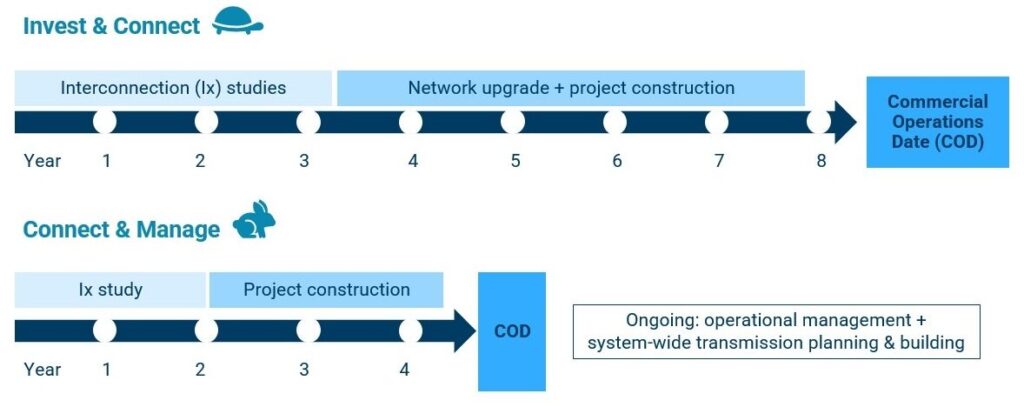
With invest‑and‑connect interconnection, used by most US grid operators, new generators must fund and wait for transmission network upgrades before connecting to the grid. Conducting the complex, lengthy studies to identify the needed upgrades and then building those upgrades creates years-long delays and high, uncertain costs.
A connect‑and‑manage (C&M) approach flips that sequence, allowing generators to plug in sooner and produce power while utilities plan and build the needed transmission throughout the projects’ operational lives. C&M speeds project development timelines, promotes competition, and ultimately lowers customer costs. Using C&M, grid operators enable “speed to power” by 1) limiting generator interconnection studies to ensuring a secure and reliable connection to the local grid substation and 2) managing generator dispatch dynamically, curtailing generators when necessary, and optimizing transmission expansion based on system-wide needs.
Exhibit 1
The two interconnection paradigms and their representative timelines
Texas keeps costs low and reliability high with C&M
For over two decades, C&M has worked in Texas — home to the second-largest state economy in the United States — encouraging competition, reducing costs, and maintaining reliability.
Projects seeking to interconnect to the grid managed by the Electric Reliability Council of Texas (ERCOT) come online in an average of four years. Since 2020, 89 gigawatts of new resources have connected to ERCOT’s grid (Exhibit 2), while average curtailment rates have remained low, at around 6% in recent years. Electricity prices in Texas are among the lowest in the country. And ERCOT’s C&M approach does not relax or bypass reliability requirements; ERCOT continues to comply with the applicable North American Electric Reliability Corporation (NERC) Reliability Standards via its transmission planning processes.
Exhibit 2
A “connect-and-manage” interconnection option is viable outside of Texas
In most of the United States, the closest comparison to the C&M approach is Energy Resource Interconnection Service (ERIS), an option within the invest-and-connect paradigm. ERIS allows a generator to connect to the grid on an “as available” basis, without guaranteeing or necessitating full deliverability. However, due to regional variation in compliance with FERC Orders 2003 and 2023, ERIS often resembles the more network-upgrade-intensive Network Resource Interconnection Service (NRIS). NRIS requires the generator to be deliverable under a range of grid conditions (including peak demand periods), and grants the resource capacity value. As a result, developers tend to underutilize ERIS, as it often entails similarly high costs and lengthy timelines as NRIS, while foregoing the capacity revenues.
Congress could help accelerate interconnection by requiring all regions to create a fast C&M service option for generation developers. Developers and energy offtakers would then have the option to choose between two paths to power: bring projects online faster and deliver low-cost energy while accepting curtailment risk, or wait years for complex studies and pay for costly, piecemeal transmission upgrades before connecting.
This approach builds on capabilities that already exist nationwide. The core building blocks of C&M — economic dispatch, which runs lower-cost generation and curtails higher-cost resources when transmission-constrained, and coordinated transmission planning — are already in place across US grid regions. A C&M option would add a new, standardized pathway to the existing ERIS/NRIS invest-and-connect framework, giving developers a defined option for meaningfully faster interconnection in exchange for curtailment risk.
This new C&M service would complement ongoing reforms, such as compliance with FERC Order 2023 and SPP’s Consolidated Planning Process. While those reforms define minimum standards and set the stage for long-term interconnection improvements, C&M is the only approach that can dramatically improve interconnection in the near-term, which is sorely needed given the increasingly large and pressing demands for power. Importantly, a C&M option would not impact US capacity markets, as system-wide capacity deliverability constructs and NRIS would remain for developers who wish to participate in capacity markets.
The opportunity to enshrine a C&M pathway for generator interconnection at the federal level is large: C&M could be a key enabler of near-term affordable electricity, speed to power, and the efficient infrastructure buildout needed to support American economic leadership, which is increasingly dependent upon the power sector.
“If regulators want to successfully power the AI era without leaving ratepayers holding the bag, they must recognize that flexible interconnection isn’t just a clever tool for managing data centers, it is the modern playbook for generation as well.”
– Ric O’Connell, Executive Director, GridLab
FERC’s New Load Flexibility Framework Is Only Half the Battle. Now, Apply It to Generation
The benefits of a federal “connect-and-manage” interconnection option
There are five main, near-term benefits to expanding the C&M approach federally:
- Advances energy affordability. Adding more generation to the grid increases competition with incumbent resources in energy markets, helping lower energy prices — the largest wholesale component of electricity bills for households and businesses.
- Accelerates new generation. C&M reduces red tape and uncertainty in the interconnection process. Thus, it allows shovel-ready generation to connect sooner by cutting study timelines and eliminating the need to wait for deep network upgrades miles away from the project (interconnection facilities local to the point of interconnection are still required for reliability).
- Improves reliability. Today, the biggest threat to resource adequacy is insufficient energy generation to meet rapidly scaling demand. C&M can bring more generation online fast and thus help fill that gap whenever the transmission is available, reducing the risk of supply shortfalls or extreme weather impacts.
- Strengthens private investment signals. By reducing interconnection uncertainty and enabling earlier market participation, C&M can improve project economics and give developers and offtakers a clearer basis for committing capital.
- Supports a more optimized and efficient grid. The invest-and-connect approach to interconnection has resulted in an inefficient, piecemeal, and slower buildout of transmission via network upgrades. C&M, by contrast, keeps transmission planning as a system-wide process, supporting greater efficiencies and right-sizing opportunities, and it fully leverages the operational tools that can avoid or defer higher-cost interventions. This turns the grid into a more flexible, actively managed system rather than a rigid “build first, connect later” model.
Faster generation deployment ensures the grid can support new industries and technologies, most of which now rely on electricity as a critical input to their operations. C&M helps ensure energy supply keeps pace with demand growth, supporting an array of US domestic industries. A more flexible, responsive electric grid thus enhances American competitiveness in the 21st century.
Authors

Sarah Toth Kotwis
Technical Manager
Katie Siegner
Manager
Abigail Weeks
Associate
Chaz Teplin
PrincipalRelated Insights

For Clean Energy Projects, How Community Benefits Are Delivered Matters
Tracking WestTEC: Where 100+ Transmission Projects Stand and What Comes Next

Help build the clean energy future. Donate today.
Independent research. Real-world solutions. Supported by donors.
RMI can pursue the highest-impact climate and energy solutions because we’re supported by people who believe change is possible. Every gift helps advance the work needed to make clean energy the default choice worldwide.
For other ways to give to RMI, including checks or gifts of stock, please visit Other Ways to Give.
