Electric charging station for electric vehicles in a mall parking lot.

Understanding the Grid Impacts of Electric Vehicle Adoption
New forecasting tools can help predict where, when, and how EVs will charge.
This is the second in a series of articles specifically designed to provide grid planning resources for consumer advocates. Read the first article “Reality Check: More EVs Could Mean Lower Energy Bills,” and the third article “Planning Ahead for EV-Ready Grids Without Leaving Ratepayers Behind.”
Electric utilities typically plan years in advance to decide what to build and where to invest. To do this, they need to answer the deceptively simple question: how much electricity will customers use? The process of answering that question, known as load forecasting, underpins everything from power plant investments to local grid upgrades. As more electric vehicles take to US streets and charge unevenly across the grid, improving how we forecast electricity demand, specifically demand from electric vehicles (EVs), is becoming essential to keeping costs down and maintaining reliability.
What is load forecasting, and what is it used for?
To ensure reliable electric service for all customers, utilities engage in several core planning exercises. These include:
- Integrated resource planning — which generation sources will be needed in the future
- Transmission planning — how to move power across regions reliably and cost-effectively
- Distribution system planning — what assets, such as transformers, circuits, and substations, are needed to deliver electric service to end-use customers
Load forecasting is a foundational component of all these processes.
Load forecasts incorporate a range of influences and inputs, including technology adoption trends, policy impacts, economic conditions, and customer usage patterns, to estimate future electricity demand. In turn, these forecasts guide grid investment decisions and shape customer costs and outcomes.
However, in today’s world of rapidly growing electrification, the traditional approach to load forecasting is not sufficient, especially when it comes to capturing demand from electric vehicles.
RMI’s Ratepayer Lab
RMI supports consumer advocates with tools, research, and direct engagement to address energy affordability challenges in the United States. Our Ratepayer Lab delivers tailored assistance for consumer advocates on issues including return on equity reform, securitization, fuel-cost sharing, integrated resource planning, performance-based regulation, customer safeguards, and effective grid planning practices for electric vehicle infrastructure.
Why should forecasting practices evolve to capture EVs?
EV charging represents a unique type of electricity demand. Vehicles are mobile — often called “batteries on wheels” — and can charge at different locations throughout the day, week, or year (unlike more static loads like your refrigerator or air conditioner). Their demand can also be significant: residential charging can be comparable to adding a large new appliance, such as a dual-unit air conditioner, while the power demand of some electric truck charging depots can reach the scale of an NFL stadium.
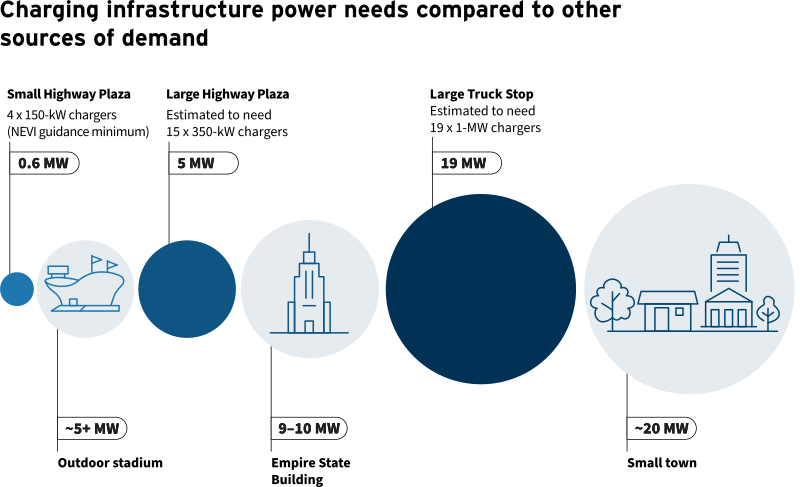
At the same time, EV chargers can be deployed relatively quickly. While this is generally a good thing, it differs significantly from the timeline of other electricity demand sources — especially those that draw significant amounts of power. This creates a very real challenge for utilities, since it often takes (much) longer to plan and build supporting grid infrastructure upgrades than to install the chargers themselves. As a result, utilities must plan for load that can appear quickly, in specific locations, and at a meaningful scale. To address this, leading utilities and engaged stakeholders are adopting more advanced approaches to forecasting.
The location and timing of EV charging demand are especially important for grid planning. For example, is charging going to occur at a location with ample available capacity, or is it expected to take place in a constrained part of the system? How does demand look at 10:00 a.m. versus 6:00 p.m.? Is there any flexibility in the time and scale of demand from the chargers (i.e., could the customer shift when they charge to reduce grid strain? And could this change be motivated through incentives?). Understanding these dimensions is critical for building systems that both meet customer needs and maintain affordability by reducing strain, and therefore investment needs, on the grid. It enables more targeted investments and highlights opportunities for solutions like managed charging and other flexible load strategies.
Traditional load forecasting has historically relied on long-term economic and other system-wide trends to estimate expected growth. However, the highly localized nature of EV-driven load growth, paired with the speed at which it can materialize, has underscored the need for and value of more granular and dynamic forecasting approaches.
What does “good” EV load forecasting look like?
There is no one-size-fits-all approach to EV load forecasting. However, many jurisdictions are seeing value in increasingly bottom-up approaches, in contrast to traditional top-down methods focused on long-term trends and system-wide needs. Bottom-up approaches leverage more granular data, such as localized travel patterns, detailed EV adoption (e.g., at the zip code level), and location-specific charging profiles (e.g., how charging is expected to vary throughout the day at a particular part of the utility system) to better reflect how load actually shows up on the grid.
At a high level, good EV load forecasting aims to answer three key questions:
- How many EVs are expected to enter the system? (Adoption over time)
- How much demand may that lead to, and where? (Scale and location of load growth)
- What does demand look like throughout the day? (Hourly charging demand and peak impacts)
These can be addressed through linking EV adoption forecasts with charging location assumptions and load profiles that translate vehicle growth into grid impacts.

Bottom-up forecasting approaches — while often more data- and time-intensive than traditional top-down approaches — offer particular value for utility distribution system planning. These approaches can incorporate richer, more diverse data inputs, including vehicle characteristics, travel behavior (e.g., vehicle telematics data), charging locations and types, and hourly load shapes, thereby capturing detailed, localized charging needs rather than relying on system-wide averages.
These highly detailed forecasts, when paired with utility hosting capacity data, can also help to identify where grid capacity constraints are most likely to emerge. This can enable targeted investments in capacity upgrades and the exploration of alternatives like managed charging, flexible service connections, and distributed energy resources to avoid or mitigate overloads or other grid constraints.
Another promising trend in load forecasting is to further emphasize the use of scenario analysis. This approach enables the exploration of impactful sensitivities that can better characterize the range of likely future outcomes, rather than focusing on a single future to plan for. It does this by varying assumptions to understand their individual impacts on the grid and investment needs. For example, in California, new guidance from the regulator specifies what kinds of data should be used in low, base, and high-load growth scenarios, with the results of each scenario collectively informing a single investment plan. Some load forecasting models also incorporate probabilistic modeling, acknowledging the uncertainty inherent in key inputs such as adoption rates, charging behavior, and technology evolution.
Ultimately, the goal of improved EV load forecasting is not a single, precise outcome, but enabling better decision-making under uncertainty.
What tools and resources exist to help stakeholders with EV load forecasting?
Granular EV load forecasts also create opportunities for advocates and other stakeholders to become more informed about utility decision-making and to more effectively assess proposed investment plans. However, given the large volume of data and assumptions involved, these forecasts can be difficult to interpret, especially for non-utility stakeholders. Fortunately, a growing set of tools and resources is helping stakeholders engage more meaningfully in the process for building load forecasts.
The Energy Systems Integration Group (ESIG) recently published a brief outlining best practices for EV load forecasting. These guidelines aim to create a more consistent and transparent approach across forecasts, while providing a clearer framework for outside parties to evaluate assumptions and methodologies. With a shared set of best practices, advocates are better equipped to ask targeted questions and assess whether the forecasts reflect real-world needs.
Third-party forecasts also provide an important point of comparison. These publicly available EV forecasts, often developed by national labs and nonprofits, have both improved and become more accessible in recent years and can help benchmark utility projections.
Example: RMI’s GridUp model
RMI’s GridUp model is a detailed, comprehensive look into EV charging demand growth across the entire United States. GridUp is built on a database of millions of individual vehicle trips to allow for locally specific forecasts based on real-world driving behavior. The web tool allows users to explore how these charging loads add up at different geographic levels — from census block groups to cities and utility service territories — providing insight into both local and system-wide impacts.
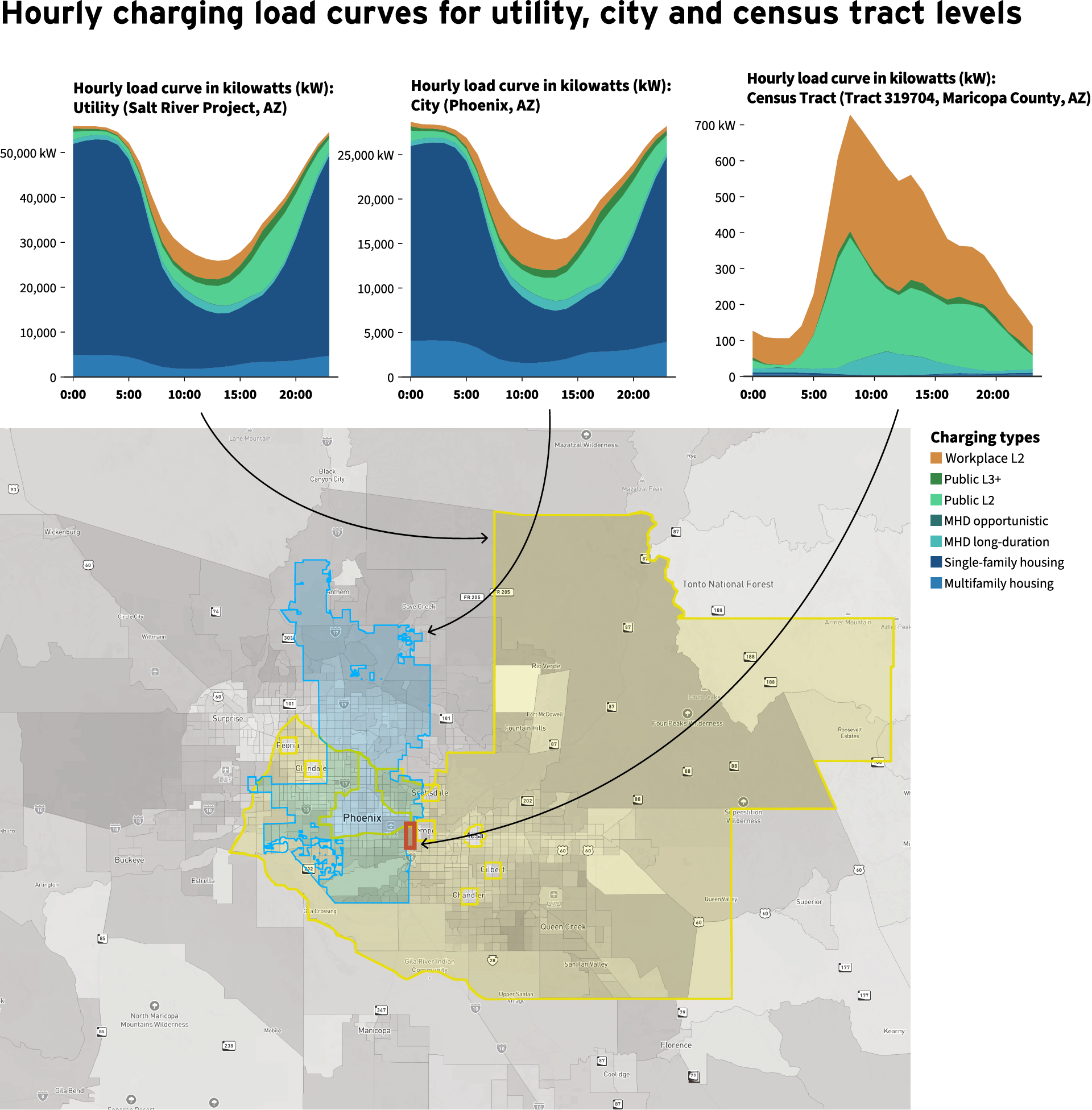
These features allow users to see how key aspects of an EV load forecast change based on their particular area of interest. Three of the key metrics available on GridUp are the peak EV load expected in a given year; the hour-by-hour load curve, which breaks EV charging load down across the day; and the types of charger being used by EVs. When different areas of the map are selected, these metrics are recalculated for that specific region.
Using the graph below as an example, if an advocate is working in the Phoenix area and wants to understand EV charging needs for just the city, they can select that area to view the relevant results. If they are working on understanding a proposal from the local utility, they can select that area instead to see how the utility’s load forecast compares to the GridUp results. This flexibility makes the load forecast useful for answering a range of questions across various use cases and stakeholder groups.
The future of improved load forecasting
As electricity demand grows, driven by increasing electrification across multiple sectors, including EVs, buildings, data centers, and other emerging loads, the stakes of getting load forecasting right are also getting higher. Improving forecasting practices, particularly through more granular, bottom-up approaches, can help ensure that distribution system investments are targeted, justified, and cost-effective.
For consumer advocates, utility distribution planners, and local transportation planners alike, this creates an opportunity to engage more deeply in how forecasts are developed, what assumptions they rely on, and how uncertainty is addressed. Improved forecasting will not eliminate uncertainty, but it can lead to more transparent decision-making and more equitable outcomes, helping ensure that the costs and benefits of grid investments are appropriately aligned with the customers who ultimately pay for them. It also presents an opportunity to lower overall costs through sophisticated advance planning, which includes consideration of the many ways that modern, flexible resources like EVs can help to support a reliable, efficient, and affordable electric system.