

Learn how we are working to transform how we use and produce energy.
Large Loads and System-Wide Transmission
Large loads are driving system-wide transmission investments beyond the load interconnection process.
Why we share this work for free
RMI is an independent nonprofit working to accelerate the clean energy transition. We publish research like this to inform decision-makers and drive real-world impact.
Our work is supported by philanthropy as well as partnerships, including fee-for-service engagements. This support makes it possible for us to share our independent insights for free.
If you find this work valuable, you can support it anytime.
Get more insights like this
Stay up to date with the latest research, analysis, and tools from RMI by opting in to receive occasional emails below. You’ll get new reports, event invitations, and practical insights to help us all accelerate the clean energy transition.
Loading form...
Your download should start automatically. If it doesn’t, click the download button below.
This work is made possible by philanthropy
RMI is a nonprofit supported by donors and partners. Philanthropy enables us to produce independent research and make resources like this freely available.
If you find this report valuable, please consider supporting our work. You can also explore how we partner with organizations to drive impact.
Jump to Section
When a large load, such as a data center, wants to connect to the electric grid, it can trigger large-scale network upgrades, an outcome the interconnection process was not designed to achieve efficiently. However, large loads are also driving system-wide transmission upgrades, a preferable alternative to piece-meal network upgrades.
In this article, we highlight three case studies that exemplify best practices in system-wide transmission planning. These best practices are intended to mitigate potential uncertainty and provide confidence in regulators and planners to approve large-scale system-wide investments.
What is system-wide planning?
While the load interconnection process is site-specific and focused on near-term service, system-wide transmission planning evaluates needs comprehensively over a multi-year horizon, usually 5 to 20 years. In Regional Transmission Organization (RTO) areas, the RTO leads the regional transmission plan, usually annually. In non-RTO areas, individual transmission owners typically assess transmission needs for their grid (more details can be found in The State Regulator’s Role in Transmission report).
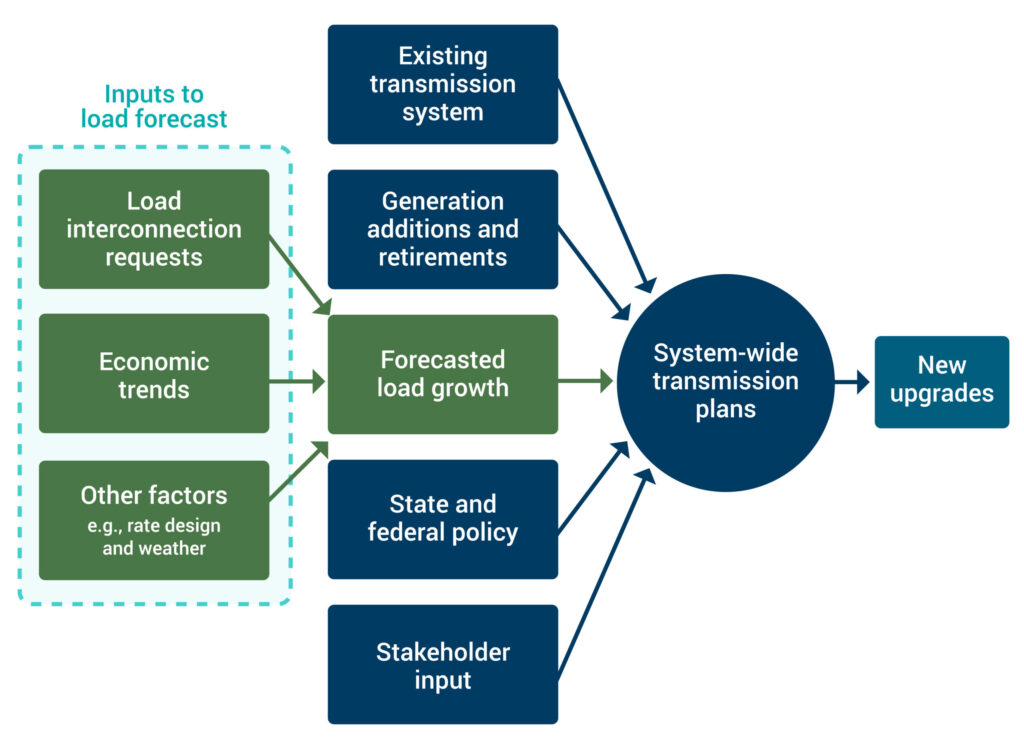
As shown in Exhibit 1, system-wide planning processes incorporate large loads through their load forecasts, one of several planning inputs. Planners forecast load by considering load interconnection requests together with macroeconomic trends, policy drivers, and other factors. RMI’s Get a Load of This report details large load forecasting further.
Exhibit 1. System-wide planning considers load interconnection requests indirectly via the load forecasting process.
As shown in Exhibit 2, load forecasts have surged since 2020. Driven largely by these growing load forecasts, planners have identified larger and larger system-wide transmission needs, as shown in Exhibit 3.
Exhibit 2
Exhibit 3
System-wide planning is preferable to the load interconnection process
System-wide planning is a better way to identify large-scale upgrades than a customer-by-customer approach. System-wide planning enables the grid to be designed more efficiently, meet broader grid needs, and do so with more regulatory and stakeholder oversight.
Furthermore, system-wide transmission projects, like those driven in part by today’s load growth, have repeatedly delivered benefits exceeding their costs, often dramatically (see reports from RMI and Grid Strategies).
In RMI’s High Voltage High Rewards report, we analyzed seven system-wide transmission projects across the United States and found that each project delivered benefits exceeding its costs, with benefit-to-cost ratios from 1.1 to 3.9. For example, the Valley–Colorado River project near Los Angeles emerged from the Southwest Transmission Expansion Plan and underwent a rigorous economic assessment by the California Independent System Operator. Since its energization in 2013, the project has delivered annual benefits approximately 3.3 times greater than its cost.
System-wide planning is worth the wait
Evidence suggests that system-wide transmission planning often leads to better long-term outcomes. However, this type of planning is usually slower, with cycles that can take one to three years. At first glance, this creates a tradeoff between “speed to power” and more deliberate planning that considers the grid as a whole.
In practice, this tradeoff is less significant than it appears. Large load interconnection processes can themselves take months or more than a year to complete, particularly when restudies are required. More importantly, regardless of how a project is identified, the approval, permitting, and construction of major transmission upgrades can take several years. These downstream timelines often dominate the overall schedule.
For example, in PJM, system-wide planning is conducted annually and typically takes about 1.5 to 2 years from initial scoping to board approval. By comparison, the study phases for large load interconnections can take months to over a year. Since 2015, upgrades identified through the interconnection process have required an additional 2.3 to 4.8 years on average to reach in-service after approval, depending on project size. Projects identified through system-wide planning would add only about 6 months to 1.5 years to the front end of this overall timeline.
Given the full life cycle of transmission development and their decades-long life, this modest additional planning time is often justified. Investing in system-wide planning up front can lead to more efficient, better-coordinated, and more valuable upgrades for the grid as a whole.
Managing risk and maximizing value through system-wide planning
Large investments identified through either the load interconnection process or system-wide planning can pose long-term risks for ratepayers. Transmission projects driven by load forecasts or specific interconnection requests often remain in service for decades, creating inherent risk if the anticipated load does not materialize.
System-wide planning, unlike the load interconnection process, can be structured to better manage these risks. Below, we highlight two approaches to mitigating uncertainty: 1) scenario planning to help identify “least-regrets” projects — those that provide benefits across a range of possible load growth futures, and 2) designing system-wide planning to phase in investments over time, hedging against uncertainty while avoiding the inefficiencies of piecemeal upgrades.
The following three examples illustrate how these approaches are already being applied in practice, demonstrating how transmission planners can accommodate significant load growth while still planning comprehensively for the grid at large.
System-wide planning can identify “least regrets” projects
System-wide transmission planning has a strong track record, but it is essential to ensure that large-scale investments deliver value across a wide range of potential futures. Robust scenario planning can mitigate risks associated with load growth uncertainty and identify a portfolio of investments that remains valuable under diverse future load forecasts.
Case Study #1: System-wide planning should evaluate multiple load growth futures.
The Southwest Power Pool’s regional transmission planning process — known as the Integrated Transmission Plan (ITP) — provides a strong example of identifying a “least-regrets” investment portfolio. SPP’s 2025 ITP outlines $19 billion in new projects, including more than 2,000 miles of 765 kV backbone transmission — the extra-high-voltage power lines that move power across states and regions. In its analysis, SPP evaluated two base load growth futures and multiple sensitivities. The demand trajectories assumed 10-year compounded annual load growth rates of 1.7% and 3.9%, with sensitivities that test these futures under various assumptions including differing natural gas prices and wind and solar deployment.
When assessing a wide range of benefits, SPP found that the identified portfolio delivers a benefit-to-cost ratio of 9.4 in the higher-growth future and 5.7 in the lower-growth future. Results across the sensitivity cases were similarly strong. By proactively planning a system-wide portfolio across multiple futures, the region can have confidence that these investments remain justified regardless of how load growth ultimately unfolds.
Recommendation: System-wide planning should evaluate multiple load growth scenarios to help commissioners, consumer advocates, and other stakeholders understand the need for and benefits of investments across a range of possible outcomes, informing better decision-making and approval.
System-wide planning can proceed in a stepwise manner
System-wide transmission planning typically identifies a portfolio of projects for development over several years, often locking in a multi-year pipeline once approved. However, planning can also proceed in a stepwise manner, phasing investments with milestones and guardrails to manage load growth uncertainty while remaining more efficient than piecemeal network upgrades. The examples below illustrate how system-wide planning can be implemented incrementally, balancing flexibility and strategic foresight.
Case Study #2: Proactive planning can balance transformative system upgrades with built-in triggers
The Delaware Basin Load Integration Plan in Texas addresses rapid load growth without relying on an “all or nothing” transmission strategy. In 2018, load in the West Texas sub-region was projected to increase from roughly 1 gigawatt (GW) in 2019 to more than 3.5 GW by 2024. With large oil and gas customers signaling new demand only one to two years in advance, ERCOT and the local transmission service provider faced challenges in meeting new load promptly.
To address this, ERCOT developed a plan capable of accommodating higher-than-committed load growth, keeping pace with the rapid additions. In 2019, ERCOT completed the Delaware Basin Load Integration study, which identified transmission needs across five trigger stages corresponding to peak demands of 3.1, 4.0, 4.6, 5.0, and 5.4 GW. When the five-year forecast reached one of these benchmarks, the plan was activated to begin developing the necessary upgrades.
This modular approach allowed planners to capture the benefits of system-wide coordination while responding quickly to new load growth. It also mitigated risk by committing to upgrades only when loads were sufficiently certain to be included in forecasts.
Recommendation: Adopt a phased, modular transmission planning approach with built-in triggers to prepare for load growth systematically while limiting financial risk for ratepayers. By implementing projects incrementally and reassessing demand forecasts over time, regulators and planners can scale investments up or down as load expectations evolve.
Case Study #3: Targeted system-wide planning in high-growth areas improves efficiency and reduces risk
NV Energy’s Western Nevada Master Plan and Apex Master Plan illustrate how system-wide transmission planning can increase efficiency and reduce risk by addressing high-growth load areas rather than responding reactively to individual load interconnection requests. In 2024, the utility focused on two key regions expecting significant load growth through 2030: near Reno, with an anticipated 7.5 GW increase addressed by the Western Nevada Master Plan, and near Las Vegas, with 1.7 GW expected growth covered by the Apex Master Plan. By designing a coordinated framework to serve anticipated demand comprehensively, NV Energy avoids piecemeal expansions.
Both the Western Nevada and Apex plans outline phased transmission and grid investments aligned with portions of projected load (e.g., 30%, 60%, 100%) and defined timelines. The Western Nevada plan will add capacity in stages: 270 MW of added incremental capacity by 2025, 1,100 MW by 2028, 1,300 MW by 2029, 1,500 MW by 2030, and 1,500 MW by 2032. This staged approach enables NV Energy to meet its anticipated load of 6 GW in the subregion by 2032.
The master plans anticipate clusters of large load customers by (1) identifying likely development zones, (2) assessing their combined system impacts, and (3) mapping phased upgrades to substations and transmission lines. By tying each phase to demonstrated customer commitments, NV Energy reduces risk, enhances reliability, and avoids inefficient piecemeal expansion.
Recommendation: Transmission providers should implement targeted, phased system-wide planning in high-growth areas, aligning investments with projected demand and customer commitments. This approach improves efficiency, enhances reliability, and reduces the financial and operational risks associated with reactive, piecemeal expansion.
Smarter grid growth with system-wide planning and risk management
In an era of rapid and uncertain load growth, system-wide transmission planning offers a more efficient, comprehensive, and forward-looking alternative to piecemeal upgrades driven by the large load interconnection process alone. In addition, planners and regulators can incorporate robust forecasting, scenario analysis, and stepwise investments strategies to mitigate risk.
What is RMI doing?
RMI provides resources on how electric tariff design and other regulatory tools can be used to connect large loads to the grid while maintaining affordability, reliability, and state policy goals. For more information visit our Large Loads Tariffs Dashboard.
In our next and final article in the series, we explore how to better integrate and streamline the load interconnection process with system-wide planning through a regional-first approach.
Authors

Sarah Wang
Senior Associate
Tyler Farrell
Manager
Claire Wayner
Senior Associate
Mark Lozano
Senior Associate
Chaz Teplin
PrincipalRelated Insights



Help build the clean energy future. Donate today.
Independent research. Real-world solutions. Supported by donors.
RMI can pursue the highest-impact climate and energy solutions because we’re supported by people who believe change is possible. Every gift helps advance the work needed to make clean energy the default choice worldwide.
For other ways to give to RMI, including checks or gifts of stock, please visit Other Ways to Give.
