

Learn how we are working to transform how we use and produce energy.
Large Loads and Network Upgrades
Large loads are triggering an increasing volume of network upgrades. Addressing those upgrades through a piecemeal interconnection process is inefficient and costly.
Why we share this work for free
RMI is an independent nonprofit working to accelerate the clean energy transition. We publish research like this to inform decision-makers and drive real-world impact.
Our work is supported by philanthropy as well as partnerships, including fee-for-service engagements. This support makes it possible for us to share our independent insights for free.
If you find this work valuable, you can support it anytime.
Get more insights like this
Stay up to date with the latest research, analysis, and tools from RMI by opting in to receive occasional emails below. You’ll get new reports, event invitations, and practical insights to help us all accelerate the clean energy transition.
Loading form...
Your download should start automatically. If it doesn’t, click the download button below.
This work is made possible by philanthropy
RMI is a nonprofit supported by donors and partners. Philanthropy enables us to produce independent research and make resources like this freely available.
If you find this report valuable, please consider supporting our work. You can also explore how we partner with organizations to drive impact.
Jump to Section
An overloaded grid is driving transformational investment in load-related network upgrades
When large loads, such as data centers, want to connect to the electric grid, the grid operator must evaluate the impact the new load will have on the transmission system and determine if upgrades will be necessary to ensure system reliability. If upgrades are needed, the size of those network upgrades can vary depending on the amount of new or upgraded infrastructure required.
We find it helpful to categorize network upgrades associated with large load projects qualitatively as “incremental,” “material,” and “transformational,” as depicted in Exhibit 1, which is adapted from the framework found in E3’s report on rate design and large load tariffs.
Exhibit 1. As transmission solutions move from incremental to transformational upgrades, their costs and time to service increase accordingly.
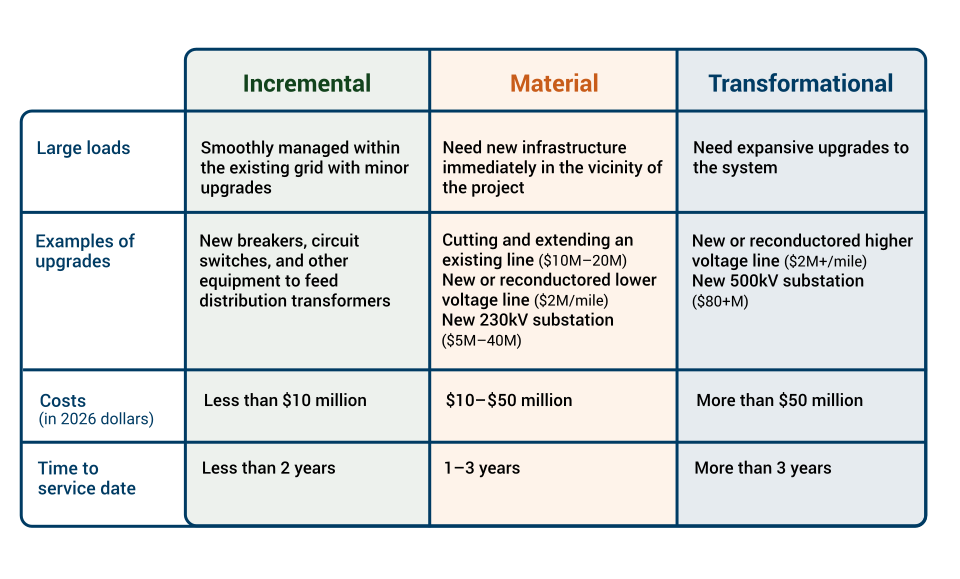
Larger load projects that cannot be easily absorbed by the existing grid can trigger transformational upgrades. For example, in Wisconsin, American Transmission Company has proposed a transformational upgrade including multiple high-voltage substations and new 345 kV transmission lines to serve a large 1.3 GW new load request, with estimated costs of $1.3B.
However, the situation is not always straightforward: similar-sized or even smaller projects can require very different infrastructure. In Virginia, a 111 MW load required a material substation upgrade costing $28 million, while a smaller 77 MW project triggered a transformational upgrade — including two high-voltage substations and new transmission lines — costing $140 million. Both requests were submitted in the same year and were located just a few miles apart.
The huge differences in the scale of identified network investments result from details in timing, precise location on the grid, and the impacts of other interconnection requests. In Virginia, at the same time as the two requests above, 33 interconnection requests submitted in 2022 resulted in the need for network upgrades.
Today, a growing share of large load network upgrades are material and transformational. Exhibit 2 reveals this trend in PJM, the Regional Transmission Organization that covers part of the Eastern United States, where the magnitude and speed of load growth have overwhelmed existing transmission capacity.
Exhibit 2. Large load interconnections increasingly require material or transformational transmission investments rather than incremental upgrades, underscoring the need for different planning processes that consider long-term, system-wide impacts.
The load interconnection process now drives a significant fraction of total transmission investments
There has been growth in both the number of load interconnection requests and the scale of the network upgrades they trigger. These trends are new and have increased the percentage of overall grid investments related to the load interconnection process. Historically, load-related network upgrades accounted for only a minor share of total transmission investment (Exhibit 3).
In PJM, for example, load interconnection investments averaged just 5.7% of all transmission spending between 2005 and 2019. Since 2019, however, this share has risen to an average of 18%. A similar pattern is observed in MISO, the operator of the grid across 15 US states in the Midwest and South, where load interconnection accounted for nearly 30% of transmission spending in 2025. In other regions, project-level data were not available.
Exhibit 3. Load-related investment (incremental, material, and transformational) is a growing share of total transmission in recent years for both PJM and MISO.
Large-scale investment is exposing limits in the interconnection process
The growth in spending due to large load interconnection is concerning because the large load interconnection process was designed primarily to identify incremental grid upgrades, with the expectation that only occasional requests would require larger, material investments. Load interconnection was never intended as a way to plan transformational upgrades that fundamentally change power flows across the regional grid or influence regional grid planning.
When large load interconnection drives a significant portion of transmission investment, there are inefficiencies and risks for all ratepayers, including:
- Missed opportunities to build projects that meet broader grid needs;
- Lack of sufficient regulatory oversight, as detailed in RMI’s 2024 report Mind the Regulatory Gap;
- Increased risk that costs will be unfairly allocated; and
- Lack of exposure to competitive bidding for transmission upgrades.
First, material and transformational investments fundamentally alter regional power flows and have the potential to address multiple grid needs at once — but the interconnection process is only designed to ensure the large load can connect. As discussed further in following articles, transmission providers design system-wide planning to identify projects that solve several issues and deliver diverse benefits, maximizing impact while minimizing overall costs.
Second, the large load interconnection proceeds through local transmission planning processes that do not include significant regulatory oversight. Efficient interconnection with limited regulatory intervention may make sense if most upgrades are incremental. However, with the substantial portion of total transmission investment that large load interconnection is driving today, regulatory oversight must be included to protect ratepayers. Given the piecemeal nature of the interconnection process, the best option for streamlined regulatory oversight is to focus on grid investment through system-wide planning, not network upgrades.
Third, using large load interconnection to build material and transformational transmission infrastructure also risks allocating costs unfairly. Currently, regions differ on how they allocate costs for network upgrades, but these costs are often socialized across a broad group of customers (the large load customer always pays for customer interconnection facilities). We believe it makes more sense for regional stakeholders to intentionally discuss and negotiate how best to pay for large-scale investments.
Finally, network upgrades identified via the large load interconnection process are not subject to competitive solicitations, unlike system-wide transmission investments, which often are. Competitive design and procurement of transmission projects can support cost-effective outcomes for ratepayers by encouraging developers to evaluate alternatives and keep costs in check, although the benefits of competition can be subject to debate.
Generation queue warnings for today’s load interconnection process
Today’s load interconnection challenges closely mirror issues that arose in generator interconnection about a decade ago. The generation interconnection process and its cost allocation rules were designed for fewer projects and slower generator turnover, resulting in piecemeal costly upgrades and backlogged queues that grid operators are still working to resolve. We see the clogged generator interconnection queue story as a cautionary one for today’s large load interconnection.
Managing large loads through system-wide and region-first planning
In this article, we established how large load interconnection has led to a concerning surge in network upgrades. Our next articles focus on system-wide planning solutions. In Article #3, we describe how system-wide transmission planning evaluates broader grid needs and long-term impacts, enabling more efficient material and transformative investments. Finally, in Article #4, we examine how regional-first planning can streamline both load interconnection and the overall system-wide planning process, while providing greater oversight and efficiency.
What is RMI doing?
RMI provides resources on how electric tariff design and other regulatory tools can be used to connect large loads to the grid while maintaining affordability, reliability, and state policy goals. For more information visit our Large Loads Tariffs Dashboard.
Authors

Mark Lozano
Senior Associate
Tyler Farrell
Manager
Sarah Wang
Senior Associate
Claire Wayner
Senior Associate
Chaz Teplin
PrincipalRelated Insights

States Are Opening the Door to Data Center Investment in Virtual Power Plants


Help build the clean energy future. Donate today.
Independent research. Real-world solutions. Supported by donors.
RMI can pursue the highest-impact climate and energy solutions because we’re supported by people who believe change is possible. Every gift helps advance the work needed to make clean energy the default choice worldwide.
For other ways to give to RMI, including checks or gifts of stock, please visit Other Ways to Give.
