Senior couple carefully reviewing their household energy bill together on a laptop at home. They seem focused and concerned.

Affordability 101: Can We Cut American Energy Bills in Half?
As people throughout the United States worry about the cost of energy, it’s time to solve the problem.
Energy affordability is now a national concern, and many energy experts are saying we’d be lucky to stabilize costs, that cutting bills isn’t even possible. That’s wrong. We can actually cut energy bills a lot.
How? We’ll give you three ways:
- Upgrade home tech: 20–50 percent lower bills
- Fix who pays: 5–40 percent lower bills for the half of US households that most need it
- Cut red tape and invest faster: 5–25 percent lower bills
To be clear, these are quick, high-level calculations based on reputable sources. But we also have deeper analysis underway to provide more specifics. In the meantime, the conversation today around energy affordability is too often muddled. Many people are unclear on the interlinked causes and potential solutions for rising energy costs, despite seeing it as a crucial issue.
In this article we will:
- Clarify the challenge, the stakes, and our focus;
- Outline the causes of the problem; and
- Provide solutions and a holistic framework that includes new solutions and specific insights for states and regions.
What are we trying to solve?
Energy affordability is a critical issue for America. People need affordable energy to ensure a decent quality of life and be financially stable. We also require affordable energy to support a strong and growing economy.
Yet energy costs are rising, and more Americans are feeling the pinch. Electricity rates rose 6.6 percent in the past year nationally, but over 20 percent in some states. Worse yet, natural gas prices are up 80 percent since 2024 and will double by 2026. That will further increase electricity costs since 40 percent of US electricity comes from natural gas. In fact, electricity rates rose twice as fast and natural gas four times as fast as inflation this year.
Even before these latest increases, one in three US households have had to reduce or forgo food or other basic necessities and one in seven families live in severe energy poverty in the United States.
In 2024, President Trump declared a goal of cutting energy bills in half. It’s a worthy goal. Can we bring it to fruition?
What is energy affordability?
Energy affordability is the ability of a household to pay for their energy use while also paying for other basic living expenses without forgoing basic necessities or risking health and safety. This matters because people often skip food or medical needs to pay for energy. They need to keep driving to work and keep the heat on. High bills can lead to disconnections that can result in health problems or even death.
Many people talk about energy burdens and energy affordability only in terms of their home utility bills. But transportation costs can also have a huge energy cost and create a greater energy burden.
What are people spending on energy?
A report from EPRI shows that the average US household spent $5,530 on energy in 2024, and over half of that was on gasoline. Many energy affordability conversations only focus on utility bills, but gasoline bills are often more than electricity and natural gas combined.
With the median US household income at $83,730 in 2024, energy costs — including transportation — make up 6.6 percent of a family’s income.
But averages and medians don’t tell the real story here. The real affordability challenge is for the lower half of US households by income, where most households spend over 10 percent of their income on energy.
What causes unaffordable energy?
In order to make energy bills affordable, we must first understand what makes them un-affordable. The energy system is complex and varied. Many efforts to address affordability only look at one area. This is like the old story about people in a dark building encountering different parts of an elephant and thinking each part is something else. We want to look at the whole elephant.
Some parts of the elephant will matter more or less for different people, but all of it is relevant. States have different laws and weather risks, utilities manage their costs differently, and people have different homes, equipment, cars, etc. All of this can change what the biggest causes are for high energy costs.
Our focus here is on energy bills — this is where people run into the sum of all these factors in one tangible question: how much do they have to pay for energy? It’s an important matter that gets discussed at kitchen tables across the country.
To clarify the complexity and capture all the major factors, we offer this framework:

People’s energy bills are based on four things:
| Energy Use | How much energy we use, which we have the most control over. The causes of high bills include:
|
| Who Pays What | How the rules are set up for who pays for what parts of our energy system:
|
| Energy System | The costs built into how we provide and deliver energy. These are institutional structures that generally require market or policy changes. This includes:
|
| Wider World Impacts | These factors are less predictable and are not part of the energy system’s design, but they have big impacts on the above. This includes:
|
How do we make energy affordable?
We can take action on each of these causes to unlock big savings. And we can do this without losing the quality of energy services. In fact, these solutions often make reliability and security better. Here’s what we have to do to increase affordability:
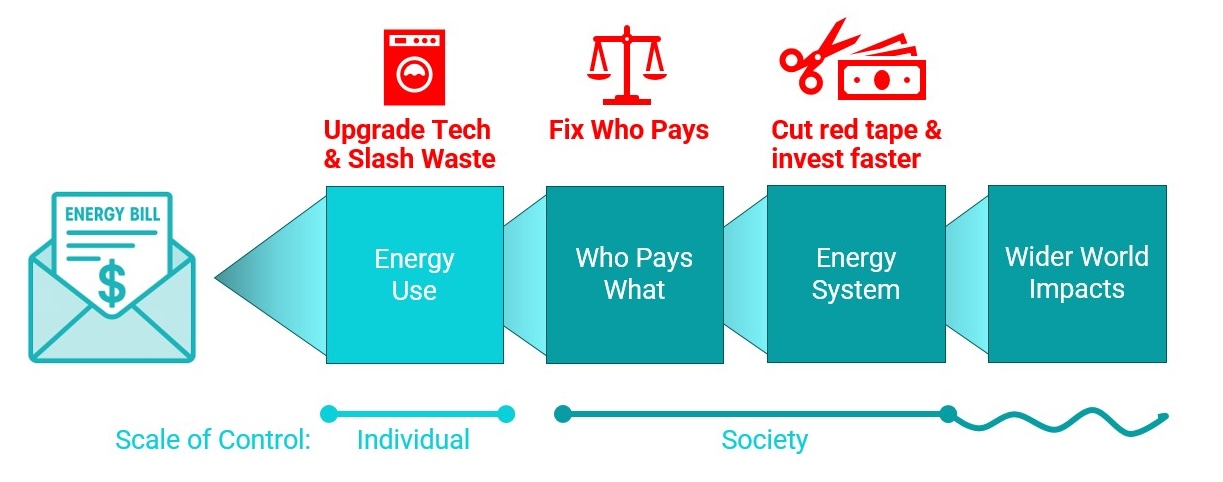
Specifically, here are some options for each:
 |
Efficiency already saves average American more than $1,000/year. And energy saved at home creates big savings across the whole energy system. Here are some of the top actions:
|
 |
Policymakers have four main tools to change the rules of who pays for what:
|
 |
We can accelerate investment in energy infrastructure and affordable resources to improve costs for consumers. There are many ways to do this, but here are some of our favorites:
|
Lowering bills now and later
For immediate relief, homeowners should look for opportunities to improve their energy use, especially when they replace equipment or vehicles. Policymakers can also take action on fast-acting solutions. We will need longer-term solutions as well, which need to be launched now to create benefits down the road.
We can use this framework to understand the specific causes and solutions needed on a state-by-state basis. Some of that work is already captured in our Energy Poverty Policy Simulator, and we will build out more state-by-state insights in the year ahead.
RMI is also working to support decision makers to match energy bill solutions to their authority (for example: best practices for governors and our electricity affordability toolkit for policymakers). We are also creating spaces for peer learning to scale up the cost-saving ideas that can work quickly (for example: Reg Lab).
We can enact the solutions above now in most places. We don’t have to wait for new solutions, but innovations are welcome. RMI will continue to work with leaders across the country to make energy affordable.