

Learn how we are working to transform how we use and produce energy.
Reliability Explored: What a Decade of Data Tells Us About US Grid Reliability
RMI’s new grid Reliability Dashboard showcases key trends in electric reliability over the past decade and can help grid planners target solutions to reduce customer outages.
Why we share this work for free
RMI is an independent nonprofit working to accelerate the clean energy transition. We publish research like this to inform decision-makers and drive real-world impact.
Our work is supported by philanthropy as well as partnerships, including fee-for-service engagements. This support makes it possible for us to share our independent insights for free.
If you find this work valuable, you can support it anytime.
Get more insights like this
Stay up to date with the latest research, analysis, and tools from RMI by opting in to receive occasional emails below. You’ll get new reports, event invitations, and practical insights to help us all accelerate the clean energy transition.
Loading form...
Your download should start automatically. If it doesn’t, click the download button below.
This work is made possible by philanthropy
RMI is a nonprofit supported by donors and partners. Philanthropy enables us to produce independent research and make resources like this freely available.
If you find this report valuable, please consider supporting our work. You can also explore how we partner with organizations to drive impact.
Jump to Section
Key Takeaways
- Reporting on electricity outages due to supply-side shortfalls is scarce and unreliable.
- Although most grid investments are targeted to increasing generation, customers experience more outages due to failures on the distribution system and extreme weather.
- Renewable resource deployment has not worsened reliability outcomes.
- RMI’s Reliability Dashboard can help inform system planning practices so that grid investments truly reduce customer outages.
Electric grid reliability has been a major topic of public policy and discourse over the past year. If we want to improve grid reliability, and do so in an affordable way, grid planners need to take steps to ensure that the investments they’re making will actually reduce the types of outages their customers experience.
To that end, we decided to take a close look at the numbers to see if the data backs current strategies to enhance reliability. RMI developed a new dashboard, leveraging data reported annually to the Energy Information Administration, to showcase the differences in electric reliability across utilities in the United States.
Recent public policy discourse has focused on the impact of load growth on grid reliability, particularly from data centers, and some policies go as far as trying to prescribe certain types of generators in the name of meeting reliability needs. However, available historic data does not show that load growth or supply-demand imbalances have driven customer outages. Over the past decade, extreme weather and failures on the distribution system — the lower-voltage wires connecting homes and businesses to the bulk electric grid — have been the primary causes of customer outages nationwide.
This reality is already all too familiar to customers, with outages caused by these “major events” reaching a decadal high in 2024. Yet public policy is currently focused on rising energy demand, which does not address distribution system needs and extreme weather risks.
To ensure grid investments are informed by reliability data, utilities and regulators must improve how they track reliability events and incorporate these insights into planning so that the right investments are being made to keep the lights on for all customers.
Planning for a reliable grid
Most regions in the United States plan for grid reliability using a one-day-in-ten-year loss-of-load expectation, a standard that functions as a benchmark that indicates whether further investment in generation is necessary to ensure sufficient ability to meet future demand (“resource adequacy”). While investments can reduce customer outages when they address the specific weaknesses causing outages, this only holds if planning decisions are aligned with the actual sources of interruption. Many outages originate on distribution systems, such as from tree contact or severe weather, where additional generation supply provides little benefit.
Although the grid is only planned to meet the aforementioned resource adequacy standard at the bulk power system level, grid reliability is best understood as an umbrella concept that depends on three distinct components: resource adequacy, stability (or operational reliability), and resilience, across both the high-voltage bulk power system and the lower-voltage distribution system.
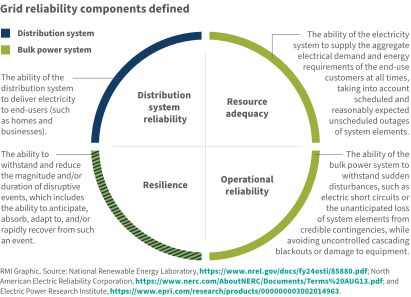
Different reliability investments affect these components in different ways and come with very different costs, ranging from low-cost operational and maintenance measures to capital intensive infrastructure investments. Ideally, planners would sequence investments by prioritizing lower-cost actions first and ensure that higher-cost measures are tightly targeted to pesistent, demonstrated sources of unreliability.
This approach would help ensure that spending produces measurable improvements in customer reliability metrics rather than defaulting to an overreliance on resource adequacy alone. However, current data collection practices obscure which component(s) failed during an outage, making it difficult to align investments with the true drivers of customer interruptions.
Quantifying grid reliability
Utilities track two key metrics when looking at the historical reliability of their system: outage durations and outage frequencies, with the threshold for an “outage” being a loss of power for five minutes or longer.
Outage duration is tracked using the System Average Interruption Duration Index (SAIDI). This metric tracks how long the average customer was without power over the course of each year. Outage frequency is tracked using the System Average Interruption Frequency Index (SAIFI). This metric tracks how many times the average customer lost power over the course of each year.
Both of these metrics can be combined to determine a utility’s outage restoration, also known as the Customer Average Interruption Duration Index (CAIDI). CAIDI tracks the average time it took electric providers to restore power to customers each year, or put differently, how long the average customer was without power when there was an outage.
From our new Reliability Dashboard on the Utility Transition Hub, we can see that over the past decade, US electricity customers experienced, on average, about six hours without power annually. However, variation from state-to-state and utility-to-utility can be significant, so be sure to check out our full dashboard to explore reliability in your state or utility.
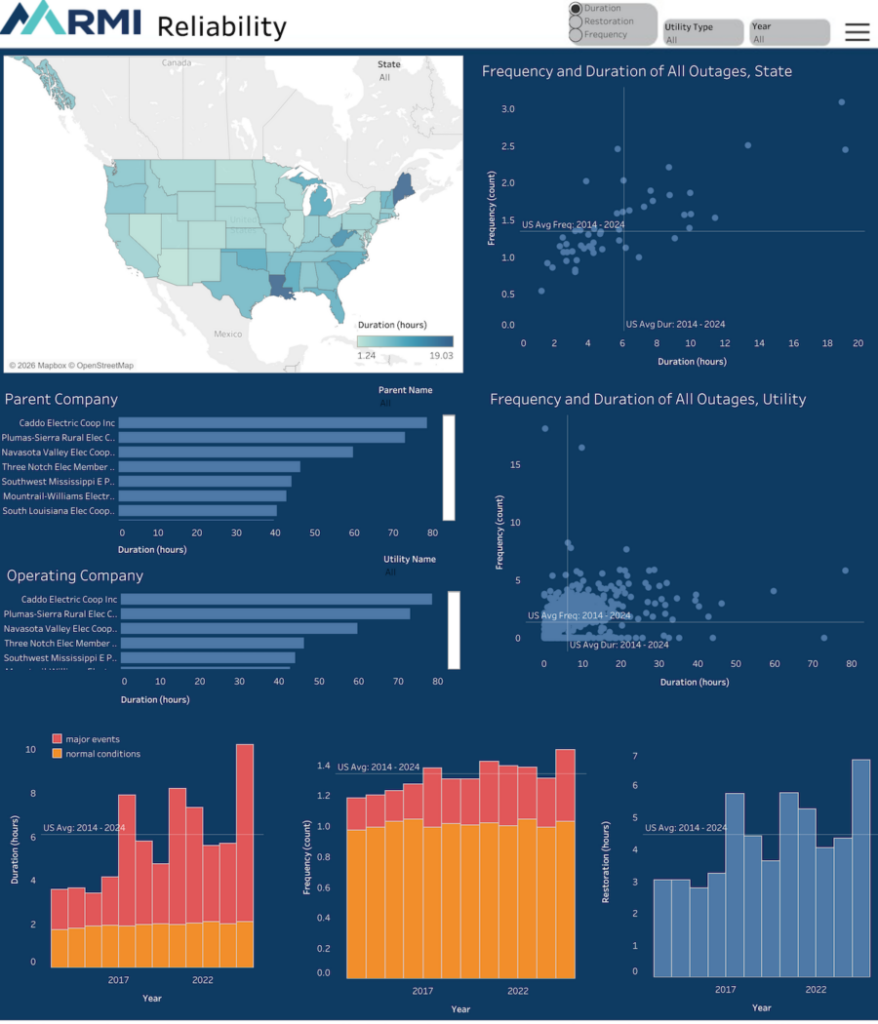
Three key takeaways from historical reliability data
When we look at reliability data and drivers of outages for customers over the past decade, we see three key trends:
1. Reporting on outages due to supply-side shortfalls is scarce and unreliable. Only about half of utilities report this metric, and each utility’s definition of “loss of supply” can vary. Utilities that do report this show that loss of supply was a minor contributor to customer outages over the past decade.
Inconsistent definitions mean that some outages classified as supply-related may actually occur on distribution systems. As a result, it is impossible to parse whether reported supply-side outages are due to power plant outages, transmission versus distribution failures, fuel supply issues, or any other factors. This reduces planners’ ability to ensure that future investments are actually addressing the most critical system needs.
For utilities that track those occurrences, loss of supply was a minor contributor to system outages. From 2014 to 2024, 57% of respondents separated outages that were due to loss of supply, and in the past five years, those outages represented less than 10% of the duration of outages the average customer experienced. In other words, for over 90% of the time that customers were experiencing outages, their utilities did not attribute these outages to supply-side shortfalls, and instead attributed them to distribution system failures.
2. Although planned investments achieve modeled targets, in reality, customer outages can exceed those targets due to failures on the distribution system and extreme weather.
The one-day-in-ten-year (which can be translated to 2.4 hours per year) planning standard is typically used to propose new supply-side resources (power plants, transmission, etc.) until modeling results meet that bulk system resource adequacy target. However, when we retroactively evaluate the average duration of customer outages over the past 10-year period, we see that many customers do not experience that standard — especially when incorporating major events.
This indicates that although utilities may be meeting their supply-side standard in planning, other types of vulnerabilities not accounted for — particularly on the distribution system — are driving customer outages beyond planning standards.
Utilities in more than half of states do not conduct comprehensive integrated system planning that includes the distribution system. As a result, while utilities plan to have enough power plants to limit bulk system outages to an acceptable resource adequacy standard, the same is not applied to the distribution system, leading to worse outcomes for customers.
3. In contrast to what some policies suggest, renewable resource deployment has not worsened reliability outcomes.
When we pull in data from the amount of deployed renewable resources in each state over the years, and connect it with this measured reliability data, we don’t see evidence that renewable resources reduce reliability. In fact, states exposed to extreme weather and heavy forests have longer customer outages on average. Overall, clean energy deployments have supported grid reliability through day-to-day operations and numerous extreme storms.
What regulators and grid planners can do to make informed decisions about reliability and encourage affordable investment
The same focus that has been placed on potential outages of the future needs to be placed on the experienced outages of today to ensure customers aren’t overpaying for grid investments that don’t meet their needs. To ensure data-driven decision-making that produces an affordable, reliable grid, regulators and grid planners can pursue the following:
- Use RMI’s new Reliability Dashboard to learn more about your state’s reliability, inform system planning practices, and improve the way that reliability data is tracked and reported so that grid investments truly reduce customer outages.
- With the rapidly evolving needs of consumers today (and entirely new classes of consumers, like datacenters), data tracking must be updated to better assess and address reliability. For example, outages from supply-side shortfalls should be clearly distinguished from transmission or distribution issues. In 2025, the Hawaiian Electricity Reliability Administrator in filing F-338153 recommended this be addressed with a generator-specific outage metric, as well as the use of segment-specific derivatives of SAIDI and SAIFI that differentiate between transmission and distribution. These metrics are already in use by other utilities internationally, such as those in Canada, Sri Lanka, and some African countries.
- Regulators can initiate compliance dockets for more detailed data, such as Michigan Public Service Commission’s docket U-21122, which requires utilities to report information about their worst-performing circuits and zip codes with the worst and best outage rates, and outline their plans to improve reliability.
- Use RMI’s new Reliability Dashboard to learn more about your state’s reliability, inform system planning practices, and improve the way that reliability data is tracked and reported so that grid investments truly reduce customer outages.
- Deploy available technologies that address the specific reliability issues localities face today, keeping in mind the evolving grid.
- Solutions to load growth are often framed around large, capital-intensive investments on the bulk power system, like new power plants, which can be expensive and may do little to reduce customer outages. In contrast, commonly overlooked and lower-cost solutions such as energy efficiency, virtual power plants, and advanced transmission technologies can both help accommodate load growth and meaningfully improve customer reliability, particularly where outages are driven by the distribution system and extreme weather. These lower-cost solutions are often overlooked due to the prevailing cost-of-service utility regulation model, which biases utility investment toward high capital cost investments. Regulators can investigate performance-based regulation practices that would help counter this bias and restructure utility incentives to ensure affordable approaches are leveraged.
- Regulators can require their utility to perform integrated distribution system planning aligned with best practices that considers investments at all levels of the grid.
- Intentionally plan for resilience to major events via improved forecasting and infrastructure.
- Improve forecasting and extreme weather considerations to better plan for the system to be resilient to future excursions beyond normal conditions.
- Build resilient inter-regional transmission in coordination with neighboring regions to access resources and support across the United States during wide-area storms.
- Leverage battery energy storage systems (both transmission-connected and distributed in virtual power plants) to directly reduce outages, and also reduce costs via temporal electricity price arbitrage.
- Deploy available technologies that address the specific reliability issues localities face today, keeping in mind the evolving grid.
As utilities ask consumers to pay more for their investments amid soaring bills, data-backed and informed decisions matter now more than ever. Improving data collection practices to become more standardized and reflect different levels of the grid is necessary to capture the complexities of grid needs to a sufficient level of detail. RMI’s new Reliability Dashboard can help regulators and planners interact with and learn from existing data, and identify smart improvements that serve all customers’ needs.
RMI’s Gaby Tosado and Jon Rea were both critical collaborators in developing the new Reliability Dashboard on the Utility Transition Hub.
Authors

Sarah Toth Kotwis
Technical Manager
Ashtin Massie
Senior Associate
Lauren Shwisberg
PrincipalRelated Insights

States Are Opening the Door to Data Center Investment in Virtual Power Plants


Help build the clean energy future. Donate today.
Independent research. Real-world solutions. Supported by donors.
RMI can pursue the highest-impact climate and energy solutions because we’re supported by people who believe change is possible. Every gift helps advance the work needed to make clean energy the default choice worldwide.
For other ways to give to RMI, including checks or gifts of stock, please visit Other Ways to Give.
