

Learn how we are working to transform how we use and produce energy.
The Governor Affordability Agenda
Insights from 37 states and a blueprint for promoting energy affordability through governor action.
Why we share this work for free
RMI is an independent nonprofit working to accelerate the clean energy transition. We publish research like this to inform decision-makers and drive real-world impact.
Our work is supported by philanthropy as well as partnerships, including fee-for-service engagements. This support makes it possible for us to share our independent insights for free.
If you find this work valuable, you can support it anytime.
Get more insights like this
Stay up to date with the latest research, analysis, and tools from RMI by opting in to receive occasional emails below. You’ll get new reports, event invitations, and practical insights to help us all accelerate the clean energy transition.
Loading form...
Your download should start automatically. If it doesn’t, click the download button below.
This work is made possible by philanthropy
RMI is a nonprofit supported by donors and partners. Philanthropy enables us to produce independent research and make resources like this freely available.
If you find this report valuable, please consider supporting our work. You can also explore how we partner with organizations to drive impact.
Jump to Section
Energy affordability has become a dominant concern across the country. After over a decade of household electricity bills growing with or slower than inflation, average residential electricity bills have outpaced inflation in 41 states over the past two years.[1] These rising costs increasingly strain household budgets, driving ongoing efforts to improve energy affordability around the country. And these energy affordability dynamics extend beyond households, to businesses of all sizes.
Governors are in a unique position to promote energy affordability because of their role at the intersection of state decision makers and their ability to affect change through a variety of tools like executive orders, legislative agendas, and regulatory directives. And they’ve been leveraging this unique position. Over the past three years, governors in 37 states have taken action on energy affordability. In the second half of 2025 alone, governors in 26 different states took an affordability-related action.
We compiled data on governor-led actions between January 2023 and January 2026 and analyzed them across several dimensions to understand how governors are choosing to address this complex issue and to identify examples that others might replicate. While this article is primarily focused on efforts to promote residential affordability, many policy solutions can have impacts that extend to commercial and industrial customers. As states continue to wrestle with this challenge, we find that governors taking effective actions are using two approaches that respond to the gravity of this moment and address longstanding, systemic affordability issues:
- Deliver holistic reforms: Governors are enacting a suite of policies that together safeguard vulnerable households, control the growth in system costs, distribute costs appropriately to different customers (including between residential, commercial, and industrial customers), and give all customers more control over their bills.
- Balance the timing of impact: These actions are providing both near-term relief to ensure customers realize benefits quickly and long-term system reforms while considering how long the impacts of different policies are likely to persist.
Looking ahead, governors can drive holistic affordability packages through a coordinated set of actions that safeguard vulnerable households, control system costs, distribute costs efficiently, and improve customer agency, delivering on both near-term relief and long-term system reforms. Below, we draw on our research to share key insights and recommendations for how governors can effectively work with other state decision makers to improve energy affordability through this framework.
Governors sit at the intersection of key decision makers
Governors can play an important role in promoting energy affordability through executive action, legislative proposals, regulatory directives, and convening industry and state leaders. Critically, governors can work with a variety of other actors, or they can act independently to promote energy affordability. Because of their unique position relative to other decision makers, governors can affect a diverse set of actions — from standing up state energy efficiency programs to coordinating with wholesale market operators — to address energy costs. The table below shows how different actors can influence energy affordability and provides real-world examples of governors effectively working with each actor.
States need holistic reforms to address their affordability challenges
Energy affordability is a complex problem, so we need holistic solutions. A diverse set of factors like aging infrastructure, electricity load growth, and extreme weather are driving energy costs, and there’s no one-size-fits-all approach to address these challenges. Fortunately, policymakers have many tools at their disposal to promote energy affordability, but it’s critical to deploy them in an effective way. In our Electricity Affordability Toolkit, we identify affordability policies across four key focus areas: safeguards for vulnerable customers, cost control, cost distribution, and customer agency.
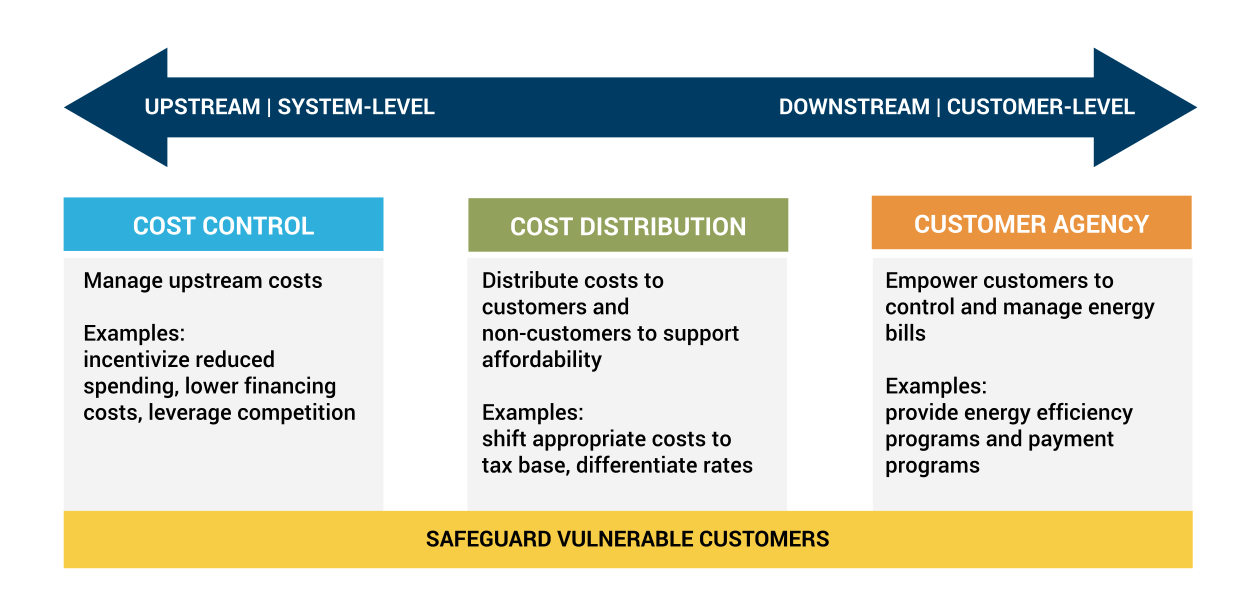
- Safeguards ensure that households facing the most severe forms of energy insecurity have access to energy and can afford their bills. Safeguards can be embedded into cost control, cost distribution, or customer agency policies by targeting vulnerable communities in policy design.State example: In Maryland, Governor Moore issued an executive order creating the Maryland Energy Advisory Council and directing them to identify recommendations to strengthen the state’s energy assistance programs. The Council will identify potential changes to these programs to improve affordability, bill stability, and energy access for vulnerable households.
- Cost control policies manage the overall size of the pie. They help ensure that utilities prioritize efficient investments and deliver energy in a cost-effective manner.State example: In New York, Governor Hochul’s Ratepayer Protection Plan includes a suite of cost control policies like modernizing rate case procedures to allow regulators to better evaluate rate utility proposals, requiring utilities to submit budget-constrained proposals in rate cases, and investigating utility bills to ensure prudent utility spending.
- Cost distribution policies help distribute costs to different groups (e.g., customer classes, income groups, utilities, private industry, etc.) in a way that promotes affordability for all.State example: In Alaska, Governor Dunleavy championed legislation to create the Alaska Energy Independence Fund, a green bank intended to leverage public financing to support sustainable energy investments and energy upgrades for households and businesses.
- Customer agency policies improve customers’ ability to control and manage their energy bills.State example: In Colorado, Governor Polis launched the Colorado Energy Savings Navigator, an easy-to-use online platform for households to identify their eligibility for over 18 energy assistance programs and 600 utility, state, and federal incentives for energy tech upgrades.
We identified the primary focus area of each governor-led action in our research, and you can see the results in the chart below. Across the country, we found that governors addressed each of these types of policies, but cost control policies are the most popular. Governors in 33 states took cost control actions while only 16 governors enacted policies promoting customer agency. One reason for the popularity of cost control actions is that they target the perverse incentives created by the traditional utility regulatory structure, which create high spending and contribute to growing costs for everyone.
However, it’s critical for governors to advance balanced packages that address each of these focus areas and provide holistic relief. For example, focusing on cost control actions can manage upstream spending but does little to improve energy affordability for vulnerable populations or give households and businesses more options for managing their energy bills and vice versa. We found that most governors prioritized actions in at least two areas, but governors in 14 of 37 states only acted in a single area. Governors in 9 states targeted every category to deliver holistic relief. For example, New Jersey Governor Mikie Sherrill’s executive orders include each category:
- Safeguards – directs the Board of Public Utilities (BPU) to identify opportunities to increase investment in low-income energy efficiency programs.
- Cost control – directs the BPU to complete a study on modernizing the utility business model through tools like performance-based regulation, multi-year rate plans, and review of supplemental transmission projects.
- Cost distribution – directs the BPU to review components of the societal benefits charge on ratepayer bills without compromising funding for energy assistance programs.
- Customer agency – directs the BPU to create a virtual power plant program administered by electric distribution utilities.
Give customers near-term relief and champion long-term system reforms
In addition to prioritizing holistic actions, states are balancing the need to provide near-term relief and address long-term system challenges. Governors face a tough but achievable task. It’s not possible to solve the problems driving energy costs overnight, but households are feeling the crunch right now.
As mentioned above, electricity bills are growing quickly in many states, and even before recent growth, one in three households reported sacrificing necessities like food or medicine just to pay their energy bills. As a result, governors are tasked with providing the near-term relief needed by so many while also promoting the reforms necessary to provide long-term affordability. As governors wrestle with this challenge and design affordability packages, they can consider the timing and persistence of relief provided by different affordability policies.
Near-term policies like bill rebates, energy efficiency programs, and disconnection protections can be implemented within 1–2 years (or even quicker, if expanding adoption of an existing program or rate) and start benefitting customers. Long-term policies like utility regulation and rate reform (e.g., performance-based regulation, fuel cost sharing, etc.) and siting and permitting reform can take a few years (or longer) to implement and deliver savings to all ratepayers. The chart below shows the most common governor-led affordability policies we found in our research by impact time horizon.
Overall, we found that governors balanced near- and long-term actions, as long-term actions account for about 65% of all actions while near-term actions account for 35%. Governors focusing on near-term actions often did so by bolstering discount rates or energy assistance programs and issuing one-time bill credits. Common long-term actions included those focused on reforming utility business models, deploying new energy resources, and improved transmission planning. Some notable examples of governors balancing near- and long-term priorities include:
- In Connecticut, Governor Lamont played a key role in passing legislation that includes a suite of energy affordability provisions. Near-term policies include public financing of energy assistance programs and a requirement for utilities to consider grid-enhancing technologies when evaluating transmission projects, among others. Long-term reforms include leveraging ratepayer-backed securitization for recovery of storm-related costs. The legislation is estimated to immediately save households approximately $100 per year off their electricity bills and deliver even greater savings to business customers while paving the way for long-term cost reductions.
- In Virginia, Governor Spanberger’s Affordable Virginia Agenda includes six bills to provide near- and long-term energy affordability. Near-term policies include expanding low-income energy efficiency programs and enabling balcony solar. Long-term reforms include optimizing grid planning and expanding energy storage capacity to reduce the need for costly generation during periods of peak demand.
In addition to pursuing both near- and long-term actions, it is important for governors to consider how the affordability benefits of actions persist over time. Affordability policies will have different impact time horizons, and their benefits will also vary in size and persistence based on policy design. For example, some near-term actions may only provide temporary relief while other actions can be implemented quickly and provide more sustained relief. Here are a few examples of different policies and how their affordability benefits can vary over time:
- Bill rebates can be implemented in the near term and be structured to provide one-time relief or more persistent relief if tied to a recurring revenue source like a cap-and-invest program.
- Ratepayer public advocates can be stood up in the near-term and provide long-lasting affordability benefits through intervention in rate cases and other regulatory proceedings.
- Virtual power plants can be implemented in the near- to medium-term and their benefits can grow over time as they become more advanced and are integrated into distribution system planning.
- Utility business model reforms like performance-based regulation will take years to implement and start delivering savings to ratepayers, but they provide highly persistent benefits by shaping utility spending for years to come.
Governors can apply these concepts as they seek to balance the dual objectives of providing immediate relief to households and businesses while also delivering long-term system reforms. It is critical to address near- and long-term affordability challenges, but the exact mix of near- and long-term policies will vary based on a state’s specific needs. For example, states with surging bills might initially prioritize providing immediate relief through bill rebates and safeguards like disconnection protections and low-income discount rates. States facing high load growth in the next 10 years might initially focus more on long-term policies like siting and permitting reform and ratepayer protections from large loads.
Governors have the tools they need to promote holistic, long-term energy affordability
Energy bills are rising quickly across the country while the energy system is strained by factors like high natural gas prices, extreme weather, and load growth. Fortunately, governors have many tools at their disposal to promote energy affordability, and they can have an outsized impact due to their unique position relative to legislatures, state agencies, utility regulators, and grid operators. Looking ahead, governors can promote near- and long-term affordability through a coordinated set of actions to safeguard vulnerable customers, control system costs, distribute costs efficiently, and improve customer agency.
[1] Based on state average electricity bills in July of each year calculated from Form EIA-861M data. Consumer Price Index for all urban consumers comes from the Bureau of Labor Statistics.


Related Insights




Help build the clean energy future. Donate today.
Independent research. Real-world solutions. Supported by donors.
RMI can pursue the highest-impact climate and energy solutions because we’re supported by people who believe change is possible. Every gift helps advance the work needed to make clean energy the default choice worldwide.
For other ways to give to RMI, including checks or gifts of stock, please visit Other Ways to Give.