

Learn how we are working to transform how we use and produce energy.
From Roadmap to Reality: A New Interactive Hub for Tracking Global Progress on Carbon Dioxide Removal
RMI and Cornell Atkinson Center for Sustainability join forces to tackle carbon dioxide removal knowledge gap
Why we share this work for free
RMI is an independent nonprofit working to accelerate the clean energy transition. We publish research like this to inform decision-makers and drive real-world impact.
Our work is supported by philanthropy as well as partnerships, including fee-for-service engagements. This support makes it possible for us to share our independent insights for free.
If you find this work valuable, you can support it anytime.
Get more insights like this
Stay up to date with the latest research, analysis, and tools from RMI by opting in to receive occasional emails below. You’ll get new reports, event invitations, and practical insights to help us all accelerate the clean energy transition.
Loading form...
Your download should start automatically. If it doesn’t, click the download button below.
This work is made possible by philanthropy
RMI is a nonprofit supported by donors and partners. Philanthropy enables us to produce independent research and make resources like this freely available.
If you find this report valuable, please consider supporting our work. You can also explore how we partner with organizations to drive impact.
Jump to Section
For 15 years, the Cornell Atkinson Center for Sustainability has been funding high-risk, high-reward research. In today’s sustainability ecosystem, nothing fits the bill better than carbon dioxide removal (CDR). Reducing emissions has long been the focus of sustainability research, yielding impressive results in solar, battery, clean fuel, and electrification technologies. But as CO2 emissions continue to rise globally, it’s become clear that a two-pronged approach is needed. While we continue to make forward progress on direct emissions reductions, we must also deploy CDR at scale to reduce residual emissions from some of the most carbon-intensive sectors and address historical emissions to restore balance in our atmosphere.
The field of CDR experienced a rapid period of growth in the early 2020s as CDR startups emerged and new researchers entered the space. One of the biggest challenges that has come from this rapid growth is simply keeping track of all the work that is being done. From research being conducted at universities, NGOs, and private companies eager to unlock new pathways to decarbonization, to ambitious new projects being launched around the globe, there is a breadth of information stakeholders need to stay apprised of — but one has to know where to look.
In 2025, Cornell Atkinson funded a project, staffed by scientific experts at Cornell, to address this challenge by creating a CDR research tracker website. This website is built on RMI’s Applied Innovation Roadmap for CDR (AIR), published in 2023, which created a snapshot of the field of CDR companies and research and assessed the path for further developing each approach. Building on the AIR, our collaborators at Cornell developed a live online tracker with the goal of improving public awareness of CDR and direct air capture (DAC), informing policies, increasing collaboration between academia and industry, and ultimately directing funding to the most pressing research and promising projects.
“This partnership pairs RMI’s innovation roadmap with Cornell Atkinson’s research strengths to do something the DAC sector has needed: make technological progress visible and accessible,” said Patrick Beary, Bruce H. Bailey Senior Director of Strategic Partnerships at Cornell Atkinson. “A shared, public picture of where the field stands is how we move faster — from identifying gaps to targeting the investments and research that accelerate near-term deployment.”
RMI’s AIR provides a clear and practical overview of what it will take for CDR technologies to scale. The roadmap examines 32 different approaches and explores what is needed to move them from early development to real-world deployment. Created for a wide audience — including policymakers, investors, technology developers, and research organizations — it highlights where innovation is most needed, what challenges stand in the way, and how CDR can play a role in building a low-carbon future.
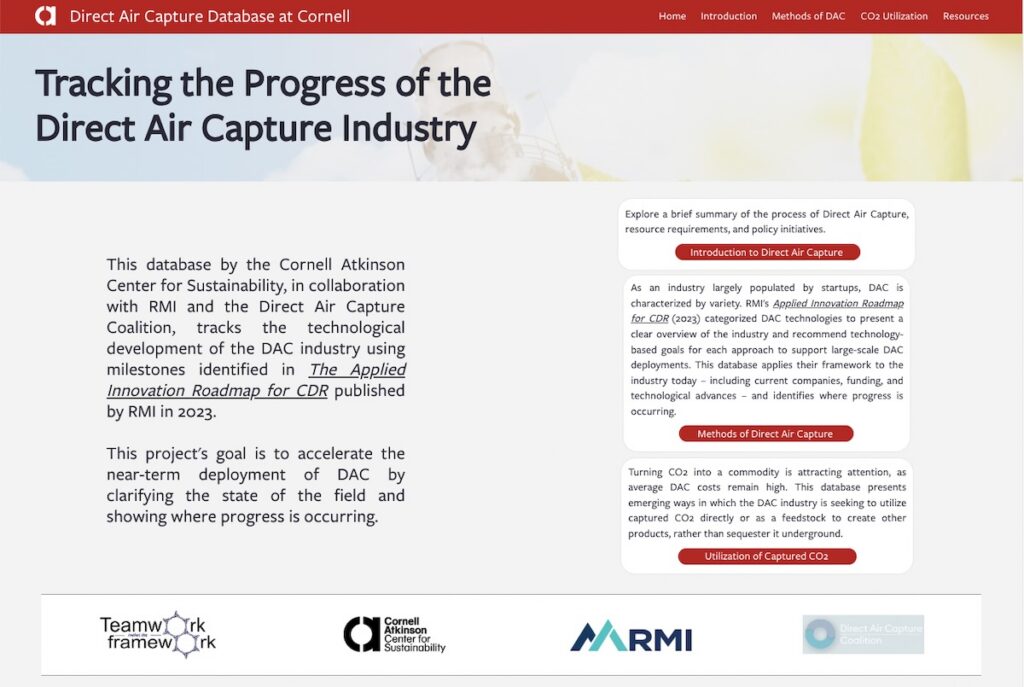
The Direct Air Capture Database by the Cornell Atkinson Center for Sustainability, in collaboration with RMI and the Direct Air Capture Coalition, tracks the technological development of the DAC industry using milestones identified in The Applied Innovation Roadmap for CDR published by RMI in 2023.
This project’s goal is to accelerate the near-term deployment of DAC by clarifying the state of the field and showing where progress is occurring.
The first phase of the website, launched in February of 2026, introduces the 10 direct air capture (DAC) technology approaches outlined in the AIR, and assesses the commercial status of these technologies. The next phase of the project, expected in summer 2026, will expand the site to cover an additional 13 types of CDR and include a review of global academic activities within each approach.
“It’s been a pleasure partnering with Cornell on this important effort,” said Rudy Kahsar, principal on RMI’s CDR initiative. “As a leading academic institution, they have experts with deep technical expertise who have helped create a database that is credible, comprehensive, and truly valuable for advancing transparency and progress across the CDR sector.”
By making the latest intelligence on the global state of CDR more accessible through an interactive website, RMI and Cornell Atkinson hope to increase buy-in for CDR, familiarize people with the range of technologies available, and give the CDR industry, NGOs, policymakers, and academic researchers the data they need for decision making at the commercial and policy level.
CDR is considered by many to be high risk, relying on new technologies and markets to make good on a lofty promise of a net-zero future. But to those working on CDR today, these technologies are the only thing putting net zero within reach. Improved knowledge sharing, project tracking, and collaboration are critical steps to unlocking the high rewards the industry can offer.


Related Insights




Help build the clean energy future. Donate today.
Independent research. Real-world solutions. Supported by donors.
RMI can pursue the highest-impact climate and energy solutions because we’re supported by people who believe change is possible. Every gift helps advance the work needed to make clean energy the default choice worldwide.
For other ways to give to RMI, including checks or gifts of stock, please visit Other Ways to Give.
