

Learn how we are working to transform how we use and produce energy.
EV Charging – The Importance of Affordable, Convenient Access
Super-fast electric vehicle charging is an important but small part of the growing charging network
Why we share this work for free
RMI is an independent nonprofit working to accelerate the clean energy transition. We publish research like this to inform decision-makers and drive real-world impact.
Our work is supported by philanthropy as well as partnerships, including fee-for-service engagements. This support makes it possible for us to share our independent insights for free.
If you find this work valuable, you can support it anytime.
Get more insights like this
Stay up to date with the latest research, analysis, and tools from RMI by opting in to receive occasional emails below. You’ll get new reports, event invitations, and practical insights to help us all accelerate the clean energy transition.
Loading form...
Your download should start automatically. If it doesn’t, click the download button below.
This work is made possible by philanthropy
RMI is a nonprofit supported by donors and partners. Philanthropy enables us to produce independent research and make resources like this freely available.
If you find this report valuable, please consider supporting our work. You can also explore how we partner with organizations to drive impact.
Jump to Section
Chinese EV manufacturer BYD has sparked headlines with the announcement of the Flash Charging Technology and Blade Battery system for its passenger vehicles. This platform promises to recharge 60% of an EV’s battery in only five minutes. While this is an impressive technical achievement and an important milestone in the maturity of EVs as an alternative to internal combustion engines, the excitement over super-fast charging times reveals a flaw in the common conception of EV charging — that it is aiming to recreate the experience of stopping at a gas station.
EV charging is actually a fundamentally different kind of refueling. Drivers no longer need to stop at a dedicated store to refuel. Electricity, the “fuel” for these vehicles, exists in nearly every home, office, and store at which a driver stops. Basing refueling on the existing electricity system introduces new opportunities for both individual drivers and the transportation system. However, it also creates new constraints.
RMI’s GridUp Tool
RMI’s GridUp EV load forecasting tool supports utilities, regulators, and policymakers to identify where and when EV charging infrastructure will be needed. This technical support is bolstered by our engagement with cities to foster access to EVs for all through multifamily charging and EV carshare cohorts.
While high-speed EV charging has a role to play for long-distance drivers and heavy-duty vehicles, these constraints mean that the system as a whole should prioritize accessible, affordable charging where people are already spending their time.
High speed means high cost
High-powered EV chargers may be convenient to drivers looking to refuel in a pinch, but they ask more of the electrical grid. When an EV charging station is connected to the grid, the utility company serving power to that station checks that its equipment has sufficient capacity to accommodate the charger. The utility will do this by finding the peak demand they expect to see from other loads and adding the EV charging load to see if it will exceed the operating limits of the affected grid equipment.
High-powered EV chargers may be convenient to drivers looking to refuel in a pinch, but they ask more of the electrical grid.
Fast charging requires high power levels, so EV fast chargers bring significant new loads. BYD’s Flash Chargers draw 1.2 megawatts of power, more than 150 times the power needed by the Level 2 chargers generally installed for home charging (and about 1,000 times what a typical US home draws).
This results in fast-charging stations being more likely to require the utility to upgrade its equipment. These upgrades are often slow and expensive. They can shift the project timeline for new charging sites from several months to several years. Fast chargers also have “spiky” demand patterns, meaning that they go from zero to high power whenever a car is plugged in. The utility has to plan around the top of these spikes, even though fast chargers are often sitting unutilized. This leads to utility equipment with a lower utilization rate, which effectively raises the cost of that equipment to the utility and its customers.
These high infrastructure costs trickle down to drivers and ultimately make fast charging significantly more expensive than slower alternatives (although often still a cost savings compared to gasoline). EV owners are already familiar with the price gap between high-power fast public charging and low-power public or home charging. A quick check of available public chargers at the time of writing this article showed that a driver in Atlanta would pay nearly six times more for their fuel at a fast charger than they would at the residential rate.
Charging availability matters more than speed
Refueling is most cost-effective and convenient when it happens where people are already spending their time — at home or work — and this is where the majority of EV charging investment should flow. This concept has been described as a tree, with at-home and workplace charging acting as the sustaining roots of the system. DC fast charging is and will continue to be the most expensive type of charging a driver can access, but it plays a supporting role. Charging behavior also suggests that fast charging will be the least utilized, as 80% of charging sessions occur at the driver’s home.
Getting to the root of EV charging needs
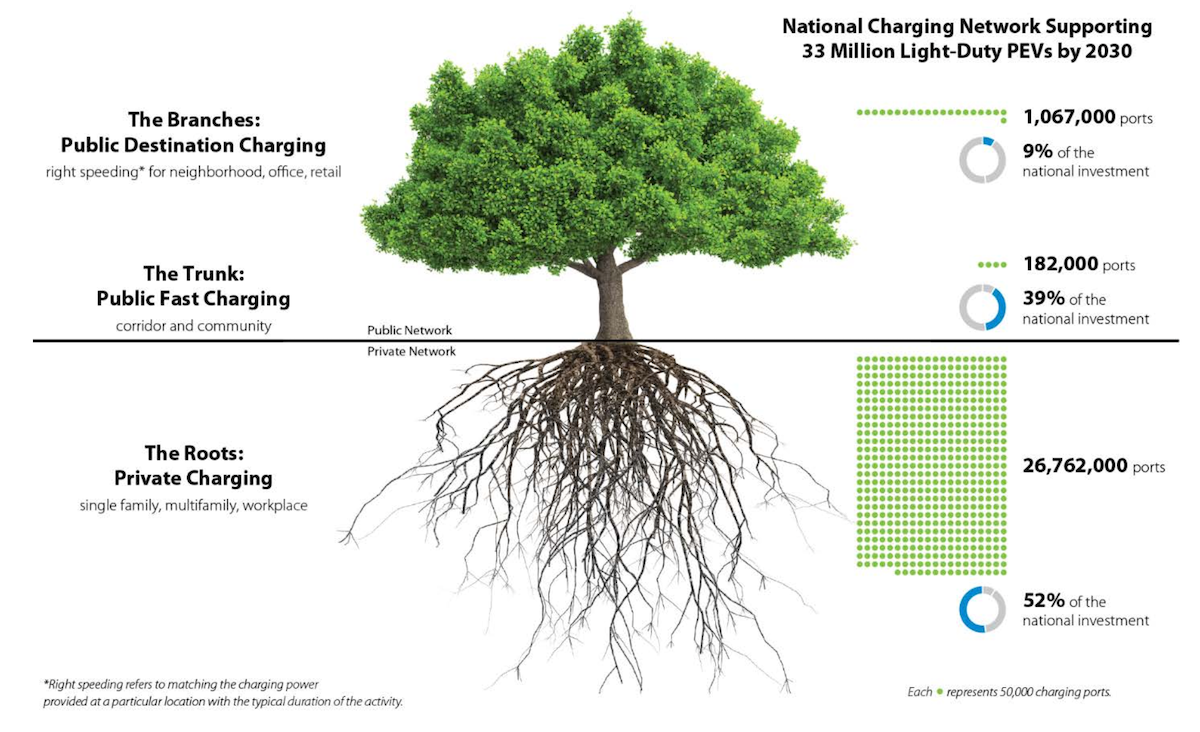
While most EV charging occurs at home today, 40% of Americans in the largest US cities live in multifamily housing. Home charging is more complicated in these dwellings. Parking limitations restrict where chargers can be placed, and building owners often don’t recognize the benefits of paying to install EV charging. People living in multifamily housing — especially in low- and medium-income neighborhoods — are also less likely to have access to public charging locations.
Policymakers and planners looking to support the transition to EVs should focus on ensuring that drivers of all backgrounds have access to charging from the roots up. There are many pieces of this puzzle:
- Interconnection, the process of asking the utility to provide power to new chargers, can be difficult for buildings and small business owners to navigate
- Permitting requirements for EV charging sites vary widely across municipalities
- Local labor availability can limit the rate at which EV chargers can even be installed.
Addressing these bottlenecks to EV charging projects in homes and workplaces will significantly support widespread EV adoption.
Focusing on the foundation of lower-power charging
High-power, fast EV charging has a key role to play in the charging network. People taking long-distance trips will want to refuel quickly and keep driving. Big vehicles, like the tractor-trailer trucks that deliver most of the packages in the United States, have large power needs and will need fast chargers. There is also a psychological benefit to publicly available fast charging — drivers like to know they won’t get stranded if they forgot to plug in their car the night before.
However, fast chargers are also the most expensive option for EV charging — both for drivers and for the grid to support. In an electrified transportation future, a robust charging network should be built on the foundation of low-cost, lower-power charging that is readily available where people already spend time. Investments in the US charging network that focus on improving access to that type of charging will be best positioned to support affordable energy and clean, efficient mobility.
Authors

Nick Pesta
Senior AssociateRelated Insights

EVs Are Coming to Island Nations. What Happens When They Retire?
Help build the clean energy future. Donate today.
Independent research. Real-world solutions. Supported by donors.
RMI can pursue the highest-impact climate and energy solutions because we’re supported by people who believe change is possible. Every gift helps advance the work needed to make clean energy the default choice worldwide.
For other ways to give to RMI, including checks or gifts of stock, please visit Other Ways to Give.
