

Learn how we are working to transform how we use and produce energy.
Bringing Clean Energy Opportunities to Women and Youth in Nigerian Agriculture
The first major convening of the Energizing Women and Youth in Agri-food Systems examined how Nigerian clean energy enterprises can stabilize livelihoods, empower women and youth, and reshape agricultural value chains.
Why we share this work for free
RMI is an independent nonprofit working to accelerate the clean energy transition. We publish research like this to inform decision-makers and drive real-world impact.
Our work is supported by philanthropy as well as partnerships, including fee-for-service engagements. This support makes it possible for us to share our independent insights for free.
If you find this work valuable, you can support it anytime.
Get more insights like this
Stay up to date with the latest research, analysis, and tools from RMI by opting in to receive occasional emails below. You’ll get new reports, event invitations, and practical insights to help us all accelerate the clean energy transition.
Loading form...
Your download should start automatically. If it doesn’t, click the download button below.
This work is made possible by philanthropy
RMI is a nonprofit supported by donors and partners. Philanthropy enables us to produce independent research and make resources like this freely available.
If you find this report valuable, please consider supporting our work. You can also explore how we partner with organizations to drive impact.
Jump to Section
On the drive toward Zuma Rock, just on the outskirts of Abuja, Nigeria, the energy challenge facing the country’s agri-food sector was impossible to ignore.
Tomatoes rested in shallow baskets under the midday sun. Crates of pepper and leafy vegetables sat exposed to heat and dust. Farmers shaded their faces with folded cardboard, watching the sky and the clock, hoping their produce would sell before it spoiled.
The Energizing Women and Youth in Agri-food Systems (EWAS) program was designed specifically to address this challenge by linking clean energy solutions with income-generating agricultural activities.
For many of these farmers, particularly women and young agripreneurs, the difference between profit and loss often comes down to one thing: power. Women and youth under 35 account for over 60% of Nigeria’s agricultural workforce, yet unreliable electricity constrains their productivity, narrows income margins, and increases vulnerability to loss.
The tomato farmer selling at the market without access to cold storage can lose up to 40% of her tomatoes by the end of the day. With reliable cold storage, that same harvest can be preserved, waste reduced, and income stabilized.
This is the promise of productive use of energy (PUE): using electricity to power cold storage, solar irrigation, milling, drying, and food processing. Across Nigeria’s agri-food value chain, from production and processing to storage, transport and marketing, reliable energy transforms labor into opportunity, enabling women and youth to work more efficiently and profitably.
Observing these market goods raised simple but urgent questions. How many women farmers have access to reliable cold storage? How many absorb daily losses because electricity, something so fundamental, remains out of reach?
Turning access into opportunity for women’s economic participation
The EWAS Program is led by Global Energy Alliance for People and Planet in partnership with the Mastercard Foundation. It is partly implemented by RMI to expand access to solar-powered productive-use technologies while advancing women’s economic empowerment in agriculture.
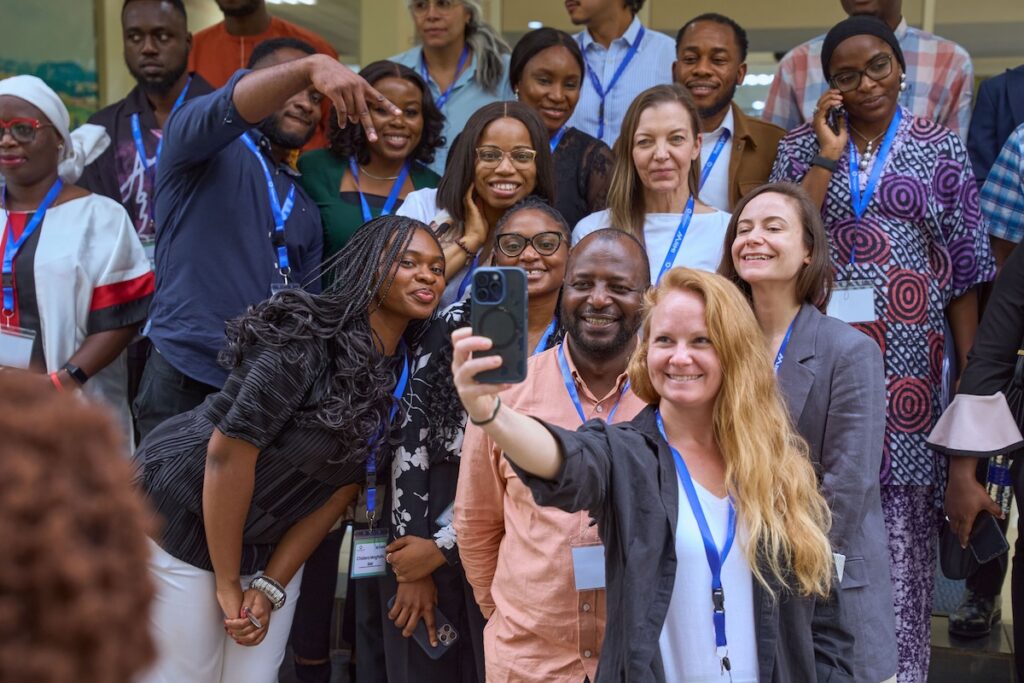
One of the first major milestones of the program was convening Nigerian productive-use enterprises, delivery partners, and technical experts for an intensive, hands-on workshop to refine inclusive business models that expand women’s and youth’s access to solar-powered equipment in agri-food systems. Through peer learning, real-time coaching, and structured working sessions, partners leave with stronger, investment-ready concepts and clear next steps to create dignified jobs and scale impact.
In her opening remarks at this workshop, Ije Ikoku Okeke, managing director of RMI’s Global South Program, emphasized that Nigeria is at a pivotal moment, with solar solutions becoming more widely available and partner interest growing. This presents the opportunity to build momentum deliberately and ensure women are strategically included in that growth.
“We want to see models that work, make the right choices, and incorporate women in a meaningful way in the work that we do,” she said. “EWAS’s role is not to tell you what to do, but to help you think about what you are building, ensuring it is inclusive and sustainable.”
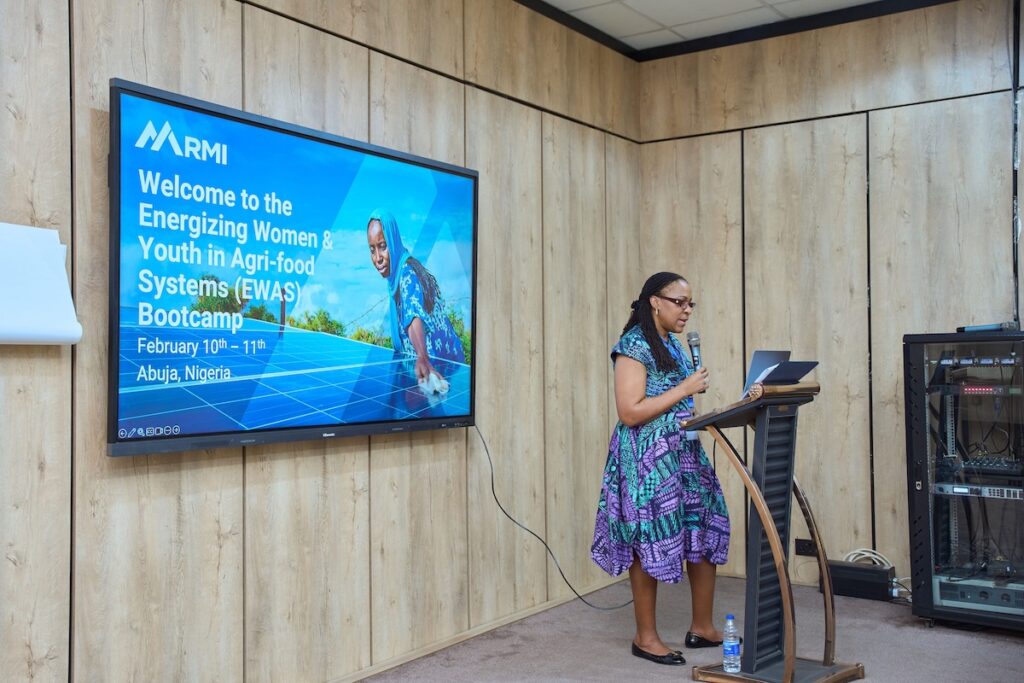
The boot camp brought together local PUE companies, including Coldbox Store, Koolboks, and SunFi, to examine how their existing PUE solutions, from cold storage to financing mechanisms, could become more accessible to women and youth entrepreneurs operating at the grassroots level.
RMI’s program director for Nigeria, Suleiman Babamanu, reinforced the boot camp’s objective of creating structure, providing technical support, and strengthening implementation pathways so that enterprises leave with actionable, investment-ready concepts.
“By the end of this convening, partners should have clearer roadmaps for delivering measurable impact,” he said.
Designing for real markets, within real-world constraints
From the opening “Who’s Who” session, it was evident that the room reflected the realities of Nigeria’s clean energy and agriculture ecosystem. Participants shared not only business models but also lived experiences from the communities they serve.
“During the hot season, when food spoilage increases, the demand for cold chain increases,” said Adedotun Saka, environmental, social, and governance lead at Koolboks. For many women farmers, however, cold storage remains financially out of reach.
In addition, EWAS financing partners acknowledged a persistent challenge: designing payment structures that reflect the seasonal, often unpredictable cash flows of women-led enterprises.
Throughout the sessions, one principle surfaced repeatedly: electrification alone is not enough. Solar power must be linked directly to productivity. It becomes transformative only when it powers irrigation systems, processing equipment, cold storage, and other income-generating tools.
The boot camp reinforced this systems-thinking approach. Participants were encouraged to move beyond counting installations and instead examine adoption rates, financing trade-offs, gender inclusion metrics, and long-term commercial viability.
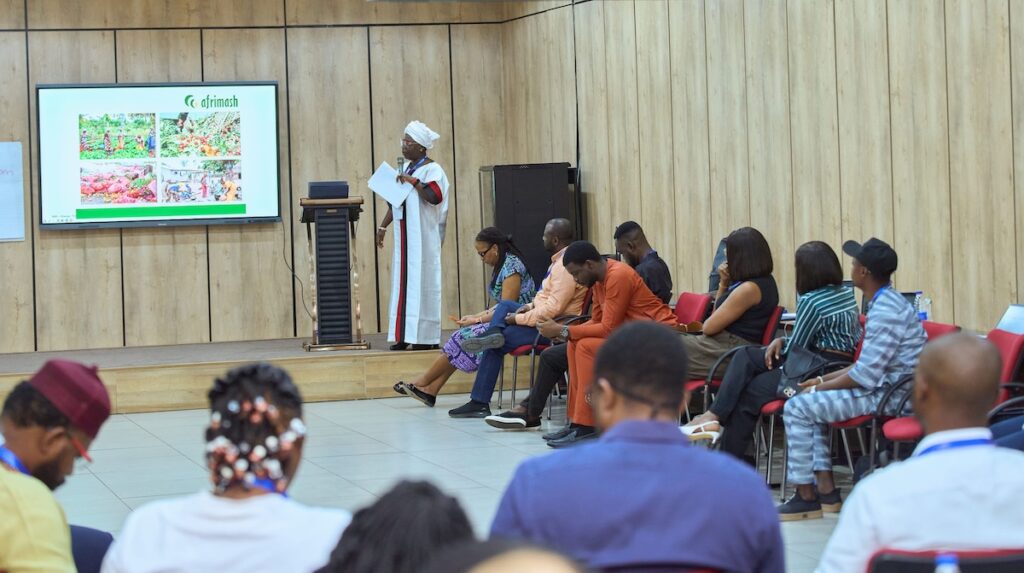
Rethinking business models
Through facilitated exercises and coaching rounds, the Nigerian enterprises were asked to define what long-term impact looks like and then work backwards to identify barriers and enabling conditions. “Although some women can afford solar-powered equipment for their businesses, a larger percentage cannot. These are the people EWAS is here for. EWAS has taught us to tweak the payment structure, so it becomes more affordable and accessible,” Ijeoma Adigo, gender expert lead and project manager at SunFi, reflected on a key learning.
That shift, from selling solar-powered equipment to designing strategies to increase access, marked a turning point in the conversations. Facilitators identified difficult trade-offs in participants’ pitch presentations. They guided participants on how to balance affordability with sustainability; how productive-use solutions could reach rural, off-grid communities without increasing transportation and logistics costs; and how businesses could support women balancing their work and household responsibilities.
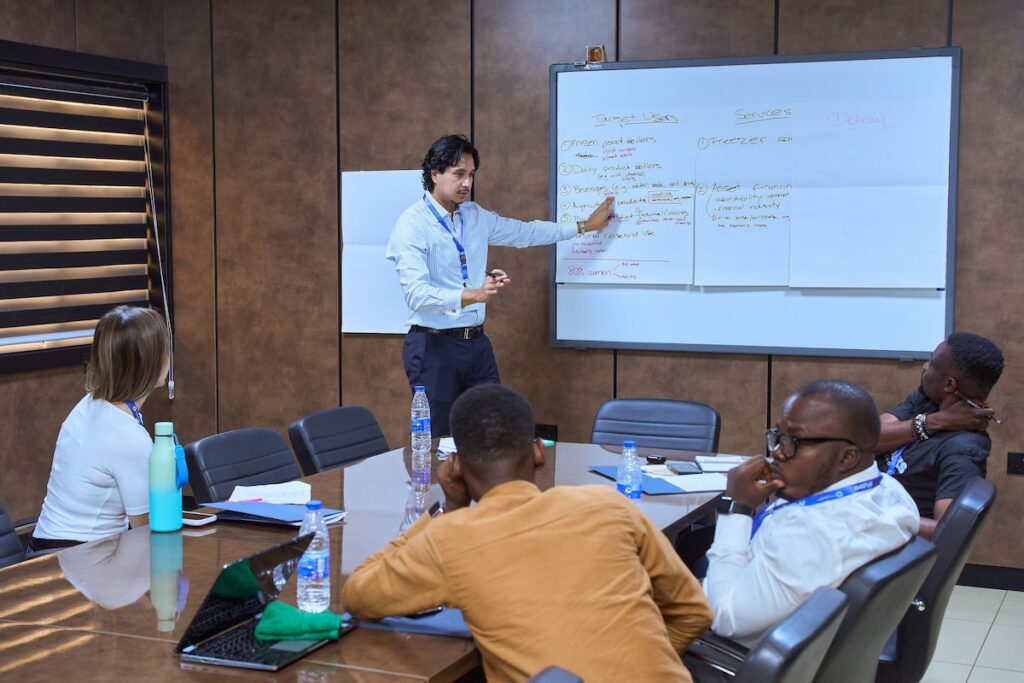
Discussion underscored the structural barriers that rural women face, including distance from urban centers, transportation costs, and uncertainty around energy supply. These challenges require intentional design, not afterthought solutions.
Inclusion and partnerships as growth strategies
A defining insight from the boot camp was that gender inclusion strengthens both economic outcomes and community resilience. EWAS positions women and youth as independent business owners and drivers of local economic resilience.
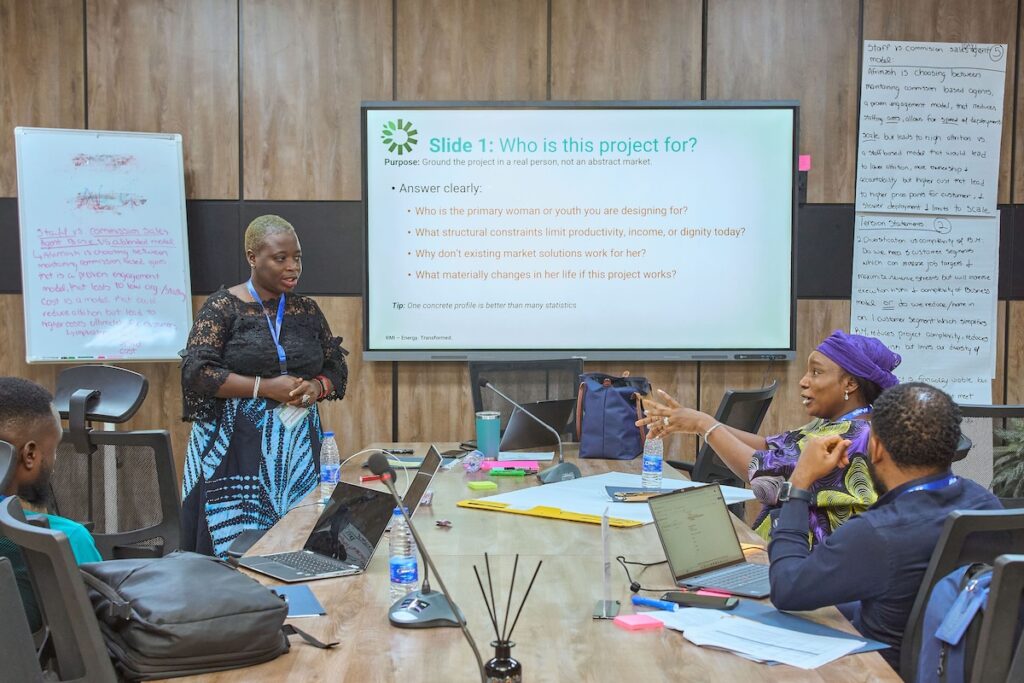
Uzochukwu Mbamalu, CEO of Manamuz Group, described the EWAS program’s approach: strengthening enterprises like his to deploy PUE technologies at scale, while ensuring that women farmers benefit from higher-quality produce and reduced spoilage.
The emphasis on partnership was also consistent throughout the convening. No single organization can deliver market access, financing, skill building, and deployment at scale alone.
“Partnership is essential in ensuring that EWAS not only succeeds but can scale and be replicated elsewhere,” said Sarah Maina Kanda, lead manager for EWAS Africa at the Global Energy Alliance. She added that the goal is to strengthen local partners and leave institutional knowledge within communities so that scaling can continue beyond the presence of funders.
As the final presentations were made, the shift in tone was clear. Conversations had moved from possibility to implementation.
The participating enterprises presented refined models designed to reduce post-harvest losses, stabilize incomes, create dignified jobs, and embed women at the center of energy-enabled agricultural growth.
The boot camp clarified that solar-powered cold storage can extend shelf life and income. It demonstrated that gender-responsive financing strengthens adoption. It reinforced that clean energy deployment must be tied to measurable livelihood outcomes.
Most importantly, it proved that the roadside produce exposed to the elements represents a solvable inefficiency within a system ready for transformation.
Translating learning into action
As EWAS transitions into its next phase, the next step is implementation at scale. What began as conversations in Abuja now represents a growing model for how clean energy can strengthen food systems across Nigeria, turning energy access into widespread economic resilience.
EWAS demonstrates a broader lesson for clean energy deployment across emerging markets: access to electricity alone does not drive development. Impact emerges when energy solutions are intentionally designed to align with livelihoods, financing realities, and inclusion.
The roadside markets remain a reminder of what is at stake. But the conversations, commitments, and clearer pathways emerging from the boot camp suggest that the shift from learning to action is already underway.


Related Insights


Nigeria’s Electricity Devolution Law Creates an Opportunity to Reshape Its Power System
Help build the clean energy future. Donate today.
Independent research. Real-world solutions. Supported by donors.
RMI can pursue the highest-impact climate and energy solutions because we’re supported by people who believe change is possible. Every gift helps advance the work needed to make clean energy the default choice worldwide.
For other ways to give to RMI, including checks or gifts of stock, please visit Other Ways to Give.
