Rethinking Air Conditioning for a Hotter, More Humid World
How we can design ACs to deliver reliable comfort, lower energy use, and reduced strain on power systems.
India — and much of the world — is heading into another season of extreme heat and humidity. From an unusually early March heatwave in India to record spring temperatures across the United States, air conditioner (AC) use is rising to provide relief. But this growing demand for cooling is also creating a difficult tension between people’s comfort, the power grid, and the planet.
Addressing this challenge requires rethinking how we cool buildings and investing in solutions that help both adapt to extreme heat and humidity and reduce energy waste.
One approach is to prioritize energy efficient AC technologies that deliver occupant comfort under real world operating conditions — without wasting energy and disproportionately impacting the power grid. This requires a shift away from optimizing performance under current standard conditions toward performance under diverse real-world load conditions. To achieve this shift, we must train research and development (R&D) engineers in new tools, techniques, and approaches. This will shape the next generation of AC technologies and design approaches that deliver real-world performance.
A recent example of this training took place in Ahmedabad, India, where the Center for Advanced Research in Building Science, CEPT University and RMI convened a two-day hands-on technical workshop titled “Foundations & Practical Orientation for AC Design Under Real-World Conditions.” The session brought together experts from across R&D, product design, simulation, modeling, and engineering to rethink design practices for AC products, and build the skills needed to make this shift a reality.
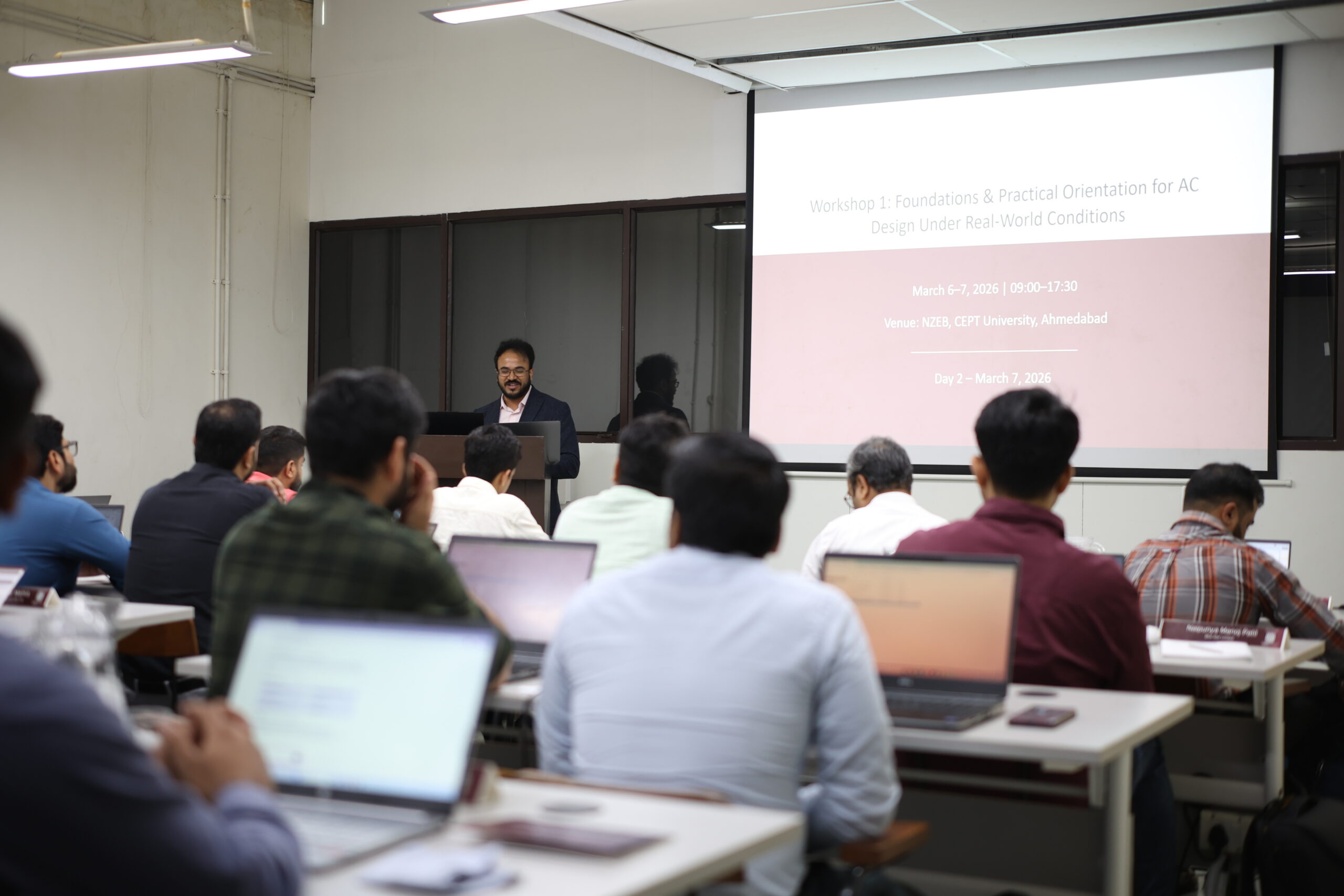
The workshop focused on how and why room ACs should be designed for real-world operating conditions. Technical sessions were supported by OTS R&D, a US-based engineering group with deep experience in translating academic research into practical HVAC product design. The goal was to strengthen engineers’ capacity to use advanced modeling and simulation tools that can optimize new designs, accelerate prototyping and testing, and support better decisions to develop products that perform efficiently and reliably in real-world conditions.
Shifting to real-world performance
Over the last two decades, India’s Bureau of Energy Efficiency has made notable progress in improving the energy efficiency of room air conditioners and other appliances, most recently by introducing new performance benchmarks for ACs, effective January 1, 2026.
However, as cities in India and across the Global South experience increasingly hot and humid summers, there is a growing realization that conventional ACs — designed primarily for temperature-only cooling — will struggle to manage humidity without wasting energy to overcool spaces.
A nine-month study by RMI and the Center for Advanced Research in Building Science, CEPT University conducted in Palava City, India, found that most ACs sold today can consume 30% more energy when required to control both temperature and humidity target conditions inside the indoor space.
Standard-setting bodies are also embracing to shift. The International Organization for Standardization ISO/TC 86/SC 6 — which develops international standards for testing and rating air conditioners and heat pumps — is steadily building toward more representative real-world performance evaluation approaches. This is reflected in the ongoing development of the ISO 21280 standard, which aims to advance beyond conventional steady-state, capacity-based methods toward evaluation under native controls across varying load conditions.
Building on this momentum, alongside evidence generate through field testing, the workshop focused on how ACs can better manage both temperature and humidity to deliver consistent comfort and energy efficiency, while being affordable to own and operate.
To see this idea in practice, participants used modeling and simulation tools to explore how design decisions affect performance outcomes. Through guided sessions using VapCyc simulation software, the engineers built system models, generated performance maps, and tested how ACs respond under varying load and humidity conditions.

These exercises, along with insights from industry presentations and discussions, illuminated the trade-offs that shape product design. By incorporating real-world conditions into simulation workflows, participants moved beyond standard test assumptions and engaged directly with the complexities of real-world operating behavior. This approach not only enables improving design accuracy but can also speed up prototyping and shorten product development cycles.
From systems to components
The second day of this workshop extended this hands-on approach to component-level design, with a focus on heat exchangers. Industry experts shared practical insights on tube-fin coil design, manufacturability constraints, and material considerations, and introduced emerging approaches such as microchannel systems and advanced refrigerant distribution.
These discussions highlighted that even well-established components remain a key area for innovation. Design choices directly influence cooling capacity and efficiency in real-world conditions, manufacturability, and ultimately product cost. As such, design must be evaluated across a range of operating contexts. Improving performance requires balancing cost, durability, and manufacturability, particularly as India’s manufacturing ecosystem continues to expand.
Now is the time to rethink design approaches with a fresh mindset. Our current product design must evolve to ease the tension between people’s comfort, the power grid, and the planet.
Looking ahead
Designing the next generation of air conditioning systems made for real-world performance will require building stronger technical capability, expanding access to the right tools, and equipping engineers and product teams with new skills. Continued coordination across manufacturers, policymakers, and researchers can help ensure that design practices, testing frameworks, and market signals evolve together, supported by a shared understanding of real-world performance.
As this alignment takes shape, it creates a pathway to translate technical insight into scalable solutions, making the future of cooling innovation a practical reality.