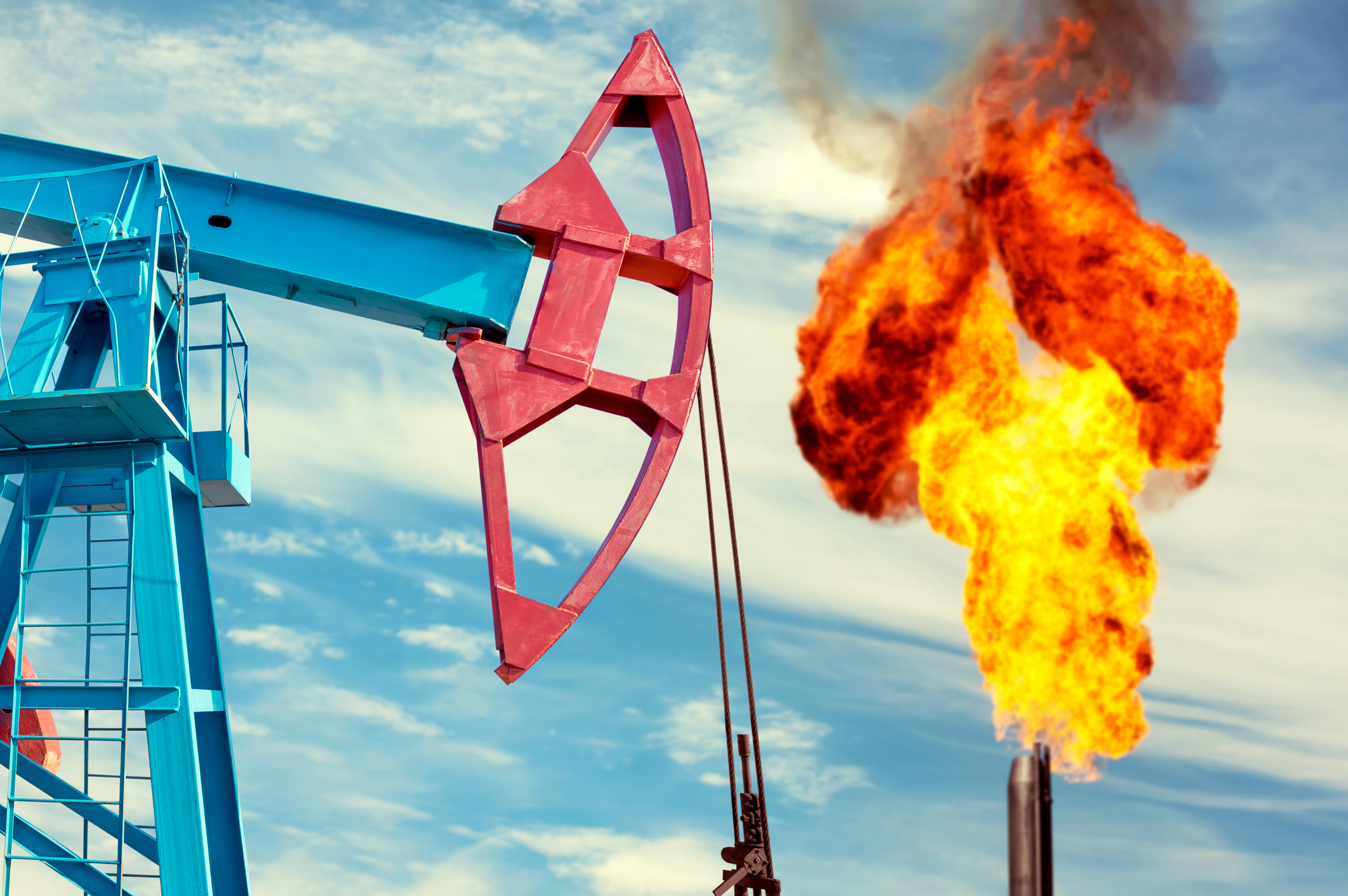
Oil rocking chair on the torch and the cloudy sky background
Methane 101: Why it matters, where it comes from, and how to tackle it.
Slashing this damaging pollutant from oil and gas, waste systems, coal mines, and more, offers one of the fastest climate wins available.
Preventing methane emissions is one of the fastest ways we can slow Earth from overheating right now. Methane isn’t just a damaging waste product. It is also a valuable commodity that is marketed as “natural gas,” which is produced alongside oil. When it leaks into the atmosphere, however, methane massively traps heat and warms our planet at an accelerated rate.
Methane was discovered in Italy 250 years ago due to bubbles arising from marshes. When collected and ignited, methane lit on fire and was initially called “swamp gas.” Although methane (chemical name CH4) has been steadily present in the Earth’s atmosphere at low levels for tens of thousands of years, its volume has increased dramatically since the Industrial Revolution due to increased fossil fuel use, agricultural expansion, and landfill development. In 2025, methane levels were at the highest ever recorded.
This increase in methane accounts for a roughly 0.5°C increase in global temperature, or nearly 30 percent of “forced” or human-made warming to date, which makes tackling methane pollution a pressing climate concern.

What makes methane so dangerous?
While carbon dioxide acts like a heat-trapping blanket around our planet, methane acts like an electric blanket with much more warming power. Methane has a lifetime of about a decade before it reacts to form other climate gases. Over a 20-year span, methane is over 80 times more powerful than carbon dioxide at warming the planet. As methane and other greenhouse gases build up at today’s elevated levels, their “blanketing” effect traps far too much heat. The greater the buildup, the greater the risk of life-threatening, property damaging, and costly extreme weather, wildfires, flooding, and other harms.
As well as being a climate concern, methane also causes substantial problems on the ground. Methane contributes to the formation of ground-level ozone, known as smog. Methane is also co-emitted with deadly contaminants and air toxins that kill and sicken people near where it is released. For example, benzene, a known carcinogen, can accompany methane when gas leaks from wells, flares, tanks, pipelines, chemical plants, and furnaces. Deadly hydrogen sulfide can be co-emitted with methane from oil and gas wells. And super-emitting methane sources that are present in very large volumes can explode and cause fires.
What are the main sources of methane?
The fossil fuel industry, landfills, livestock, and agriculture are the major human-made sources of methane, making up about 55 percent of current methane pollution. Natural sources, like wetlands, swamps, and thawing permafrost, produce roughly 45 percent. Different places have different shares of methane.
Methane is invisible, usually odorless, and under high pressure. This means it can readily leak in every stage of the oil and gas supply chain. It is easily emitted from landfills when food and other organic waste decompose. Some crops release methane as they grow. And animals, like cattle, expel it as a waste product.
How can we cut emissions?
The best place to slash methane is to start where we can make the most immediate impact. Methane from fossil fuels is a prime target because the methane in gas is a valuable commodity that is widely traded. Preventing gas from escaping means that companies can recoup money and prevent exposure to harmful impacts. Stopping leaks, reducing venting, and limiting flaring can quickly cut energy waste and curb methane emissions.
For landfills, a suite of tools is available to stop methane pollution at waste sites. These include reducing food waste, diverting food waste from the waste stream away from the disposal sites to anaerobic digesters or composting facilities, improving landfill cover practices, and enhancing gas capturing efficiency.
Cutting methane from livestock involves changes to waste handling and animal diets. Promising experiments are taking place with novel cattle feeds that reduce overall emissions. And reducing methane emissions from agriculture calls for changes to cultivation practices and other new control methods.
As a backstop, there is also work underway to study methane removal. As this powerful greenhouse gas builds up in the atmosphere, there may be a role to develop methods in the future for its removal in addition to efforts underway to cut methane emissions in each sector.
How can data accelerate action?
To tackle leaks and ultimately prevent them before they happen, we need to make invisible methane visible. This requires sensors and checks on the ground to make sure equipment is working as it should, as well as aerial surveys and even satellites to catch leaks as they happen.
Data-to-action efforts involve updated infrastructure, improved monitoring, and tighter regulations to enable faster responses to unexpected events that can reduce methane releases. The greatest opportunities in tackling methane emissions lie in more accurately measuring the emissions and reducing reliance on the industry’s self-reported emissions, which leads to emissions undercounting, as the exhibit below from Texas illustrates.
What is being done at the international level to prevent methane pollution?
Countries at COP26 in 2021 signed on to the Global Methane Pledge, which calls for a 30 percent reduction in 2020 methane levels by 2030. The 159 country signatories currently represent roughly 50 percent of the total methane emitted today.
Other initiatives involve incentivizing the production of low-methane oil and gas. The European Union’s methane regulations, which came into force in 2024, apply strict measures, including bans on venting and flaring and a low-methane standard that gas importers must meet.
How is RMI involved in tackling methane?
RMI works at multiple points to slash and prevent methane pollution. Our initiatives help to quantify and visualize methane to support policy adoption and advance market activation.
RMI’s Oil Climate Index plus Gas (OCI+) is an open-source analytic tool that estimates and compares the life-cycle greenhouse gas emissions intensities, including methane, of a majority of oil and gas resources worldwide from extraction to consumption.
RMI also quantifies methane emissions from oil and gas and waste sectors for ClimateTRACE, a coalition tracking greenhouse gas emissions from every global sector.
Through WasteMAP, a partnership between RMI and Clean Air Task Force, we’ve created an open, online platform that aggregates and maps reported, modeled, and observed waste methane emissions data worldwide.
We are also part of the CarbonMapper coalition, which helps shed light on major emitters. Last year, RMI was part of the launch of the Tanager-1 satellite, which has been hard at work tracking super-emitters and speeding solutions.
 Source:
 MiQ, a voluntary certification standard developed by RMI and SystemIQ that grades gas production on an A–F scale, has certified a volume of 24 billion cubic feet per day of low-methane-leakage gas. In July, we released an analysis showing that, with Pennsylvania acting as the keystone producer, US output of certified low-leakage gas can meet demand from both domestic and international buyers.
RMI has also mapped the vast number of uneconomic and end-of-life wells — marginal wells — across the United States. Future work will focus on pinpointing high-emitting marginal wells and stopping their emissions.
What are the benefits from reducing methane?
Methane has a much shorter lifetime in our atmosphere than carbon dioxide. This means that reducing methane now immediately prevents it from warming Earth in the short term. Methane also takes longer to react into dangerous air pollutants, like smog. Any action to prevent or more quickly stop methane leakage protects our health and safety. Rapidly attending to large methane plumes and preventing explosions can prevent risk to people and property.
Driving down methane emissions buys us crucial time to accelerate new technologies and scale the energy transition. Cutting methane means a cooler planet, a healthier environment, and clearer skies — and wasting fewer energy sources.