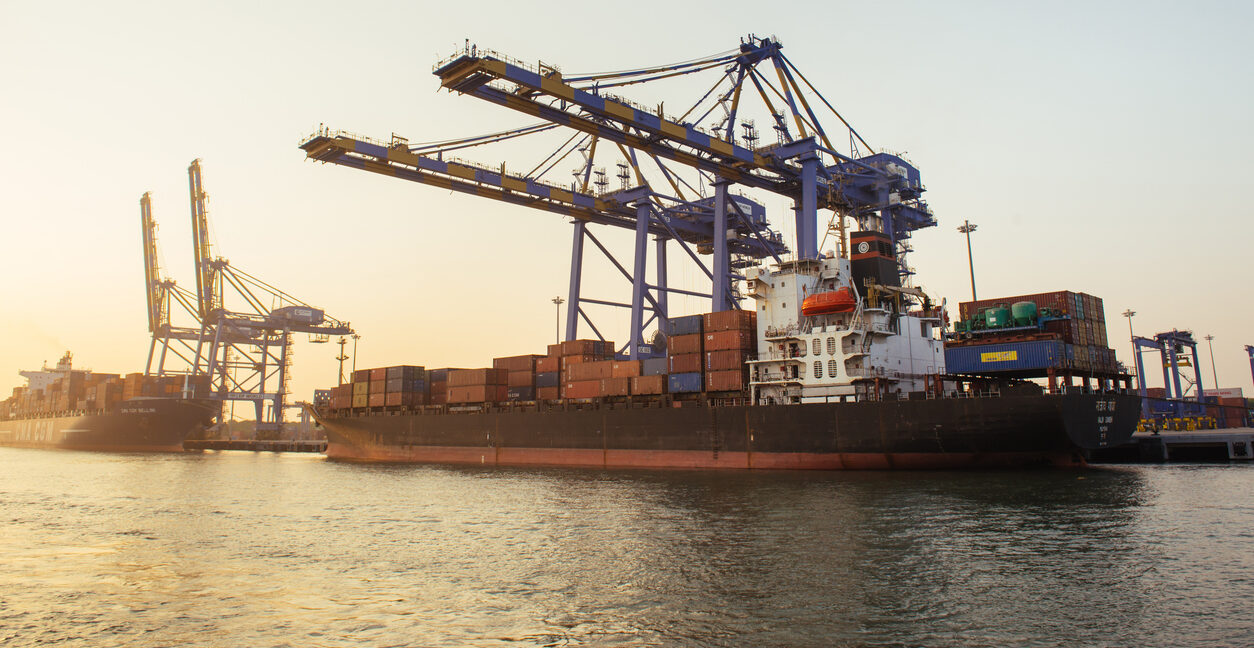
Cochin, India - January 15, 2016: The International Container Transshipment Terminal (ICTT), part of the Cochin Port, Kerala, India. Cochin Port is a major and is one of the largest ports in India. The modern port was established in 1926.
Green Shipping Corridors Can Help Scale India’s Green Hydrogen Ecosystem
Shipping routes that use zero-emission fuels are a critical mechanism to aggregate maritime demand for green fuels and decarbonize the shipping sector at scale.
India’s maritime sector is a cornerstone of its economic growth, facilitating over 90 percent of the nation’s trade by volume. As the country charts a path toward a low-carbon future, national frameworks such as the Harit Sagar Guidelines and the Amrit Kaal Vision 2047 are steering ports and shipping toward sustainability and energy transition.
Building on the National Green Hydrogen Mission, India has designated three of its ports — V. O. Chidambaranar (VOC), Paradip, and Deendayal — as hydrogen hubs, anchoring more than 12 million tons (Mt) per year of announced green hydrogen and derivative projects. These efforts are laying the foundation for a hydrogen-ready maritime ecosystem capable of supporting both renewably produced fuel (e-fuel) bunkering and exports.
The next frontier lies in translating these early initiatives into coordinated green shipping corridors that can aggregate demand across sectors and geographies. Despite strong policy momentum, India still lacks a comprehensive techno-economic framework to assess viable routes, fuel competitiveness, and enabling infrastructure. Green shipping corridors can bridge this gap by serving as living laboratories for integrated decarbonization, linking domestic coastal trade with international export routes. With India’s strategic position on the East–West maritime routes and its growing cost advantage in e-fuel production, reinforced by SECI’s green ammonia tenders, this is a defining moment to operationalize the next phase of maritime decarbonization.
With India’s strategic position on the East–West maritime routes and its growing cost advantage in e-fuel production, reinforced by SECI’s green ammonia tenders, this is a defining moment to operationalize the next phase of maritime decarbonization.
The Rotterdam–India–Singapore route will emerge as India’s first green shipping corridor
India’s coastal cargo traffic has increased from 74 Mt in 2014–15 to 162 Mt in 2023–24 and is projected to reach 230 Mt by 2030 under the Coastal Shipping Bill 2024. While routes such as VOC–Deendayal are vital for early pilots, their limited throughput constrains economic feasibility. Container vessels account for about 40 percent of calls on this route, translating to roughly 19–20 kilotons of annual e-fuel demand which is insufficient to justify dedicated bunkering infrastructure or achieve economies of scale.
In contrast, the Rotterdam–India–Singapore corridor presents a transformative opportunity in both scale and strategic relevance. As highlighted in RMI’s report Sailing Towards Net Zero, by aggregating demand across these major global trade hubs, the route could unlock over 1 Mt per year of e-fuel bunkering demand by 2030, driven by India’s estimated export potential of 7 Mt/y of green methanol and 11 Mt/y of green ammonia. Anchored at VOC Port, this corridor can serve as India’s first commercially viable green shipping route, enabling shared infrastructure, standardized e-fuel certification, and harmonized policy frameworks with early-mover partners such as the Netherlands and Singapore. Lessons from this international route can cascade to domestic corridors, allowing them to leverage established supply chains and cost efficiencies.
Coastal corridors are critical but lack scale, undermining their business case
Coastal corridors such as VOC–Deendayal are essential for domestic learning though commercially constrained by scale. The pilot-scale of annual e-fuel demand estimated at ~19–20 kt leads to higher per-unit fuel costs which can be reduced by up to 40 percent through scaled production.
On a vessel operation basis, the lifetime total cost of ownership (TCO) for a green methanol vessel is estimated at US$184 million, nearly 80 percent higher than the conventional very low sulfur fuel oil (VLSFO) baseline of US$102 million. Achieving cost parity requires targeted incentives, including vessel capital subsidies (–15 percent), port-charge rebates (–50 percent), and a fuel cost viability-gap mechanism (–25 percent). Combined, these interventions could reduce costs close to parity with conventional fuels.
While such coastal pilots are crucial learning opportunities, larger-scale international corridors provide a clearer pathway to driving down market and infrastructure costs. By aggregating volumes through interconnected e-fuel corridors and regional bunkering hubs, VOC Port can advance toward full decarbonization while positioning itself as both a strategic e-fuel bunkering hub and a key export node in India’s emerging green hydrogen ecosystem.
International corridors bring scale and enable globally competitive price points
Similar to coastal routes, the higher costs of e-fuels compared to VLSFO affect vessel economics on international corridors. However, scale and supportive policy frameworks can close this gap. Since fuel represents up to 60 percent of a vessel’s lifetime cost, switching to e-fuels can raise the TCO by 1.5–2 times compared with conventional operations.
For proposed corridors from VOC Port to Rotterdam and Singapore, India’s low-cost e-fuel production combined with the IMO’s Net Zero Framework can substantially improve competitiveness. The framework penalizes high-emission fuels while incentivizing zero and near-zero (ZNZ) emission alternatives through ZNZ rewards and differentiated compliance mechanisms. Under an optimistic IMO policy scenario, the TCO of ammonia-powered vessels could be 28 percent lower on the VOC–Rotterdam route and 16 percent lower on the VOC–Singapore route than conventional vessels. Even under conservative assumptions, IMO incentives can halve the cost premium — from around 40 percent to below 20 percent.
Crucially, this vessel-level TCO premium has minimal impact on cargo economics: delivered green ammonia costs at import ports vary by only ±2–3 percent, underscoring that international corridors can achieve global price parity while driving large-scale maritime decarbonization.
Beyond economics, India’s green corridors will be forged through collaboration
As India navigates the next decade of maritime transition, collaboration, scale, and strategic partnerships will define success. The country is already deepening bilateral relationships with the Netherlands and Singapore, which will be pivotal in translating the green corridor vision into implementation. These partnerships can align operational standards, harmonize certification processes, and mobilize investment across exporting and importing hubs.
Yet, analysis alone will not deliver outcomes. The success of green corridors will hinge on broad stakeholder alignment, bringing together shipping lines, fuel producers, port authorities, and policymakers to co-develop viable business models and shared infrastructure.
This initiative marks only the beginning. The next phase demands collective action, a coalition of early movers committed to piloting and scaling corridors that redefine the future of sustainable maritime trade. India now stands at the cusp of this opportunity, ready to lead by example and anchor the global transition to zero-emission shipping.