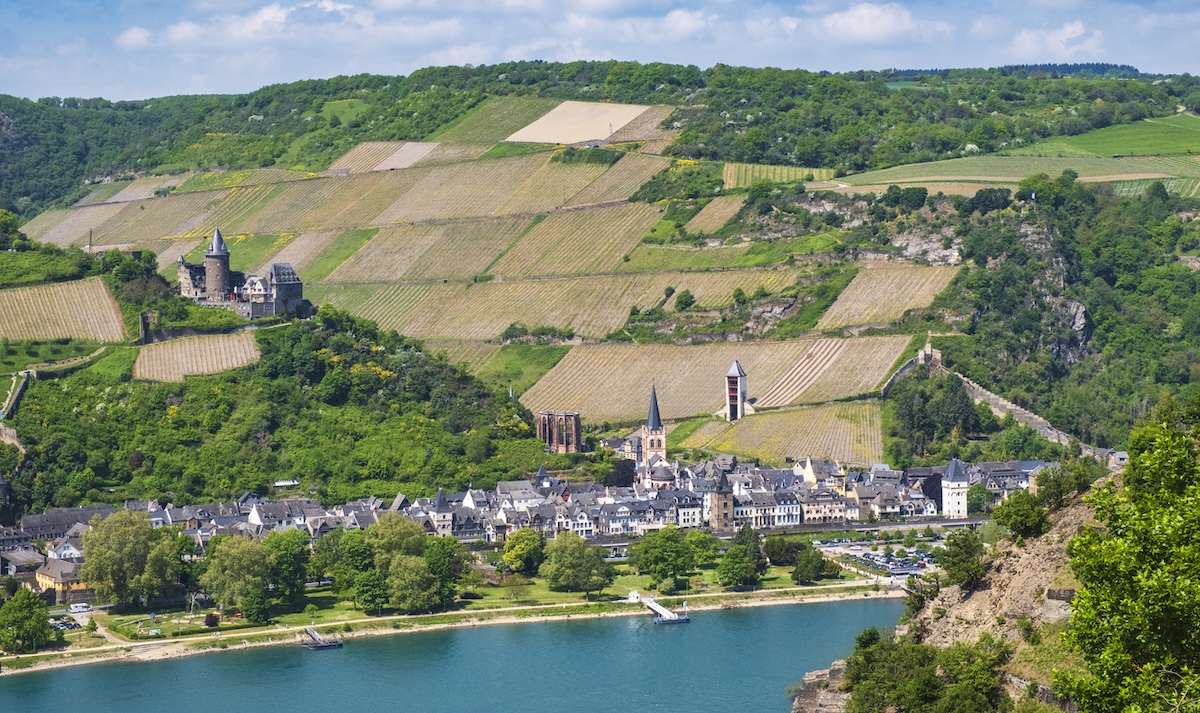
View from a hiking trail in the Rheingau Mountains near Lorch down into the Rhine Valley on a sunny spring day
10 Project Finance Lessons from Europe’s Geothermal-Lithium Lighthouse
The Lionheart lithium and geothermal power project in Germany provides learnings for first-of-a-kind industrial dealmakers raising capital in an uncertain world.
In December 2025, European and Australian investors closed a pioneering €2.2 billion (US$2.5 billion) deal for phase one of Vulcan Energy Resources’ Lionheart lithium extraction and geothermal heat and power plant in Germany’s Upper Rhine Valley. When completed in 2028, Lionheart aims to produce enough lithium hydroxide monohydrate (LHM) for 500,000 electric vehicle batteries each year and enough heat for 90,000 homes nearby. Lionheart shows how dealmakers learned from previous first-of-a-kind (FOAK) industrial transactions to structure a measured, bankable financing package.
While neither direct lithium extraction nor lithium electrolysis are entirely new technologies, Lionheart is among the first projects globally to integrate geothermal power generation, lithium extraction from naturally heated brines, and electrolysis‑based lithium hydroxide production at commercial scale. Compared with conventional lithium mining methods (e.g., hard‑rock mining or evaporation ponds), geothermal brine extraction can significantly reduce land disturbance and water consumption.
Lionheart’s project financing includes several features from earlier innovative industrial deals, such as using government loan guarantees, sharing equity upside with offtakers, and selecting banking partners with climate expertise. But Vulcan also implemented at least 10 other de-risking measures, which helped entice almost two dozen international investors in times of unprecedented geopolitical uncertainty.
RMI’s Deal Lab
RMI’s Deal Lab accelerates clean energy investment by reducing the time it takes for markets to learn how to structure complex deals. It does this by convening key counterparties early to align on technical assumptions, contract design, and risk allocation, enabling the creation of “lighthouse deals” that can move forward faster. By making these deal structures and lessons public, Deal Lab helps other investors replicate and scale similar transactions.
Founded in 2018, Vulcan raised its first major financing in 2022, securing €50 million from investors like carmaker Stellantis (formerly Fiat Chrysler). The Lionheart project financing was two years in the making:
- In November 2023, Vulcan launched the debt raise with French bank BNP Paribas as financial advisor.
- Then in December 2024, Vulcan secured almost €1 billion in conditional debt commitments.
- Finally in December 2025, Vulcan closed its final €2.2 billion construction package (see capital stack below).
“This transaction marks an important milestone in Europe’s ambition to secure sustainable access to critical raw materials. It clearly demonstrates how innovative financing structures and close collaboration across stakeholders can play a decisive role in accelerating the transition toward a resilient, low-carbon economy. At ING, we are happy to play our role in this transition.”
Behind the deal was a carefully structured set of measures to reduce risk for investors. Lionheart relied on an innovative portfolio of de-risking measures. The following 10 takeaways from Lionheart show how to finance other ambitious projects in tough markets. For simplicity, they are organized by financial and operational de-risking.
Financial de-risking
1) Protecting lenders
The project’s main revenue source is lithium and since lithium prices were low during the financing period, Vulcan and (crucially) its customers agreed on a “basket of fixed, floor-ceiling, and index-based floating prices” so that banks could appropriately size how much debt the project’s revenues could support. This price certainty was critical for bankers because of lithium markets’ relative novelty and volatility.
Along with long-term, take-or-pay contracts for most of its output and protecting commercial lenders with government debt guarantees, Lionheart also has a debt-to-equity ratio of 60:40 — relatively conservative compared to the 80% leverage often seen in traditional European renewables, for example. It had initially targeted 65:35. Lionheart’s owners are forecasted to receive a post-tax, levered return of 16.6%, which aligns with return profiles typically sought by energy transition funds.
Additionally, Vulcan safeguards lenders’ repayments using three structuring measures. First, because FOAK projects face many unforeseen risks, Lionheart’s financing package includes a €108 million Commercial Standby Facility (i.e., a “rainy day fund”). Next, the estimated €1.476 billion construction cost includes an upsized 15% contingency — an increase from the 10% originally estimated. And lastly, Vulcan and its creditors have agreed to “sweep” any extra cash the project generates in good years to first replenish project-level reserve accounts before any remaining cash goes to its equity owners.
2) Government equity
Germany’s state‑owned development bank, KfW, provided €150 million in equity from its new €1 billion Raw Materials Fund for a 14% stake in Vulcan’s German holding company. Governments regularly provide debt, debt guarantees, and grants, but equity at this scale is relatively rare and incredibly helpful to lighthouse transactions that can blaze a trail for many other deals.
3) Public listing in Australia
Vulcan listed some of its shares on the Australian stock market, whereas similar deals are usually done entirely by private investors. Though this means Vulcan’s books are open to much more public scrutiny than a private company, it allows Vulcan to tap large, liquid pools of capital. And because of Australia’s long history of mining, Australian retail and institutional investors are well-versed with mining stocks.
4) Certifying greenness
To assuage climate-focused investors that may have been weary of a mining project’s environmental credentials, Vulcan secured a “dark green” second party opinion from S&P. Perhaps a green bond refinancing is on the cards post-construction.
5) Incentivizing good partnerships
Because of the relatively low proportion of debt, Vulcan needed a larger-than-expected amount of equity and this meant enticing a variety of equity co-investors. Vulcan did this by giving construction firm HOCHTIEF “preferred supplier status” (i.e., the right to match any other contractors’ offers for subsequent work) in exchange for €169 million in equity.
Additionally, different equity owners have different “lock up periods” before which they cannot sell their shares. KfW has the longest potential lock up of June 2032. This gives private investors confidence that the German government will not exit the project before they do.
6) Mitigating foreign exchange risk
To mitigate currency fluctuations, 70% of Vulcan’s base loan repayments are in Euros while 30% are in US dollars. Diversifying across two currencies mitigated exposure to unexpected volatility in the currency markets.
Operational de-risking
7) Proven operations
Infrastructure investors have historically been more skeptical of geothermal projects’ operating performance than more widespread renewable technologies like wind and solar. In the lead up to its financing, Vulcan had been running a pilot since April 2021, set up a lithium extraction optimization plant in November in 2023, completed a lithium electrolysis optimization plant in 2024, and shipped battery‑quality LHM samples to multiple offtakers in early 2025. These critical steps provide investors with operational proof-points ahead of full commercial operations.
8) On-site power
One of the mine’s trump cards is its dedicated behind-the-meter geothermal power source, meaning it doesn’t need to rely on potentially volatile/expensive grid power. In fact, its geothermal heat can also displace (increasingly expensive, politically contentious) imported Russian gas. Lionheart’s alignment with European geopolitical goals was a key factor in securing government support.
9) Multiple revenue streams
Investors love projects and companies with diversified revenue streams because the project can still generate some cash even if one revenue stream fails. Lionheart will sell lithium, power, and heat. Depending on the evolution of the global regulatory environment, the project may even be able to bolster revenues in the future by selling environmental attributes.
10) On-site refining
Supply chain risk is a common concern for industrial investors who worry that each additional step transporting raw commodities to refineries increases costs. Vulcan is among the few vertically integrated projects that will extract lithium and convert it into battery-quality LHM on-site. Of course, there is always a trade-off between vertical integration and project-on-project risk exposure with which investors need to gain comfort.
Putting Lionheart in Context
Geopolitics are part of the energy transition. Lionheart highlighted a crucial, growing partnership between the EU and Australia — two democracies (and “middle powers” as Mark Carney recently posited) in a world facing a struggle being “great powers.”
The year 2025 was rough for investors in marquee industrial decarbonization projects: Swedish EV battery maker Northvolt filed for bankruptcy in Sweden in March, US$3.7 billion of US federal grants were canceled in May, and green steelmaker Stegra sought additional funding after cost overruns in October. But 2025 ended with a Christmas gift. Lionheart’s triumphant financing in December was a lighthouse transaction that gave other dealmakers not just a financing template, but an indication that capital markets are ready to fund innovative, well-structured deals.
It took two years to align dozens of counterparties around Lionheart’s deal terms. It must have taken many iterations for bankers to agree on the frequency of cash sweeps, for equity partners to align on lock-up periods, for EPC contractors to summon those equity checks, and so on. It took a lot of lawyers, leading to a lot of billable hours. We cannot wait for market forces alone to execute similar deals — it will take too long. To speed up the process, RMI is launching the Deal Lab, which will help transform one-off FOAK deals into scalable lighthouse deals.
To participate in the Deal Lab, contact Nabil Bennouna at nbennouna@rmi.org.