

Learn how we are working to transform how we use and produce energy.
Why we share this work for free
RMI is an independent nonprofit working to accelerate the clean energy transition. We publish research like this to inform decision-makers and drive real-world impact.
Our work is supported by philanthropy as well as partnerships, including fee-for-service engagements. This support makes it possible for us to share our independent insights for free.
If you find this work valuable, you can support it anytime.
Get more insights like this
Stay up to date with the latest research, analysis, and tools from RMI by opting in to receive occasional emails below. You’ll get new reports, event invitations, and practical insights to help us all accelerate the clean energy transition.
Loading form...
Your download should start automatically. If it doesn’t, click the download button below.
This work is made possible by philanthropy
RMI is a nonprofit supported by donors and partners. Philanthropy enables us to produce independent research and make resources like this freely available.
If you find this report valuable, please consider supporting our work. You can also explore how we partner with organizations to drive impact.
Jump to Section
With gas prices at some of the highest levels in recent years, interest in electric vehicles is surging. But EVs do more than save money at the gas pump. They have a lower total cost of ownership, produce less greenhouse gas emissions, protect against volatile oil prices, and deliver instant torque and acceleration, making them fun to drive. As EV range increases, charging infrastructure becomes more widespread, and EV and battery prices continue to fall, we expect to see many more EVs on the road soon.
Already, global EV sales are estimated to account for 27% of new-car sales in 2026, up from 9% five years ago, according to BloombergNEF. Sales of electric buses and 2- and 3-wheelers —which dominate roadways in the Global South — are tracking closer to half of all new purchases. Vans and heavy trucks — one of the most difficult to electrify vehicle types — are growing quickly too.
In this article, we steer into why EVs are gaining traction around the world.
Owning an EV is cheaper than owning a gas-powered vehicle
Although the initial purchase price of some EVs may be more expensive than their internal combustion engine (ICE) counterparts, the cost over the lifetime of an EV is often cheaper. With fewer mechanical parts to wear out and no need to replenish engine oil or transmission fluids, EVs cost less to maintain and fuel than ICE vehicles. And while US federal tax credits for EV purchases have been phased out, many states still offer tax credits or rebates.
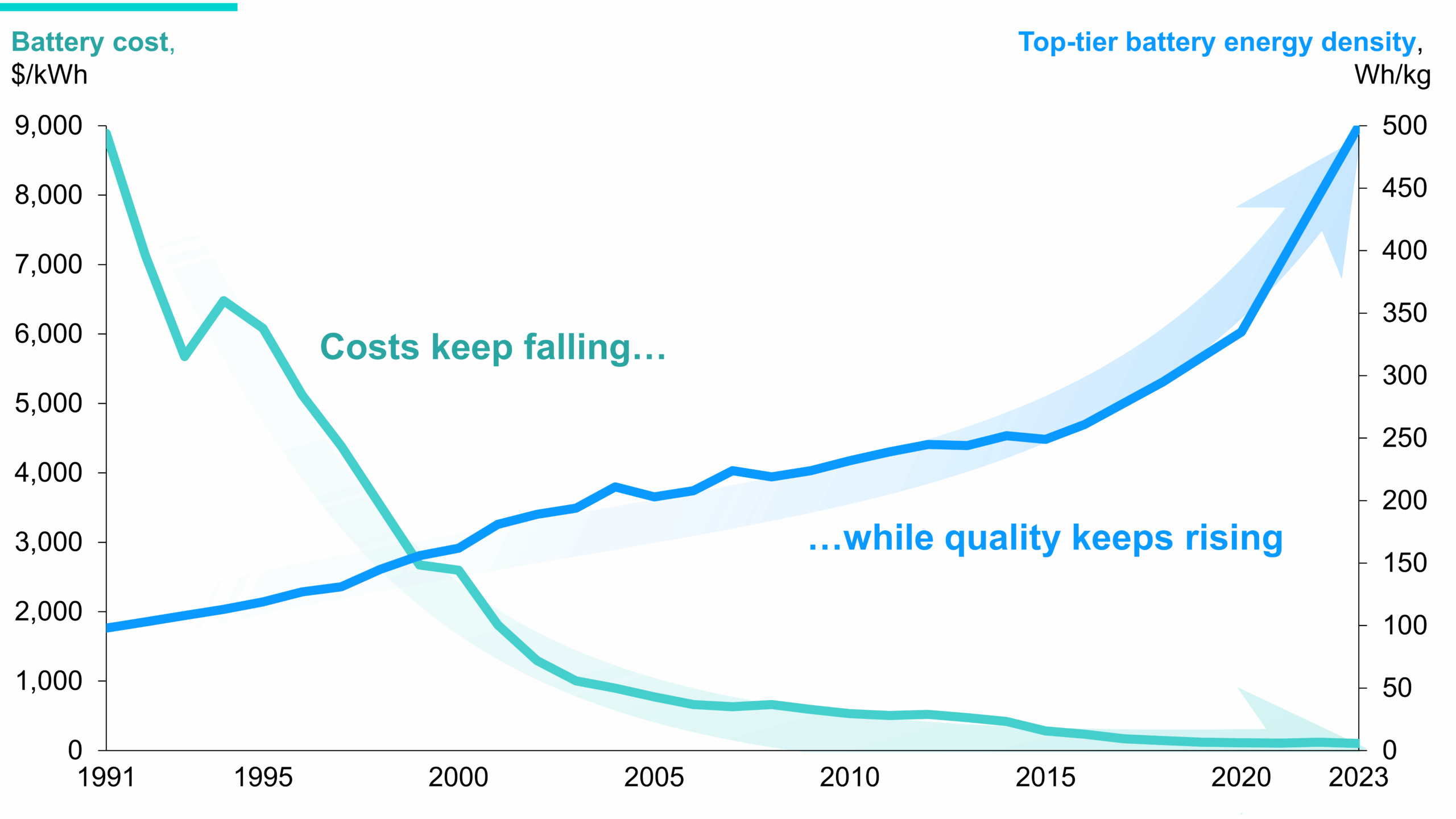
The falling costs of EV batteries are making EVs more affordable. Lithium-ion battery prices have decreased 90% since 2010, one of the fastest cost declines of any energy technology ever. This has, in turn, helped lower the price of EV while helping to boost their range.
In some countries, the purchase price of an EV is actually lower than an ICE vehicle. In China, the world’s largest car market, nearly all small battery electric car models are priced lower than the average small ICE car, and more than half of battery electric SUV sales were priced lower than an average ICE SUV.
EVs emit less pollution
Electric vehicles have no tailpipe emissions. And even if the electricity used to charge the EV is generated from coal or natural gas, an EV still produces less greenhouse gas emissions than an ICE vehicle over its lifetime. In fact, an EV can produce 75% less climate pollution than an ICE vehicle over its lifetime, even when including the upstream emissions of electricity generation. And if your grid is partially powered by wind or solar energy, EVs’ edge will be even higher. Beyond greenhouse gases, EVs also emit far less of the conventional pollutants that harm local air quality and public health: 90% less nitrogen oxides and half as much particulate matter.
EVs’ emissions advantage persists even when including battery manufacturing. Research from Argonne National Laboratory found that although emissions from EV manufacturing are higher than for assembling a gasoline car, the total emissions over an EV’s lifetime are lower.
Electric motors are much more efficient than gas engines
One of the reasons why EVs have a lower carbon footprint than their ICE counterparts is due to the substantial efficiency edge of an electric motor compared to an internal combustion engine and drive train .
In a gas-powered vehicle, only about 16%–25% of the energy from gasoline is converted into energy to move the car. A big share of the energy is lost as heat and friction when metal axles, gears, and other moving parts encounter mechanical resistance.
In an EV, the power train is much simpler: energy goes directly from the motor to the wheels converting about 90% of the energy from the battery. Regenerative braking, which lets EVs create more electricity while slowing down, adds to their efficiency advantage.
Additionally, an electric motor delivers full torque instantly, while ICE engines have to build up engine speed, and move through a series of mechanical gears before hitting full torque. The upshot: EVs accelerate faster, more smoothly. For EV drivers, the pulse of instant, powerful acceleration is a hallmark that ICE engines struggle to match.
Countries around the world are implementing ambitious EV policies
From Argentina to Zimbabwe, countries around the world are implementing policies and measures to accelerate EV adoption.
Last year, Argentina lifted import tariffs on low-cost EVs and announced that starting in 2027, all new buses must be electric or compressed natural gas-powered.
For its part Zimbabwe, mirroring moves across much of Africa, is targeting a goal of 33% EV market penetration by 2030 and has cut import duties across a wide array of EVs, battery, and solar infrastructure.
In bigger global markets, China provides grants to purchase EVs, with extra benefits for scrapping an old ICE vehicle. Canada recently announced the launch of its EV Affordability Program, providing lease or purchase incentives up to US$3,500 for electric vehicles.
The European Union has allocated $3.4 billion to EV battery manufacturing. Germany is one of many countries that has a vehicle tax exemption for EVs, and Russia is allocating $72 million to subsidize the purchase of EV charging equipment. The list goes on.
How will the grid handle all of these EVs?
In the United States, more than 1 million EVs were sold in 2025, despite the phaseout of federal tax credits for consumers and financial support for manufacturers. And globally, BloombergNEF forecasts that EVs will account for more than 50% of all vehicles sold in 2035. These additional EVs mean more electricity demand on the grid.
There are many ways we can prepare for all of these EVs:
Better forecasting: Utilities need better methods to determine when and where to invest in grid infrastructure. RMI’s GridUp tool offers one example. An open-access tool that identifies where EV load growth is likely to materialize, GridUp can help utilities and other stakeholders be proactive instead of reactive in planning grid upgrades.
Managing load: One way to better meet charging demand is through managed charging. Strategically encouraging charging at specific times — for example, during off-peak periods — can reduce grid distribution capacity needs by up to 30%. Managed charging can also help EVs absorb surplus renewable energy, lowering system costs, and reduce the cost of a charge for consumers and fleets — a win-win scenario.
Some utilities are entering into agreements with electric trucking fleets to reduce charging during periods when energy demand is expected to be highest. These flexible service connections work well for trucks, since they don’t need to be plugged in 24/7 and can charge at times when the grid is underutilized.
Exporting EV electricity back to the grid: EVs can actually benefit the grid directly too. As vehicle-to-grid (V2G) capabilities expand, EVs will increasingly be able to support the grid by exporting energy back onto the distribution system. V2G technology can also enhance local energy resilience by providing backup power for homes and businesses.
Electric mobility extends beyond cars
The electrification of mobility goes well beyond passenger cars. A growing number of trucking fleets are going electric, as the cost of electric heavy-duty trucks is becoming competitive with their diesel counterparts. Globally, sales of electric trucks doubled from 2024 to 2025, and sales of heavy-duty trucks almost tripled.
Electric two and three-wheelers are also seeing rapid adoption in many parts of the world. In India, where two and three-wheelers are the main way to get around, 1.4 million electric scooters and motorcycles were registered in fiscal year 2026, a 22% increase from the previous year.
And in Nigeria, RMI analysis shows that electric motorbikes could make up 70% of the two-wheeler market in the next 15 years. Currently two-wheeled EVs are cheaper than their gas-powered motorcycle counterparts.
Electric bicycles are also becoming popular at an increasing rate, with sales outpacing those of electric vehicles in the United States. Since 60% of US vehicle trips are less than 6 miles, e-bikes can make perfect sense.
Electric transport isn’t limited to roads either. It is possible to even find electric boats and electric airplanes.
From niche to mainstream
Electric vehicles are no longer a niche technology. Falling costs, improving performance, and supportive policies are making them an increasingly practical choice for drivers around the world. And as utilities, governments, and industry work together to expand charging infrastructure and modernize the grid, the benefits of electrified transportation will extend well beyond the vehicles themselves. The transition is already underway — and it’s reshaping how people and goods move around the world.


Related Insights

Building Charging Networks That Meet Drivers’ Needs Without Breaking the Bank
Help build the clean energy future. Donate today.
Independent research. Real-world solutions. Supported by donors.
RMI can pursue the highest-impact climate and energy solutions because we’re supported by people who believe change is possible. Every gift helps advance the work needed to make clean energy the default choice worldwide.
For other ways to give to RMI, including checks or gifts of stock, please visit Other Ways to Give.
