

Learn how we are working to transform how we use and produce energy.
Accelerating Industrial Clean Heat Through Clean Heat Standards
How policymakers can include industry in a clean heat standard to increase value and spur deployment of clean heat technologies
Why we share this work for free
RMI is an independent nonprofit working to accelerate the clean energy transition. We publish research like this to inform decision-makers and drive real-world impact.
Our work is supported by philanthropy as well as partnerships, including fee-for-service engagements. This support makes it possible for us to share our independent insights for free.
If you find this work valuable, you can support it anytime.
Get more insights like this
Stay up to date with the latest research, analysis, and tools from RMI by opting in to receive occasional emails below. You’ll get new reports, event invitations, and practical insights to help us all accelerate the clean energy transition.
Loading form...
Your download should start automatically. If it doesn’t, click the download button below.
This work is made possible by philanthropy
RMI is a nonprofit supported by donors and partners. Philanthropy enables us to produce independent research and make resources like this freely available.
If you find this report valuable, please consider supporting our work. You can also explore how we partner with organizations to drive impact.
Clean Heat Memo Series
Executive Summary
Industrial heat is essential to manufacturing and is traditionally generated through the burning of fossil fuels. Industrial clean heat provides the heat for an industrial facility using technologies like electricity, thermal energy storage, waste heat recovery, geothermal energy, or clean fuels. This reduces overall energy use, improves air quality (especially around fenceline communities), hedges against price spikes, increases global competitiveness, and reduces greenhouse gas emissions. States that take an active role creating a market for new technologies like industrial clean heat will be best positioned to capture economic benefits from industrial transition.
Many clean heat technologies are mature but are not being adopted at scale due to various policy and market barriers. State policies such as a clean heat standard (CHS) can help overcome these barriers by creating a durable incentive for investment, including the opportunity for industrial facilities to generate revenue through clean heat credit markets, depending on program design.
A CHS is a performance standard that can be placed on heat providers to reduce the carbon intensity of heating fuels. Its purpose is to accelerate deployment of lower-emissions heating resources by obligating heat providers to deliver or fund clean heat technologies, prioritizing lowest-cost greenhouse gas reductions first.
A CHS is similar to a renewable portfolio standard and low carbon fuels standard but focuses on heat and is consistent with states’ historic use of environmental regulations that apply to fuels sold within state boundaries. In proposals to date, CHSs include the fuels needed to provide space heating to the residential and commercial sectors. However, expanding participation to industrial heat could provide support to industrial firms that desire to transition to cleaner heating resources and expand the options for states to effectively reduce climate and air pollutants from a wide variety of local emitters.
States considering a CHS that includes industrial heat must make several key policy design decisions, including which heating fuel providers are obligated (i.e., regulated) under the program, how to calculate baseline emissions, how emissions reduction targets and trajectories are established, and how compliance credits are generated, valued, and traded. Colorado’s existing state program and proposals and studies in Vermont, Massachusetts, and Maryland demonstrate a range of approaches to these design choices.
Policymakers can tailor a CHS to align with industrial sector characteristics, affordability considerations, and state climate goals while balancing emissions reductions, program costs, market development, and equitable distribution of benefits.
Key policy design considerations for policymakers include:
| Design feature | Key considerations |
|---|---|
| Obligated parties Entities required to demonstrate emissions reductions under the CHS | Obligated fuel providers: Whether all heating fuel providers or only a subset, such as regulated utilities, are obligated. This shapes program scope, customer coverage, cost distribution, and whether a credit market is appropriate. |
| Baseline emissions calculations Calculation of an inventory of thermal emissions used to determine the volume of emissions addressed by the CHS | End-use sectors included in the baseline: What sectors the CHS baseline addresses. For example, emissions only from residential and commercial buildings or additionally from industrial heat. Industrial subsectors included in the baseline: If industry is included in the baseline, whether all industrial sectors are covered or whether to focus on subsectors with more mature, readily available clean heat technologies. |
| Clean heat targets Emission reduction targets obligated parties must meet under the CHS | Long-term emissions reduction target: How to set long-term emissions reduction targets based on state climate goals, technical feasibility, technology availability, and cost-effectiveness of clean heat technologies. Combined and differentiated targets and trajectories for end-use sectors: Whether to combine targets across all covered sectors for a larger credit market or to set sector-specific targets for more tailored support. Target timeline: How quickly clean heat obligations increase over time. |
| Compliance rules Rules governing qualifying emissions-reduction activities and credit generation under the CHS | Credit-generating parties: Which entities can generate clean heat credits, such as fuel providers, industrial facilities, contractors, and heat-as-a-service companies. Credit-generating activities: Which activities can count toward credit generation. Activity guardrails: Whether and which limits or safeguards for certain credit-generating activities, especially use of alternative fuels, must be set to ensure meaningful emissions reductions. Industrial credit-generating activities when industrial heat is not included in program baselines: Whether industrial clean heat projects can generate credits even if industrial heat is excluded from the CHS baseline. Credit retirements with sector-specific targets: Whether credits generated in one sector can be used for another sector’s obligation or must remain within the sector where they were generated. Credits per activity: How credits are calculated, including emissions accounting boundaries, upstream emissions treatment, and crediting for long-lived measures. |
Introduction to Industrial Heat
Industrial heat is needed to manufacture everyday products that people rely on — from food and medicine to steel and cement. Traditionally, industrial heat has been provided from fossil fuels like natural gas, oil, and coal. But new technologies can provide the same industrial heating benefits, more efficiently, and with fewer air and climate pollutants. Using “clean heat” can also protect against price shocks from turbulent global energy markets and supports global competitiveness for manufacturers who export their goods internationally, particularly to European markets with a carbon border adjustment mechanism.
Industrial heat is responsible for about 9% of all US greenhouse gas emissions, making clean heat technologies a near-term, high-impact opportunity for industrial decarbonization. This is particularly true for facilities that operate predominantly at low to medium temperature ranges (below 400°C), such as food and beverage, pulp and paper, consumer goods, and some chemical manufacturing.
Industrial heating technologies like industrial heat pumps, e-boilers, thermal batteries, and solar thermal are technologically mature and readily deployable. Other technologies such as enhanced and advanced geothermal are still maturing technologically and can also benefit from early offtake support from large industrial customers. However, these technologies are not being adopted at scale due to various market and policy barriers, including increased operating costs driven by the higher cost of using electricity instead of natural gas for heating processes. This is often called the “spark gap.”
Coordinated action and state support are needed to reduce costs and accelerate deployment, ultimately spurring these nascent markets to scale. States that take an active role in creating a market for new technologies will be best positioned to capture economic benefits from industrial transition. Recent analysis suggests a growing industrial electrification market could support $471 billion in economic growth, including $252.3 billion in deployment-related growth and $257.6 billion in manufacturing-related growth. In some cases, places that support the deployment of these technologies by providing incentives may also have an edge in attracting the manufacturing of these technologies.
A CHS is one option states could consider to incentivize first movers to modernize their facilities. A well-designed CHS can accelerate deployment of clean heat technologies that improve industrial efficiency, reduce energy use, and emit fewer pollutants by creating a long-term compliance obligation and potentially a market-based system that supports investment in lower-emissions industrial heat.
Policy Overview
A clean heat standard (CHS) is a means to support investment in technologies and actions that generate lower-emissions heat (i.e., “clean heat”) by creating an obligation for fuel providers to deliver or fund lower-emissions heating solutions to end users. “Fuel providers” refers to entities that provide fuel for heating, which may include utilities and private fuel delivery companies.
A CHS can simply obligate fuel providers to take actions to meet the standard, or it can include a credit trading system (i.e., a market) wherein eligible parties generate credits by undertaking qualifying clean heat generating activities that obligated parties can then purchase to meet their annual obligations. This system requires clear eligibility criteria and standards.
Exhibit 1
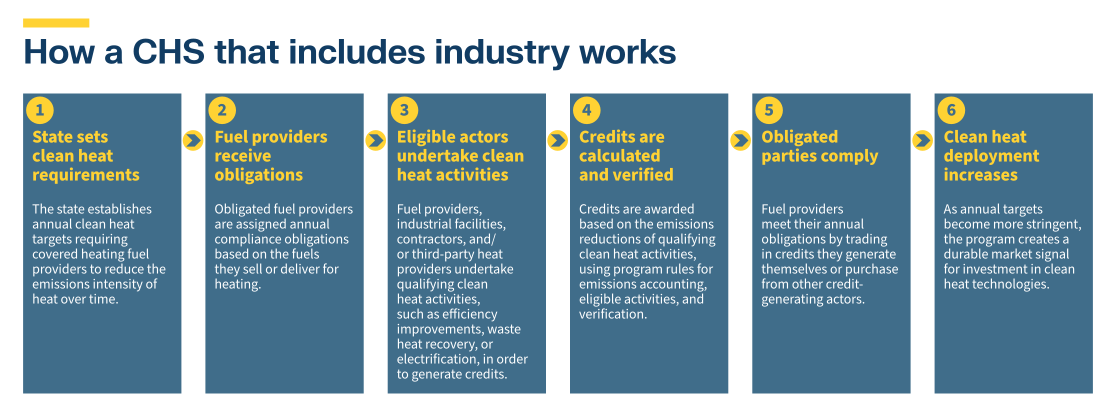
A CHS is akin to other well-established programs like a renewable portfolio standard (RPS) and low carbon fuel standard (LCFS), which are similarly target-based and require regulated entities to increase deployment of lower-emissions technologies or resources over time, sometimes with a tradeable credit option.
The authority to implement a CHS is consistent with states’ historic use of environmental regulations that apply to fuels sold within state boundaries, which can be applied to both regulated utilities and private fuel suppliers. While many analogous energy policies (e.g., RPS, energy efficiency standards) are implemented through regulated utilities, there is also a strong precedent for state policies that place compliance obligations directly on fuel suppliers or private companies (e.g., renewable fuel blending mandates, LCFS, and cap-and-trade programs).
Historically, state CHS policies have been largely considered within the context of the fuel used to heat residential and commercial buildings. Extending a CHS to the industrial sector allows a state to support deployment of modern industrial heating technologies that can also improve local air quality and public health and reduce carbon emissions. Depending on CHS policy design, it may also provide an opportunity for industrial facilities to generate revenue through their actions to reduce the carbon intensity of their heat-related emissions. This is especially important for first mover industries transitioning to clean technology to maintain competitiveness or achieve other economic benefits. There are several design options for policymakers and regulators to consider when including industry in a CHS.
Policy Design and Implementation Considerations
CHS policies and approaches will differ state-to-state but can include a range of design choices and parameters. There are four major design features of a CHS: obligated parties, baseline emissions calculations, clean heat targets, and compliance rules. Policymakers will have to make additional design choices beyond these features and can do so in conjunction with these features, including whether and how to tailor a CHS structure to meet the unique needs of their state, its economic sectors, and its energy ratepayers.1
This section describes the most relevant decisions and considerations for each design feature.
Obligated parties
The obligated party is the entity responsible for providing clean heat and retiring clean heat credits in line with the annual obligations set out by the CHS rulemaking. The obligated party must be defined at the outset of the policy but can change over time to accommodate changes in clean heat resources, customers, and market share.
Key policymaker design decisions
1. Obligated fuel providers
In the United States, fuels used for heat across industry, residential, and commercial buildings include natural gas (59%), petroleum products (e.g., fuel oils, propane, kerosene, gasoline) (33%), coal (5%), and wood (3%) (Exhibit 2).
Exhibit 2
Policymakers should consider which fuels are used for heat in their state and who their end users are when determining which fuel providers to obligate. The amount of fuels used for energy — most of which is used for heat generation — varies across states and across heating end-use sectors (Exhibit 3).
Exhibit 3
Policymakers must also consider the types of fuel providers operating in their state. Fuel providers differ across fuel types. Natural gas typically comes from both utilities and third-party or non-utility energy companies (see Utility-Only Obligation Considerations) and is delivered to customers by pipelines. The remaining heating fuels, called delivered fuels, include petroleum products, coal, and wood. These are typically delivered by truck or rail and supplied by a range of private fuel companies, from small local businesses to large national providers.
Deciding which suppliers to obligate is a crucial determinant of the scope of the CHS and its potential impact to spur market transition to clean heat. This decision also affects where the costs of the program fall. To mitigate unfair distribution of costs to ratepayers, policymakers can build in ratepayer protections to the policy. These can include measures like requiring a portion of CHS credits to come from efforts that benefit low-income ratepayers or setting higher credit values for projects that benefit these ratepayers. States can also implement complementary policies like a clean heat production tax credit to drive down operating costs of clean heat projects, and execute utility reforms to increase use of non-pipeline solutions and decouple utility profits from capital investments.
A CHS program like Colorado’s obligates only large gas utilities; other proposed program designs (e.g., Maryland, Vermont) obligate any entity that sells fuel for use as heat within state boundaries. The decision to only obligate utilities allows for a policy that is not market-based. This option is discussed in the Utility-Only Obligation Considerations box below. The remainder of this document centers on CHS programs that obligate all fuel providers and include a credit market.
Exhibit 4
Baseline emissions calculations
Implementing a CHS requires calculation of baseline thermal emissions in order to determine the volume of emissions that can be addressed by the policy. This baseline is determined through calculation of the total fuel delivered for heat in the state by the obligated parties in a certain year. For example, this could be the first year of policy enactment or the year used for an emissions inventory baseline. When setting a baseline, policymakers must decide which sectors should be included.
Key policymaker design decisions
1. End-use sectors included in the baseline
Since most state CHS proposals to date have focused on the building sector, their baselines only address emissions from buildings (e.g., Maryland). One way for policymakers to incorporate industry within a CHS is to add it to the baseline. For example, Vermont’s proposed CHS includes heating fuel delivered to all end consumers, including industry.
2. Industrial subsectors included in the baseline
Clean heat technologies are generally more commercially mature and cost-effective for low- and medium-temperature industrial heat applications (operating under 400°C) than for high-temperature applications. Low- and medium-temperature heat demand is common in sectors such as food and beverage, textiles, pulp and paper, consumer goods manufacturing, and some chemicals manufacturing, while high-temperature heat is often required in other sectors like refining, steel, cement, and other chemical manufacturing.
Policymakers could limit the baseline to relevant industrial subsectors with access to mature and readily available clean heat technologies, providing greater design flexibility and reducing system costs. Doing so would reduce the share of industrial emissions addressed by the policy and could limit incentives for innovative approaches to emissions reductions in hard-to-abate industries requiring high-temperature heat. One option to balance inclusiveness and policy efficacy with cost implications is to set staggered or differentiated clean heat targets for different fuel types or end uses, as further described in Clean heat targets.
Exhibit 5
Exhibit 6
Clean heat targets
The CHS sets annual obligations (or clean heat targets) that each obligated party must meet by trading in an equivalent number of credits (see Compliance rules below). Credits are awarded based on the emissions reduction of eligible clean heat projects. Obligations are usually based on an obligated party’s percentage contribution to baseline emissions, with future obligation values set according to the program’s overall emissions reduction trajectory.
Obligations and credits are typically measured in terms of greenhouse gas (GHG) emissions reduced. For example, one clean heat credit is the equivalent of 1 metric ton (MT) CO2e of emissions reductions under Vermont’s CHS proposal.
Key policymaker design decisions
1. Long-term emissions reduction target
The target end point of a CHS, in total tons of CO2e reduced (or clean heat provided) should be designed according to what is technically and economically feasible, based on current and expected clean heat technologies over the time horizon of the policy, and also with the intent to send a long-term market signal. If a state already has GHG emissions reduction targets and those targets align with the potential for clean heat technology adoption, they can also act as a starting point when designing the CHS targets.
A CHS can also authorize a state entity like the public utilities commission (PUC) or energy or environmental agency to assess the CHS on a regular cadence based on the cost-effectiveness of providing clean heat resources and adjust based on real-world market conditions and developments. Vermont’s CHS proposal, for example, directed the state’s PUC to establish a 10-year forward schedule for clean heat credit requirements, updated every three years based on actual emissions reductions and market conditions.
2. Combined and differentiated targets and trajectories for end-use sectors
Combining targets and trajectories for all sectors can expand the size of the credit market and number of credit generating activities, which improves the effectiveness of the market and simplifies compliance for obligated parties. However, keeping obligations separate allows for more tailored design and support for each sector and helps ensure meaningful progress across multiple sectors rather than relying on the market to concentrate on the lowest cost interventions.
Using US national fuel consumption averages as an example, if residential fuel consumption accounts for 24% of statewide consumption, commercial for 20%, and industrial for 55%, policymakers have a choice in whether annual obligations match those percentages (or their equivalent state breakdown) or if obligations can be met through an open market across end users to develop the cheapest possible clean heat interventions.
Separating annual targets and trajectories between sectors may also have impacts on the credit market. Policymakers must decide whether credits generated in one sector can be used to comply with another sector’s obligation (see Compliance rules for more details). A key consideration is the relative scale of heat demand and therefore potential credit generation across sectors.
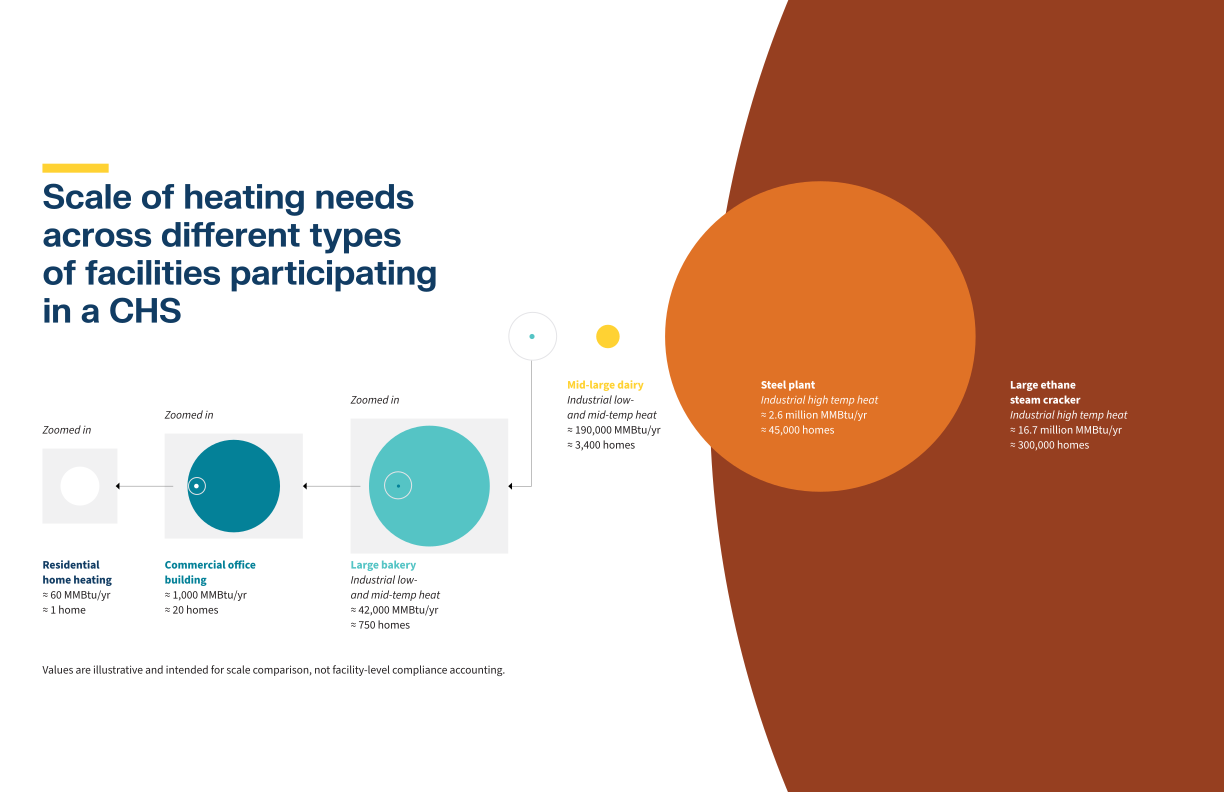
As shown in Exhibit 7 below, a single large industrial facility may generate significantly more credits than a residential home. Therefore, in a combined credit market, a single large industrial clean heat project could create enough credits to dominate the credit supply and potentially impact the scale of emissions reductions across sectors.
Exhibit 7
Scale of heating needs across different types of facilities participating in a CHS
3. Target timeline
To provide adequate market signals to increase the supply of clean heat resources, a CHS would need to be both ambitious and long-term, with interim targets. Example trajectories are modeled in Exhibit 8 below.
Although a linear trajectory can create a predictable annual compliance path, the obligation rate does not need to remain constant across the policy’s lifetime. For industry, it may be appropriate for annual obligations to increase more gradually in the policy’s initial years and then ramp up more aggressively in later years as clean heat technologies — particularly for heavy, high-temperature industrial processes — become more widely available at lower costs.
This increase can be achieved through the slow ramp up or staggered phase-in trajectories shown in Exhibit 8. The more gradual approach mimics the approach of other industrial emissions reduction policies like emissions-intensive, trade exposed credit allowances and compliance schedules under Washington’s cap-and-invest program, which enables companies to comply in the short term while planning for more significant investments in the long term.
Exhibit 8
Illustrative approaches to designing a CHS emissions trajectory. Note: All approaches reach the same end target of 80% emission reduction by 2050 and start with representative baseline emissions of 10 million tons.
Compliance rules
Under a CHS, obligated parties achieve compliance with annual clean heat targets by trading in a number of credits equivalent to their obligations. Obligated parties generate credits, which are awarded to them by the state, by undertaking eligible measures to reduce emissions under the CHS. The credit value of a measure is determined by the emissions reduction attributable to the measure. For example, if an obligated party were required to reduce emissions by 1 MT CO2e in a given year, and each credit was worth 1 MT CO2e, the entity would have to trade in 1 credit to satisfy its annual obligation. Policymakers have several options for determining how credits are generated and how annual compliance is achieved.
Design decisions around credit-generating activities, eligible entities, and credit calculations have significant impacts on the total cost and effectiveness of the policy. In general, greater flexibility and more options for generating credits increases market competition and can lower program costs. However, a set of activities and entities that is too broad can dilute the impact and incentives needed for deep decarbonization.
Key policymaker design decisions
1. Credit-generating parties
A key benefit of the CHS is the potential for many entities to participate in generating credits. These entities could include fuel providers, industrial facilities, contractors, or heat-as-a-service companies (third-party providers that own and operate heating equipment while selling heat at a set price to industrial offtakers).
2. Credit-generating activities
Most activities that reduce the emissions generated per unit of heat should be included as credit-generating activities. These include activities that improve the efficiency of heat production such as waste heat recovery and steam system optimization, as well as fuel switching or electrification technologies such as electric boilers, thermal energy storage, and industrial heat pumps.
3. Activity guardrails
Certain activities can be subject to limits or changing eligibility over time to ensure they do not overtake the credit market, are adopted in alignment with state policy priorities, and contribute to meaningful emissions reductions. This is especially relevant for the question of whether fuel switching from fossil fuels to alternate fuels like renewable natural gas, hydrogen, or others should be credit-generating. If policymakers opt to allow the use of alternate fuels under the CHS, guardrails can include requiring life-cycle accounting of GHG emissions from biofuels receiving the credit, accounting for methane leaks in the gas system, and barring credit-generation eligibility for biofuel use where that use is known to cause other environmental or social harms.
4. Industrial credit-generating activities when industrial heat is not included in program baselines
Allowing industrial clean heat actions to generate credits and obligated parties to use those credits to meet their annual obligations, even if industrial heat is not part of baseline calculations, allows obligated parties the flexibility to generate and retire credits across all their heating customers. It would also allow industrial facilities to voluntarily undertake clean heat projects and generate revenue from the sale of clean heat credits to obligated parties for their compliance. This revenue could help offset an industrial facility’s costs from switching to clean heat. This decision may have implications for other sectors.
In particular, large industrial facilities may have more capacity (e.g., staff, expertise, or funding) to voluntarily undertake large-scale clean heat projects than smaller-scale facilities or actors in the industrial or other sectors, concentrating credit generation to a narrow set of industrial actors. For example, a large facility with low- or medium-temperature needs may be able to deploy market-ready technologies, like an industrial heat pump, that generate a large volume of clean heat credits at a lower cost per ton of CO2e reduced compared to many smaller projects in the same or other sectors.
In a market-based system that favors the lowest-cost credit-generating activities, careful consideration would need to be made to ensure clean heat benefits are being equitably distributed.
5. Credit retirements with sector-specific targets
If there are separate annual clean heat targets for each sector (e.g., residential, commercial, industrial), policymakers must decide which credits can be retired to meet the individual targets. If credits cannot be applied across sectors, for example, the clean heat credits retired to meet annual obligations in each sector would need to come from that same sector (e.g., industrial heat pump credits can be used to meet industrial obligations, but not residential). While separating the clean heat targets can allow for more targeted support, it does add complexity to the administration of the policy and may have different cost implications compared to a combined obligation and marketplace.
6. Credits per activity
In general, the number of credits granted for each qualifying activity under the CHS should be directly proportional to the tons of CO2e reduced by the activity or volume of clean heat provided. Other questions policymakers will have to consider include:
- Are upstream emissions included or does the system boundary only include on-site emissions? For example, are emissions from the generation of electricity and methane leakage in natural gas supply chains included? For example, utilities filing clean heat plans under Colorado’s CHS must reduce emissions from distribution leakage and end-use combustion of gas. Under Vermont’s CHS proposal, however, annual compliance obligations would be set based on life-cycle CO2e emission reductions.
- How are credits for long-lived measures like heat pumps calculated? For example, do credits generated across 10 years of a heat pump installation apply in year 1 or every year? Under Vermont’s CHS proposal, credits would have been given for each year of the expected life of an installed measure. The value of the credits would be equal to the annual avoided life-cycle CO2e emissions of the fuel use due to installation of the measure, minus the life-cycle emissions of the fuel that is used instead in that year.
- Will early action credits be awarded? Early action credits are those generated in a set number of years before the CHS takes place that can be then used toward obligations once the standard is live. Maryland is considering the option for early action credits, a common lever used in other standards like RPS.
- Are credits bankable? Similar to early action credits, policymakers can decide if credits generated in a compliance year can be banked and used toward obligations in a future compliance year.
Implementing Entities
A variety of decision makers and entities can be involved in the design and implementation of an industrial CHS. The appropriate implementing entity or entities for a CHS will depend in part on whether the program applies only to regulated utilities, applies uniformly to both regulated utilities and other types of fuel providers (delivered fuel providers and non-utility natural gas providers), or splits oversight between utility regulators (e.g., a PUC) and environmental regulators (e.g., a state environment or air quality agency).
A unified program can support consistent reporting, crediting, and compliance rules across fuels, while a utility-only or split-jurisdiction approach may require additional coordination to avoid uneven treatment of fuels or customers.
| Venue | Potential role |
|---|---|
| Legislature |
|
| PUC |
|
| State Agencies and Other Regulators |
|
Real-World Examples
Some states have already enacted, have previously worked to enact, or are in the process of developing a CHS.
Colorado
The first CHS in the United States was implemented in Colorado in 2021. The Colorado CHS requires gas distribution utilities with more than 90,000 retail customers to submit a clean heat plan (CHP) to the Colorado PUC outlining how they will reduce emissions by 4% by 2025, 22% by 2030, and 41% by 2035. Utilities must fulfill these emissions reductions requirements while ensuring costs passed through to customers remain below 2.5% of their annual bills. A variety of measures are allowed for compliance, including energy efficiency programs, recovered methane use, and heat pump deployment.
Colorado’s CHS design differs from others in that it does not involve any credit trading and only applies to utilities, not other fuel providers. Baselines include CO2 emissions from the combustion of gas from residential, commercial, and industrial customers, although industrial customers are included only if their gas use is part of an obligated utility’s baseline, which includes retail customers only. Transport customers and customers who report their GHG emissions to the US Environmental Protection Agency are excluded.2
Furthermore, the emissions reduction targets set by the PUC apply to the obligated utility without delineation of what sector emissions reductions must come from. While Colorado’s Clean Heat Plan may be easier to implement because it avoids credits and focuses solely on regulated utilities, it does leave out other heating fuels and lacks the flexibility of a credit market. Atmos Energy Corporation and Xcel Energy have already filed CHPs that have been approved by the PUC. Black Hills Energy is currently seeking approval for its CHP initially filed in 2023.
Vermont
In 2023, the Vermont legislature passed legislation to establish a CHS, requiring the PUC to develop a proposal for the program. This program would be a credit-based CHS to reduce emissions across the entire thermal sector, including residential, commercial, and industrial heating applications. Emissions reduction targets under the program would be 26% below 2005 GHG levels by 2025, 40% below 1990 GHG levels by 2030, and 80% below 1990 levels by 2050, in accordance with statewide emissions reductions targets.
The industrial sector would be included in the CHS baseline. Obligated parties under the CHS would be regulated natural gas utilities serving customers in Vermont, entities importing heating fuels for ultimate consumption in Vermont, and entities that produce or process heating fuel within Vermont for ultimate consumption in Vermont. The PUC would be required to establish an initial 10-year forward schedule for clean heat credit requirements, updated every three years.
Credits generated under the program would be based on life-cycle CO2e emissions reductions. Credit-eligible measures include a variety of actions such as thermal energy efficiency improvements, heat pump installations, and installation of electric appliances with thermal end uses. Renewable natural gas use would be permitted, with some qualifications. The law also set carbon intensity thresholds that fuels would have to meet in order for their use to be credit eligible.
The state legislature did not vote to approve the PUC’s CHS proposal after the PUC expressed concerns with high costs and administrative complexity of the program, effectively stalling the proposal indefinitely.
Massachusetts
Massachusetts finalized the draft framework of a buildings-only CHS in 2023 for proposed implementation in 2026. Emissions reduction trajectories under the framework follow a linear path, with statewide emissions reductions increasing by 1 million MT of GHG emissions each year from 2026 through 2050. Under the draft framework, retail sellers of natural gas, heating oil, propane, and electricity would be obligated parties. Obligations for electricity sellers would be set based on existing building electrification programs in early years and increase over time. Obligations for other covered entities would be based on their reported emissions. The framework also details a requirement to complete a specified number of residential electrification projects each year.
Any clean heat meeting CHS requirements would count toward obligations under the program, even if that project is supported by other programs, like federal tax credits. Compliance would be demonstrated using clean heat credits. There would be two types of credits: full electrification credits (tied to the electrification requirement) and emission reduction credits.
In December 2025, the Massachusetts Department of Environment delayed implementation until 2028, claiming further analysis is needed on heating fuels and affordability trends.
Maryland
In 2024, Maryland Governor Wes Moore signed an executive order directing the Maryland Department of the Environment (MDE) to propose a CHS for buildings that would expand the state’s Renewable Portfolio Standard to the thermal sector. The order places this proposal in the context of state agency efforts to implement the state’s Climate Pollution Reduction Plan, which includes strategies for meeting state targets of a 60% reduction in statewide GHG emissions by 2030 and net zero by 2045.
At the end of 2025, MDE received final approval for the Heating Fuel Provider Reporting Program, which began collecting data in 2026. The Reporting Program collects relevant data from fuel providers across all types and end-use sectors to inform CHS design. The design of the CHS is ongoing through 2027 with the goal for implementation in 2028. Though program design details have not been released, Maryland’s CHS is expected to have a credit market, with heating fuel providers as the obligated parties. Separately, the Regulatory Assistance Project released a report in 2023 with several suggestions for a Maryland CHS program design.
Conclusion
A CHS for industry allows states to support first movers in industry to modernize their facilities and adopt lower-emissions heating technologies while maintaining competitiveness. By creating a durable policy signal, a CHS can reduce the cost and risk of early clean heat investment, support industrial facilities wishing to make changes before their peers, help position in-state manufacturers to compete in markets valuing lower-carbon products, and improve public health outcomes tied to industrial emissions. As states design these programs, they can tailor obligations, crediting rules, and sector coverage to encourage early action while preserving flexibility for the diverse needs of industrial facilities and CHS-covered obligated parties.
Additional contributors: Ankur Dass and Drew Veysey.
Endnotes
- In 2024, the Regulatory Assistance Project (RAP) and Energy Futures Group (EFG) published separate extensive reports on CHS design. RAP’s report is titled Clean Heat Standards Handbook (2024), and EFG’s is A Comparison of Clean Heat Standards: Current Progress and Key Elements (2024). Although these reports are not focused on a CHS for industry, they do contain additional information on a CHS that readers can review for more details on this policy. ↩
- Colorado separately regulates its largest industrial facilities’ greenhouse gas emissions directly through the Greenhouse Gas Emissions and Energy Management for Manufacturing (GEMM) 1 and 2 rules, rather than including them in the CHS. ↩



Related Insights




Help build the clean energy future. Donate today.
Independent research. Real-world solutions. Supported by donors.
RMI can pursue the highest-impact climate and energy solutions because we’re supported by people who believe change is possible. Every gift helps advance the work needed to make clean energy the default choice worldwide.
For other ways to give to RMI, including checks or gifts of stock, please visit Other Ways to Give.