

Learn how we are working to transform how we use and produce energy.
EVs Are Coming to Island Nations. What Happens When They Retire?
Battery waste disposal challenges in small island states and emerging solutions
Why we share this work for free
RMI is an independent nonprofit working to accelerate the clean energy transition. We publish research like this to inform decision-makers and drive real-world impact.
Our work is supported by philanthropy as well as partnerships, including fee-for-service engagements. This support makes it possible for us to share our independent insights for free.
If you find this work valuable, you can support it anytime.
Get more insights like this
Stay up to date with the latest research, analysis, and tools from RMI by opting in to receive occasional emails below. You’ll get new reports, event invitations, and practical insights to help us all accelerate the clean energy transition.
Loading form...
Your download should start automatically. If it doesn’t, click the download button below.
This work is made possible by philanthropy
RMI is a nonprofit supported by donors and partners. Philanthropy enables us to produce independent research and make resources like this freely available.
If you find this report valuable, please consider supporting our work. You can also explore how we partner with organizations to drive impact.
Jump to Section
Electric vehicle adoption is accelerating worldwide, with one of every four cars sold globally in 2025 being electric. Recent hikes in fossil fuel prices have also made lower-cost EV ownership more attractive to car owners, boosting sales even more over the past few months. This trend is expected to continue, with an estimated 28% of all new cars sold to be EVs this year, and the global EV fleet projected to grow more than sixfold by 2035.
Based on these adoption figures, an estimated 1.2 million EV batteries could reach end-of-life (EOL) by 2030, rising to 14 million by 2040. Improper disposal of these batteries releases toxic chemicals, creates fire hazards, and poses other environmental and safety risks. This makes safe, responsible EOL battery waste management crucial.
For remote regions like small island nations, both the cost and the need for effective EOL EV battery waste management are heightened. Although island nations greatly benefit by reducing reliance on oil imports through renewable energy deployment and greater EV ownership, they face unique challenges in managing used batteries. These challenges include logistical difficulties and heightened environmental safety concerns stemming from their unique geographies.
However, developing an EOL EV battery management strategy around battery collection, logistics, and recycling infrastructure can put island nations on the path to success. The good news is that the solutions needed already exist — the challenge is making these solutions accessible to remote regions and adapting them to the unique realities of island geographies.
As EV adoption accelerates, the decisions made today will determine whether end-of-life batteries become a hazard or a valuable resource. Understanding the key challenges and building blocks of an effective battery management system is the first step toward creating a safer, cleaner, and more circular EV ecosystem.
As EV adoption accelerates, the decisions made today will determine whether end-of-life batteries become a hazard or a valuable resource.
A system designed for scale meets small markets
Handling batteries at EOL involves collecting, processing, and transporting batteries to a centralized location for downstream activities such as reuse and repurposing, or mechanical shredding as the first step of recycling. Large Lithium-ion (Li-ion) batteries used in EVs are typically removed at dealerships or dismantlers and then packaged and transported to a recycler’s location, where their health is assessed for second-life use or recycling.
Replicating this model in island nations is challenging due to space constraints for processing these batteries locally and the lack of a specialized workforce needed to handle these new technologies. There is also a complex and evolving web of regulations across agencies and markets that govern battery shipment to other regions, and the inherent disadvantage of a small market size, which hampers business models that rely on scale. The diversity of battery formats further complicates these issues — each type of battery requires specialized tools, training, and instructions for safe handling.
Specialized workforce needs for EOL EV battery handling
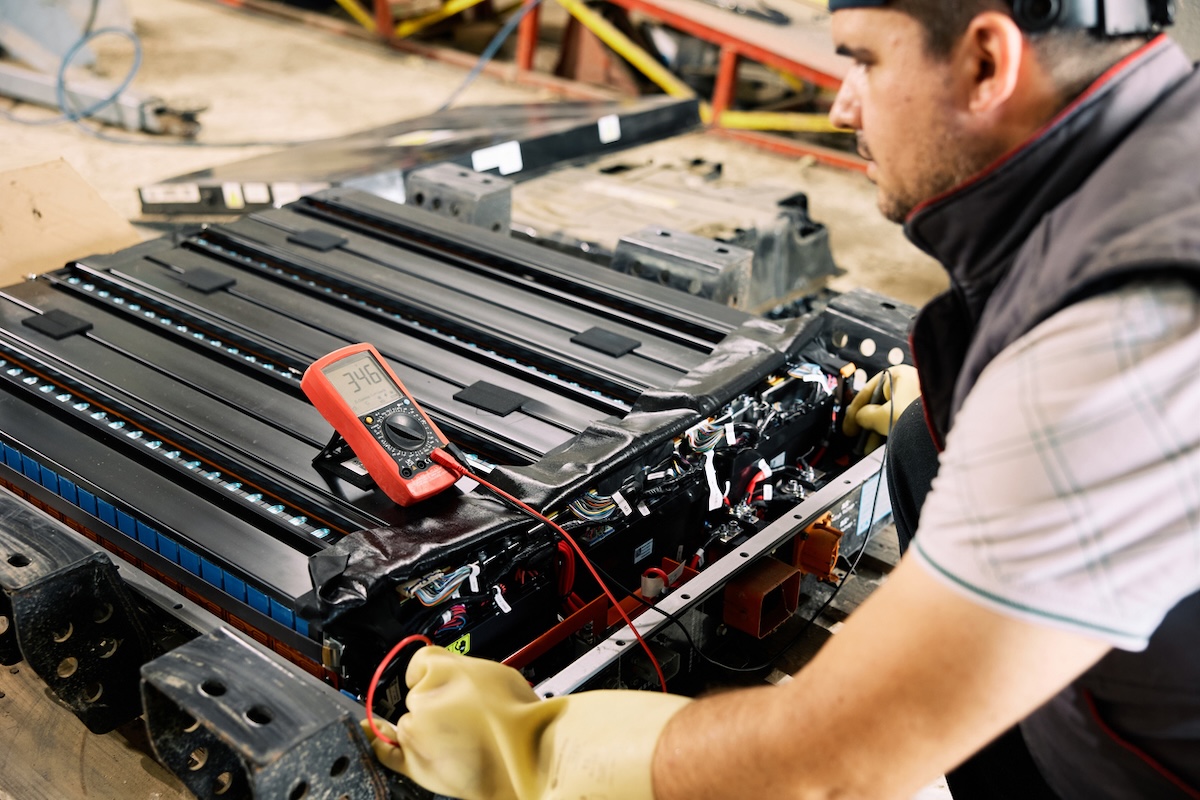
Li-ion batteries have become ubiquitous in modern life: powering devices from phones to EVs and utility-scale energy storage. Larger Li-ion batteries, such as those used in the latter, are heavy, high-voltage systems. These attributes make specialized training, tools, and personal protective equipment essential for safe removal from vehicles. Testing and further dismantling of the battery may be necessary for transportation and re-use or repurposing, which requires technical knowledge of design and safe discharge procedures, as well as access to diagnostic data and tools.
In large markets such as North America, Europe, and major Asian countries, access to essential information, services, tools, and training for EOL EV battery management is more readily available, largely due to the presence of a robust manufacturing base and well-established technical service networks. For instance, in North America, auto dealerships as well as organizations such as the Automotive Recyclers Association and the Recycled Materials Association have built a comprehensive network of technical service providers specializing in auto dismantling, salvage, and recycling. These networks facilitate the safe and efficient management of EOL batteries through established infrastructure and processes, supported by a technical workforce equipped with specialized EV training.
In contrast, island regions often lack the specialized technical networks and service providers found in larger markets. This is a familiar challenge for island governments, who are often already responsible for managing complex waste streams such as retired vehicles, electronic waste, used tires, and hazardous materials in the absence of robust private-sector recycling and disposal networks. With growing EV adoption, EOL EV battery waste may be an additional waste stream to be managed by the appropriate government agencies.
To address these gaps, governments must invest in capacity-building initiatives that upskill the existing workforce, such as leveraging the technical expertise of local auto dealers for broader support in battery handling. Additionally, it may be necessary to engage external services to support logistics and dismantling needs. Building local capacity is essential to ensuring the safe and responsible management of EV battery waste in these locations.
Regulatory and logistical challenges in transporting EV battery waste
While engaging external battery service providers to dismantle and export battery waste may seem simpler than developing local capability in resource-constrained geographies, it is fraught with complexities arising from an intricate, evolving network of regulatory and market requirements designed to ensure compliance and safety. Once discharged, dismantled, and properly packaged, the batteries may be transported from an island to a designated repurposing or recycling facility located on the nearest landmass. This journey involves both land and marine transport, each governed by its own set of regulations (air transport of used batteries is subject to certain restrictions and generally avoided).
Addressing these requirements often means consulting with industry experts familiar with regulations established by international and importing country regulatory agencies. While specific requirements vary by destination, island nations are likely to export batteries to larger processing hubs in countries such as the United States, China, or Europe, necessitating compliance with multiple regulatory frameworks. For example, the marine shipment of EV batteries is regulated by the International Maritime Organization (IMO) under the International Maritime Dangerous Goods (IMDG) Code, while the transfer of Li-ion batteries across borders is governed by the Basel Convention.
Because transportation costs are a significant consideration, islands will likely seek to export batteries to the nearest neighbor with battery management infrastructure. For many Caribbean islands, this destination may be the United States. Importing used batteries into the United States requires Coast Guard approval and adherence to guidelines specified by the US Pipeline and Hazardous Materials Safety Administration.
Once on land, transportation of used or waste batteries is regulated by the US Department of Transportation under Title 49 of the Code of Federal Regulations (CFR) 173. These batteries must also meet classification requirements set by the US Environmental Protection Agency, which mandates that waste batteries be managed as “universal waste.” Taken together, these codes and guidelines establish the minimum standards for packaging and labeling.
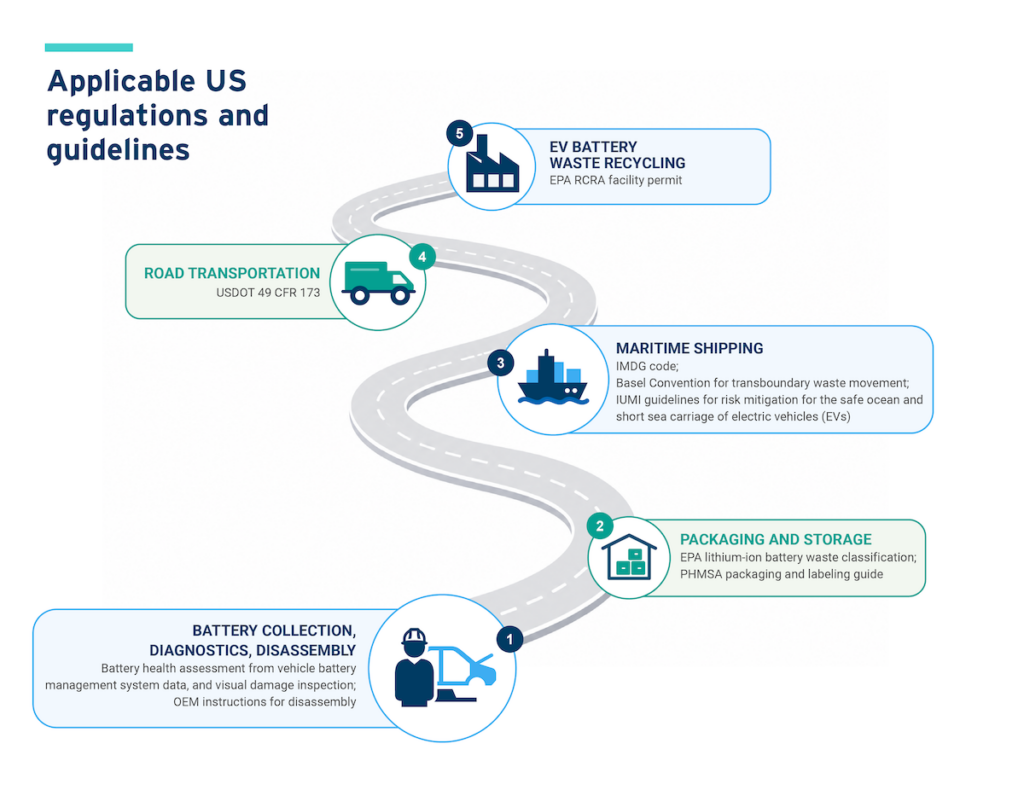
However, important gaps remain between regulatory requirements and industry best practices. In reality, operational guidance on safety and proper handling of batteries is often found in automaker training manuals and industry group recommendations. For example, the International Union of Marine Insurers provides best practice recommendations for handling, stowing, and incident response to mitigate risks. Such practical guidelines help bridge the gap between regulatory compliance and operational safety.
Small scale, bigger problems
Developing an EOL EV battery management strategy for island states demands extensive planning, capacity building, and financial resources. These challenges are intensified by their small geographic size and remote location, which prevent these states from benefiting from economies of scale or the competitiveness benefits available in larger markets.
One potential solution is shredding EV batteries prior to transportation, which eliminates flammable components and preserves valuable critical minerals and other byproducts as a powdered mixture, thereby simplifying storage, handling, and transport. However, the shredding equipment currently available is designed to process several thousand metric tons of batteries — far exceeding the modest quantities currently received at most island waste facilities. As a result, while shredding may be considered a practical option in the future with greater EV adoption and more batteries reaching the end of their life cycle, it is not applicable at the current scale.
A lighthouse in the Atlantic: Bermuda is leading the way to EOL battery waste management for islands
Facing many of the challenges outlined above, the Government of Bermuda has begun proactively planning for island-specific battery waste management solutions. By understanding their waste-disposal environment, assessing the scale of expected battery retirements, and engaging with local stakeholders, the government is using local insights to develop a comprehensive national EV waste strategy that includes shipping EOL batteries to the United States in the near term while waste volumes are low, and in parallel, developing on-island shredding facilities to economically process battery waste as volumes increase over the next decade.
Insights from Bermuda’s Solid Waste Department and local industry stakeholders, such as automotive dealers and importers, brought into sharp relief a gap in the safe and effective storage and disposal of retired EV batteries in Bermuda, highlighting the need for an off-island battery recycling solution.
Through active engagement with local and external stakeholders, experts, innovators, and service providers, a comprehensive needs and capacity assessment, and scenario planning, RMI is supporting the development of a set of battery recycling pathways tailored to Bermuda’s current and future EV battery waste disposal needs. These pathways explore investment in a local shredding facility to ensure readiness for rising battery volumes in the coming decade, while identifying off-island export and safe storage facilities as the near-term economic option. This approach has demonstrated how meaningful engagement and data-driven strategy can uncover both immediate and future pathways for EOL EV battery management, while also tracking technology developments as they mature and commercialize, keeping the door open for investing in better solutions at the right time.
Bermuda’s practical and collaborative approach serves as a lighthouse for other remote or island regions facing similar hurdles, including limited scale, logistical complexity, and technical capacity. As more islands confront these challenges, Bermuda’s phased strategy — adapting to short-term solutions while remaining agile enough to adopt emerging technologies in the future — may serve as a model to learn from. In an electrified future, collective demand across disparate island geographies can foster the development and commercialization of island-specific solutions, ultimately strengthening the global network for responsible EOL EV battery waste management.
The authors would like to thank E.J. Klock-McCook for his contributions to this article.


Related Insights
Building Charging Networks That Meet Drivers’ Needs Without Breaking the Bank

Help build the clean energy future. Donate today.
Independent research. Real-world solutions. Supported by donors.
RMI can pursue the highest-impact climate and energy solutions because we’re supported by people who believe change is possible. Every gift helps advance the work needed to make clean energy the default choice worldwide.
For other ways to give to RMI, including checks or gifts of stock, please visit Other Ways to Give.
