

Learn how we are working to transform how we use and produce energy.
Developing Nigeria’s EV infrastructure
How policy and finance can help Nigeria build reliable EV infrastructure
Why we share this work for free
RMI is an independent nonprofit working to accelerate the clean energy transition. We publish research like this to inform decision-makers and drive real-world impact.
Our work is supported by philanthropy as well as partnerships, including fee-for-service engagements. This support makes it possible for us to share our independent insights for free.
If you find this work valuable, you can support it anytime.
Get more insights like this
Stay up to date with the latest research, analysis, and tools from RMI by opting in to receive occasional emails below. You’ll get new reports, event invitations, and practical insights to help us all accelerate the clean energy transition.
Loading form...
Your download should start automatically. If it doesn’t, click the download button below.
This work is made possible by philanthropy
RMI is a nonprofit supported by donors and partners. Philanthropy enables us to produce independent research and make resources like this freely available.
If you find this report valuable, please consider supporting our work. You can also explore how we partner with organizations to drive impact.
Jump to Section
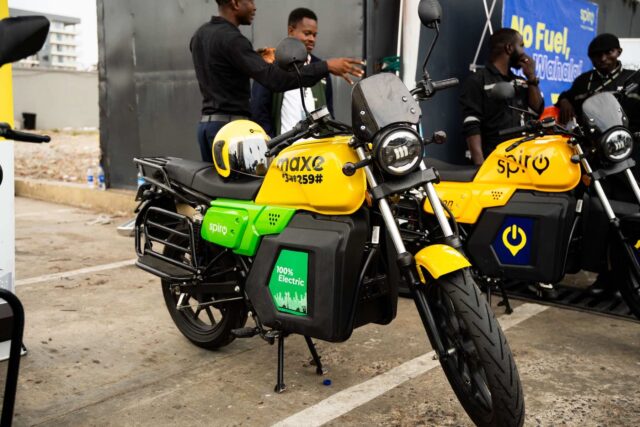
Nigeria’s electric vehicle (EV) market is still in its early stages, but it is growing, and reliable charging infrastructure will be essential to further its expansion. The country had an estimated 20,000 EVs by the end of 2025, with early adoption concentrated in two- and three-wheelers, commercial fleets, ride-hailing vehicles, and other high-utilization segments. Battery swapping is expanding, and some operators are already pairing charging sites with solar and battery storage to improve reliability where grid service is weak.
Nigeria’s EV market can move from early deployment to scale by honing targeted policy, stakeholder coordination, charging infrastructure, and finance in place, This report models two adoption pathways: a business-as-usual case that still requires a steady build-out of charging and swapping sites, reaching about 1500 installations by 2040 and 24,000 by 2060; and an optimistic case in which stronger policy support, faster infrastructure deployment, and deeper market uptake raise that requirement to about 35,000 sites by 2040 and 207,000 by 2060. In both scenarios, battery-swapping stations will account for most of the early build-out, while plug-in charging for all vehicles will expand as commercial four-wheelers and other vehicle segments grow.
This report proposes a policy-led approach in which the policy package centers on the EV charging roadmap, tariffs, land access, permitting, standards, and coordination across institutions, while finance closes the remaining commercial gap through demand aggregation, viability-gap support, risk-sharing instruments, and project finance for assets with an operating record.
Implementation will require coordinated action from government agencies, electricity regulators and distribution companies, state institutions, and financiers. Key actors include the Presidential Initiative on CNG and EV (Pi-CNG & EV), Nigerian Electricity Regulatory Commission (NERC), state electricity regulators, National Automotive Design and Development Council (NADDC), Standards Organization of Nigeria (SON), the Nigerian Electricity Management Services Agency (NEMSA), electricity distribution companies (DisCos), state transport and public-private partnership institutions, and financiers each covering a different part of the deployment chain. Collectively, these institutional and financing actors can create the conditions for moving charging infrastructure to bankable deployment at scale.
Acknowledgements
RMI would like to thank David I. David of the Clean Technology Hub and Umar Muhammed of the Nigerian Electricity Regulatory Commission for their contributions to this report.
Authors

Monkgogi Buzwani
Associate
Kelly Carlin
Manager
Samhita Shiledar
Principal
Ridwan Zubair
AssociateRelated Insights

Building Charging Networks That Meet Drivers’ Needs Without Breaking the Bank
Help build the clean energy future. Donate today.
Independent research. Real-world solutions. Supported by donors.
RMI can pursue the highest-impact climate and energy solutions because we’re supported by people who believe change is possible. Every gift helps advance the work needed to make clean energy the default choice worldwide.
For other ways to give to RMI, including checks or gifts of stock, please visit Other Ways to Give.
