

Learn how we are working to transform how we use and produce energy.
Making US Critical Mineral Refining Projects Investable
How innovation, bankable demand, and risk sharing can unlock domestic refining capacity
Why we share this work for free
RMI is an independent nonprofit working to accelerate the clean energy transition. We publish research like this to inform decision-makers and drive real-world impact.
Our work is supported by philanthropy as well as partnerships, including fee-for-service engagements. This support makes it possible for us to share our independent insights for free.
If you find this work valuable, you can support it anytime.
Get more insights like this
Stay up to date with the latest research, analysis, and tools from RMI by opting in to receive occasional emails below. You’ll get new reports, event invitations, and practical insights to help us all accelerate the clean energy transition.
Loading form...
Your download should start automatically. If it doesn’t, click the download button below.
This work is made possible by philanthropy
RMI is a nonprofit supported by donors and partners. Philanthropy enables us to produce independent research and make resources like this freely available.
If you find this report valuable, please consider supporting our work. You can also explore how we partner with organizations to drive impact.
Jump to Section
Batteries, semiconductors, motors, and the energy systems that power them underpin the modern economy — from consumer electronics and vehicles to the electric grid and defense systems. The minerals that enable these technologies are therefore increasingly viewed through an economic and national security lens, particularly as refining and processing remain highly concentrated geographically.
The United States is taking significant steps to diversify critical mineral supply chains and expand domestic refining. Policy helps create the enabling conditions, while producers must deliver competitive supply, buyers must provide credible demand, and financiers must be able to underwrite the resulting cash flows. Without coordination across these actors, the US risks supporting individual projects without creating a competitive domestic ecosystem.
Exhibit 1: Ecosystem actors and their roles in building a competitive domestic mineral refining sector
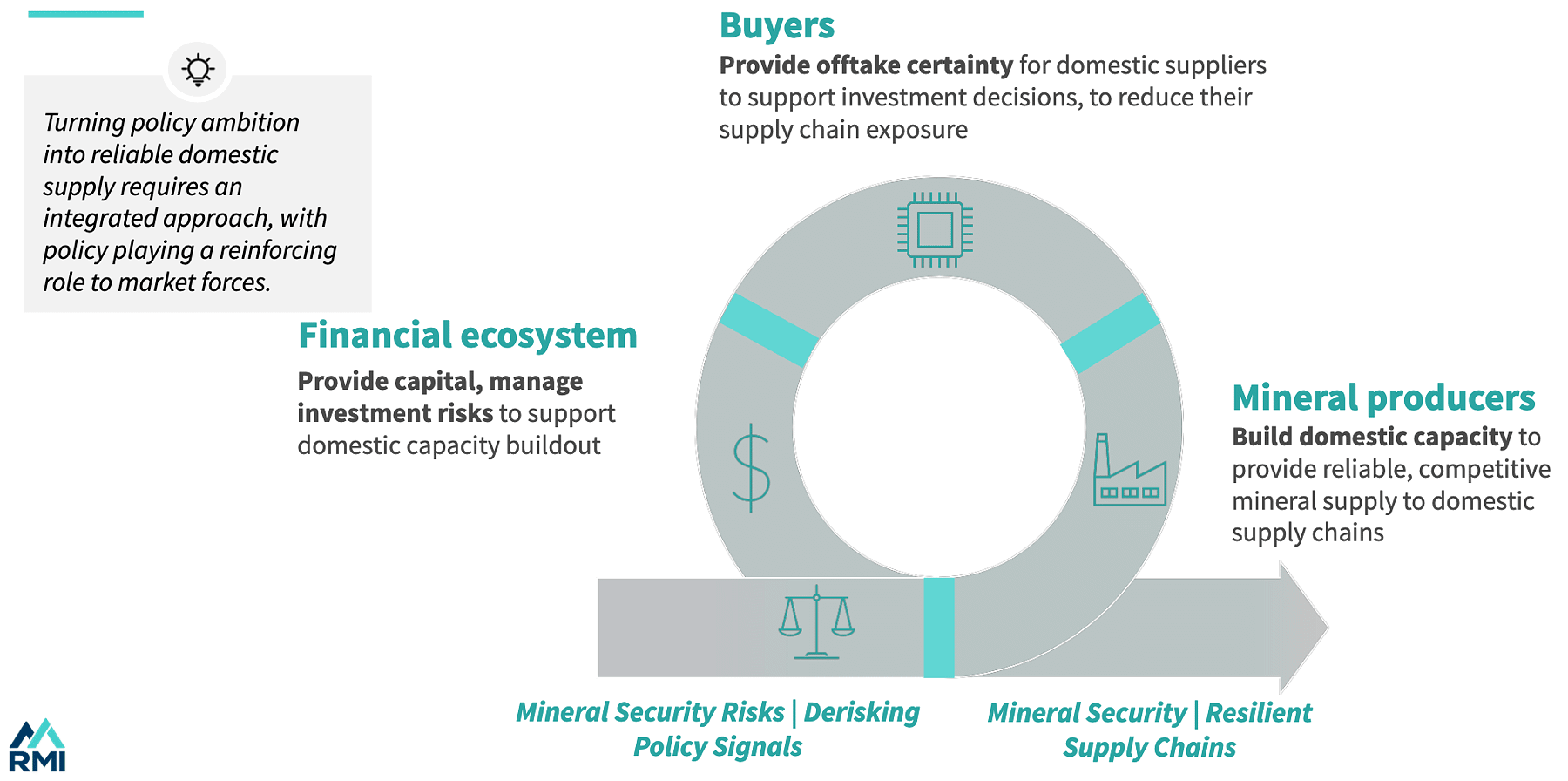
The challenge is particularly acute for new refining projects. Domestic entrants must compete with established producers while navigating technology, feedstock, infrastructure, permitting, workforce, financing, and market risks. US policy is increasingly moving toward more targeted interventions — including trade measures, price support, equity deals, domestic manufacturing incentives, and partnerships — but these measures do not by themselves answer a fundamental question: Will a new refinery generate sufficiently predictable cash flows to attract capital?
That question is becoming more immediate in battery recycling. In August 2026, the US Bureau of Industry and Security introduced new restrictions on exports of black mass, a recycled intermediate containing recoverable battery minerals. Much of the black mass generated from battery manufacturing scrap and end-of-life lithium-ion batteries has historically been exported to Asia for recovery, while the United States has limited domestic refining capacity for these feedstocks. Restricting exports could create a stronger domestic supply opportunity, but utilizing that feedstock will require investment in processing capacity that can compete economically with established overseas facilities.
The same challenge extends across the broader set of critical minerals needed for batteries, semiconductors, motors, and energy infrastructure.
While these questions cut across critical mineral markets — from rare earths and gallium to copper, aluminum, and battery minerals — this article uses battery recycling as an illustrative case to examine them in greater depth. The combination of growing domestic feedstock, emerging refining technologies, concentrated overseas processing, and rapidly evolving policy provides a useful lens to examine the broader challenge: how to turn the strategic value of diversified mineral supply into projects that can attract investment. We then draw out where these lessons apply and where different market structures require different approaches across other critical minerals.
Different Minerals, Different Strategies
The United States is one of the world’s largest markets for the technologies and infrastructure that underpin an increasingly electrified economy. This creates substantial potential demand for domestic refining. But critical minerals differ sharply in market size, growth potential, supply concentration, processing technology, and market dynamics. The investment strategy therefore cannot be one-size-fits-all.
Exhibit 2
At one end are smaller-volume minerals such as gallium and rare earth elements. These materials are critical inputs to semiconductors, permanent magnets, and other advanced technologies, so disruptions in relatively small mineral markets can affect much larger downstream industries. A United States Geological Survey report notes emerging rare earths processing capacity, and no existing capacity for producing gallium. Their small market size and susceptibility to supply-demand imbalances and price volatility can make them difficult propositions for conventional commodity suppliers. Diversifying these supply chains may therefore require targeted interventions that create demand certainty, including strategic offtake, stockpiling, and partnerships with allied producing countries. Given their relatively small volumes, price support mechanisms could be an efficient risk-sharing mechanism as well.
At the other end are high volume, heavily traded commodities such as copper, aluminum, and nickel. These markets can attract substantial private capital, but thin margins and intense global competition create a different challenge. Despite an established domestic processing base, the United States remains more than 40% reliant on imports for these commodities. New projects often start at a structural cost disadvantage: capital costs for nickel and copper refining projects are roughly 70 percent higher outside the dominant producing regions — Indonesia and China, respectively — while new graphite projects can face capital costs up to 150% higher. Higher energy, labor and other operating costs can widen this gap further, while incumbent producers benefit from existing infrastructure, economies of scale, integrated supply chains, and large domestic markets.
For markets of this scale, government procurement or stockpiling interventions would be inefficient. Interventions should nominally aim to narrow structural cost disadvantages and create market conditions in which domestic producers can compete at commercial scale. In cases where price distortions result as a consequence of regional subsidies or state-backed financing, trade measures such as anti-dumping and countervailing duties or Section 232 tariffs could be leveraged to support the competitiveness of domestic producers for certain commodities like copper and nickel.
Between these extremes are fast-growing commodities such as lithium, cobalt, graphite, and silicon, where expanding demand from batteries, semiconductors, power electronics, and other advanced technologies creates a growing addressable market for private investment. The United States has limited processing capacity for these minerals and remains highly reliant on imports of battery- and semiconductor-grade refined products. Export controls and concentrated supply chains increase the risks of disruption, creating space for new technologies and entrants to challenge incumbent processes. But rapid changes in technology and manufacturing processes, combined with commodity-price volatility, can make the investment case challenging. New entrants must also compete with highly concentrated incumbent refining ecosystems on cost, product quality, scale, utilization, technology access, and workforce capabilities. These markets therefore offer significant opportunities for commercially driven diversification — but only if new projects can overcome both cost and execution disadvantages.
Diversification strategies must therefore simultaneously improve the competitiveness of new supply and strengthen resilience without imposing costs that undermine the competitiveness of downstream products. Innovation can narrow the competitiveness gap, while stronger buyer demand signals can improve bankability. Financing and targeted public risk-sharing can then address risks that emerging producers cannot efficiently carry themselves. Scaling these markets therefore requires coordinated action across producers, buyers, investors, and policymakers rather than one single intervention.
Battery recycling provides a useful example of this investment challenge. It can supply four of these fast-growing materials — lithium, nickel, cobalt, and graphite. The United States exported more than 100,000 tons of black mass in 2025, illustrating the gap between domestic battery preprocessing and downstream refining capacity. Recent restrictions on black-mass exports increases the need for investing into domestic capacity capable of processing it economically.
The capital requirement is substantial. A US black-mass refinery processing 25,000 tons per year (equivalent to processing 13 GWh or about 160,000 EV battery packs) could require roughly $160–$690 million in capital investments, depending on the technology. By 2035, US recycling volumes could require 220,000 tons per year of refining capacity; after accounting for 74,000 tons of annual operating and under-construction capacity, the remaining gap could require roughly six additional facilities totaling between $1 and $4 billion in investment. And because some emerging refining processes can handle both recycled and mined feedstocks, the potential investment opportunity extends beyond battery recycling alone.
Leapfrog innovations can close competitiveness and investment gaps
Emerging refining technologies are addressing the cost disadvantage by lowering capital and operating costs, reducing the scale required for commercial operation, and allowing facilities to process a wider range of feedstocks. These advantages are particularly relevant for fast-growing minerals such as battery materials and rare earth elements, where new entrants are not necessarily locked into the technologies and facility designs used by incumbent producers.
Exhibit 3
The significance of these innovations goes beyond lowering the cost of an individual facility. Smaller, modular projects can reduce the amount of capital committed before technology, feedstock, and demand are fully proven, while feedstock flexibility can improve utilization. But even a lower cost refinery needs credible, long-term offtake agreements in order to attract private capital. Where downstream manufacturing capacity is limited — as remains the case for parts of the US battery-materials value chain — domestic refiners may need export markets to secure long-term demand. Nth Cycle’s 10-year $1 billion offtake agreement with Trafigura, a global commodity group, illustrates one pathway for providing that revenue certainty.
Black mass refining to recover battery minerals provides a particularly visible example of the investment challenge, but the underlying bankability problem extends well beyond recycling. While rare earth separation, gallium refining, copper processing, and other midstream projects face different technologies and market structures, they also face a common challenge: overcoming cost and project risks while securing sufficient feedstock and long-term revenue to attract capital. Across these markets, that investment case depends not only on reducing the cost of domestic supply, but also on recognizing the value that more resilient supply creates downstream.
Cheap Imports Can Carry Hidden Costs
Lower-cost imports can be attractive to downstream buyers when sourcing decisions are made primarily on unit price. Consider a buyer choosing between an imported material and a domestic alternative carrying a 20% premium. The imported material may appear to be the obvious choice — until a trade restriction, supply disruption, compliance requirement, or other shock erodes those initial savings.
These hidden costs of supply-chain exposure mean the true cost advantage of imports can be smaller than the headline price suggests. Import dependence can create financial exposure through disrupted production, price volatility, additional inventory and working-capital requirements, compliance costs, and project delays. These costs may be difficult to observe during normal market conditions but become material when concentrated supply chains are disrupted.
Supply Disruption and Trade Exposure
Supply disruptions can put much larger downstream value at risk. In 2025, the suspension and subsequent quota system on cobalt exports from the Democratic Republic of the Congo contributed to a sharp increase in cobalt prices. More recently, rare earth export controls constrained supplies of critical materials and magnets, contributing to production cuts and temporary shutdowns among some automakers. The IEA estimates that full export controls on rare earth minerals could put approximately $6.5 trillion in annual downstream economic output at risk.
Financing Impact
Supply chain uncertainty can also raise financing costs. The US Energy Information Administration’s 2026 Annual Energy Outlook, for example, applies a three-percentage-point increase to both debt and equity cost modeling for clean energy and storage projects facing uncertainty over tax credit eligibility. For developers, a higher cost of capital increases required returns and can weaken project economics and bid competitiveness.
Compliance and Procurement Costs
To take advantage of tax credits worth billions across planned projects, US clean energy projects must increasingly trace component costs, ownership, and sourcing to demonstrate compliance with Prohibited Foreign Entity requirements. These requirements can affect supplier selection, procurement schedules, inventory strategies, and even ownership structures — raising the overall costs of demonstrating compliance.
For buyers, the relevant comparison therefore is the total cost of secure supply: the delivered material cost plus the expected financial exposure associated with disruption, trade policy, compliance, and other supply-chain risks. A domestic source can therefore carry some price premium and still make economic sense if it reduces exposure across a much larger downstream value chain. For example, analysis of EU battery recycled-content requirements suggests that even a 50% premium on recycled materials could increase total battery cell production costs by less than 2%.
These supply chain dynamics reveal a fundamental market coordination problem: refiners bear much of the cost and risk of creating resilient supply, while much of its value accrues downstream to buyers. Exhibit 4 shows how that gap can be narrowed. Innovation can lower domestic production costs; stronger buyer commitments can translate the value of resilience into revenue; and targeted price support can protect against commodity price downside. Together, these levers can move domestic refining closer to an investable proposition — connecting the value buyers place on secure supply with the revenues producers need to build it.
Exhibit 4
Buyers’ role in creating the market
Downstream buyers capture much of the value of a more resilient supply chain, and their procurement decisions can help translate that value into investment in new domestic capacity. For refiners, the strength of the demand signal matters as much as the existence of demand. Investors need confidence that customers will purchase sufficient volumes for long enough to support the economics of a new facility. Buyers can strengthen that signal further through take-or-pay commitments or longer contract tenors — effectively sharing some of the risk required to bring new supply online.
Relying on individual bilateral agreements has limitations. A large buyer may be able to anchor one project, but coordinated demand from multiple buyers can demonstrate that a broader market exists. Aggregating prospective demand gives producers and investors greater visibility into the scale and durability of the opportunity and can support investment across multiple projects rather than relying on a handful of bespoke transactions.
This approach has precedent in other emerging commodity markets. RMI’s work in sustainable aviation fuel and steel has used aggregated buyer demand to demonstrate a market for lower-emissions products before supply exists at scale. In steel, for example, buyer commitments help translate corporate demand into procurement volumes that producers can use to support investment in new production capacity.
Critical minerals present a similar opportunity. Rather than waiting for competitive domestic supply to emerge before committing demand, downstream buyers could help create the conditions for that supply to scale — individually through stronger offtake contracts or collectively by making the scale of demand for resilient supply visible to producers and investors. Recent critical-mineral-related transactions provide early evidence of what these commitments look like in practice and how different buyers are sharing risk beyond simply agreeing to purchase material.
Exhibit 5
Buyers are playing an increasingly important role in supporting new US refining and processing capacity, but the strength of these commitments — and the risks buyers are willing to share — vary considerably. The deals reviewed point to four emerging trends:
Commercial offtake is providing volume certainty, but rarely a visible resilience premium
Most refining offtake agreements reviewed are market-linked or do not publicly disclose pricing. Instead of visibly paying a premium for domestic supply, buyers are primarily supporting projects through longer-term volume commitments, including take-or-pay structures that shift some demand risk from producers to buyers. For refiners and lenders, the principal value is greater revenue certainty rather than a guaranteed price premium.
Some buyers are putting capital behind the domestic supply they want to secure
Buyer support also extends beyond purchasing commitments. Some buyers are preparing for future material, taking strategic equity stakes, providing debt or project financing, and supporting working-capital needs. These structures allow buyers to help bring new capacity online while securing access to future supply.
Buyers are retaining protection against technology and product performance
Long-term offtake does not necessarily mean unconditional revenue. Agreements may condition volumes, pricing, or termination rights on product qualification, specifications, production milestones, or technology performance. These provisions protect buyers from execution risk but can limit how much revenue certainty an agreement provides to financiers before commercial performance is demonstrated.
Government support extends beyond the tools typically available to commercial buyers
The US government is leveraging a broader set of mechanisms, including strategic equity, procurement commitments, direct lending, and explicit price protection, sometimes within the same transaction. Unlike commercial buyers, government can use these tools to address strategic or commodity price risks that individual buyers may be unwilling or unable to absorb. However, the packages remain largely bespoke, with varying durability and impacts on project economics.
Price volatility and construction overruns can break projects
Strong offtake can reduce demand and revenue risk, but it does not protect a project from every source of downside. Two risks are particularly consequential for emerging critical mineral projects: commodity-price volatility can undermine operating economics after capacity is built, while construction overruns can prevent a project from reaching operations at all. Both require forms of risk sharing beyond conventional volume commitments.
Commodity price risk
Critical mineral prices can fluctuate sharply over the life of a refinery, materially changing revenues even when production volumes and customer demand remain secure. This creates a particular challenge where commercial offtake remains linked to prevailing commodity prices: a project can have a buyer and still become uneconomic when prices fall below sustainable production costs.
The 2025 MP Materials–US Department of Defense (DoD) partnership illustrates one approach to addressing this downside at the project level. DoD established a 10-year floor price of $110/kg for neodymium-praseodymium (NdPr) — roughly double the prevailing market price when the agreement was announced — covering NdPr content in qualifying MP products sold or stockpiled. Through a minimum revenue level, the structure aims to reduce MP’s exposure to commodity price downturns, provides greater cash flow certainty, and strengthens its ability to support debt.
But replicating bespoke government backed price floors beyond individual projects is difficult to scale. The more recent Serra Verde transaction illustrates the complexity: its support package combines long-term offtake and pricing support with a government-capitalized special-purpose vehicle, Defense Production Act forward purchases, US Development Finance Corporation financing, and warrants. Such risk-sharing structures can unlock strategically important projects but require substantial transaction-specific coordination , making it hard to replicate across the entire sector.
The emerging Forum on Resource Geostrategic Engagement (FORGE) seeks to address the same challenge at a broader market level. Rather than establishing a government-backed floor for an individual producer, the proposed framework would use reference price floors and adjustable tariffs across participating countries to limit competition from imports priced below agreed benchmarks. Illustratively, if a reference price similar to MP’s $110/kg NdPr floor were applied market-wide, imports priced below that level could face tariffs intended to restore the reference price within participating markets.
However, a reference price is not the same as guaranteed producer revenue. FORGE’s effectiveness for refiners and their financiers will depend on whether the framework ultimately creates sufficiently durable reference prices — and how buyers respond.
Construction cost overrun risk
Even when demand and pricing risks are addressed, a more immediate challenge remains: getting a facility through construction and into commercial operation without exhausting the developer’s capital. Recent US recycling projects demonstrate this challenge: Li-Cycle secured full offtake and backing from Glencore for mixed hydroxide precipitate (MHP) from its planned Rochester Hub, and access to a conditional DOE loan for the Rochester facility. Yet construction halted after projected costs increased sharply, from approximately $560 million to nearly $1 billion. Ascend Elements similarly entered bankruptcy protection with major customer agreements in place while its flagship Kentucky facility remained unfinished due to escalating costs. In both cases, customer demand existed; the challenge was financing and absorbing the cost of reaching operations.
Refining projects do not need entirely new financing mechanisms to address construction risk. Adjacent capital-intensive projects, such as the Sangdong tungsten mine and processing facility in South Korea, offer established precedents for allocating construction and execution risk across project participants beyond sponsors and lenders. In Sangdong mine’s case, alongside a long-term offtake and price-floor arrangement, a creditworthy offtaker, Plansee Group, also provided a $20 million cost-overrun guarantee and $9.8 million debt-reserve support for a $75 million project finance facility. The project demonstrated that low-cost senior debt can be paired with third-party completion and sponsors’ cost-overrun support for construction risk, rather than leaving project sponsors and lenders to bear that risk alone.
Exhibit 6: Allocating Construction, Revenue, and Credit Risk Across Project Partners
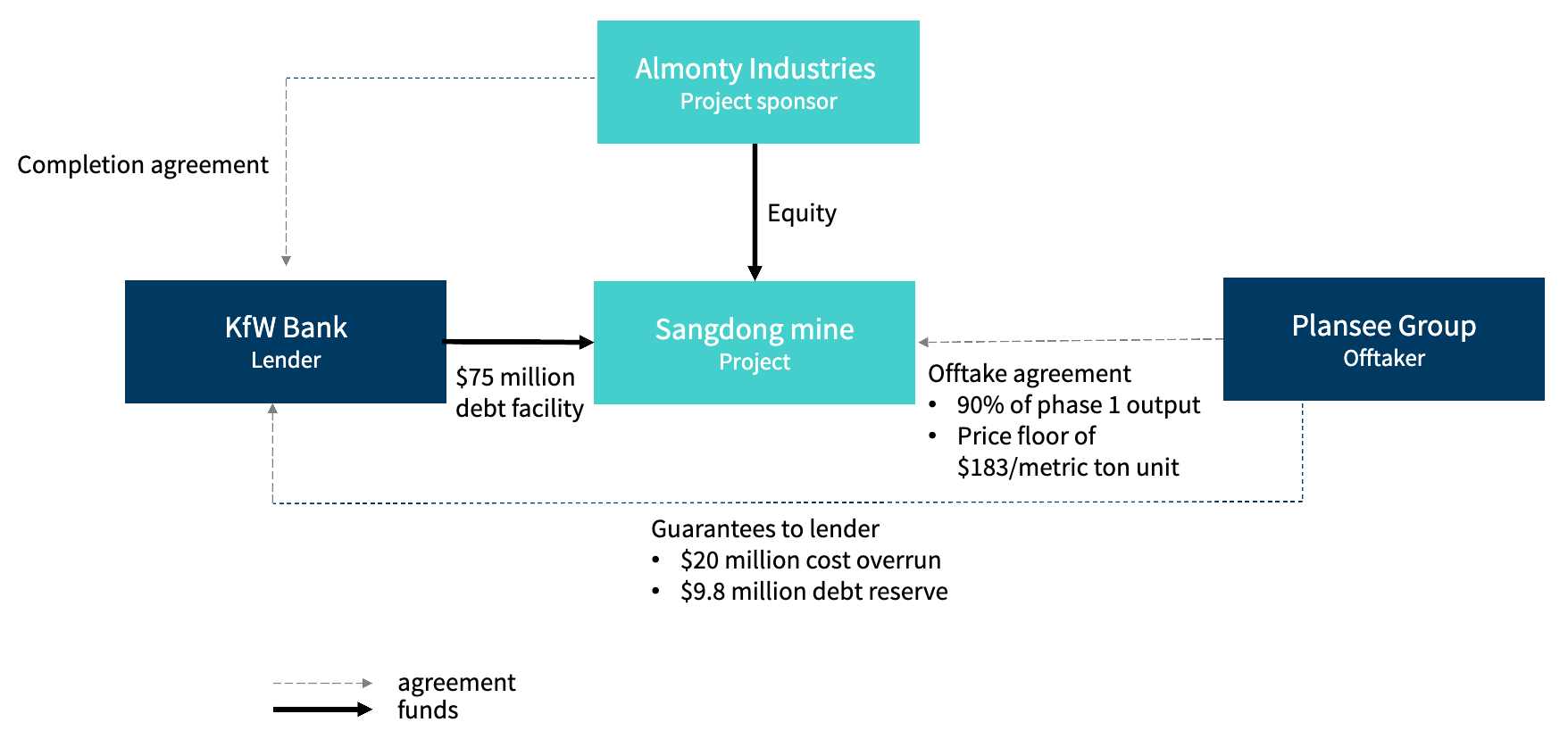
There is no single model for addressing construction and completion risks. The appropriate structure depends on each project’s technology, sponsor, counterparties, and operating environment. Construction and completion risk is routinely addressed through mechanisms such as cost overrun guarantees, contingency facilities, and completion support in other capital-intensive energy and infrastructure projects. Federal support can help address this gap, but existing structures may still leave project sponsors exposed to substantial risks: reimbursement-based awards require developers to incur costs before receiving funds, cost-share requirements leave sponsors responsible for significant capital, and loan drawdowns can depend on co-financing and construction milestones.
The broader lesson from successful capital-intensive projects is therefore that bankability often depends on assembling the right combination of risk-sharing mechanisms and counterparties for each project — and that deal-structuring role is traditionally played by leading investment banks.
Investible US mineral refining requires systems-level thinking
The examples throughout this analysis point to a broader lesson: domestic refining becomes more investable when interventions across the market reinforce one another. The United States has substantial momentum behind critical mineral supply chain diversification, but these efforts will deliver resilience only if technology, demand, finance, and policy develop as a connected system rather than as isolated interventions.
The appropriate model will differ across mineral markets. Strategic, minor minerals may require stronger public intervention, while larger, faster-growing markets offer greater scope for commercially driven solutions. Across both, however, the underlying challenge is similar. Innovation must narrow the cost and capital disadvantage of new domestic capacity; buyers must translate the value of secure supply into credible demand; and financing structures must allocate commodity, construction, and scale-up risks to the actors best able to manage them. Buyers, project sponsors, equipment providers, lenders, and public institutions can each absorb different portions of these risks, rather than leaving emerging refiners to carry risks their balance sheets cannot support.
This means innovation in how projects are financed and commercialized must accompany innovation in refining technology itself. Policy can reinforce this system by addressing strategic risks that commercial actors cannot efficiently absorb, but it cannot substitute for competitive project economics, credible customers, or effective risk allocation.
The opportunity is to move beyond supporting individual projects and toward creating a repeatable market model for resilient mineral supply — one that combines cost-reducing technology, bankable demand, fit-for-purpose financing, and targeted public support. Without that coordination, the United States risks supporting individual projects in the supply chain without creating the competitive domestic refining ecosystem needed for long-term mineral security.
The authors would like to thank Shravan Bhat for his contributions to this article.



Related Insights


Building Charging Networks That Meet Drivers’ Needs Without Breaking the Bank

Help build the clean energy future. Donate today.
Independent research. Real-world solutions. Supported by donors.
RMI can pursue the highest-impact climate and energy solutions because we’re supported by people who believe change is possible. Every gift helps advance the work needed to make clean energy the default choice worldwide.
For other ways to give to RMI, including checks or gifts of stock, please visit Other Ways to Give.
