

Learn how we are working to transform how we use and produce energy.
Rural Electric Co-ops and the Future of American Energy
How co-ops can translate America’s growing energy needs into lasting rural value
Why we share this work for free
RMI is an independent nonprofit working to accelerate the clean energy transition. We publish research like this to inform decision-makers and drive real-world impact.
Our work is supported by philanthropy as well as partnerships, including fee-for-service engagements. This support makes it possible for us to share our independent insights for free.
If you find this work valuable, you can support it anytime.
Get more insights like this
Stay up to date with the latest research, analysis, and tools from RMI by opting in to receive occasional emails below. You’ll get new reports, event invitations, and practical insights to help us all accelerate the clean energy transition.
Loading form...
Your download should start automatically. If it doesn’t, click the download button below.
This work is made possible by philanthropy
RMI is a nonprofit supported by donors and partners. Philanthropy enables us to produce independent research and make resources like this freely available.
If you find this report valuable, please consider supporting our work. You can also explore how we partner with organizations to drive impact.
Jump to Section
Rural electric cooperatives (co-ops) can play a significant role in shaping successful deployment of the energy infrastructure that will power an American economy that is demanding more electricity. As nonprofit utilities owned and governed by the members they serve, co-ops are deeply rooted in many rural communities. Yet they are sometimes overlooked in national energy conversations. In 2024, they served just 15% of US utility electricity sales. However, future power plants will be concentrated in rural places, and RMI analysis finds that 41% of the wind and solar projected to be built through 2035 will be on land served by a co-op.
Yet projected deployment does not mean actual deployment: projects must navigate technical and economic constraints, permitting and land-use decisions, and community concerns. As the utilities that power much of rural America, co-ops can help bridge the gap between projected infrastructure and energy development that is shaped by and meets the needs of rural communities.
Co-ops deliver 15% of US utility electricity sales, yet their territories overlap with 41% of projected wind and solar development through 2035.
Source: RMI analysis, EIA, NLR ReEDS
The unique role of co-ops
US electricity consumption is rising for the first time in decades. According to the Energy Information Administration, wind, solar, and storage will meet much of this demand, accounting for 93% of capacity additions in 2026.
However, these clean energy projects often face pushback at the state and local level, and polling has found that rural Americans are more concerned about the local benefits and impacts of wind and solar projects than people in suburbs and cities. Local decision makers are receptive to the views of their communities, and local support for projects can depend on trusted relationships in addition to project economics. This is where co-ops can play a role: they have technical expertise, local accountability, and community relationships that uniquely position them to translate between system-wide energy goals and energy development that reflects local priorities and benefits rural economies.
RMI’s analysis captures where projected wind and solar will be built, regardless of who owns the project or uses its power. Co-ops (whether distribution co-ops or generation and transmission associations) may own or purchase power from some of these projects to serve rural members. In these cases, new wind and solar can help serve local load growth and potentially put downward pressure on rates.
Other utility-scale projects will connect to the transmission system and provide electricity to neighboring counties or states. Although these projects generate direct local economic benefits through tax revenue, land lease payments, and employment wages, host communities may still weigh these benefits against the local impacts of development.
Co-ops can serve as translators between the energy system and the communities they serve. This would build on roles some co-ops already play beyond electricity delivery, from supporting economic development and workforce initiatives to helping communities address broader infrastructure needs. Their technical expertise and local relationships can (1) connect energy development with local and regional economic opportunities, (2) help bring community priorities into state and local decisions about how energy infrastructure is planned and developed, and (3) help members understand the value and tradeoffs that development can bring.
- Economic development. Co-ops can leverage their longstanding relationships with local governments, businesses, and landowners to help communities better understand and capture the economic benefits associated with energy development. In South Carolina, Newberry Electric Cooperative and the South Carolina Power Team attracted a Samsung washing machine manufacturing facility to Newberry County. By working with state and local partners to secure a suitable building and relocate the existing tenant, the co-op and its economic development partners helped make the site viable for Samsung’s investment, bringing 950 jobs and $350 million in local investment to the community. This role also applies with renewable energy projects, although benefits can vary: some projects provide power to co-op members, while projects whose energy flows elsewhere also generate local benefits through tax revenue, land lease payments, and jobs.
- Local planning. Co-ops’ technical knowledge and local perspective can inform land-use and infrastructure planning. In Virginia, a representative from the Shenandoah Valley Electric Cooperative served on a county-wide Solar Ordinance Review Committee created to develop standards for new solar facilities. They worked alongside planning commissioners, community representatives, economic development officials, the Farm Bureau, and other stakeholders to discuss zoning and siting, natural resource protection, and economic considerations, and ultimately align projects with the community’s goals and priorities. While formal involvement in these processes is not a standard utility practice, these roles offer a promising way for co-ops to bring electric-system expertise and community perspectives into decisions about energy development.
- Member engagement and education. As member-governed utilities, co-ops’ have regular channels for communicating with their communities. Oklahoma Electric Cooperative’s (OEC) 250 kilowatt “Solar Garden,” originally an R&D project, became an educational platform when community members asked to learn more. Staff led tours for more than 1,000 visitors. As a follow-on project, OEC built a 2 megawatt solar park and learning center on school district land, whose land lease revenue offsets about 95% of the two local high schools’ annual electricity costs.
Sioux Valley Energy, a co-op operating in parts of South Dakota and Minnesota, responded to their community’s stated need for “boots on the ground” economic development support by expanding its community development team and meeting regularly with elected officials, business owners, and other stakeholders to help address issues such as workforce housing, childcare, and water access. As communities consider new wind and solar development, this kind of engagement can build trust and help co-ops better understand and represent their members’ priorities.
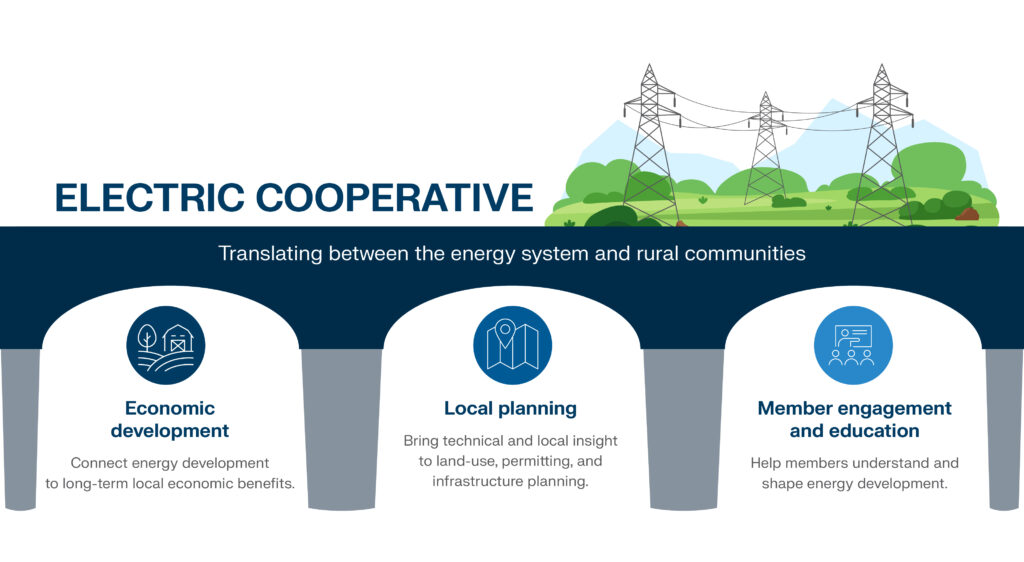
The co-op’s role as a translator is not about securing support for any particular project. Every co-op is different, and the extent to which co-ops take on this role will vary by local context. But co-ops across the country face an opportunity to help ensure that community priorities inform decision-making and that energy development creates lasting local value.
Co-ops are uniquely positioned to translate between system-wide energy goals and energy development that reflects local priorities and benefits rural economies.
Co-ops can help communities solve collective challenges
A co-ops’ foremost mission is to provide electric service for its members. But co-ops across the country have extended their role in response to the needs of the communities they serve. Co-ops build broadband networks, support economic development initiatives, partner on workforce development, and help communities pursue infrastructure and grant opportunities. In many places, they can be viewed not simply as electricity providers, but also as institutions that help communities solve collective challenges. Solving future energy challenges will depend on local coordination, trust, and community engagement, and co-ops are placed well to help guide deployment that works for their communities.
As America’s electricity demands grow, co-ops can serve as translators between system-wide needs and the priorities of their rural members. Their record as institutions that help communities solve collective challenges points to opportunities for co-ops to guide energy development in ways that support local economies, reflect community priorities, and strengthen member relationships.



Related Insights

States Are Opening the Door to Data Center Investment in Virtual Power Plants


Help build the clean energy future. Donate today.
Independent research. Real-world solutions. Supported by donors.
RMI can pursue the highest-impact climate and energy solutions because we’re supported by people who believe change is possible. Every gift helps advance the work needed to make clean energy the default choice worldwide.
For other ways to give to RMI, including checks or gifts of stock, please visit Other Ways to Give.
