

Learn how we are working to transform how we use and produce energy.
The Importance of Data Center Flexibility in Southeast Asia
Why we share this work for free
RMI is an independent nonprofit working to accelerate the clean energy transition. We publish research like this to inform decision-makers and drive real-world impact.
Our work is supported by philanthropy as well as partnerships, including fee-for-service engagements. This support makes it possible for us to share our independent insights for free.
If you find this work valuable, you can support it anytime.
Get more insights like this
Stay up to date with the latest research, analysis, and tools from RMI by opting in to receive occasional emails below. You’ll get new reports, event invitations, and practical insights to help us all accelerate the clean energy transition.
Loading form...
Your download should start automatically. If it doesn’t, click the download button below.
This work is made possible by philanthropy
RMI is a nonprofit supported by donors and partners. Philanthropy enables us to produce independent research and make resources like this freely available.
If you find this report valuable, please consider supporting our work. You can also explore how we partner with organizations to drive impact.
Jump to Section
Executive Summary
Southeast Asia is emerging as a hotspot for data center development, but the scale of growth is highly uncertain. Regional data center demand could quadruple by 2035, with Malaysia, Indonesia, Thailand, and the Philippines positioned as key growth markets. Malaysia has the largest near-term pipeline: projected new data center demand ranges from 1.1 GW to 7.7 GW by 2030 — posing significant uncertainty for a system with roughly 20 GW of peak demand today.
Meeting this uncertain growth using only traditional generation and grid buildout poses risks of stranded assets and increased costs to electricity customers. Data centers are large, concentrated, fast-ramping loads, and their actual utilization is often uncertain. These factors raise the risk that utilities overbuild long-lived infrastructure at a cost that is later socialized across customers.
Data center flexibility offers a low-regrets solution that can reduce costs and help utilities and regulators manage reliability, grid stability, and uncertainty challenges. Data centers can reduce or shift load during critical hours through workload orchestration, on-site batteries, backup systems, and geographic or temporal load shifting. Early pilots show this load shifting can be done without meaningful performance loss at the data center.
This brief presents high-level modeling on the value of data center flexibility in the Peninsular Malaysia system and finds that:
- A conventional assumption of 24/7 firm supply for data centers could drive major new gas and network investment. RMI’s analysis finds that by 2030 Peninsular Malaysia may need roughly 3 GW of new CCGT gas capacity and 2 GW of solar PV to serve ~5 GW of projected data center load.
- Data center flexibility could materially reduce system costs and support more clean energy integration. Looking at cases in 2030 where data centers provide peak shaving or load shifting, RMI found that data center flexibility can help defer up to 800 MW of gas investment, provide system cost savings ranging from ~$26–$75 per kilowatt (kW) of peak load reduced, and more than double solar capacity additions and generation. Deferring the need for long-lived capital investments with long lead times is critical to manage load growth uncertainty.
Power sector policymakers and regulators can turn data centers from a grid risk into a grid asset by acting early. Malaysia and other Southeast Asian markets can capture this opportunity by:
- Tightening large-load interconnection rules to reduce speculative requests and improve load transparency;
- Creating flexible interconnection agreements and large-load tariffs that reward data centers for peak shaving, load shifting, and emergency response; and
- Integrating data center flexibility into power system planning so it is optimized alongside bulk generation and transmission investments.
Introduction
Southeast Asia is expected to be a regional hotspot for data center development, with some estimates projecting data center demand to quadruple by 2035. Malaysia, Indonesia, Thailand, and the Philippines are emerging as key growth markets in the region, while Singapore — a more mature data center hub in the region — is expecting more modest growth (see Exhibit 1). Malaysia is seeing the highest growth in the region, with relatively low development costs and electricity tariffs and latency benefits from proximity to Singapore. Thailand and Indonesia offer similar advantages, as well as direct subsea cable access and massive, fast-growing digital economies. The Philippines is an emerging data center market with reduced regulatory hurdles and fiber-optic cable proximity, where localized grid impacts can be significant despite a smaller share of expected demand growth.
Exhibit 1: Projected data center demand in 2030 in select Southeast Asian countries
Note: Bars represent averages from a range of sources, including Wood Mackenzie, Boston Consulting Group, Mordor Intelligence, and Cushfield & Wakeman, while dashed bars represent the range of estimates across these sources. Cushfield & Wakeman estimates are limited to the largest data center hubs in each country and therefore may not be comprehensive.
This expected boom in data centers has the potential to reshape power sector planning in the region. Large markets such as the United States often dominate the discussion on data centers, where key issues such as interconnection delays, massive investments in new power capacity, rising electricity costs, and water usage are increasingly part of mainstream public discourse. While the absolute demand growth expected in Southeast Asia is smaller, countries such as Malaysia are expecting to see their power systems grow proportionally on par with some US states experiencing concentrated load growth, like Texas. At the same time, Southeast Asia sits at an inflection point in its data center growth, providing an opportunity to proactively get ahead of potential challenges other markets have experienced, while still capturing the economic benefits of data center development.
RMI will be releasing a series of briefs on how data center flexibility can shift these large loads from being a potential grid risk to a grid asset. This first brief explores why implementing and incentivizing data center flexibility is a low-regret near-term action for energy policymakers and regulators. Specifically, it covers:
- The potential power sector impacts of data centers in a Southeast Asia context;
- The technical potential for data center flexibility; and
- The potential benefits of data center flexibility in Southeast Asia, using Peninsular Malaysia as an example.
In subsequent work, RMI will dig deeper into quantifying the power sector benefits of data center flexibility and how different business models and regulatory tools can unlock it.
How Data Center Growth Could Affect Southeast Asia’s Power Systems
Data centers have the potential to support economic outcomes, including direct investment, increased tax revenues, improved digital sovereignty, and job creation. To help capture these benefits, several Southeast Asian governments are deploying fiscal, regulatory, and infrastructural strategies to position their nations as data center hubs. For example, Malaysia and Indonesia have implemented measures to reduce data center construction timelines and streamline permitting, establishing dedicated industrial parks close to Singapore’s border (in Johor and Batam and Bintan, respectively) with pre-zoned land plots already equipped with fiber-optic and water infrastructure. Thailand is also offering tax incentives and subsidies to reduce the cost of data center development, while also aiming to facilitate data centers’ access to clean energy via direct power purchase agreements (PPAs).
However, these economic objectives may be in tension with power sector goals of electricity reliability, affordability, and stability if data center load is not managed proactively. The rapid increase in data center load globally has surfaced key challenges related to 1) demand uncertainty, 2) resource adequacy, 3) grid stability, and 4) cost allocation (see Exhibit 2).
Exhibit 2
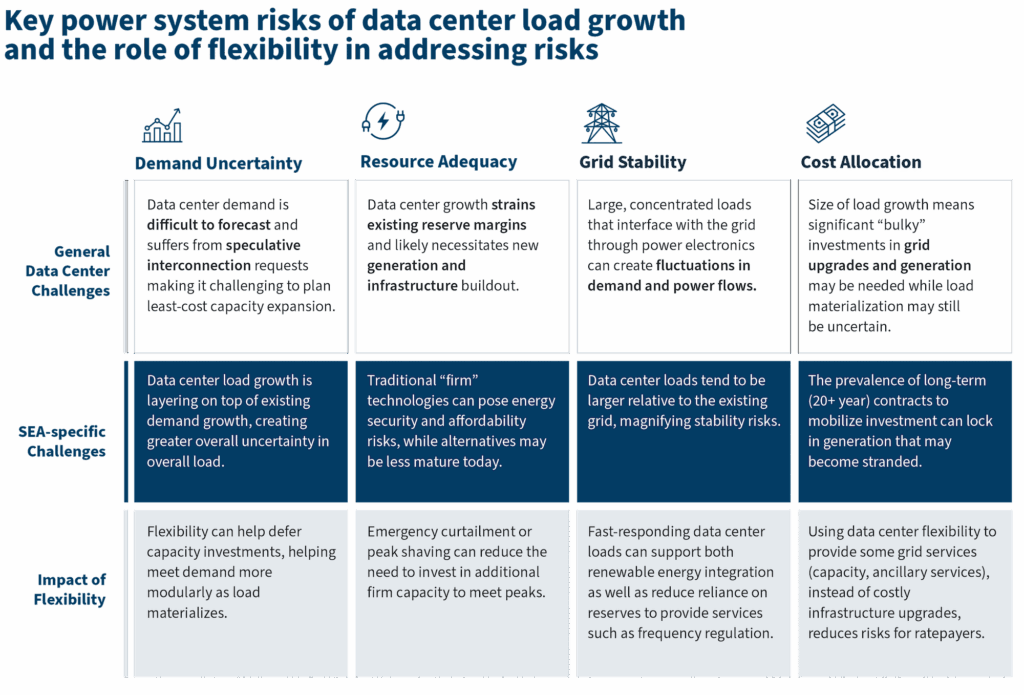
Although these challenges can emerge for any country facing load growth, data center load growth — combined with the unique context of Southeast Asian power systems — can magnify these issues. Unlike historical load growth, which has tended to be more gradual and distributed, data center load growth is rapid and arriving in large, discrete, and concentrated chunks. Meanwhile, power system planners in Southeast Asia are already grappling with load growth uncertainty from other economic sectors. Electricity systems in the region tend to be smaller and often less interconnected compared to other major data center markets, such as the United States or China, with more nascent ecosystems for renewable energy, battery energy storage systems (BESS), and other clean technologies.
This section explores how these dynamics are combining to create power system risks for the region, drawing on examples and an initial analysis in Malaysia.
While the broad challenges of data center load growth are universal, the relative importance of these challenges — and strategies to address them — will vary across markets in Southeast Asia. Data center load growth is showing up in different ways in each country’s unique energy context:
- Malaysia is experiencing a concentrated pipeline of hyperscale data center projects in strategic hotspots, where large loads are arriving faster than traditional utility planning cycles.
- In Thailand, existing headroom of the generation fleet provides an opportunity to strategically utilize existing capacity while leveraging data centers to support longer-term clean energy investment, integration, and transmission expansion.
- In Indonesia, the load growth challenge is intertwined with its long-term planning for geographically fragmented island grids.
- The Philippines will face a different set of constraints with relatively higher electricity costs amplifying affordability concerns alongside the need to manage system reliability.
1. Demand forecasting
Uncertain data center load forecasts must be layered on top of already uncertain demand projections in Southeast Asia, further complicating least-cost system planning.
Data centers can significantly increase the error bars on demand forecasts, given their size and concentration. Even prior to data center growth, countries across Southeast Asia have seen rapidly growing electricity demand, driven by population growth, economic expansion, cooling, and electrification.
Right-sizing investments to meet fast-growing demand has historically been challenging across the globe, with some countries either under- or overshooting target reserve margins, with the latter leading to temporary overcapacity.1 Data centers can exacerbate load forecasting challenges and overbuild risks, given both their scale and uncertainty. In Malaysia, for example, data center projections range from an additional 1.1–7.7 GW by 2030, creating significant uncertainty relative to its current ~20 GW peak system size today.
This uncertainty can be worsened through speculative interconnection requests.2 In Malaysia, less than half of contracted data center demand has materialized to date, due to low utilization and speculative applications, where developers may plan to expand the data center in phases, but apply for the full final capacity up front. This lack of load materialization can lead to underutilized or “stranded” assets, with costs that are then socialized among ratepayers who don’t accrue any of the benefits.
To address speculative requests, Malaysia and Thailand are considering measures to ensure data center developers take greater accountability for interconnection requests. In Malaysia, developers are now required to achieve 85% of their declared electricity usage within the first four years from the date of interconnection and to have requests verified by a Data Center Task Force. In Thailand, the regulator is in the process of rolling out a requirement for data center investors and developers to secure bank guarantees or collateral against power sector purchases. While such measures can reduce uncertainty driven by developer speculation, uncertainty on data centers’ final energy usage remains hard to eliminate.
Uncertainties in load forecasting make least cost expansion difficult, leading to off-cycle, fast track, or directly negotiated contracts for new capacity. Unlike the United States or Western European markets that had previously experienced stagnating electricity load growth for decades, Southeast Asian markets are better primed for meeting load increases in the face of uncertainty. However, data center buildout is often much quicker than other types of load growth and associated energy infrastructure buildout, leading to timing mismatches in power generation and pressure to build out centralized generation and transmission.
Historically, emergent demand in growth markets may have been met through fast-track procurement processes or direct contract negotiations. These processes have often favored certain types of technologies, whether due to offtaker familiarity, ability to secure financing, or more standardized permitting and approval processes. Given the rapidly evolving costs of solar, energy storage, and other technologies that may still be maturing in Southeast Asia, there is a risk that off-cycle capacity expansion leads to resource buildout that may not be optimal from a longer-term, least-cost planning and energy security perspective.
2. Resource adequacy
The speed, magnitude, and uncertainty of data center load growth can put pressure on resource adequacy margins and reserves, leading grid planners to prioritize investment in “firm” resources. Conventional firm resources may pose energy security and affordability risks in Southeast Asia.
Data center loads are typically considered to be 24/7 loads, drawing a stable amount of energy and requiring high reliability (i.e., firm supply). Compared to other industrial loads (which might have scheduled idle times and lower load factors), data centers tend to operate at higher continuous load factors (>80%).3 This presumed “flat” operating profile can have two implications for system planning: 1) a bias toward building more inflexible resources — designed to supply a stable output — to meet growing data center demand, and 2) a need for additional “peaking” capacity to ensure adequacy during peak energy events.
Without employing specific strategies to reduce the cost of meeting peak energy demands, Malaysia may add significant new gas capacity in the face of rising data center loads, creating energy security and affordability risks. Based on capacity expansion models run using TransitionZero’s Scenario Builder tool (see the Technical Appendix for details), data center load could result in an additional ~3 GW of gas generation, alongside an additional 2 GW of solar PV through 2030.4 Long-lived investments in generating capacity in Malaysia are often enabled through long-term PPAs. To be bankable, PPAs will typically have long tenors (20–25 years), receive take-or-pay capacity payments, and allow for fuel cost pass through. Fuel cost pass through can expose customers to global price volatility driven by imports, supply chain shortages, and geopolitical conflicts. While Malaysia is a producer and net exporter of natural gas today, significant capacity additions of gas could further risk Malaysia becoming a net importer of LNG.
Exhibit 3: Installed capacity and capacity additions and retirements by technology in 2030 in a scenario without and with projected data center load growth in Malaysia (GW).
Results data can be found at https://builder.transitionzero.org/solardataset902/flexibility-analysis-my-final/2050-s1-baseline-w-dc-copy-35
3. Grid stability
Data center loads’ relative size in Southeast Asia’s smaller grids can magnify grid stability issues.
Data center loads can potentially introduce rapid power fluctuations in a grid — much larger and faster than traditional industrial process loads. Large step changes in demand create more pronounced frequency deviations, requiring faster and larger balancing responses from generation resources. In Southeast Asia, the relative scale of a single data center is generally large compared to current power system sizes (see Exhibit 4 below for a comparison across key data center markets).5
In smaller, less interconnected systems, a single data center connection, disconnection, or ramp period can increase the need for operating reserves and fast-ramping generation, often met by gas generation or BESS given their dispatchability and fast response times, respectively. However, deploying resources to support frequency regulation can raise system operating costs and constrain the pace of large load integration.
Exhibit 4: Comparison of relative data center size in select power markets globally
Concentrated, fast-ramping loads can also cause significant voltage fluctuations, particularly in already-constrained transmission corridors. Utilities need to invest in transmission upgrades and dedicated grid-support technologies to avoid load curtailment and reduced power quality for customers. Offline trips, sudden demand reductions, and constant small fluctuations of a data center can have an outsized impact on system operations, creating broader reliability concerns. Since large loads account for a large proportion of demand in a single node, an unexpected interruption can create a sudden energy supply-demand imbalance that could trigger cascading operational responses and voltage excursions.
4. Cost allocation
In Malaysia, asset stranding and overinvestment would be especially costly for existing customers due to a potential heavy reliance on combined cycle gas to meet growing demand.
A strong reliance on combined cycle gas turbine (CCGT) plants to meet incoming data center load could amplify cost and lock-in risks for existing ratepayers. The typical PPA structures in Southeast Asia (typically long-term, take-or-pay capacity-based payments with fuel cost pass through) can create several challenges. First, capacity payments mean that plants are remunerated even if not dispatched, increasing costs for customers when load does not materialize. Second, CCGT plants are relatively inflexible, with longer start-up times and higher minimum stable loads compared to grid-forming battery energy storage and its demand-side equivalent power electronics in data center facilities. As a result, systems dominated by CCGT plants may start to see uneconomic dispatch of these assets and/or renewable energy curtailment (for example, a system operator may maintain minimum loads if a gas plant may be needed to meet evening peaks later). This can result in increased fuel costs in the near term and asset stranding in the longer term.
The stepwise buildout of traditional “firm” generating resources can also hinder power sector planners’ ability to phase in cheaper generation as it becomes available. Evidence from other markets has shown the potential of large, PPA-backed assets to slow the deployment of newer low-cost technologies in oversupplied markets. In Indonesia, for example, overestimation of demand forecasts led to an overbuild of coal capacity, with reserve margins in Java-Bali reaching 57% in 2022 and projected to remain between 40% and 60% for the next decade (against a 35% target). Much of this coal capacity is under long-term, take-or-pay PPAs, creating inefficiencies due to both underutilized capacity and by posing barriers to phasing in cheaper renewables in an oversupplied and inflexible power system.
The Potential to Unlock Data Center Flexibility
Demand flexibility from data centers is emerging as a priority among energy policymakers, regulators, and utilities to minimize system costs while supporting continued load interconnection.
By first considering data center flexibility in planning scenarios, and then implementing it through programs, regulations, and business models, power sector decision makers can address many of the above power system challenges systematically at lower cost. Decision makers in Southeast Asia have an opportunity to proactively create the policy and regulatory frameworks to ensure the benefits of data center flexibility can be realized ahead of bringing on the more than 10 GW in new data center load projected between 2025 and 2035 across the region.
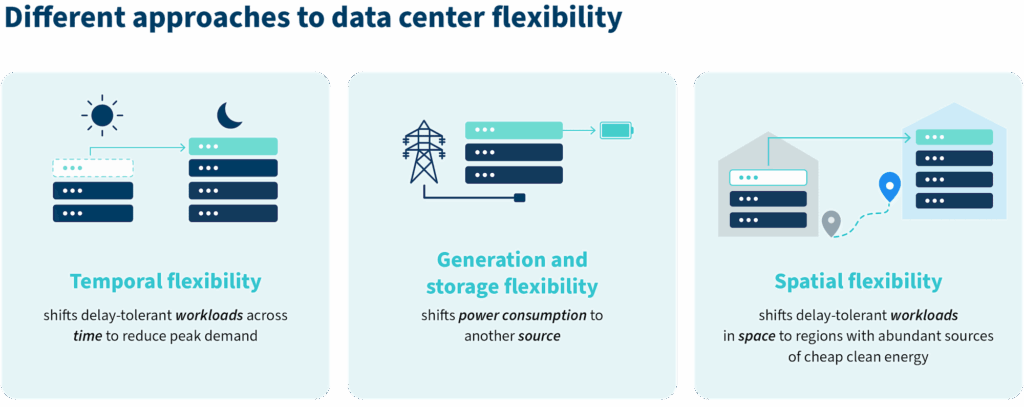
Despite the notion that data centers need 24/7 firm power, they can leverage flexibility in three main ways: temporal flexibility, generation and storage flexibility, and spatial flexibility (see Exhibit 5 below). Data center flexibility is often faster and more cost-effective than grid buildout for the system, while providing valuable services that can facilitate continued industrial and residential load growth and variable renewable energy integration. Since data centers operate with fast response times and — for a large fraction of data center services — latency leeway, they can serve as a source of planned peak grid reduction or as reactive assets that mitigate sudden changes in grid conditions.
Exhibit 5
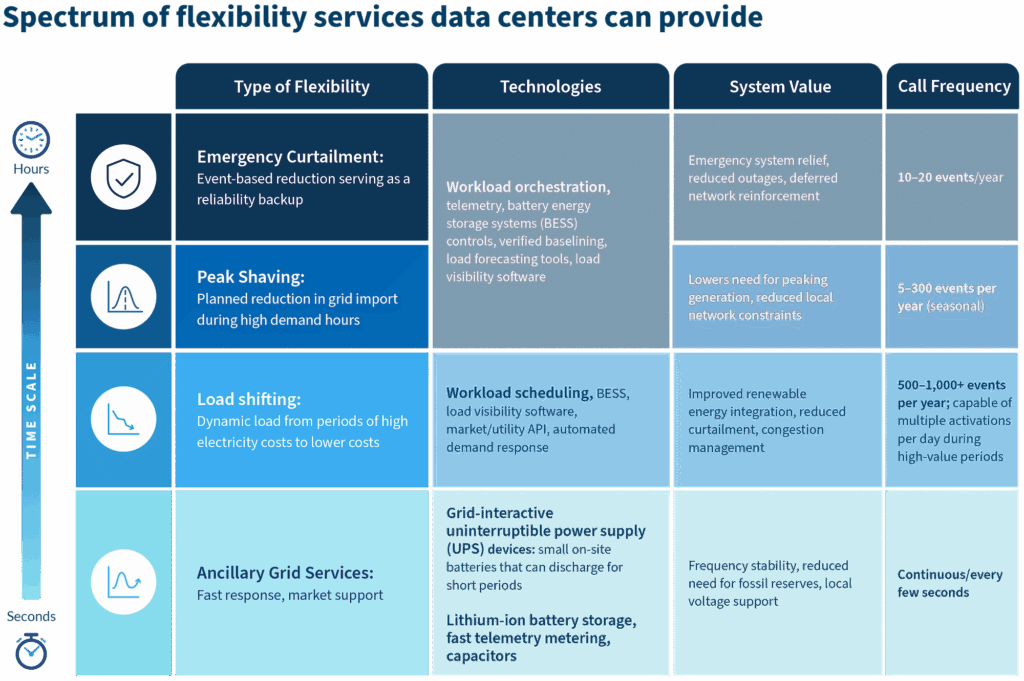
Additionally, data centers offer significant flexibility “upside” on grid operations and stability by potentially contributing to a wider range of ancillary services. Even though this brief focuses on peak shaving and load shifting, flexible data centers can provide a range of grid services, including faster (~seconds) responses and provision of ancillary services through on-site BESS or uninterruptible power system (UPS) devices.6 Enabling sub-second demand-side response would help reduce reliance on supply-side thermal resources for services like frequency regulation and voltage control. Incentives and regulation can eventually capture the value that these additional services provide.
Exhibit 6
But can data centers really be flexible? Emerging evidence globally
Pilots and studies across the world have demonstrated that data centers can be flexible demand resources, but traditional industrial demand response incentives are often insufficient to incentivize the newest AI and cloud campuses. Faster speed to power, which needs to be realized early during the development and interconnection process, can be the strongest levers to incentivize AI data centers to operate flexibly.
Several pilots of load flexibility at AI data centers have shown that flexibility can be implemented without compromising uptime and performance, while providing site and system-level benefits.
Emerald AI, a data center workload orchestration startup, found that AI data centers can behave like fast-responding resources while maintaining service quality, demonstrating their results on a live 96-GPU cluster operating realistic workloads. The system received 22 dispatch events from National Grid and EPRI over five days. Not only was the response quick (30% power reduction in less than 40 seconds) and sustained (10%–40% reductions sustained for 2–10-hour durations), the system achieved 99% data center performance on highest-priority jobs during flexibility events with 100% compliance to requested power targets. Flexibility was achieved through automated workload management, by pausing non-critical jobs, and by slowing down lower-priority jobs when possible, being aware not to compromise deliverability to the end user. This flexibility was conducted in response to central dispatch orders from the utility.
Emerald AI’s demonstration showed that AI facilities can provide peak shaving, ramping support, emergency response, and renewable-following demand without significant service degradation, and that flexibility can work like dispatchable assets for system operators.
Data center flexibility is also purported to have cascading system benefits from reduced capacity buildouts, as well as benefits to the data center itself. A study conducted by Princeton, Camus, and encoord found that a 500 MW data center can achieve full operation years earlier with minimal grid impacts through a combination of flexible grid connections, compute flexibility, storage, local generation, and behind-the-meter capacity. By assuming 25% of data center load as flexible, grid curtailment only occurred less than 0.5% of the year, indicating that flexibility can be useful for a small number of critical hours. Additionally, the study found that implementing 20% conditional service on capacity avoided 273 MW of new capacity additions and $78 million in system supply costs, primarily from avoided peak infrastructure gas buildout.
Flexibility also enables additional grid headroom utilization and reduces the need for further buildout. A widely cited paper from the Nicholas Institute at Duke University found that at 0.5% yearly curtailment (approximately 177 hours), the United States could accommodate an additional 98 GW of load on the existing grid. As demonstrated later in this brief, a comparable benefit could be untapped for grids in Southeast Asia.
Hyperscalers in the United States are recognizing the value of flexibility, incorporating it into their own planning and investments. As of March 2026, Google has contracted a cumulative 1 GW of demand-response capacity into its utility contracts, leveraging a variety of flexibility tools including workload orchestration and energy-responsive computing.
While enterprise and AI data centers have not been moved by traditional flexibility compensation mechanisms such as demand response incentives or time-of-use pricing, regulators can incentivize flexibility through speed-to-power.
Fast but interruptible interconnections can have a larger positive impact on data center companies’ bottom lines compared to firm interconnections that would only happen years later. A three-to-five-year interconnection delay can cripple the economics of data center projects, as revenue is deferred, capital remains tied up, and pre-operation debts continue accumulating interest. With flexibility incorporated, electricity planners may be willing to accelerate a data center’s interconnection, assuming infrastructure buildout can be reduced or deferred. Accelerated interconnection can further reduce data center companies’ development risk and improve their financing terms. In short, the value of a data center developer entering the market earlier can likely outweigh the value of perfect firmness.
Already, some regulators and grid operators are looking to encourage (or mandate) flexibility by offering flexible data centers faster speed to power (examples below). These novel interconnection frameworks may specify measurable flexibility capabilities such as managed ramp rates, emergency demand reduction, coordinated operation and dispatch, technical specifications of behind-the-meter battery energy storage systems, and participation modes in ancillary services.
Flexibility examples
Regulators and grid operators already trading faster grid access for flexible operation.
Under Executive Order 14318, the US government offers fast-tracked permitting, provided the data center incorporates on-site infrastructure and grid-flexible designs. Also, the Federal Energy Regulatory Commission issued show-cause orders to all six regional grid operators to justify how their current large load connection mechanisms are sufficient, or how they propose to reform them. One of the core categories grid operators must address is “flexible transmission,” where grid operators are allowed to dynamically adjust power flow based on grid strain, price, or congestion signals.
OpenAI’s Stargate data center in Abilene, Texas, combines a 1.2 GW interconnection with battery storage and gas backup generation. The data center is registered as a controllable load resource, indicating that it can bypass standard queue delays under the condition it drops load during peak grid stress.
The Electric Reliability Council of Texas (ERCOT) has recently implemented a “Batch Zero” framework, allowing facilities of 75 MW and above to get prioritized in the interconnection queue by registering as provisional controllable load resources. Data centers registered under this framework can bypass transmission buildout in exchange for operating under real-time grid dispatch controls that allow for curtailment during periods of congestion.
The Southwest Power Pool (SPP), which covers 17 states in the central and western United States, provides an accelerated pathway through its Conditional High Impact Large Load (CHILL) service. This framework establishes a 90-day expedited interconnection mechanism by placing facilities into specific, non-firm curtailable service classes. As long as facilities agree to automatic, conditional curtailment during grid emergencies, they can bypass the aggregate study queue, which is often years long.
In Ireland, EirGrid requires large energy users to provide demand-side flexibility to help stabilize the grid and manage high renewable penetration. Facilities need to demonstrate their ability to reduce load, shift energy usage, and deploy on-site generation or battery storage during periods of system stress or scarcity.
Silicon Valley Power (in partnership with Emerald AI), a municipal utility in California, will be the first utility to publicly offer accelerated supply in exchange for a flexible interconnection.
The potential value of flexibility in Southeast Asia: A look at Malaysia
Peninsular Malaysia faces a growing challenge: meeting rising data center demand while transitioning its power and scaling clean firm generation.
Data center demand is coming at a time when Malaysia has committed to not renew existing coal PPAs after their 25-year expiry and expects to take around half of its coal capacity (7 GW) offline between 2029 and 2035. At the same time, “clean firm” resources remain more nascent, given Peninsular Malaysia’s limited wind, geothermal, and additional hydro potential, leaving solar PV as the primary renewable generation source.
Utility-scale BESS deployment is also at an earlier stage in Peninsular Malaysia, with the first project reaching commercial operation in May this year. However, a modest investment by a data center to become flexible (for example, in software-based workload orchestration, on-site batteries, or intelligent energy management) may avoid substantial investments, helping ease this tension.
If Peninsular Malaysia’s 5 GW of data center demand was assumed to require a 24/7 firm supply, the system may need to build considerable new gas capacity in 2030. According to RMI’s analysis in Scenario Builder, existing headroom can be utilized to interconnect 4.2 GW of new data center load through 2029 with limited capacity additions. However, in 2030, significant new capacity investments would be needed to meet the 5 GW base case growth scenario, including 2 GW of solar PV and 3 GW of CCGT gas capacity (as shown in Exhibit 3).
While the additional solar PV capacity meets a substantial amount of demand during daylight hours, CCGT is required to meet evening peaks and ensure adequate supply during dry season months when hydro generation is lowest or the coal is ramped down (e.g., for maintenance).
Exhibit 7: 2030 Peninsular Malaysia peak demand dispatch by technology during the days with highest peak and lowest hydro availability of the year. Corresponds to results of Scenario #2 described in the Technical Appendix.
Results data can be found at https://builder.transitionzero.org/solardataset902/flexibility-analysis-my-final/s3-0-gas-dispatch-2030-copy-158 .
These dynamics illustrate the potential value of data center flexibility in providing peak shaving and load shifting. Looking at 2030, reducing data center load at peak net load hours can help decrease gas generation that would otherwise be dispatched to meet evening peaks (see Technical Appendix for the details on the peak shaving and load shifting scenarios). By lowering net load at the most critical 400 hours of the year, Malaysia can potentially defer several hundred MW of CCGT investment (see Exhibit 8).7
While data center expansion continues, uncertainty remains about the scale and timing for that growth. Peak shaving from data centers can serve as a near-term, time-bound solution to manage this uncertainty, reducing risks of overbuilding new gas supply while providing a buffer against oil and gas prices. This capacity deferral may be particularly valuable in Peninsular Malaysia given its early stage of BESS deployment: the ability to leverage data center flexibility for peak shaving can reduce system costs by ~US$30 million in 2030 — a US$26/kW peak load reduction — even as it provides more time for BESS markets to mature (Exhibit 9).
Exhibit 8: 2030 Peninsular Malaysia installed capacity and generation across constant, peak shaving, and flexible data center loads.
While peak shaving can be a temporary measure to reduce overbuilding just for peak demand, load shifting can offer a more durable solution for data center companies and power system operators and planners. Load shifting can be accomplished by both temporal flexibility technologies as well as on-site generation and storage flexibility (Exhibit 5).
Under the load shifting scenario, if data centers can shift load during ~600 hours (~6.8% of the time), Malaysia may avoid or defer up to 800 MW of gas, or 0.16 MW per MW of data center load. This would not only reduce overall costs, due to avoided additional capex and fuel costs, but the system and ratepayers would also avoid fuel price volatility, additional obligations stemming from fuel offtake, or an import-dependent gas supply chain in the longer term. By shifting load to lower net load hours, load shifting can also support greater integration of solar PV, resulting in 4.6 GW of additional capacity, or 0.92 MW of new solar per MW of data center load.
Significant grid system cost savings could result from load shifting data centers, in addition to better reliability and larger renewable energy integration. The flexible data center scenarios allow for greater than 5 TWh of additional solar generation to enter the grid compared to the 24/7 demand data center scenario. With the combination of cheap solar and more than 1 GW of peak net load reduction, the load shifting scenario saves around US$90 million — a capacity value benefit of US$75/kW of peak load reduced (Exhibit 9). Additional system cost savings could come from investment deferrals on the transmission system that might be needed to solve the constraints that clustering can bring. However, the estimation of these benefits would require more detailed modeling including power flow constraints.
Exhibit 9: 2030 Peninsular Malaysia total system costs and peak net load
Results data can be found at https://builder.transitionzero.org/solardataset902/flexibility-analysis-my-final/s3-0-gas-dispatch-2030-copy-159.
As the ASEAN Power Grid (APG) continues developing, flexible data centers can become an important lever to ensure broader benefits of cross-border interconnection. Flexible data centers could become important controllable loads capable of absorbing surplus renewable generation across the interconnected system, supporting more liquid electricity trading and improving regional power system resilience.
The expansion of the APG can also consider incorporating outcome-based grid access conditions that require data centers to provide clean energy sourcing and meet power usage efficiency (PUE) and water usage efficiency (WUE) conditions to secure power, as well as requiring data center participation in demand response or flexible load programs.
In the confluence of the APG development and data center load growth, Southeast Asia can take advantage of a unique opportunity to integrate digital infrastructure with an increasingly interconnected and decarbonized electricity system.
Why Flexibility Makes Sense for Data Center Load Growth
With or without data center load growth, flexibility is a critical solution as countries expect to see increasing shares of variable renewables and electrification. While flexibility can come from multiple sources, such as utility-scale BESS, virtual power plants, demand-side flexibility from traditional industrial loads, or more flexible gas technologies, deploying flexibility at data centers offers the following advantages:
Data center load is likely to come regardless; there are minimal downsides to incentivizing this load to be flexible.
Malaysia and Thailand face several gigawatts of data center demand in their respective queues. While power constraints are not yet a binding issue as they are in some US power markets, there are ongoing discussions on the emerging risks to resource adequacy in both countries. As a result, both geographies have implemented queue-filtering tactics like rejecting non-AI workloads in Malaysia and up-front collateral for minimum planned power utilization thresholds in Thailand.
On top of these efforts, ensuring that data centers that do interconnect can provide some load flexibility will allow countries to better utilize existing headroom, avoid grid stability disruptions, manage capacity expansion needs, and avoid resource adequacy shortfalls. Decision makers can work alongside data center companies to make sure flexibility incentives that enable faster interconnection and lower costs are right-sized and do not deter potential investment.
Data centers provide a centralized “sandbox” to pilot and test demand-side flexibility solutions, enabling impact even if only implemented across a few sites.
Data center load growth is a watershed moment for countries to align their broader strategy around advanced manufacturing, electrification, and digitalization by creating the infrastructure environment necessary to deploy clean energy hubs. Data centers can be used to proactively test the necessary grid conditions and installed upgrades to enable broader demand-side flexibility across the system. Data centers can be targeted use cases to test bespoke schemes, such as dedicated large load tariffs and interconnection policies, as well as to measure the risks and capabilities of different load types in providing flexibility to collect detailed data for planning and designing appropriate mechanisms.
Data centers can also catalyze necessary system investments in grid modernization and digital optimization solutions that will serve as a foundation for broader flexibility programs and ancillary service compensation deployable to other sources of load growth, such as industrial electrification, scaled electric vehicle deployment, or increases in cooling demand.
Data centers represent a unique opportunity to mobilize private investment in power system assets.
Creditworthy hyperscalers have demonstrated strong willingness to pay for speed to power. Corporate balance sheets may provide more bankability than traditional utility-backed investments or where remuneration models may be less proven. Data center companies can help de-risk earlier-stage technologies and pilot novel flexibility approaches, whether through deployment of behind-the-meter BESS or through facilitating VPP pilots.
What’s Next
In this brief, RMI introduced the opportunity for data center flexibility, drawing on simplified analysis of Peninsular Malaysia’s power system. In the coming months, RMI plans to conduct more detailed power system analyses in Peninsular Malaysia and other Southeast Asian markets to further quantify the potential power system benefits and impacts of data center flexibility. Future briefs will also aim to answer questions around what it takes to unlock this flexibility potential via regulatory incentives and business models, such as through flexible interconnection agreements or integration into large load tariffs or procurement schemes.
Should you be interested in learning more or exploring collaboration, please reach out to tmatsuo@rmi.org and dangel@rmi.org
Additional Contributors
RMI is thankful for the reviews and contributions of Dr Aznan Ezraie Ariffin (TNB Research), Isabella Suarez and Handriyanti Puspitarini (TransitionZero), and Daniel Padilla (Emerald AI)
Technical Appendix
Assessing the impacts and opportunities of data center load growth in Malaysia using Scenario Builder
To better understand the directional impacts of data center load growth and the mitigating role that data center flexibility can have in Southeast Asia, RMI utilized TransitionZero’s Scenario Builder tool. Scenario Builder is a least-cost power modeling tool that includes both long-term capacity expansion and hourly dispatch modeling. For the analysis shown here, RMI focused on assessing Peninsular Malaysia’s power system, where data center load growth is concentrated.
RMI used Scenario Builder’s default model for Malaysia as a starting point, while updating several parameters to better reflect certain realities in Malaysia (e.g., no new coal capacity additions, achievement of solar PV targets). Four scenarios were run:
- Counterfactual scenario with no data center load – using load forecasts from Peninsular Malaysia’s Power Development Plan (PDP), RMI ran a capacity expansion model as a reference case excluding data center load growth.
- Base case data center load growth – RMI used the current pipeline of announced data center projects and data center demand forecasts from Peninsular Malaysia’s PDP to build out an estimated increase in data center load. Adding announced data center projects and the PDP’s expected growth rate results in 5 GW data center operating capacity in 2030. RMI assumed this load was a 24/7 flat load by adding it to the total hourly load without data centers (i.e., shifting the gross demand upward but keeping the shape), and ran a capacity expansion model up to 2030 and a dispatch model for a single year in 2030 for this scenario (Exhibits 3 and 6).
- Data centers providing peak shaving – RMI ran a dispatch model for 2030 that assumed data centers can reduce their load during ~400 critical load hours, characterized by highest net load or when intra-day net load peaks coincided with low hydro or coal availability (Exhibits 8 and 9). This generally resulted in an average data center load reduction of 5% across events and up to 29% in the highest net load hour.
- Data centers providing load shifting – RMI ran a dispatch model for 2030 that assumed data centers can shift load during the ~600 critical load hours, under the same characterization as above, to low net load hours (Exhibits 8 and 9). Load was always shifted intra-day and generally resulted in average data center load reduction of 14% across events and up to 29% in the highest net load hour.
The analysis conducted in Scenario Builder is intended to be directional, showing order of magnitude opportunities for data center flexibility. The results have several limitations and should not be considered precise. These include:
- Flexibility is modeled using simplified approaches and assumptions. Under Scenario Builder, it is not possible to optimally dispatch demand flexibility as a resource at the time of writing of this brief. Therefore, flexibility is exogenously applied by altering load profiles.
- Data center flexibility was derived from top-down assumptions. Rather than detailed, bottom-up load profiles for data centers, RMI assumed a maximum flexibility of 40% reduction of load, while generally keeping load reductions to roughly 5% and 20% in the peak shaving and load shifting scenarios, respectively. RMI intends to further refine its analysis through a more in-depth power system analysis in a following brief to further validate and quantify the potential benefits of data center flexibility in key Southeast Asian markets.
- Peninsular Malaysia is represented as a single node, copper plate model. Generators are aggregated to their technology group while transmission constraints are not represented, which may be relevant given the concentration of data center load in certain regions in Malaysia.
- The optimization model included traditional supply-side resources like open cycle or combined cycle gas, renewables like solar and wind, additional hydro, biomass, and battery energy storage systems. It excluded alternative options like transmission reinforcement, imports, synchronous condensers, and advanced network technologies since the model is simplified and does not represent the grid’s constraints.
Endnotes
- Thailand, for example, has a reserve margin closer to 50% against a 15% target, while Indonesia’s Java-Bali reserve margin was 42% in 2024 against a 35% target. ↩
- Speculative interconnection requests occur when data center developers either request interconnection in multiple jurisdictions or over-declare power needs to secure grid capacity for future needs. ↩
- These high load factors were seen before the AI boom. However, there is early evidence that load factors may be changing with newer generation AI facilities. ↩
- These results in Malaysia stem from assuming a continuous ability to produce low-cost domestic gas coupled with its plans to phase down its coal fleet, generally low wind speeds for onshore wind, and traditional hydro resources that begin reaching a resource potential limit by 2030. ↩
- The table intends to show the potential grid stability issues a single large campus can create. However, the concentration of multiple data centers can also create grid stability concerns, if they utilize similar power protection quality equipment and response mechanisms, as observed in Virginia in 2024. ↩
- UPS devices help provide instantaneous back-up power to critical data center loads. While historically used in emergency situations only as a bridge before back-up generators power up, UPS devices can also provide fast response ancillary services. ↩
- Notably, 400 hours is generally higher than typical response frequencies for traditional demand response programs, highlighting the need to utilize the full potential of data center flexibility in order to realize benefits due to deferred capacity investments. ↩
Authors

Diego Angel Hakim
Manager
Ayaan Asthana
Pat Hoody

Tyeler Matsuo
Principal
Wini Rizkiningayu
Principal
Sydney Williams
Related Insights
Help build the clean energy future. Donate today.
Independent research. Real-world solutions. Supported by donors.
RMI can pursue the highest-impact climate and energy solutions because we’re supported by people who believe change is possible. Every gift helps advance the work needed to make clean energy the default choice worldwide.
For other ways to give to RMI, including checks or gifts of stock, please visit Other Ways to Give.