

Learn how we are working to transform how we use and produce energy.
Community Benefits in Energy Projects
Understanding the building blocks that utilities, cooperatives, and clean energy developers have used to engage communities
Why we share this work for free
RMI is an independent nonprofit working to accelerate the clean energy transition. We publish research like this to inform decision-makers and drive real-world impact.
Our work is supported by philanthropy as well as partnerships, including fee-for-service engagements. This support makes it possible for us to share our independent insights for free.
If you find this work valuable, you can support it anytime.
Get more insights like this
Stay up to date with the latest research, analysis, and tools from RMI by opting in to receive occasional emails below. You’ll get new reports, event invitations, and practical insights to help us all accelerate the clean energy transition.
Loading form...
Your download should start automatically. If it doesn’t, click the download button below.
This work is made possible by philanthropy
RMI is a nonprofit supported by donors and partners. Philanthropy enables us to produce independent research and make resources like this freely available.
If you find this report valuable, please consider supporting our work. You can also explore how we partner with organizations to drive impact.
Jump to Section
Community opposition has been a long-standing factor in delayed or derailed energy projects. But there is a growing body of real-world examples showing how to address that opposition differently.
This report shares findings from a joint study of community benefit plans (CBPs) made by utilities and developers. RMI and the University of Minnesota (UMN) Center for Science, Technology, and Environmental Policy (CSTEP) collaborated on the research and analysis. Although the development of the CBPs in our study was federally driven, several project developers went beyond compliance in their commitments, experimenting with partnerships to support community benefits design and distribution, transparency and accountability mechanisms, and internal organizational shifts to deliver on their commitments.
Analysis of the plans and real-life examples show how three recommended practices can be put into action:
- Build stakeholder relationships and enable communities to engage, ideally in early project stages and through two-way engagement processes.
- Use community engagement to determine community benefits.
- Use direct accountability to communities to earn trust and buy-in.
Details within the report help other utilities and developers adapt these practices to engage with the communities surrounding their projects, deliver meaningful benefits, and navigate the concerns that generate local opposition.
We cite specific examples from over 25 utilities and developers that illustrate how to identify and engage external partners, how to determine appropriate community benefits, and ways to demonstrate accountability for benefits to communities. We offer the selected examples as implemented precedents that clarify how to move from abstract values to operational decisions.
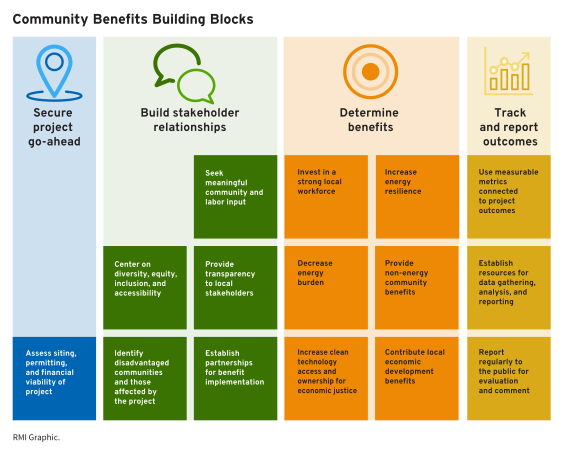
The report also points to resources and tools for putting best practices into action. These include the Community Benefits Building Blocks, which support internal and external community benefits planning discussions. As a range of local concerns might fuel community opposition, project owners and communities can use the Building Blocks to match benefits to local priorities for process inclusion, benefit distribution, and outcome accountability.
Authors


Kristine Chan-Lizardo
eLab Network Coordinator and Marketing Lead
Zach Clayton
Senior Associate
Erifili Draklellis
ManagerRelated Insights
For Clean Energy Projects, How Community Benefits Are Delivered Matters
Tracking WestTEC: Where 100+ Transmission Projects Stand and What Comes Next

Help build the clean energy future. Donate today.
Independent research. Real-world solutions. Supported by donors.
RMI can pursue the highest-impact climate and energy solutions because we’re supported by people who believe change is possible. Every gift helps advance the work needed to make clean energy the default choice worldwide.
For other ways to give to RMI, including checks or gifts of stock, please visit Other Ways to Give.