

Learn how we are working to transform how we use and produce energy.
For Clean Energy Projects, How Community Benefits Are Delivered Matters
RMI analysis of more than 200 large-scale clean energy projects found that successful projects offered host communities roughly the same financial value as failed projects, but structured those benefits differently.
Why we share this work for free
RMI is an independent nonprofit working to accelerate the clean energy transition. We publish research like this to inform decision-makers and drive real-world impact.
Our work is supported by philanthropy as well as partnerships, including fee-for-service engagements. This support makes it possible for us to share our independent insights for free.
If you find this work valuable, you can support it anytime.
Get more insights like this
Stay up to date with the latest research, analysis, and tools from RMI by opting in to receive occasional emails below. You’ll get new reports, event invitations, and practical insights to help us all accelerate the clean energy transition.
Loading form...
Your download should start automatically. If it doesn’t, click the download button below.
This work is made possible by philanthropy
RMI is a nonprofit supported by donors and partners. Philanthropy enables us to produce independent research and make resources like this freely available.
If you find this report valuable, please consider supporting our work. You can also explore how we partner with organizations to drive impact.
Jump to Section
For more on the data and our methodology download the data dictionary and data library:
Large-scale clean energy generation and battery storage projects can help deliver more affordable energy to people across the United States. As with all large infrastructure development, communities that host these projects may have concerns about what benefits the projects will deliver to their community, and the project’s potential impacts. RMI looked at how developers have tried to address these concerns over the past 15 years, including whether the size and type of financial benefits they offered made a difference in whether projects succeeded.
We found that successful projects did not necessarily offer communities more financial value than failed projects. Instead, they more often structured that value in ways that were direct, visible, and responsive to local priorities. For developers, the findings suggest that how community benefits are delivered may matter as much as how much is offered.
Successful projects did not necessarily offer communities more financial value than failed projects. Instead, they more often structured that value in ways that were direct, visible, and responsive to local priorities.
What the data tells us
RMI compiled and analyzed the financial benefit structures that developers offered communities (e.g., tax revenue, host community agreements, community benefits agreements) and the total value of those benefits for more than 200 utility-scale solar, onshore wind, and battery storage projects. These projects all required local approval at the township- or county-level as a key factor in their success or failure and had publicly available information on proposed community benefits. The 96 successful projects represent 17.9 gigawatts and an estimated $33.2 billion in successful investment. We also analyzed 101 projects that failed to secure local permits, representing 18.8 gigawatts and an estimated $33.6 billion in unrealized investment.
This analysis identifies patterns in how financial benefits were structured across successful and failed projects; it does not establish that benefit structure caused a project to succeed or fail. Other factors can shape local permitting outcomes besides developers’ offers to provide benefits and mitigate impacts, such as project characteristics and local sentiments, as well as other non-public factors like grid interconnection cost estimates. However, an aspect of local denial was present for all the failed projects in our analysis, enabling the comparison and evaluation of benefit structures relative to project outcomes.
We found that developers of successful projects offered approximately the same amount of money to host communities as projects that failed to secure local permits. One pronounced difference was how those benefits were structured. Projects that successfully navigated local opposition and secured local permits more often used a combination of structures to make project value direct, visible, and controllable for communities. Furthermore, successful projects more often offered structures designed to benefit members of the broader community, in addition to hosting landowners and local government.
Developers of successful projects in our data set offered approximately $232,500/megawatt (MW) in local benefits over a project’s lifetime, compared with $214,600/MW for failed projects — an 8% difference, nearly the same amount of money. This $/MW benchmark is the sum of all benefits offered locally over the entire project lifetime, including taxes to the local government(s), landowner payments, and additional funding to the broader community, standardized in 2026 dollars. For example, in a hypothetical 150 MW project, a successful project would offer $34.9 million to local stakeholders across the project lifetime, while an unsuccessful project might have offered $32.2 million. The exhibit below demonstrates that the range of financial benefit package amounts that developers offered were similar, regardless of whether the local government successfully permitted or denied the project.
Almost two-thirds of failed projects in our analysis relied mainly on traditional property tax revenue to deliver value, typically with payments to landowners too. On the other hand, 60% of projects that secured local permitting used a combination of financial structures beyond only traditional taxes, including payments in lieu of taxes (PILOTs), host community agreements, and community benefit agreements. These structures can give landowners and neighbors, local governments, and the broader community a clearer connection to project benefits, greater visibility into their value, and more say in how they are used. Payments can provide landowners and neighbors with revenue for hosting infrastructure and compensate for any impacts; different forms of tax revenue can help local governments improve infrastructure and services; and additional funding to the broader community can visibly direct money to their top priorities, such as programs, organizations, and infrastructure.
Benefits should be direct, visible, and controllable
These findings suggest that developers should consider not only the total value of a community benefit package, but also how communities view and experience that value. A successful project should have benefits that are direct, visible, and controllable:
- Direct: Is the connection between the benefits and the project clear and straightforward?
- Visible: Can all host community members easily see and understand how much value the project is providing?
- Controllable: Who will determine how the benefits are spent (e.g., landowners, host municipality, broader community)?
The examples below illustrate how these characteristics can take shape in practice, highlighting ways to make a benefit’s connection to the project clear, its value visible, and its use responsive to community priorities.
| DIRECT | Money flows directly from project to individual community stakeholders (e.g., landowner payments or land leases). Example: Hawaiian Electric has a minimum community-benefit contribution regulation of $3,000/MW-year for developer request for proposals to bid into the state’s integrated resource plan. This clearly supports direct project to benefit connection and it is worth watching what outcomes result from this new adder. |
| VISIBLE | Commitments negotiated and documented in community benefit agreements are tangible, often benefit the broader community, and are trackable. Example: The developers of the Jacumba Solar Park in California have made several itemized financial pledges directed toward community priorities, including $1 million designated toward funding local rooftop solar installations, $250,000 for the Jacumba Community Park, and $125,000 for a local senior meal delivery program. Discussions between the project team and community members are ongoing to determine how to allocate the remaining $2.5 million in funds. |
| CONTROLLABLE | Pledging money directly to local community organizations gives them control of spending funds according to their priorities, in addition to tax revenue provided to local government(s). Example: The Bull Hill Wind project in Maine makes annual payments to community benefit accounts for the county, host towns, and local recreation nonprofits. Dedicated funding accounts allow each entity to decide what public purpose funds are directed to, without mandated limitations, including property tax reductions, economic development projects, land and natural resource conservation, tourism promotion, and energy cost reduction. |
Financial benefits can be delivered through a range of structures, each shaping how communities perceive and experience the value a project provides. Building on the characteristics above, the table below describes these structures and compares them based on how directly the benefit is connected to the project, how visible it is to residents, and who is seen controlling the funding.
Community experience of financial benefit structures
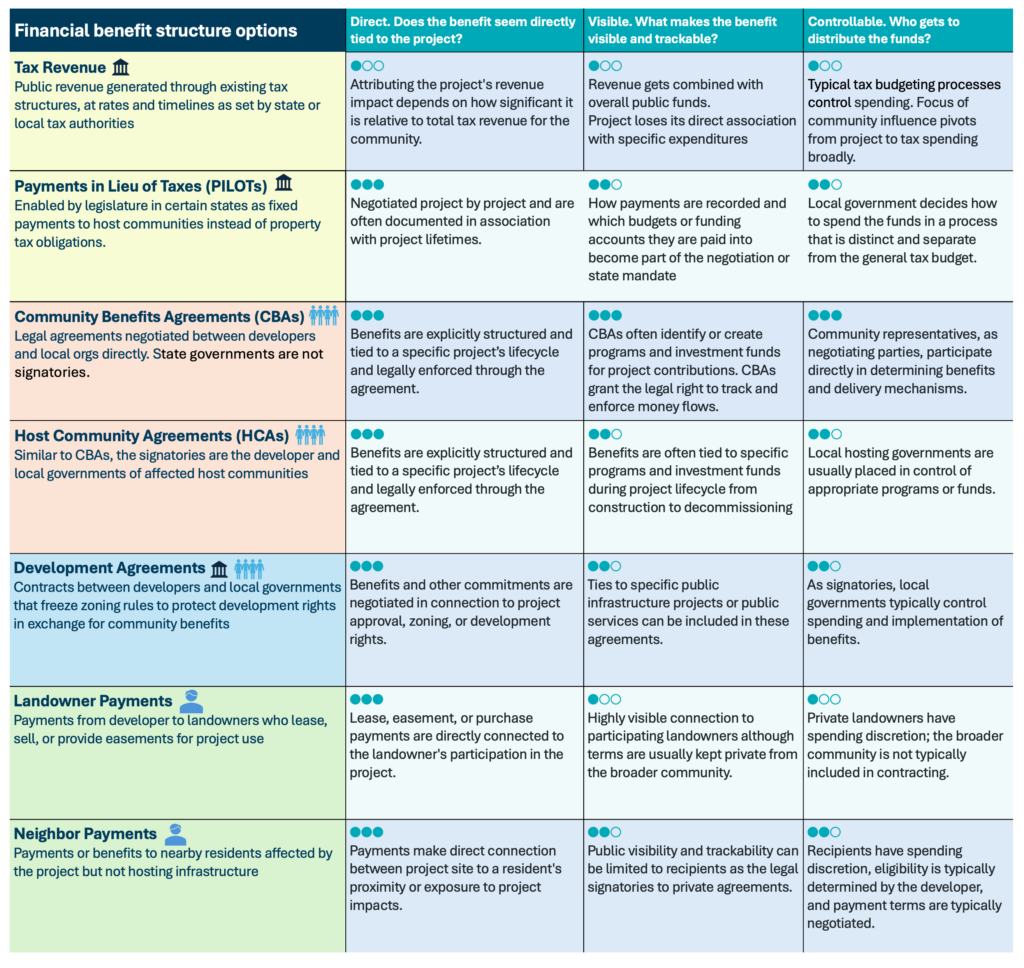
Traditional tax revenue is a clear example of the challenge of making benefits tangible. University of Texas research suggests tax revenue to counties or townships could be less visible to the broader community and have less influence on public support for the project, because it can be:
- indirect and not visibly experienced by most residents;
- absorbed into broader local government budgets rather than clearly attributed to the project; and
- reduced through abatements or vary over time, limiting predictability for local governments and their control.
Consequently, when communities associate little direct and visible value from a project, the community concludes the project is not in their interest. In some cases, modest environmental and aesthetic concerns and weak claims can more easily derail projects.
By contrast, other benefit structures can create a clearer connection for different local stakeholders between the project and its value:
- PILOT agreements — which provide local governments with more long-term tax predictability and control — were offered in 25% of successful project versus 15% of failed projects.
- Community benefit agreements, host community agreements, or direct payments were present in 43% of successful projects compared with 24% of failed projects.
There are still projects in our data set that failed to secure local permitting despite offering a high-quality combination of benefits. Benefits may not be able to address all community concerns, nor mitigate all project impacts. However, developers could consider these findings and the corresponding $/MW benchmarks as a starting place for their offers to host communities. Clean energy projects can also provide more benefits to host communities than the ones we’ve outlined in this analysis, such as job creation, resiliency, and energy affordability.
Our findings suggest developers can reexamine how much value a project provides and especially how that value reaches host community stakeholders. Most failed projects in the analysis relied primarily on traditional tax revenue, pointing to an opportunity for developers to take a more expansive approach to community benefits. Ultimately, benefit structures that make value easier to connect to the project, easier to see, and easier for local stakeholders to shape could help developers build packages that feel more meaningful and responsive to host communities’ concerns and priorities.
Authors

Leah Komos
Associate
Kristine Chan-Lizardo
eLab Network Coordinator and Marketing Lead
Erifili Draklellis
Manager
Zach Clayton
Senior AssociateRelated Insights
Tracking WestTEC: Where 100+ Transmission Projects Stand and What Comes Next

Rural Electric Co-ops and the Future of American Energy
Help build the clean energy future. Donate today.
Independent research. Real-world solutions. Supported by donors.
RMI can pursue the highest-impact climate and energy solutions because we’re supported by people who believe change is possible. Every gift helps advance the work needed to make clean energy the default choice worldwide.
For other ways to give to RMI, including checks or gifts of stock, please visit Other Ways to Give.