

Learn how we are working to transform how we use and produce energy.
The Affordability Case for a Distribution System Operator
Why the next chapter of utility reform runs through the distribution grid, and a new body of work to help get it right.
Why we share this work for free
RMI is an independent nonprofit working to accelerate the clean energy transition. We publish research like this to inform decision-makers and drive real-world impact.
Our work is supported by philanthropy as well as partnerships, including fee-for-service engagements. This support makes it possible for us to share our independent insights for free.
If you find this work valuable, you can support it anytime.
Get more insights like this
Stay up to date with the latest research, analysis, and tools from RMI by opting in to receive occasional emails below. You’ll get new reports, event invitations, and practical insights to help us all accelerate the clean energy transition.
Loading form...
Your download should start automatically. If it doesn’t, click the download button below.
This work is made possible by philanthropy
RMI is a nonprofit supported by donors and partners. Philanthropy enables us to produce independent research and make resources like this freely available.
If you find this report valuable, please consider supporting our work. You can also explore how we partner with organizations to drive impact.
Jump to Section
With affordability now the defining issue in electric utility regulation, the distribution system sits at the center of the story. Distribution system investment has become one of the largest and fastest-growing drivers of customer bill increases nationwide.1 Facing aging infrastructure, mounting resilience threats, and the first sustained load growth in a generation, utilities are proposing record capital programs to expand and harden their local grids. Under traditional cost-of-service regulation, every dollar of that spending flows into rates, and customers are feeling it.
But building more of everything isn’t the only way to meet these needs. No longer a one-way delivery network, the distribution system now includes a vast and growing fleet of distributed energy resources (DERs) – batteries, electric vehicles (EVs), smart thermostats, heat pumps, rooftop solar – that can shave peaks, defer capacity upgrades, and provide grid services. When integrated into grid planning and operations, DERs can displace a meaningful share of energy costs. This flexibility warrants a fundamental reframing of the utility business model around new capabilities and functionalities that can reduce the total cost of delivering reliable service compared to the status quo.
Capturing the benefits of DERs will require evolving the grid’s functions (how the distribution system is planned, operated, and coordinated), its incentives (how utilities earn returns and are held accountable for outcomes), and its governance (who makes decisions about grid-edge resources and in whose interest). These changes must advance in complementary ways because progress on any one front without the others leaves value stranded. This coordinated evolution is what is often referred to as a distribution system operator, or DSO, model. The question for regulators shifts from how much cost customers can bear for new system capabilities to how those capabilities will displace other cost drivers across the grid.
This is the focus of a new research effort led by Current Energy Group, with support from GridLab, and in collaboration with RMI and the Regulatory Assistance Project (RAP). Over the coming months, we are developing a foundational report on DSO models and affordability. This article previews the core argument and the principles guiding the work.
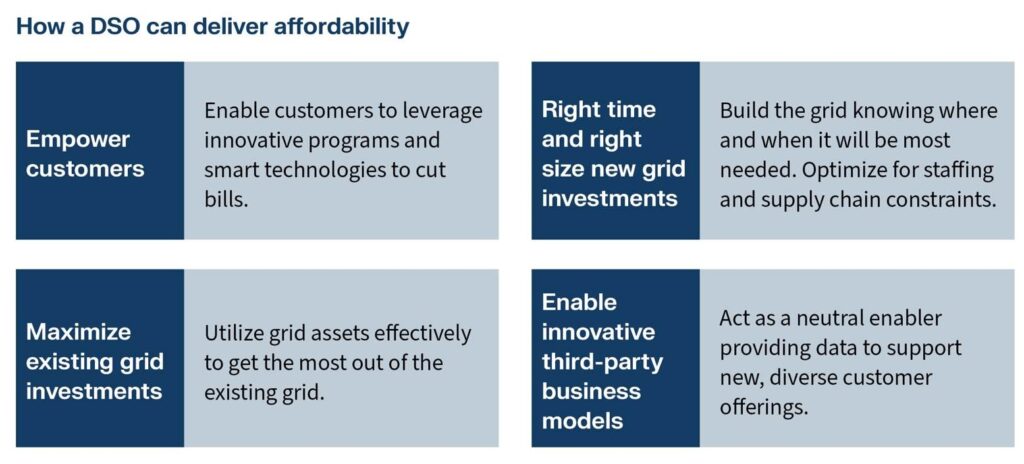
A confluence of challenges demands a comprehensive solution
Utility regulators today confront a convergence of pressures that individually strain existing frameworks and, taken together, demand a fundamental rethink of how electric systems are planned, operated, and paid for.
Affordability pressures are intensifying. Rising electricity costs consume a growing share of household budgets, even before the next wave of grid investment lands in rates.
Load growth is back with a vengeance. After decades of flat demand, electrified transportation and heating, reshored manufacturing, and the expansion of data centers and AI computing are driving load growth at a pace the system hasn’t seen in a generation.
Resilience has become an essential part of operations. Wildfires, hurricanes, heat waves, and winter storms are exposing the fragility of centralized infrastructure designed for stable conditions that no longer exist.
The current business model does not provide an incentive for utilities to develop the technical capabilities to put distributed resources to work. Under traditional cost-of-service regulation, a utility earns its return on the capital it deploys rather than on grid performance. The result is a systemic bias toward poles-and-wires solutions even when DER coordination can deliver the same service at lower cost. Although some regulators have attempted to change the utility model, their efforts, such as customer programs and performance incentives for DER integration, have yet to shift the focus away from the traditional approach of building more infrastructure.
This is what a well-designed DSO addresses in practice: bending the cost curve by shaping a utility model whose functions, incentives, and governance are structurally designed to capture the system’s cheapest resource, wherever it’s located.
Great Britain’s experience provides valuable lessons applicable to the US regulatory context. In practice, Great Britain’s distribution network operators have undergone a deliberate, regulator-driven transition toward DSO functions, such as forecasting and planning around flexibility, procuring grid services from distributed resources through competitive tenders, and operating networks actively rather than passively.
Advanced grid functions
Part of what makes DSO conversations difficult is definitional fog. “DSO” is used to describe everything from a modest software upgrade to a full structural separation of the distribution utility. Our work will cut through this by defining the DSO functionally, by the advanced grid capabilities it must perform, rather than by any single institutional form.
Five core functions anchor that definition:
- Integrated system planning that treats DERs as genuine alternatives to traditional capacity.
- DER market administration to provide a platform through which distributed resources participate in grid and market services.
- Active system operations to serve customers safely and reliably while coordinating DER activity to optimize resources and customer value.
- Transmission-distribution coordination to ensure that flexibility at the grid edge is visible to and informs the bulk power system.
- Data access and management that enables planning, markets, and operations to function and enables third-party innovation and solutions.
In addition, a comprehensive DSO model must address two additional elements: DSO structure and incentive alignment. DSO structure refers to institutional and governance design, including safeguards for neutrality, especially when the system operator’s role can conflict with utilities’ ownership interests. Incentive alignment involves reforming how revenue is generated to ensure that managing a battery system is as financially appealing as building a new substation. Our report will focus on these two elements, as regulatory discussions often stall in these areas.
What does “good” look like?
Defining the DSO is only half the task. We also need standards for what a good DSO looks like from an equitable, customer-centric, and public-interest standpoint. Our work ahead will establish a set of foundational principles that can support any inquiry into DSO design and grid modernization. For example, those may include:
Affordability at the center. A DSO should first be evaluated on its ability to reduce total system costs and customer bills over time.
Least-cost requires that all resources compete. Planning and procurement should be resource-neutral, meaning if a portfolio of coordinated DERs can meet a system need more cost-effectively than a traditional investment, that portfolio should be selected consistently.
Customer choice and participation as advantages. Customers who invest in flexible resources should have clear, fair, and accessible ways to be compensated for the value they provide.
Neutrality builds trust. Governance must ensure a level playing field where conflict-of-interest protections are essential components of design.
Transparency and data access as preconditions. Stakeholders, market participants, and regulators cannot evaluate or trust what they cannot see. Open planning assumptions, hosting capacity data, and performance reporting are essential components of the model and support continuous improvement and iteration.
What comes next
Over the next several months, we will develop a foundational report articulating the DSO-affordability vision and the regulatory framework needed to realize it, with emphasis on financial incentive alignment, DSO structure, and governance reform. The research will focus on interviewing practitioners from both sides of the Atlantic: US utilities, British distribution network operators, British regulators, government and community leaders, and competitive service providers developing businesses at the grid edge.
The affordability crisis is real, and the temptation to treat grid transformation as its cause will only grow. Done right, defined by its functions, disciplined by its incentives, and accountable to the public interest, the DSO becomes a pathway to bending the cost curve.
Do you agree that DSO is a key activity to support affordability? Help shape the conversation by providing feedback:
This work is led by Current Energy Group, with support from GridLab, and in collaboration with RMI and the Regulatory Assistance Project (RAP).
Endnotes
- Since 2014, distribution system investments have been the fastest-growing category of utility capital spending nationwide. See: Cara Goldenberg, Kaja Rebane, Gennelle Wilson, and Xavier Zheng, A Strategic Framework for Utility Cost Control: How to Promote Cost-Efficiency Through the Energy Transition, RMI, 2025, https://rmi.org/insight/a-strategic-framework-for-utility-cost-control. ↩︎


Related Insights
Reality Check: For Power Plants, Changing the Fuel Doesn’t Fix the Economics
For Clean Energy Projects, How Community Benefits Are Delivered Matters
Tracking WestTEC: Where 100+ Transmission Projects Stand and What Comes Next

Help build the clean energy future. Donate today.
Independent research. Real-world solutions. Supported by donors.
RMI can pursue the highest-impact climate and energy solutions because we’re supported by people who believe change is possible. Every gift helps advance the work needed to make clean energy the default choice worldwide.
For other ways to give to RMI, including checks or gifts of stock, please visit Other Ways to Give.
