

Learn how we are working to transform how we use and produce energy.
Subnational Industrial Strategy in the Electro-Industrial Era
How states and regions can win durable investment, jobs, and leadership in new energy.
Why we share this work for free
RMI is an independent nonprofit working to accelerate the clean energy transition. We publish research like this to inform decision-makers and drive real-world impact.
Our work is supported by philanthropy as well as partnerships, including fee-for-service engagements. This support makes it possible for us to share our independent insights for free.
If you find this work valuable, you can support it anytime.
Get more insights like this
Stay up to date with the latest research, analysis, and tools from RMI by opting in to receive occasional emails below. You’ll get new reports, event invitations, and practical insights to help us all accelerate the clean energy transition.
Loading form...
Your download should start automatically. If it doesn’t, click the download button below.
This work is made possible by philanthropy
RMI is a nonprofit supported by donors and partners. Philanthropy enables us to produce independent research and make resources like this freely available.
If you find this report valuable, please consider supporting our work. You can also explore how we partner with organizations to drive impact.
Jump to Section
Introduction
Electricity demand is surging. Industrial competition between states and nations is intensifying. Communities across the United States are demanding not just that their leaders protect them from pollution and out-of-control energy bills, but also that the communities have agency in how their regions plan around and participate in an economic climate that is ripe with opportunity but fraught with volatility. This economic climate is the electro-industrial era, in which growth and national security depend on an increasingly interconnected system of electrified technologies and supply chains. Eventually this era could enable tremendous economic benefit, but uncertainty reigns as to which places and which people will see and feel these gains.
The electro-industrial era carries enormous implications for the global energy transition and economic development within the United States. But state and regional leaders have agency over how this era takes shape and the benefits they can secure for the places they represent. To navigate this environment and capture billion-dollar investment and cluster development opportunities, these leaders can turn to new energy industrial strategy. Industrial strategy refers to proactive governmental and public–private efforts to shape the build-out of markets in strategic sectors.
New energy industrial strategy recognizes that economic competitiveness, energy security, and pollution reduction goals will succeed when advanced together and falter when attempted separately. This lesson applies not just geopolitically, but also locally.
That is why RMI’s economic development team has partnered with the New Energy Industrial Strategy (NEIS) Center since its launch in 2025 to develop a framework for subnational industrial strategy, a vision for what it can achieve in different places, and a toolkit for its disciplined advancement that includes policy, incentive, and financing design insights. The charts, maps, and tables shared here highlight the many takeaways from this initiative, including from our collaborations with Rhodium Group and the W.E. Upjohn Institute for Employment Research.
At the federal and subnational level, industrial strategy extends beyond direct financial support. The insights highlighted here make clear that state and local tax credits and project-level investment incentives play an important role in mobilizing private capital, catalyzing job and cluster growth, and enabling electricity capacity expansion. But they also show that the effectiveness of such programs depends heavily on their design, the industries targeted, the depth of existing state and national supply chains, and the broader policy landscape. For subnational industrial strategy to succeed, policymakers and economic developers must move with ambition and prudence simultaneously.
Background
The technologies powering the electro-industrial era broadly share three features (Exhibit A1): efficiency, because machines avoid combustible losses and deliver more precise control; scalability, as production costs fall while volumes rise; and digitalization capacity, in which hardware performance can improve through software upgrades. These features have enabled exponential cost declines across batteries, solar PV systems, semiconductors, and power electronics, among other technologies, which have increased adoption in more places and in more sectors. As manufacturers have continued to innovate and gain experience and scale, these cost declines have continued, along with performance improvements, as demand has risen (Exhibit 1; Exhibit 2).
Exhibit 1
Exhibit 2
Mainland China’s massive manufacturing capacity for many of these technologies and supply chains, and the efficiencies made possible via economies of scale, have contributed to the cost reductions for these technologies. But overconcentration, as shown in Exhibit 3, creates economic and national-security risks, and supply-chain disruptions in strategic industries threaten trillions of dollars in value worldwide.
Exhibit 3
The United States has begun to address these vulnerabilities through a series of industrial policy measures, catalyzing hundreds of billions of dollars of investment in electro-industrial projects across the country. But the rollback of key portions of this policy landscape has disrupted the build-out of supply chains (Exhibit 4) and electricity infrastructure and complicated the United States’ ability to compete in new export markets (Exhibit 5).
Exhibit 4
Exhibit 5
The consequences extend beyond manufacturing and trade. Data centers, reindustrialization, and economy-wide electrification are causing huge increases in electricity demand (Exhibit 6), which can worsen both affordability and reliability in places that cannot handle this growth. Consequently, the economic development benefits of the electro-industrial era will concentrate most heavily in the places that build electricity systems that are scalable, flexible, resilient, and clean.
Exhibit 6
The absence of robust federal leadership increases the role for states, regions, and other subnational actors to capture investment. But even where the federal government remains supportive of electro-industrial growth and clean energy, states and regions can still reap economic gains from subnational industrial policy.
Opportunity
Subnational industrial policies enable states to accelerate technology commercialization, catalyze investment and job growth, expand grid capacity, slash heat-trapping pollution, and tame electricity-price inflation, all at the same time.
To quantify these benefits in different parts of the country, RMI partnered with the Rhodium Group on industrial policy analyses for two multistate regions: a collection of Southeastern states that represent roughly 30% of electricity demand growth nationwide over the next decade, and the South-Central and Southwestern states that sit at the cusp of the next wave of investment in new geothermal technology. In Rhodium Group’s modeling, state-level industrial policy includes levers for supply-chain manufacturing and electricity infrastructure development (Exhibit A2). The policies modeled by Rhodium Group include tax incentives, permitting reform, and financing support; it is important to note, however, that industrial policy comes in many other shapes and sizes.
In the Southeast, the industrial policy would catalyze $46 billion to $82 billion in private-sector investment by 2035 and yield an additional 59–102 GW of electricity-generation capacity (Exhibit 7). That capacity expansion represents a 234%–405% increase relative to baseline expectations. These policies would reduce residential and industrial electricity rates by 1%–2% while the rest of the nation would see price increases of 9%–11%. They would also help the Southeast boost manufacturing capacity in key segments of the solar supply chain, including cell, wafer, and polysilicon production.
Exhibit 7
In the South-Central and Southwest, industrial policy for next-generation geothermal can catalyze $5 billion to $12 billion in new investment, including roughly $1 billion supporting geothermal manufacturing. The more ambitious state action scenario would boost both the region’s share of national geothermal capacity and total national capacity (Exhibit 8). These policies, like those for the Southeast, would lead to lower power prices relative to a baseline scenario.
Exhibit 8
Both sets of industrial policies would catalyze substantial job growth (Exhibit A3; Exhibit A4). Just as important, both sets of policies are cost-effective. Rhodium Group’s modeling finds that subnational industrial policy can mobilize between $2.48 and $8.16 in new private capital for every $1 of state-level spending (Exhibit 9).
Exhibit 9
Subnational industrial strategy must sometimes span multistate regions because industrial bases, resource basins, and supply chains often span state lines. Regional coordination matters because place-based economic advantages often accumulate through cluster development. Clusters are geographic concentrations of related firms, workers, and infrastructure, which enable greater learning and productivity gains, especially as technologies commercialize, integrate, and scale (Exhibit 10). This is key for states because clusters, more than individual projects, provide sustained economic opportunity and durable jobs.
Exhibit 10
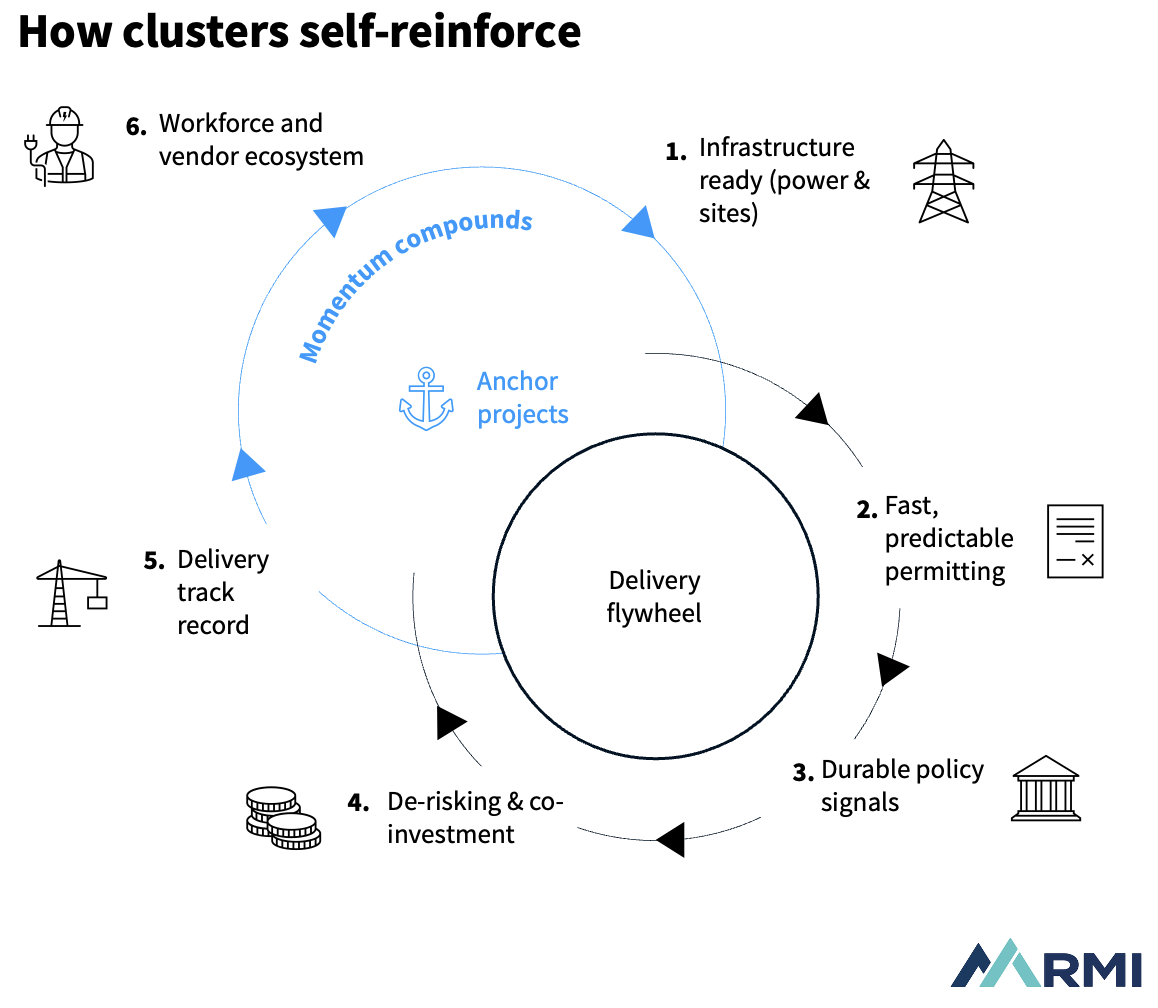
Subnational industrial policy can kick-start or accelerate competitive cluster development, and early momentum is critical to securing lasting advantages. States across the country are passing policies to attract investment, jobs, and manufacturing projects, and some are seeing results, leading to electro-industry clusters already forming across the United States. In some cases, these clusters encompass multiple manufacturing industries. The co-location of EV and battery manufacturing in states like Georgia and North Carolina is one such example (Exhibit A5). In other cases, electro-industrial clusters encompass not just energy technology manufacturing but also semiconductors, electricity infrastructure, and data center development (Exhibit 11).
Exhibit 11
Some states and regions are developing clusters that capitalize on anchor projects announced several years ago. Nevada leaders courted and ultimately secured an investment from Tesla in the mid-2010s that has been key to the state’s Lithium Loop cluster initiative.
Exhibit 12
The leaders of states that have yet to win such anchors understand they must make up for lost ground if they are to develop and sustain robust clusters. Consider for example how Oregon’s leaders described the race to win investment in the manufacture of technologies like solar and battery storage in 2024:
“Oregon’s window of opportunity to stake its claim as a leader in clean energy tech manufacturing is narrow and rapid response is essential…. Because of the clustering effect, the stronger that competitor states’ clean tech clusters grow, the greater the challenge Oregon faces in attracting investment.”
While some windows of opportunity may have narrowed since 2024, others have widened. In geothermal power, for example, Oregon has emerged as an early leader in an approach to geothermal power that, if successfully commercialized, promises extremely high energy density.
For established technologies like batteries and solar and emerging ones like next-generation geothermal, subnational industrial policy offers states a framework for building early leads and catching up to regional competitors. The next section describes its application.
Application
To enable effective subnational industrial strategy, RMI developed a new framework, GREASE, for policy design and evaluation. GREASE stands for governance, regional targeting, expansive ambition, accountability, sector strategies, and environmental co-benefits (Exhibit 13).
Exhibit 13
GREASE enables state and regional stakeholders to assess policy design and effectiveness across goals (e.g., economic competitiveness) and domains (e.g., private capital mobilization). In four key areas where state policy can play a particularly important role in accelerating electro-industrial projects — market development, private capital mobilization, site readiness, and workforce development — states are already passing policies (see Exhibit 14 for a breakdown of policies passed in seven Southeast states).
Exhibit 14
But policy design matters just as much, and RMI used GREASE to surface policy design questions and recommendations to bridge policy gaps in electro-industry research on the US Southeast and the US Southwest and South-Central regions, which can apply to other regions across the country (Exhibit A6).
RMI and partners have leveraged themes within the GREASE framework to evaluate traditional economic development incentives and envision new forms of public financing for electro-industrial technology. Part of the reason for this focus is that states are typically far more cash-strapped than the federal government.
An Upjohn Institute evaluation of state and local development incentives for 50 of the largest-scale investments nationwide indicates that while investment incentives are largely set to yield positive returns for state residents (Exhibit 15), the cost-effectiveness of these incentives is highly sensitive to several factors, from a preexisting state supply chain to the format of the incentives themselves. For example, the disbursement of incentives as specialized services, e.g., infrastructure and workforce support, can improve incentive cost-effectiveness by roughly 50% compared to cash incentives (Exhibit 16).
Exhibit 15
Exhibit 16
While evaluating traditional economic development incentives is important, electro-industrial technologies are quickly evolving. Consequently, subnational industrial policy must ensure that public financing mechanisms support projects with different capital risk profiles. This is why RMI developed a guide on how state public investment and finance institutions (SPIFIs) can accelerate electro-industrial build-out through risk absorption, capital mobilization, and investment coordination (Exhibit A7). SPIFIs are uniquely positioned to unlock electro-industrial growth because they invest in projects with strong economics to boost returns, but they can also invest in projects with a strong public interest and can accept lower or longer-term returns than a private lender. Since barriers to electro-industrial investment differ by technology, and different regions prioritize leadership in different technologies, policy priorities will differ by region.
Across the country, and across domains, states are moving to seize new opportunity. Some state action precedes recent federal industrial policy and its subsequent retrenchment; Nevada’s work to attract Tesla is one such example of this. Other initiatives have followed and directly complemented federal industrial policy. One example is the Make It in Michigan Competitiveness Fund. Another is the Green CHIPS Act in New York.
Other industrial policy approaches are emerging through multistate coordination. One such example is the Mountain West Geothermal Consortium, which seeks to accelerate enhanced geothermal systems commercialization and deployment in Arizona, Colorado, New Mexico, and Utah. Coordinated action across politically diverse states can serve as a powerful catalyst for investor confidence.
Open Questions and Next Steps
The main takeaway from RMI’s work on subnational industrial strategy to date is that pursuing multiple economic and industrial goals simultaneously requires a mixture of discipline and care, particularly when resources are tight. However, with the right approach, state and regional leaders can successfully leverage industrial policy tools to attract and retain priority investment and industry clusters that play to the strengths of the places these leaders represent.
The insights developed through this initiative can help to develop and sharpen state policy today. But new energy technology and the electro-industrial ecosystem are evolving, as is the political and economic climate in the United States. Several questions remain, including:
- How can states identify creative and practical ways of funding ambitious new energy industry initiatives?
- How should governors and other elected officials ensure that industrial policy addresses immediate affordability concerns and accelerates technology commercialization at the same time?
- How should elected officials and economic development leaders communicate the jobs-related benefits of securing manufacturing investment when the nature of manufacturing is rapidly evolving?
- How can state policy and economic leaders design and evaluate industrial policy when relevant market and supply-chain data is unavailable or out of date?
- How can state and regional leaders ensure that they position emerging and established industrial clusters to serve not just domestic markets but also global customers?
To explore these questions, amplify new insights and best practices, and accelerate the development of new energy industrial policy across the United States, RMI is building a national community of practice, New Energy Works, for economic development and energy policy practitioners and stakeholders. For more information, contact the authors at econdev@rmi.org.
Acknowledgments
The authors thank Lachlan Carey and Sarah Ladislaw at the New Energy Industrial Strategy (NEIS) Center for supporting this work. The NEIS Center is a thought partner, funder, and community builder that helps create advanced energy systems that support competitive economies and power the industries of the future.
Related Resources
- “Beyond Green: Forging a New Energy Industrial Strategy for an Age of Competition,” New Energy Industrial Strategy (NEIS) Center, 2025, neiscenter.substack.com.
- Building a Geothermal Powerhouse Region in the South-Central and Southwest United States, Rhodium Group, 2026, rhg.com.
- Building the United States’ Electro-Industrial Economy: A Framework for State Public Investment and Finance Institutions, RMI, 2026, rmi.org.
- “GREASE Lightning: A Playbook for Investment-Led, State-Driven Electro-Industrial Economies,” RMI, 2025, rmi.org.
- Policy Priorities for Electro-Industrial Growth in the Southeast United States, RMI, 2026, rmi.org.
- Policy Priorities for Electro-industrial Growth in the South-Central and Southwest United States, RMI, 2026, rmi.org.
- Sizing and Seizing Economic Opportunity in New Energy Technology, RMI, 2026, rmi.org.
- Solving the Gridlock: America’s Electric Supply Chain Opportunity, RMI, 2026, rmi.org.
- The Economic Benefits and Costs of State and Local Incentives for Clean Energy Projects, W.E. Upjohn Institute for Employment Research, 2026, research.upjohn.org.
- “The Evolution of Green Industrial Policy,” New Energy Industrial Strategy (NEIS) Center, 2025, neiscenter.substack.com.
- “The Geothermal Supply Chain Is America’s to Gain — or Lose,” RMI, 2026, rmi.org.
- Unlocking Electro-industrial Growth to Meet Surging Electricity Demand in the Southeast, Rhodium Group, 2026, rhg.com.
- “Webinar — Advanced Industrial Zones to Bolster Regional Economic Development,” RMI, 2026, rmi.org.
- “What’s Next for Advanced Energy Manufacturing in the United States?,” RMI, 2025, rmi.org.
Appendix
Exhibit A1
Exhibit A2
Exhibit A3
Exhibit A4
Exhibit A5
Exhibit A6
Exhibit A7
Authors

Aaron Brickman
Senior Principal
Ben Feshbach
Associate
Hannah Perkins
Strategic Communications LeadRelated Insights

Gas Utility Depreciation: Recommendations for an Uncertain Future

Help build the clean energy future. Donate today.
Independent research. Real-world solutions. Supported by donors.
RMI can pursue the highest-impact climate and energy solutions because we’re supported by people who believe change is possible. Every gift helps advance the work needed to make clean energy the default choice worldwide.
For other ways to give to RMI, including checks or gifts of stock, please visit Other Ways to Give.
