

Learn how we are working to transform how we use and produce energy.
Stored Potential
Data suggests utility-scale battery energy storage systems are becoming increasingly important for a safe, affordable, and reliable power system in the United States
Why we share this work for free
RMI is an independent nonprofit working to accelerate the clean energy transition. We publish research like this to inform decision-makers and drive real-world impact.
Our work is supported by philanthropy as well as partnerships, including fee-for-service engagements. This support makes it possible for us to share our independent insights for free.
If you find this work valuable, you can support it anytime.
Get more insights like this
Stay up to date with the latest research, analysis, and tools from RMI by opting in to receive occasional emails below. You’ll get new reports, event invitations, and practical insights to help us all accelerate the clean energy transition.
Loading form...
Your download should start automatically. If it doesn’t, click the download button below.
This work is made possible by philanthropy
RMI is a nonprofit supported by donors and partners. Philanthropy enables us to produce independent research and make resources like this freely available.
If you find this report valuable, please consider supporting our work. You can also explore how we partner with organizations to drive impact.
Jump to Section
Across the United States, communities are facing difficult choices about how to balance reliability, affordability, safety, and local priorities when planning the future of their electric systems. Utility-scale battery energy storage systems (BESS) are one of the fastest-growing resource options available to help meet that challenge.
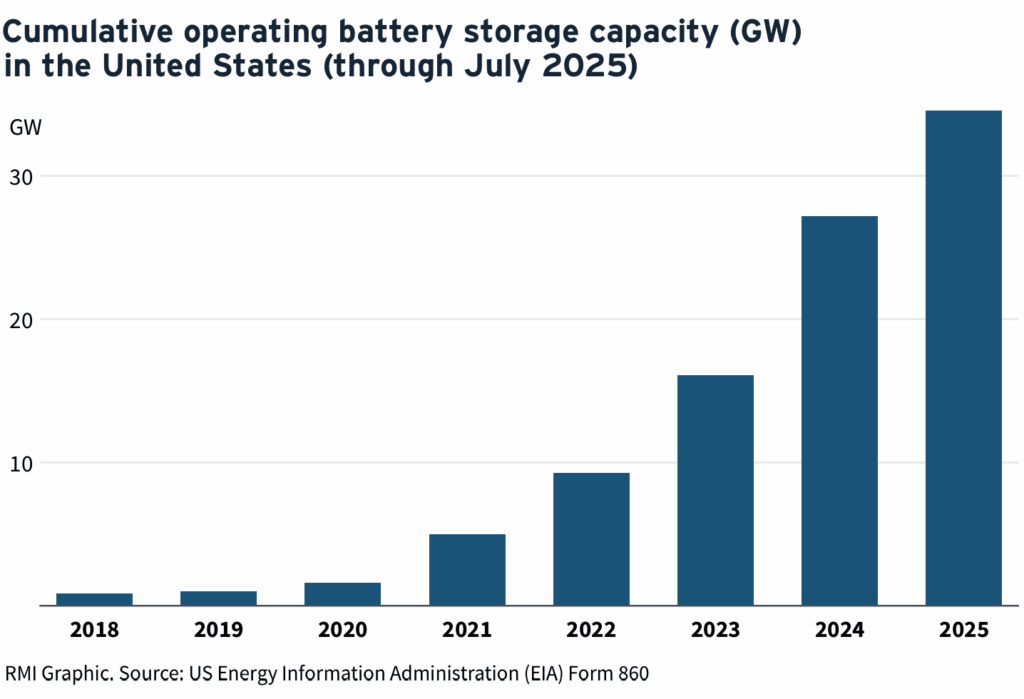
Since 2018, US battery storage capacity has increased more than 40-fold, with roughly 67 gigawatts of additional battery projects planned to come online by 2030. As deployment grows, real-world operating data is beginning to show how batteries perform during periods of grid stress and the benefits they can deliver to host communities and the broader grid.
RMI’s new report, Stored Potential, examines large-scale BESS projects across the United States, drawing on available data to assess their reliability contributions, economic impacts, community benefits, and improving safety performance.
The report details how:
- Batteries help keep the lights on during grid stress.
In California, batteries supplied 13%–19% of total generation during the most grid-stressed hours of 2024. During the state’s 2022 heat wave, they delivered 3.4 GW of capacity, helping to prevent the blackouts that occurred during a similar event in 2020. In Texas, batteries supplied 6%–9% of electricity during the most grid-stressed hours of 2025, delivering up to 7 GW of fast-responding power.
- Battery storage can lower electricity costs during high-demand periods.
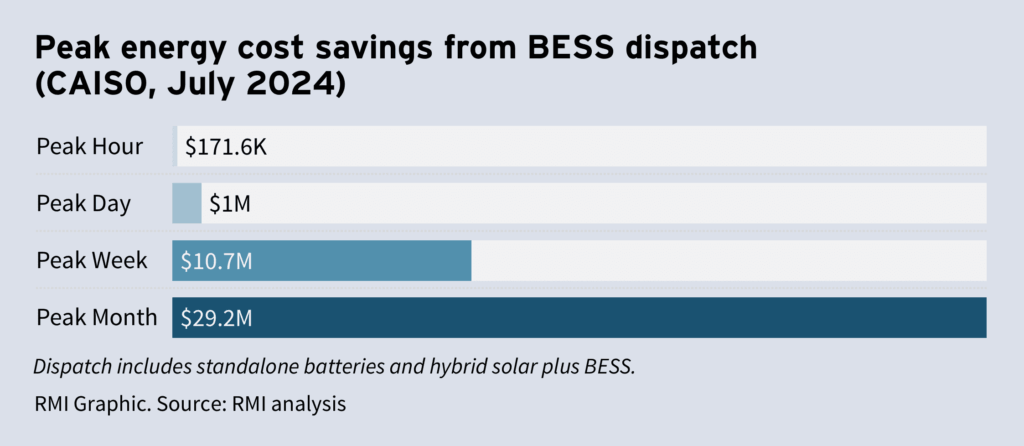
BESS can charge when electricity prices are low and discharge during high-cost peak hours, reducing reliance on expensive peaker plants and lowering costs for ratepayers. In California, RMI’s analysis found that battery dispatch avoided an estimated $29 million in peak energy costs in July 2024 by displacing higher-cost generation, helping lower wholesale electricity prices.
- BESS projects can provide meaningful local economic benefits.
Because most of the value of a battery project lies in taxable equipment and infrastructure, utility-scale BESS facilities can generate significant revenue for host communities. A typical 200 MW project can generate roughly $1.3 million to $2 million per year in local tax revenue for infrastructure and facilities such as schools, emergency services, road maintenance, and county operations.
As the US power system evolves, communities need clear, consistent information to evaluate new energy infrastructure. Stored Potential provides an evidence-based assessment of BESS benefits and declining safety risks, as well as mechanisms to align projects with local needs.
Download the report to explore the data, case studies, and community mechanisms that can shape the next phase of utility-scale battery storage deployment in the United States.
Additional Contributors:
Bev Bendix , Drew Beyer, Jesse Cohen, Genevieve Lillis, Sarah Toth Kotwis, and Gaby Tosado
Authors

Erifili Draklellis
Manager
Celia Tandon
Associate
Aradhana Gahlaut
Senior Associate
Lauren Shwisberg
PrincipalRelated Insights

States Are Opening the Door to Data Center Investment in Virtual Power Plants

Help build the clean energy future. Donate today.
Independent research. Real-world solutions. Supported by donors.
RMI can pursue the highest-impact climate and energy solutions because we’re supported by people who believe change is possible. Every gift helps advance the work needed to make clean energy the default choice worldwide.
For other ways to give to RMI, including checks or gifts of stock, please visit Other Ways to Give.