

Learn how we are working to transform how we use and produce energy.
Procuring and Scaling Grid Flexibility
Two practical guides for policymakers and regulators to procure the flexibility their power systems need and create the conditions for battery storage investment at scale.
Why we share this work for free
RMI is an independent nonprofit working to accelerate the clean energy transition. We publish research like this to inform decision-makers and drive real-world impact.
Our work is supported by philanthropy as well as partnerships, including fee-for-service engagements. This support makes it possible for us to share our independent insights for free.
If you find this work valuable, you can support it anytime.
Get more insights like this
Stay up to date with the latest research, analysis, and tools from RMI by opting in to receive occasional emails below. You’ll get new reports, event invitations, and practical insights to help us all accelerate the clean energy transition.
Loading form...
Your download should start automatically. If it doesn’t, click the download button below.
This work is made possible by philanthropy
RMI is a nonprofit supported by donors and partners. Philanthropy enables us to produce independent research and make resources like this freely available.
If you find this report valuable, please consider supporting our work. You can also explore how we partner with organizations to drive impact.
Jump to Section
How should decision makers procure the flexibility their power systems need? What role can battery energy storage systems (BESS) play in providing that flexibility? And what conditions are needed to turn BESS pipelines into sustained deployment? Two resources from RMI and Global Energy Alliance provide practical guidance to help global power sector leaders answer these questions.
Periods of technological change have repeatedly reshaped electricity systems, requiring regulators and system operators to adapt planning, operational, and procurement frameworks to maintain reliable and affordable electricity and support economic growth. Today is no different. Declining renewable energy costs, growing electricity demand, advances in digital technologies, evolving operating conditions, and increasing focus on energy security are changing the services power systems need and increasing the value of flexibility — the ability to respond to changes in electricity supply, demand, and grid conditions.
New technologies are also expanding the range of resources capable of providing that flexibility. Battery energy storage systems, in particular, can support resource adequacy, system balancing, and system stability across multiple timescales. Decision makers need frameworks to identify and procure the services their systems require, while developers and investors need regulatory and commercial conditions that allow projects to reach financial close and scale.
This two-part series provides practical guidance for policymakers, regulators, utilities, and system operators across both challenges.
Part 1 — Procuring Grid Flexibility
A global guide for decision makers to increase power system reliability and affordability in the context of rapid technological change
There is no single pathway to enabling flexibility. Rather than prescribing a single procurement model, Procuring Grid Flexibility provides decision makers with practice guidance to:
- Understand evolving reliability needs and the drivers increasing the value of power system flexibility.
- Translate reliability needs into procurable services and define the performance requirements needed to deliver them.
- Select and design appropriate procurement mechanisms based on grid needs, market structure, institutional capacity, and other system conditions.
- Apply lessons from international experience and identify where additional technical analysis, stakeholder engagement, or peer learning may be needed for implementation.
Download part 1 here.
Part 2 — Making BESS Investable
How policy, procurement, and market design translate project pipelines into operational battery energy storage system fleets and sustained deployment
Making BESS Investable builds on the procurement foundations in the first report and examines the conditions needed for projects to attract investment, reach financial close, and scale. It provides decision makers with practical guidance to:
- Understand how BESS markets develop over time, from establishing procurement foundations to sustained, market-driven deployment.
- Identify the conditions needed to make BESS projects bankable: using four pillars — delivery certainty, regulatory clarity, revenue access, and revenue predictability — to diagnose barriers to investment.
- Identify and prioritize reforms based on local market conditions, institutional capacity, and stage of market development.
- Draw lessons from global markets on how regulatory, commercial, and financing frameworks can evolve as BESS deployment scales.
Download part 2 here.
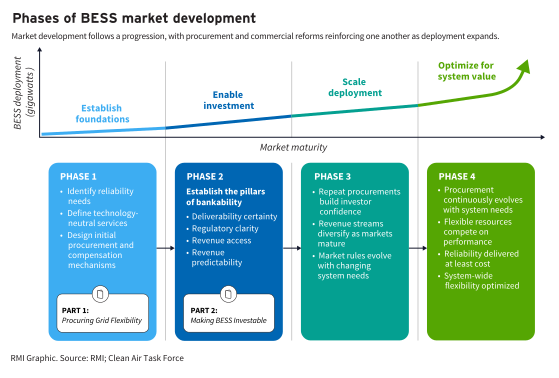
Together, the reports provide a practical pathway from understanding what flexibility a power system needs and how to procure it, to creating the conditions that enable investment and sustained deployment.
RMI and Global Energy Alliance continue to support governments in translating these concepts into implementation through BESS roadmaps, economic viability assessments, procurement and market design, regulatory reform, project deployment resources, and more.
To discuss how these frameworks could be applied in your jurisdiction, access additional resources and international case studies, or explore opportunities for technical support, contact electricity-contact@rmi.
RMI gratefully acknowledges the Global Energy Alliance for People and Planet for its partnership and support of this work through the Global BESS Consortium. For more on Global Energy Alliance and the BESS consortium, please visit BESS Consortium | Global Energy Alliance for People and Planet.
We extend particular thanks to the following colleagues at the Global Energy Alliance for their contributions to these reports: Damola Omole, Deepthi Valsan, and Nirmal Shaju.

Authors

Drew Beyer
Senior Associate
Janela Cantre
Tony Chen

Eshan Gupta
Associate
Sarah Toth Kotwis
Technical Manager
Genevieve Lillis
Manager
James Sherwood
Principal
Kriti Singh
AssociateRelated Insights

For Clean Energy Projects, How Community Benefits Are Delivered Matters
Tracking WestTEC: Where 100+ Transmission Projects Stand and What Comes Next


Help build the clean energy future. Donate today.
Independent research. Real-world solutions. Supported by donors.
RMI can pursue the highest-impact climate and energy solutions because we’re supported by people who believe change is possible. Every gift helps advance the work needed to make clean energy the default choice worldwide.
For other ways to give to RMI, including checks or gifts of stock, please visit Other Ways to Give.
