

Learn how we are working to transform how we use and produce energy.
Transforming Indonesia’s Transportation
Accelerating EV Adoption for Two- and Four-Wheelers
Why we share this work for free
RMI is an independent nonprofit working to accelerate the clean energy transition. We publish research like this to inform decision-makers and drive real-world impact.
Our work is supported by philanthropy as well as partnerships, including fee-for-service engagements. This support makes it possible for us to share our independent insights for free.
If you find this work valuable, you can support it anytime.
Get more insights like this
Stay up to date with the latest research, analysis, and tools from RMI by opting in to receive occasional emails below. You’ll get new reports, event invitations, and practical insights to help us all accelerate the clean energy transition.
Loading form...
Your download should start automatically. If it doesn’t, click the download button below.
This work is made possible by philanthropy
RMI is a nonprofit supported by donors and partners. Philanthropy enables us to produce independent research and make resources like this freely available.
If you find this report valuable, please consider supporting our work. You can also explore how we partner with organizations to drive impact.
Jump to Section
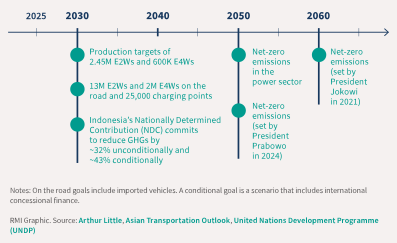
Exhibit 1: Indonesia e-mobility and net-zero goals timeline
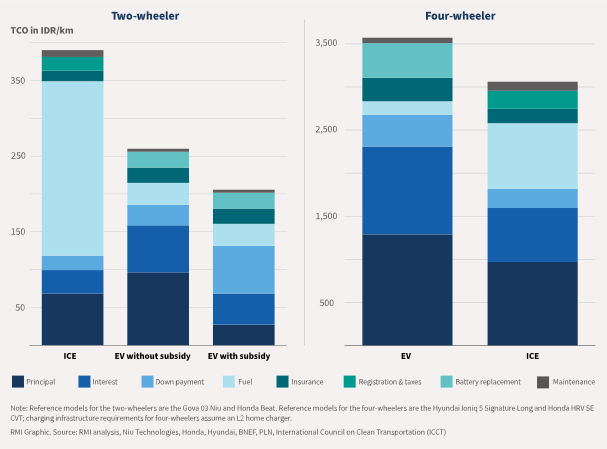
EVs provide health benefits due to their zero tailpipe emissions, save money for consumers because of their lower total cost of ownership (TCO), and can help Indonesia reach its climate pollution goals due to their lower life-cycle CO2 emissions. Even without subsidies, the cost of two-wheel EVs is over 30 percent lower than their gasoline counterparts on a TCO basis, as seen in Exhibit 2 below. The unsubsidized cost of four-wheel EVs is still higher than gasoline vehicles but is projected to reach cost parity on a TCO basis by 2025–2026, depending on the model and utilization.
Exhibit 2: TCO comparison for two- and four-wheelers
This report provides a whole-system approach for how Indonesia can accelerate the adoption of electric two- and four-wheelers. This includes:
- EV policy – Comprehensive supply-side policies, as well as demand-side and infrastructure policies can support increased EV market growth.
- EV financing – De-risking financing can improve affordability and increase capital from private financiers.
- Technology adoption – Ensuring there are a diverse range of affordable vehicles on the market as well as sufficient charging infrastructure to meet Indonesian market needs is essential for increasing adoption.
- Corporate engagement and consumer awareness – Corporate stakeholders have a key role to play as early adopters, and to create demand for vehicles and charging infrastructure. Additionally, public awareness efforts can ensure consumers have the information they need to make purchasing decisions.
The Indonesian government has goals of 13 million electric two-wheelers and 2 million electric four-wheelers on the road by 2030. Reaching these goals requires significant collaboration across a wide range of stakeholders such as government ministries, original equipment manufacturers, PLN (Indonesia’s state-owned electric utility), infrastructure providers, fleet operators, financiers, and business associations. This report details the near-term and long-term actions necessary to meet these goals.
The authors are grateful for the input provided on the report by the International Council of Clean Transporation (ICCT), the Institute for Transportation and Development Policy (ITDP), and Randy Rakmadi and Etsa Amanda of Yayasan Visi Indonesia Raya Emisi Nol Bersih (ViriyaENB).
The authors would also like to thank the Drive Electric Campaign for their generous support that made this report possible.
Authors

Monkgogi Buzwani
Associate
Kelly Carlin
Manager
Rizky Fauzianto

Hannah Lindsell
Senior Associate
Marie McNamara
Manager
Brian O’Hanlon
Managing Director
Samhita Shiledar
Principal
Kriti Singh
Associate
AEML
Eko Adji Buwono (ENTREV)
Related Insights
For Clean Energy Projects, How Community Benefits Are Delivered Matters

Tracking WestTEC: Where 100+ Transmission Projects Stand and What Comes Next
Help build the clean energy future. Donate today.
Independent research. Real-world solutions. Supported by donors.
RMI can pursue the highest-impact climate and energy solutions because we’re supported by people who believe change is possible. Every gift helps advance the work needed to make clean energy the default choice worldwide.
For other ways to give to RMI, including checks or gifts of stock, please visit Other Ways to Give.
