

Learn how we are working to transform how we use and produce energy.
The EV Revolution in Five Charts and Not Too Many Numbers
The exponential growth of electric vehicles marks the end of the ICE age, putting half of oil demand at risk
Why we share this work for free
RMI is an independent nonprofit working to accelerate the clean energy transition. We publish research like this to inform decision-makers and drive real-world impact.
Our work is supported by philanthropy as well as partnerships, including fee-for-service engagements. This support makes it possible for us to share our independent insights for free.
If you find this work valuable, you can support it anytime.
Get more insights like this
Stay up to date with the latest research, analysis, and tools from RMI by opting in to receive occasional emails below. You’ll get new reports, event invitations, and practical insights to help us all accelerate the clean energy transition.
Loading form...
Your download should start automatically. If it doesn’t, click the download button below.
This work is made possible by philanthropy
RMI is a nonprofit supported by donors and partners. Philanthropy enables us to produce independent research and make resources like this freely available.
If you find this report valuable, please consider supporting our work. You can also explore how we partner with organizations to drive impact.
Jump to Section
The exponential growth of electric vehicles (EVs) means that ICE (internal combustion engine) sales and gasoline demand have already peaked and will be in freefall by 2030. So the end of the ICE age has begun, putting at risk half of global oil demand. This is the subject of RMI’s latest report: X-change: Cars.
1. EV Sales are growing exponentially up S-curves
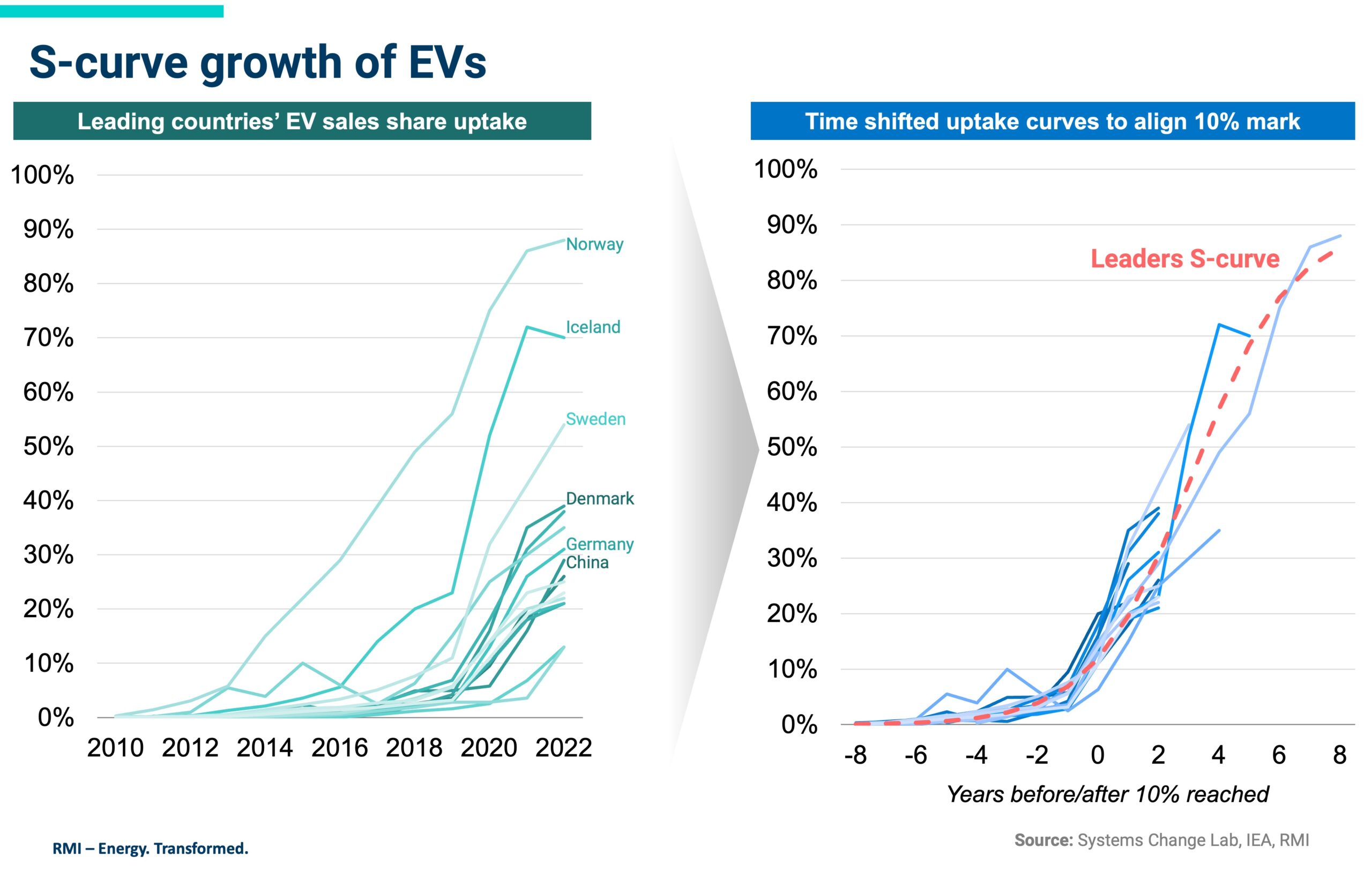
EV sales growth is on an S-curve, and one country after another is taking a similar path. In broad terms it is taking about six years for countries to go from 1 percent to 10 percent market share and then another six years or so for leading countries to get to 80 percent. Globally, nearly one in five car sales in 2023 will be an EV, up from one in ten two years ago.
2. Forecasters keep underestimating the speed of EV growth
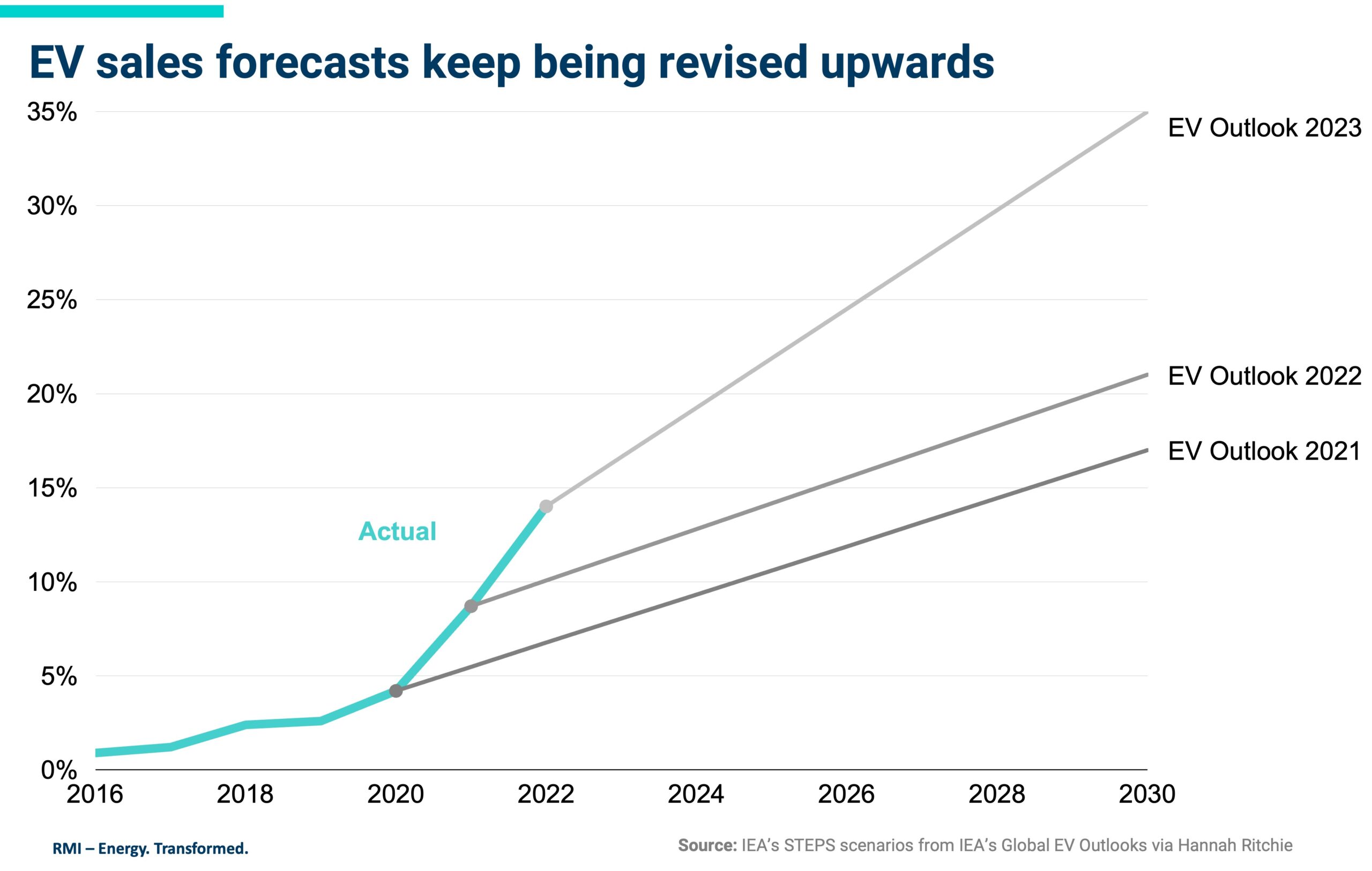
Each year forecasters revise their EV market share projections upwards, as battery prices fall on learning curves, consumer preferences shift to EVs, and leading countries figure out how to upgrade grids and deploy charging infrastructure. Consensus is currently clustered around an EV market share of 40 percent in 2030, but that would require growth to slow down dramatically. Such a slowdown is of course possible, but that is a contrarian position, not a default one.
3. The drivers of change are getting stronger
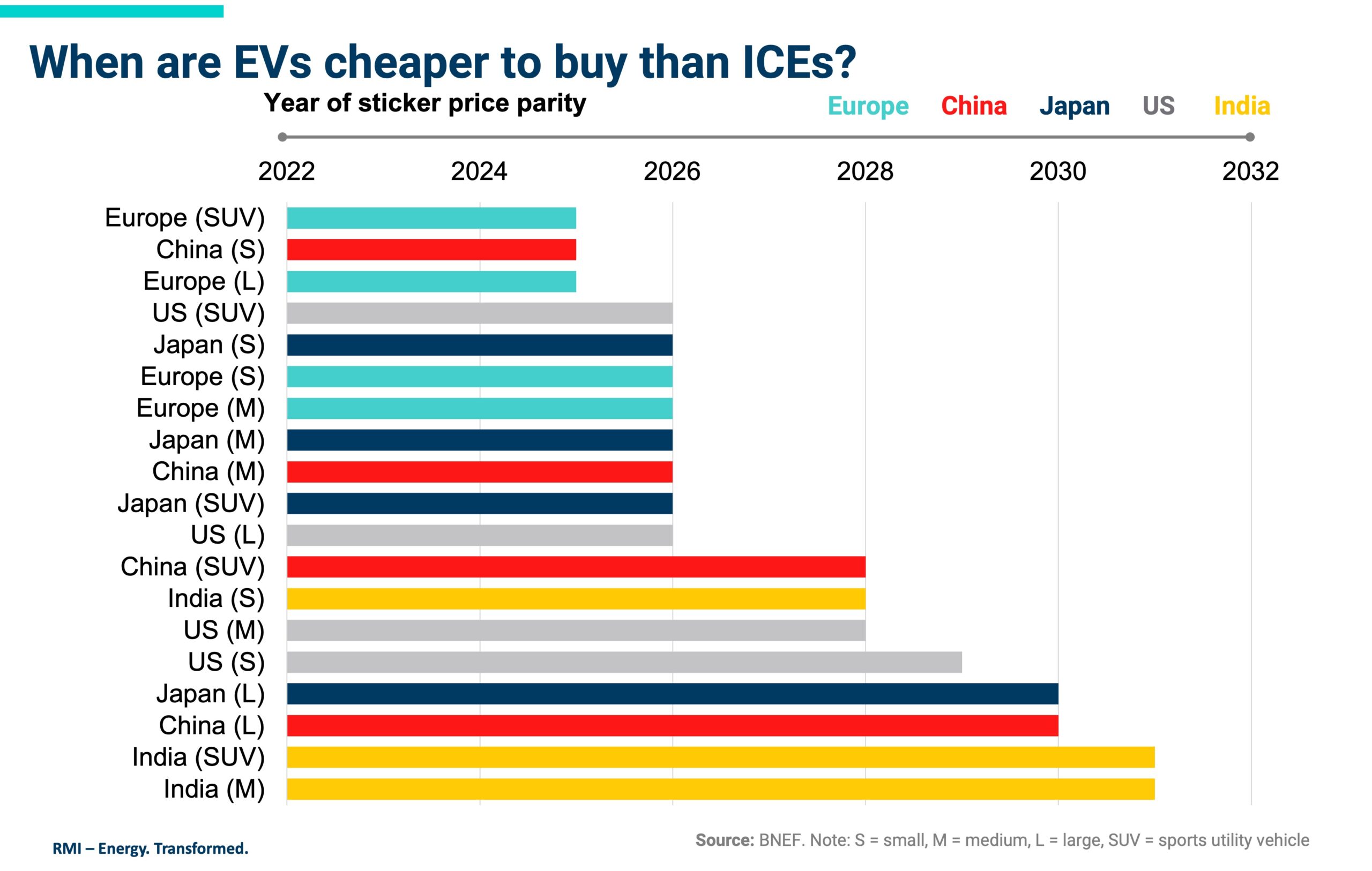
The main driver of change has been policy but now it is being joined by economics and the race for technology leadership. Continuity on learning curves implies battery prices will halve by 2030, enabling every major country and vehicle type to enjoy sticker price parity. Meanwhile, Chinese leadership has sparked a race to the top to dominate the EV technologies of the future.
4. Exponential growth will continue
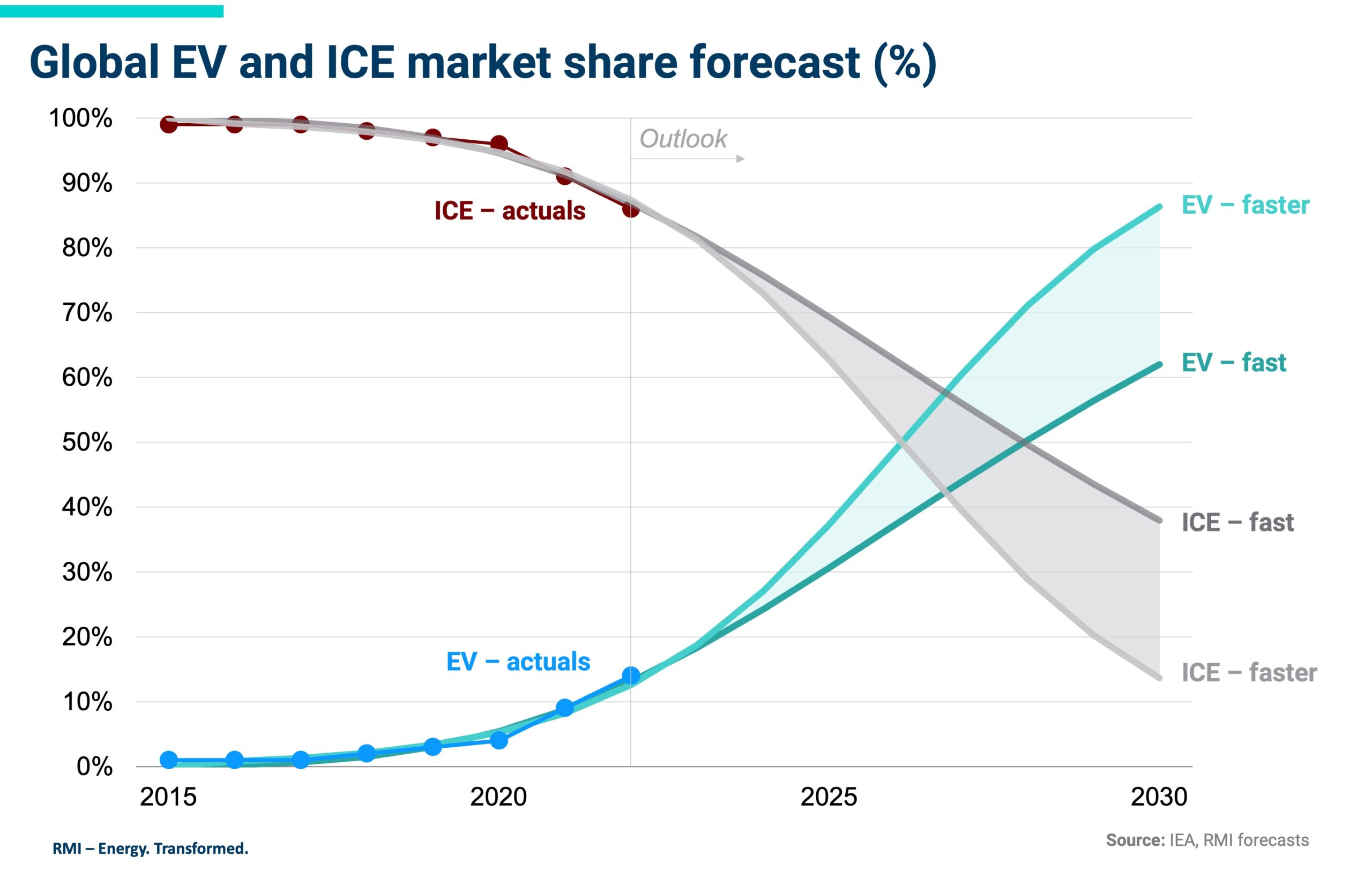
Our S-curve modelling, based on the EV growth so far and the lessons of other technology shifts, suggests EV sales will grow at least four-fold by 2030, and make up between 62 percent and 86 percent of global car sales in 2030. EV sales could overtake ICE sales as early as 2026.
5. The growth of EVs pushes the ICE fleet and oil demand for cars into terminal decline
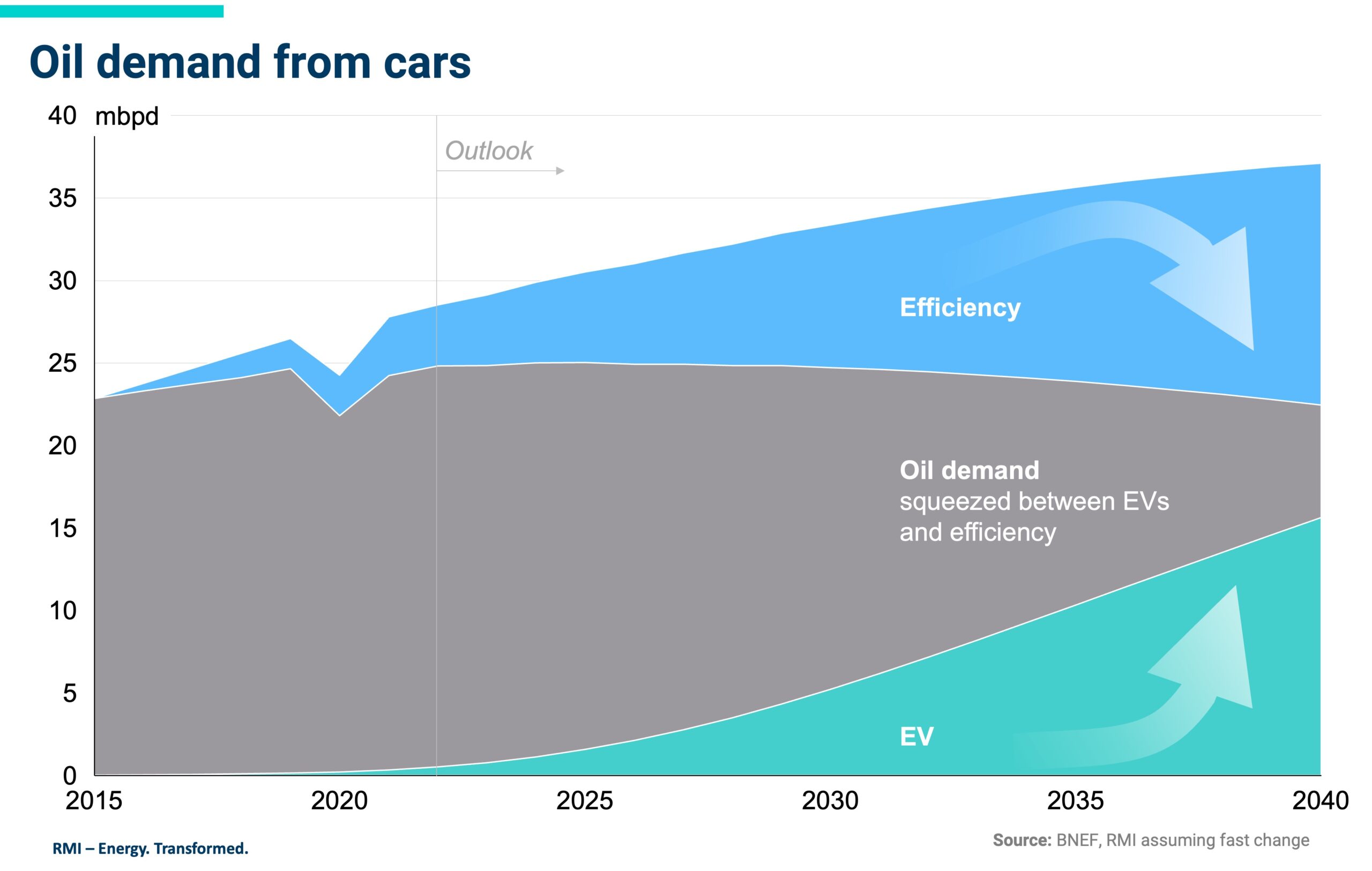
The growth of EVs up S-curves means that ICE sales peaked in 2017, gasoline demand peaked in 2019, and the ICE fleet will peak in the middle of the decade. Oil demand for cars will then be squeezed between continued efficiency gains and the rise of EVs. Once electric vehicles make up the vast majority of car sales, the world is around 15 years away from a quarter of oil demand falling to zero. And where cars lead, so a similar path is taken by 2-wheelers in the Global South and trucks in developed markets, meaning that half global oil demand from the road sector will soon be at risk.
The end of the ICE age is here, but we cannot rest on our laurels; challenges are many and we need to keep solving them. For motivations as diverse as costs, peace, air pollution, and climate, it is essential to make this fast transition faster.
Find the full report here
Authors

Kingsmill Bond
Sam Butler-Sloss
Related Insights



Help build the clean energy future. Donate today.
Independent research. Real-world solutions. Supported by donors.
RMI can pursue the highest-impact climate and energy solutions because we’re supported by people who believe change is possible. Every gift helps advance the work needed to make clean energy the default choice worldwide.
For other ways to give to RMI, including checks or gifts of stock, please visit Other Ways to Give.
