

Learn how we are working to transform how we use and produce energy.
Why we share this work for free
RMI is an independent nonprofit working to accelerate the clean energy transition. We publish research like this to inform decision-makers and drive real-world impact.
Our work is supported by philanthropy as well as partnerships, including fee-for-service engagements. This support makes it possible for us to share our independent insights for free.
If you find this work valuable, you can support it anytime.
Get more insights like this
Stay up to date with the latest research, analysis, and tools from RMI by opting in to receive occasional emails below. You’ll get new reports, event invitations, and practical insights to help us all accelerate the clean energy transition.
Loading form...
Your download should start automatically. If it doesn’t, click the download button below.
This work is made possible by philanthropy
RMI is a nonprofit supported by donors and partners. Philanthropy enables us to produce independent research and make resources like this freely available.
If you find this report valuable, please consider supporting our work. You can also explore how we partner with organizations to drive impact.
Jump to Section
This report was co-authored with Energy Transition Office Nigeria (ETO Nigeria). We would like to thank them for acting as a key partner in the creation of this report. ETO Nigeria supports the Nigerian government in the implementation of its Energy Transition Plan, and is resourced by the Global Energy Alliance for People and Planet (GEAPP) and Sustainable Energy for All (SEforALL).
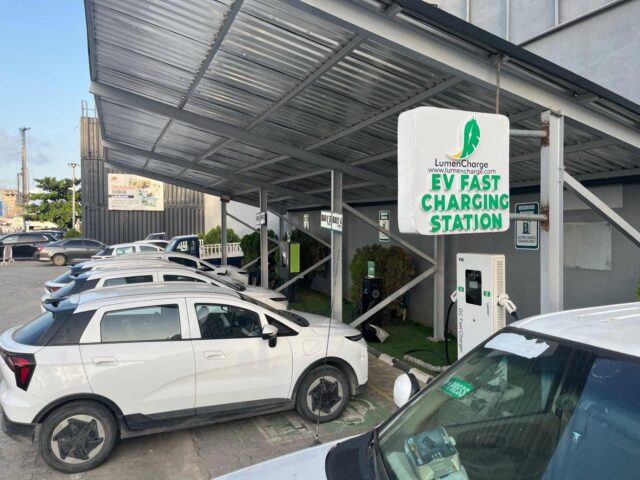
Nigeria has experienced rapidly rising transportation costs since the removal of its fuel subsidy in 2023. The country is also looking to position itself as a technological and economic leader in EV manufacturing.
Underpinning these rising costs and the country’s EV ambition, Nigeria has one of the world’s most ambitious decarbonization efforts — to reach carbon neutrality by 2060. In 2022, Nigeria published its Energy Transition Plan, which summarizes the ways in which the country will reduce emissions; it then established the Energy Transition Office, responsible for leading the plan’s execution.
The transportation sector is a critical part of Nigeria’s decarbonization strategy. RMI’s report, A Vision for E-Mobility in Nigeria: The Opportunity, Challenges, and Path Forward, developed in partnership with Nigeria’s Energy Transition Office, outlines the challenges and opportunities facing the country as it works to implement this strategy.
The report also includes:
- A framework stakeholders can use to advance their e-mobility efforts;
- The environmental, economic, and social benefits of electrification; and
- The policies, finance mechanisms, and actions that will rapidly, equitably, and efficiently electrify Nigeria’s transportation sector.
As Africa’s most populous country, with one of the continent’s largest economies, Nigeria has the power to not only transform the lives of its citizens but also those of dozens of other countries, which can learn from Nigeria’s experiences and develop and implement strategies of their own.
Authors

Patience Bukirwa

Monkgogi Buzwani
Associate
Kelly Carlin
Manager
Hannah Lindsell
Senior Associate
Kriti Singh
Associate
Samhita Shiledar
Principal
Dave Mullaney
Clay Stranger
Lolade Abiola (Energy Transition Office
Nigeria)
Abdulrasheed Wakil (Energy Transition Office
Nigeria)
Related Insights

Building Charging Networks That Meet Drivers’ Needs Without Breaking the Bank


Help build the clean energy future. Donate today.
Independent research. Real-world solutions. Supported by donors.
RMI can pursue the highest-impact climate and energy solutions because we’re supported by people who believe change is possible. Every gift helps advance the work needed to make clean energy the default choice worldwide.
For other ways to give to RMI, including checks or gifts of stock, please visit Other Ways to Give.
