

Learn how we are working to transform how we use and produce energy.
Assessing a Louisiana-Japan Green Shipping Corridor
A feasibility study for dry bulk trade
Why we share this work for free
RMI is an independent nonprofit working to accelerate the clean energy transition. We publish research like this to inform decision-makers and drive real-world impact.
Our work is supported by philanthropy as well as partnerships, including fee-for-service engagements. This support makes it possible for us to share our independent insights for free.
If you find this work valuable, you can support it anytime.
Get more insights like this
Stay up to date with the latest research, analysis, and tools from RMI by opting in to receive occasional emails below. You’ll get new reports, event invitations, and practical insights to help us all accelerate the clean energy transition.
Loading form...
Your download should start automatically. If it doesn’t, click the download button below.
This work is made possible by philanthropy
RMI is a nonprofit supported by donors and partners. Philanthropy enables us to produce independent research and make resources like this freely available.
If you find this report valuable, please consider supporting our work. You can also explore how we partner with organizations to drive impact.
Jump to Section
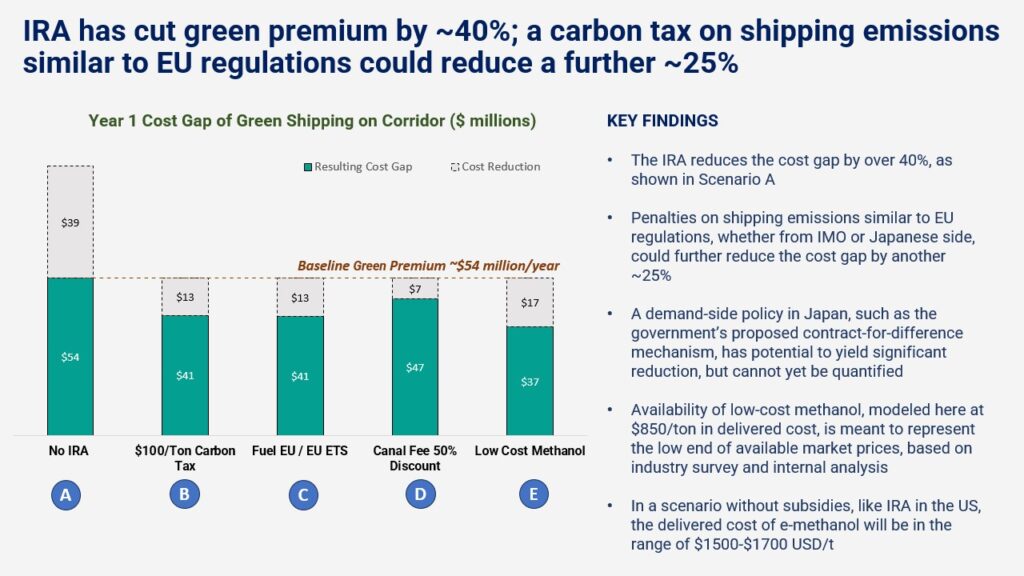
This feasibility study explores the viability of establishing a green shipping corridor for dry bulk trade between the US Gulf Coast and Japan, focusing on technical, economic, and operational components. The initiative, driven by both public and private sector interest, aims to decarbonize shipping by utilizing zero or near-zero emission fuels. The study aligns with the goals of the US and Japanese governments and private stakeholders to reduce emissions, promote alternative fuel production, and build infrastructure for low-carbon fuels.
This analysis was supported by the Green Hydrogen Catapult and led by RMI in collaboration with the Maersk Mc-Kinney Moller Center for Zero Carbon Shipping, Cargill, and Hy Stor Energy. The study examines the feasibility of adopting green methanol as a fuel in dual-fuel bulk carriers by 2030, identifying key cost drivers and opportunities for reducing cost premiums and evaluating the influence of potential policies and regulatory frameworks on the deployment of zero-emission technology.


Related Insights

The Opportunity for Heat Pumps to Put Downward Pressure on Electricity Rates


Gas Utility Depreciation: Recommendations for an Uncertain Future
Help build the clean energy future. Donate today.
Independent research. Real-world solutions. Supported by donors.
RMI can pursue the highest-impact climate and energy solutions because we’re supported by people who believe change is possible. Every gift helps advance the work needed to make clean energy the default choice worldwide.
For other ways to give to RMI, including checks or gifts of stock, please visit Other Ways to Give.
