

Learn how we are working to transform how we use and produce energy.
Advance Market Commitments Today Can Build a Low-Carbon Tomorrow
At a time when rising emissions call for rapid innovation in a range of sectors, AMCs can help signal to producers that buyers are ready once the technology is.
Why we share this work for free
RMI is an independent nonprofit working to accelerate the clean energy transition. We publish research like this to inform decision-makers and drive real-world impact.
Our work is supported by philanthropy as well as partnerships, including fee-for-service engagements. This support makes it possible for us to share our independent insights for free.
If you find this work valuable, you can support it anytime.
Get more insights like this
Stay up to date with the latest research, analysis, and tools from RMI by opting in to receive occasional emails below. You’ll get new reports, event invitations, and practical insights to help us all accelerate the clean energy transition.
Loading form...
Your download should start automatically. If it doesn’t, click the download button below.
This work is made possible by philanthropy
RMI is a nonprofit supported by donors and partners. Philanthropy enables us to produce independent research and make resources like this freely available.
If you find this report valuable, please consider supporting our work. You can also explore how we partner with organizations to drive impact.
Jump to Section
Innovation often takes two things: someone to create the innovative product, and someone to pay for it. Where that can become complicated is in the case of new technologies, especially ones so new that they don’t yet have a market ready to pay. Online platforms like Kickstarter can fill this gap when it comes to one-off, smaller projects – true believers front inventors the money to pursue their innovation in return for being first to get the finished product. But what about kickstarting an entire market?
Enter advance market commitments, AMCs for short. Just like a Kickstarter, they are a financial mechanism designed to stimulate the development and deployment of new technologies by guaranteeing a future market for them. On a large scale, an AMC is a promise by governments, private companies, or other entities to purchase a specified amount of a product or service once it becomes available. This commitment gives suppliers proof to bring to investors, lenders, and developers that their product will have an end market, which leads to the development and deployment of innovation.
AMCs also have the benefit of reducing risk for those promising to purchase the end product: for some AMCs, purchasers only have to pay once the product is produced. The signal of intent alone is meant to stimulate investment from others. Additionally, many AMCs have a pool of suppliers that buyers can choose from, meaning risk is spread across several suppliers, and concentration risks are reduced.
And we’ve already seen that they work. Take the example of vaccines: in 2009, donors created an AMC that committed to spend $1.5 billion to purchase the pneumococcal vaccine for low-income countries. This AMC sent a signal to pharmaceutical producers that a market was ready for the product, and production increased and vaccination coverage accelerated significantly. In another example, in 2020, California signed a $50 million AMC agreement with Civica RX for low-cost insulin production. This AMC is expected to lead to more transparent and drastically reduced prices for insulin.
At a time when rising emissions call for rapid innovation in a range of sectors, AMCs can help signal to producers that buyers are ready once the technology is. This is especially important for sectors such as aviation, buildings, and nascent industries like hydrogen and carbon dioxide removal which need strong demand signals to prove to financers that there are buyers out there ready to purchase innovative products. Below, we define the core steps involved in creating an AMC and some key considerations.
Defining the market
A successful AMC starts with good design: identifying the product to incentivize, who will be involved, and what success looks like.
An AMC must define the market relevant to its activities and should align its design with the market it intends to advance. A successful AMC must define the boundaries of the market, including products supported, its geographic area, customer base, and other considerations. Questions such as what products the AMC should support, how the product’s success is measured, and which geographies are being targeted all inform a market definition.
Answering questions of purchasing is also pivotal to an AMC: whether AMC members only pay for a completed product or service, if they receive a discount on the final price, or whether they are merely subsidizing development are key considerations. The level of funding required to be a member, and how that is defined, must also be taken into account.
Suppliers, buyers, and supporters: the foundations of an AMC
In addition to defining the market, a successful AMC also identifies who will be involved and what success looks like. AMCs must define who is an eligible supplier — this could mean companies, governments, or entities already focused in the targeted sector; companies, governments, or entities with capabilities to expand into the sector; or a mixture.
Depending on the AMC’s target, buyers can range from public or private entities. In the case of government entities, defining at which government level (e.g., national, international, sub-national) buyers are eligible will guide the design of the AMC.
Outside of suppliers and buyers, supporters in the fields of philanthropy, academia, and NGOs can also guide AMCs by engaging with and informing the design process and providing expertise in the AMC’s initial stages. These non-government, non-corporate actors can also serve as mediating entities in AMC design stages where there may be conflict-of-interest issues for other actors.
The nuts and bolts
Beyond these core definitions of market scope and buyers, AMCs can vary based on the standards and methodologies they use and in how those standards and methodologies are selected. They can also differ in their approach — that is, how a product or service is purchased. Standards are the high-level principles project developers must follow, whereas methodologies are detailed procedures for quantifying emissions, embodied carbon, removals, and other metrics that comply with an overarching standard. The way an AMC designs its standards and procurement processes will change its impact.
An AMC could either adopt existing standards and methodologies or create them from scratch. Making standards and methodologies from scratch takes more time and effort and risks contradicting other market mechanisms; however, it allows for more flexibility and could set a higher bar for a market. Additionally, it is important to decide what body, made up of which individuals, has the power to determine standards and methodologies.
Determining how procurement occurs is largely a question of who. Who conducts solicitations? Who conducts diligence (ensures projects and products are up to par and what they claim to be)? Who has final decision-making power? Who executes the purchase? The answer to each of these questions can be some combination of the AMC mechanism or members of the AMC.
Challenges, risks, and mitigation strategies
Like any policy or market-shaping tool, AMCs present challenges, but many risks can be mitigated through thoughtful design. One risk of an AMC is that suboptimal technologies may be locked in if the market is defined too narrowly or does not allow for flexibility as best practices and technologies evolve. However, this risk can be mitigated if the market is defined by the performance outcomes that technologies must deliver rather than by specific technologies, and by regularly reviewing and updating the market definition.
Furthermore, there can be risk to governments or purchasers who commit money to the AMC because, oftentimes, they are investing in early-stage technologies that have not yet been proven commercially. This risk can also be mitigated by making payments contingent on product delivery (an approach that is only feasible for more mature products), pooling money from several buyers, spreading purchases across a variety of suppliers, and having back-up plans, such as a buffer stock of the product.
AMCs are not a silver bullet, but with additional complimentary policy, they can make a real difference for early-stage technologies. For example, AMCs do not occur on the scale necessary to develop shared infrastructure. Other mechanisms, like supply side incentives and industrial clusters are likely necessary for this. Further, an AMC can lay the groundwork for mechanisms that require greater lead time to set up but are better and more scalable long-term solutions.
Supportive mechanisms and which gaps they fill
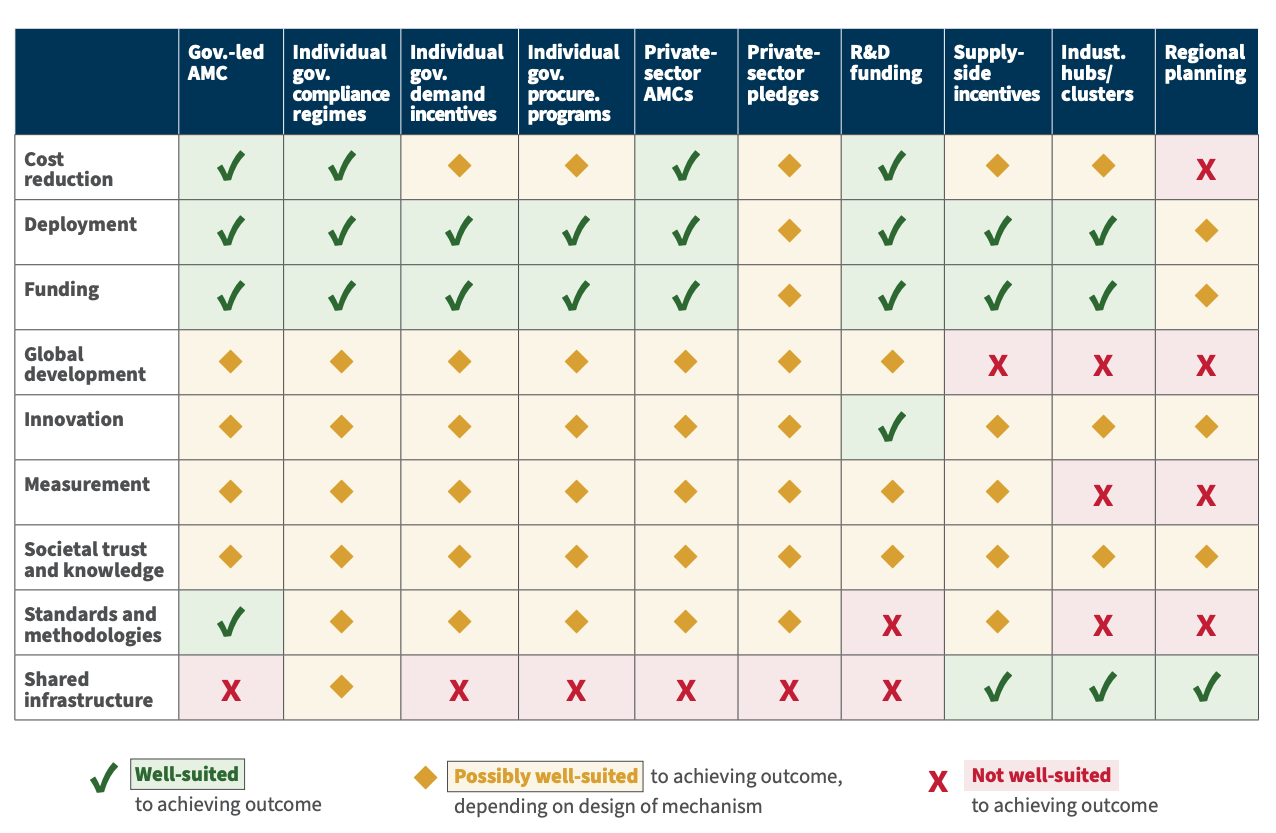
RMI Graphic: Source: RMI analysis
Note: You can find more information about this graphic in our report, A Government-Led Advance Market Commitment (AMC) for Carbon Removal
Looking Ahead
The scale of the challenges before us in accelerating the energy transition and reversing decades of pollution are immense. These challenges call for big ideas from organizations that can solve these problems together. AMCs can provide a powerful market signal that buyers are available for the solutions we urgently need, helping to get investors off the fence and encourage innovators.



Related Insights

A Government-Led Advance Market Commitment (AMC) for Carbon Removal



Help build the clean energy future. Donate today.
Independent research. Real-world solutions. Supported by donors.
RMI can pursue the highest-impact climate and energy solutions because we’re supported by people who believe change is possible. Every gift helps advance the work needed to make clean energy the default choice worldwide.
For other ways to give to RMI, including checks or gifts of stock, please visit Other Ways to Give.
