

Learn how we are working to transform how we use and produce energy.
Why we share this work for free
RMI is an independent nonprofit working to accelerate the clean energy transition. We publish research like this to inform decision-makers and drive real-world impact.
Our work is supported by philanthropy as well as partnerships, including fee-for-service engagements. This support makes it possible for us to share our independent insights for free.
If you find this work valuable, you can support it anytime.
Get more insights like this
Stay up to date with the latest research, analysis, and tools from RMI by opting in to receive occasional emails below. You’ll get new reports, event invitations, and practical insights to help us all accelerate the clean energy transition.
Loading form...
Your download should start automatically. If it doesn’t, click the download button below.
This work is made possible by philanthropy
RMI is a nonprofit supported by donors and partners. Philanthropy enables us to produce independent research and make resources like this freely available.
If you find this report valuable, please consider supporting our work. You can also explore how we partner with organizations to drive impact.
Jump to Section
Updated on 9/17/2026
Critical sectors of our economy like cement, steel, maritime shipping, and aviation urgently require decarbonization. But decarbonizing these sectors is expensive, as most transitions require significant new infrastructure to be built. And supply is typically concentrated in relatively few large facilities, whereas demand – and especially demand willing to pay a premium – is fragmented.
But what if buyers could pool their purchasing power to help overcome these barriers? By working together, buyers can send a powerful demand signal for commonly defined green products, gain economies of scale, and reduce individual first-mover risk, helping accelerate the deployment of critical low-emissions products.
Let’s break it down.
What is demand aggregation?
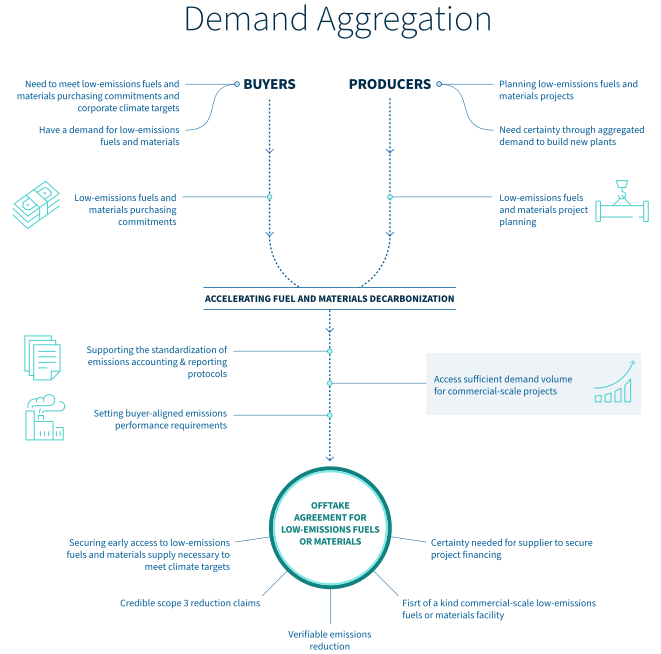
Demand aggregation is the process of consolidating individual demand from multiple buyers into a single, larger signal.
This strategy, used to structure collective procurement of large volumes, enables climate-ambitious consumers to accomplish two important goals: send a stronger demand signal for low-emissions products and subsequently help suppliers to accelerate new investments. With nearly 600 low-emissions projects required to come under construction before 2030 to bring heavy industrial sectors in line with net zero, leveraging demand pooling mechanisms will be critical to limiting global warming to 1.5°C above pre-industrial levels.
Why aggregate demand?
Although the technologies exist to significantly slash emissions across heavy industry and transportation, scaling these low-emissions alternatives is initially expensive and requires large upfront investment. Each industry’s path to decarbonization requires infrastructure buildout (i.e., constructing or adapting new or existing production facilities or building and connecting new energy delivery and storage capacity) and each comes with its own set of complexities, risks, and capital expenses. Especially in earlier stages of the market, these costs typically make low-emissions alternatives more expensive than their conventional counterparts— a price difference known as the “green premium”. While existing federal and local incentives are helping to shrink this gap, there is a need to share these costs across value chains, and many producers are relying on partnership with their customers to cover what costs remain.
To provide their financers with certainty of demand for their new “premium” products, suppliers will look to secure large-volume, advance purchasing agreements with customers. Luckily, this type of demand security is possible, as there is increasing momentum from buyers to procure low-emissions goods and services across their value chains in line with their climate targets. Several clean purchasing commitments and pledges exist across sectors to shore up demand from ambitious corporations that are interested in purchasing or financing low-emissions products as a step towards meeting their climate goals.
While producers can and are independently sourcing demand from interested customers bilaterally, aggregating demand can help accelerate the process, particularly where single buyers need to manage their volume exposure to first-of-a-kind projects and share risk with fellow first movers. Platforms convened by NGOs can help mitigate these first-mover buyer risks, educate buyers and the broader market, and combine purchasing power from the largest buyers in the market, which suppliers can leverage when building their offtake portfolios.
What else can demand aggregation achieve?
Another key opportunity of demand aggregation is building greater alignment around voluntary standards and other market infrastructure that buyers need to purchase with confidence and assess environmental impact. Using collective purchasing power, aggregation can encourage buyers and suppliers to align on high-quality standards and product definitions, guidelines, and tools, harmonizing and streamlining processes within these sectors. In this way, demand aggregation platforms can effectively help direct purchasing power towards the projects that can truly help transform sectors. Further, standardized systems make future purchases easier to navigate, reducing barriers of entry for new market entrants and allowing for further market acceleration.

How can aggregated demand stimulate low-emissions supply?
For the purposes of decarbonizing commodity sectors, such as aviation fuel or steel, demand aggregation can be most impactful at the stage of project financing, where predictable, long-term cash flows are critical to providing confidence to lenders. Securing enough offtake for a sufficient green premium over a longer timeframe can help demonstrate this predictability that financers will look for to ensure the producer will make good on its obligations.
Demand aggregation, particularly when structured to support the financing and development of a single facility via a facilitated joint procurement process like a request for proposal (RFP), can help low-emissions producers reach the committed volumes at a price that is needed to provide confidence to financers. While buyers can and should pursue bilateral offtake opportunities for low-emissions materials and services where possible, demand aggregation can help accelerate the process and provide opportunities for first movers who lack the power to negotiate on their own for lower-emission offerings.
Further, one-off procurement may be limited in the size of investment it supports at any given production site. Facilitating joint offtakes at a single facility has the potential to go beyond minor decarbonization investments, ensuring that existing demand and associated willingness to pay is creating an impact beyond the existing market and stimulating new, additional supply of low-emissions commodities.
As low-emissions technologies scale, demand aggregation will likely become less critical, as buyers and markets mature, meaning that buyers alliances will not have to exist in perpetuity. As these markets advance, buyers’ tolerance for long-term, large volume contracts will increase, and financial intermediaries with the ability to take on risk can help bridge the gap, serving as initial offtakers and selling on low-emissions products to other buyers in more of a “spot market”. And in the longer term, with supply growth and other market condition changes, green premiums are expected to shrink—in some cases reaching price parity—making low-emissions alternatives competitive in traditional markets. In the meantime, as green premiums and capital requirements remain high, demand aggregation will continue to play a key role in catalyzing industrial decarbonization.
Unlocking demand
Where does demand come from, and how can it become an effective catalyst for decarbonization?
While some buyers can signal green demand by directly purchasing and using lower carbon fuel or materials, others with more complex supply chains are separated from lower emissions producers by multiple intermediaries who process, blend, and/or transport the commodity before it makes its way into a final product or service. Further, many companies interested in low-emissions products do not purchase or use the product at any point in the supply chain, but rather a service as a function of that product. For example, an airline purchases sustainable aviation fuel (SAF), not the companies paying to fly around their people or goods. Expanding the demand pool to include these downstream purchasers who do not typically directly procure fuels and materials enables the premium to be passed through complex supply webs and directly support low-emission production facilities, effectively targeting and engaging those with the most buying power through indirect procurement.
When direct procurement is not an option, buyers need a tool to offtake indirectly. Book and claim mechanisms — which allow buyers to contract for the environmental attributes separately from a physical product (and pay the premium associated with those attributes) — provide a robust indirect procurement tool. Indirect procurement can be used alongside direct procurement models in buyers platforms to expand the pool of customers across end-use sectors and strengthen the demand signal.
RMI’s collaborative approach to mobilize demand
It’s clear that mobilizing strong demand is critical to decarbonize the key materials and services central to our way of life. Because we recognize that a strong demand signal is the flywheel that can help unlock the changes we need to meet our climate targets, much of our work at RMI in industry and heavy transport is focused on equipping buyers to effectively drive this change. Aggregation is a key part of this, as is education and building the credible market infrastructure – standards, accounting guidance, and registries — that buyers use to impactfully procure low-emissions products and services.
Alongside our partners, RMI is working collaboratively on initiatives across sectors focused on creating impactful demand signals for heavy industrial decarbonization. The table below highlights some of our work to date.
| Initiative | Established | Impact |
|---|---|---|
| Sustainable Aviation Buyers Alliance (SABA) | 2021 | An alliance operated by RMI, EDF, and GMA that helps companies that rely on air transport decarbonize by creating market infrastructure for and facilitating collective purchases of sustainable aviation fuel certificates (SAFc). |
| Zero Emissions Maritime Buyers Alliance (ZEMBA) | 2023 | Co-founded by the Aspen Institute and now led by GMA, this buyers group aggregates demand for zero-emissions shipping solutions and sustainable maritime fuels. Its collective tenders trace environmental attributes through Katalist, a nonprofit registry operated by RMI and the Mærsk Mc-Kinney Møller Center for Zero Carbon Shipping. |
| Sustainable Steel Buyers Platform (SSBP) | 2023 | An RMI-led buyers group that brings together major steel purchasers to translate corporate demand for near-zero-emissions steel into purchasing agreements that can help unlock investment in new low-emissions iron and steel production. |
| Sustainable Concrete Buyers Alliance (SCoBA) | 2025 | An RMI and GMA initiative that aggregates demand for low-emissions cement and concrete and channels it into coordinated procurement and offtake agreements that can give producers greater confidence to invest in next-generation building materials and production capacity. |
| Green Ammonia Buyers Alliance (GABA) | 2026 | An RMI, GMA, and 3Degrees collaboration that aggregates demand from food and beverage companies to scale the market for green ammonia-based fertilizer and demonstrate demand for lower-emissions fertilizer solutions while helping them advance their sustainability goals. |
| Low-emissions chemicals initative | 2026 | An emerging RMI and GMA initiative focused on strengthening demand for low-emissions high-value chemicals (HVCs), initially targeting ethylene. |
Looking forward
As demand aggregation approaches in aviation and maritime shipping take off, materials sectors are following in their footsteps with similar tools, starting with steel, and building into cement and concrete, chemicals, and others to follow.
Building off the success of initial offtake agreements, SABA and ZEMBA have continued to support aggregated procurement efforts. The SSBP is driving its first aggregated green iron and steel offtake, and RMI and GMA have launched procurement efforts for the cement and concrete, chemicals, and fertilizer sectors. RMI is also exploring how corporate demand can drive investment in other sectors, from aluminum and copper to semiconductors. These initiatives will continue to facilitate demand aggregation as markets mature, scaling the demand signal needed to catalyze the supply of low-emissions products.
Authors

Claire Dougherty
Manager
Laura Hutchinson
Manager
Maeve Masterson
Associate
Chandler Randol
Senior Associate
Charlotte Emerson
Related Insights
Gas Utility Depreciation: Recommendations for an Uncertain Future

Help build the clean energy future. Donate today.
Independent research. Real-world solutions. Supported by donors.
RMI can pursue the highest-impact climate and energy solutions because we’re supported by people who believe change is possible. Every gift helps advance the work needed to make clean energy the default choice worldwide.
For other ways to give to RMI, including checks or gifts of stock, please visit Other Ways to Give.