

Learn how we are working to transform how we use and produce energy.
Why we share this work for free
RMI is an independent nonprofit working to accelerate the clean energy transition. We publish research like this to inform decision-makers and drive real-world impact.
Our work is supported by philanthropy as well as partnerships, including fee-for-service engagements. This support makes it possible for us to share our independent insights for free.
If you find this work valuable, you can support it anytime.
Get more insights like this
Stay up to date with the latest research, analysis, and tools from RMI by opting in to receive occasional emails below. You’ll get new reports, event invitations, and practical insights to help us all accelerate the clean energy transition.
Loading form...
Your download should start automatically. If it doesn’t, click the download button below.
This work is made possible by philanthropy
RMI is a nonprofit supported by donors and partners. Philanthropy enables us to produce independent research and make resources like this freely available.
If you find this report valuable, please consider supporting our work. You can also explore how we partner with organizations to drive impact.
Jump to Section
In partnership with the Bezos Earth Fund, Global Optimism, and Systems Change Lab, RMI is pleased to present the first in a series of reports analyzing the exponential growth of renewable energy technologies globally. The series demonstrates why and how major areas of the energy system, from electricity and electric vehicles to hydrogen and heat pumps, are achieving further market penetration and getting us closer to global climate goals, faster than many realize.
In X-Change: Electricity, RMI’s Kingsmill Bond, Sam Butler-Sloss, Amory Lovins, Laurens Speelman, and guest author Nigel Topping, former High Level Climate Champion, make the case that solar and wind generation are on an exponential path which will lead to disruption of the electricity sector this decade.
Solar, wind, and batteries have been following a typical path for new technology. Learning curves lead to falling prices lead to rapid growth in new capacity, which leads to change in the generation mix on an S-curve. New solar and battery capacity, policy targets, the momentum of change, and the logic of S-curves all point to continued exponential growth in solar and wind generation for the rest of this decade at 15%–20% a year.
Along with learning curves, superior economics, energy security, climate necessity, and local pollution remain a powerful combination for change in the global electricity sector. Furthermore, this analysis shows that solar power, the cheapest energy source in history, will halve in price by 2030.
Despite those who say insurmountable barriers to the energy transition are everywhere, growth keeps happening. While barriers are specific and local, solutions are generic and global and will continue to overwhelm resistance to change. As a result, fast growth will lead to a tripling in solar and wind generation by 2030 while faster growth will mean a quadrupling in generation, to produce more than 14,000 terawatt hours (TWh) and overtake fossil fuel supply.
But this is a call to action, not a moment to sit back. Around the world, countries, in partnership with the private sector, need to build out grids, change permitting laws, scale up flexibility solutions, improve regulatory and market systems, and speed up deployment in the Global South.
Global share of electricity generation by source
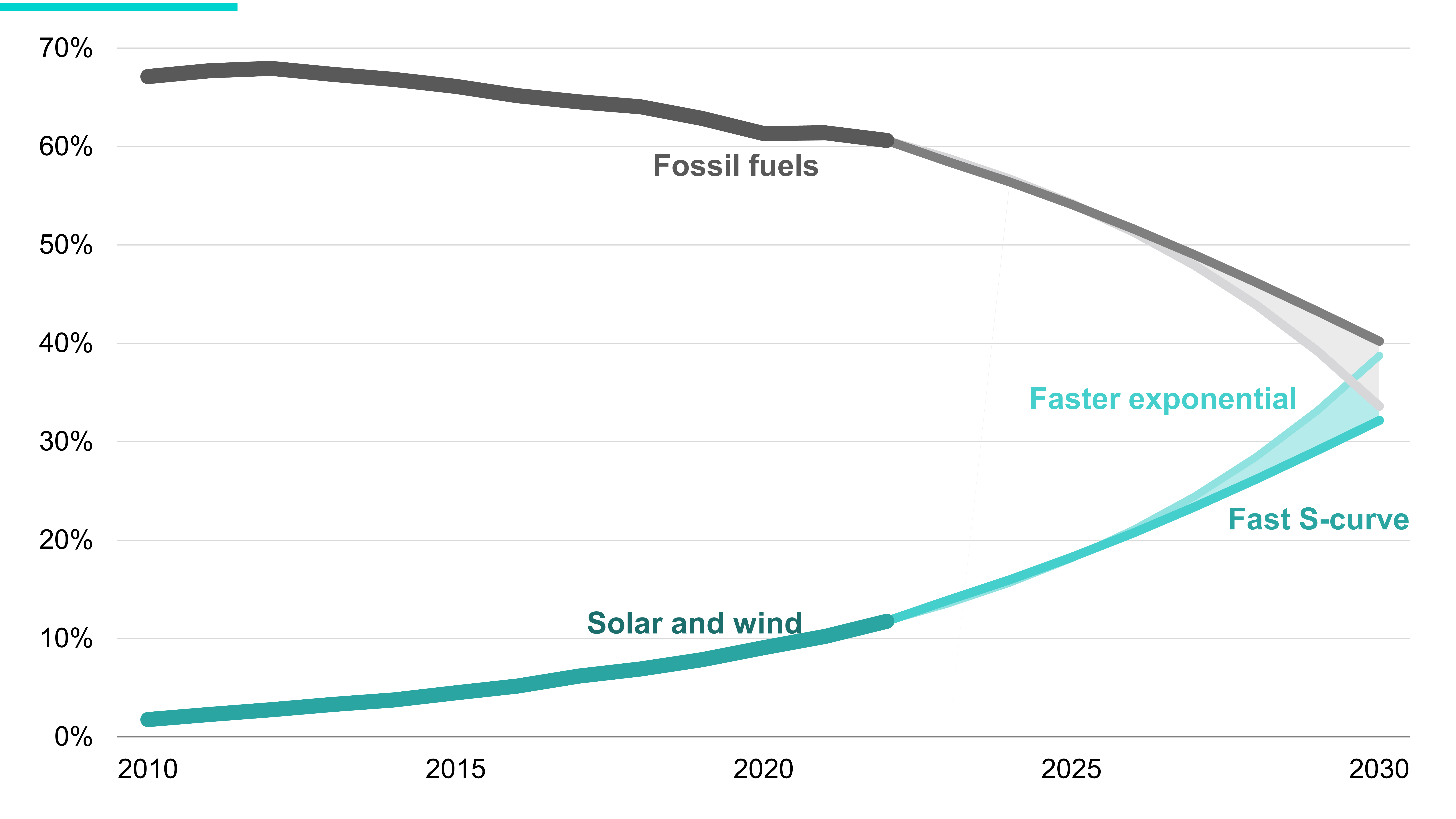
Source: Energy Institute, RMI forward
Learn more about this report and complementary research from our partners at Bezos Earth Fund and Systems Change Lab by viewing the press release here.
For media inquiries, please contact Marissa Gantman at mgantman@rmi.org.
Authors

Amory Lovins
Cofounder and Chairman Emeritus
Laurens Speelman
Principal
Kingsmill Bond
Sam Butler-Sloss
Nigel Topping
Related Insights




Help build the clean energy future. Donate today.
Independent research. Real-world solutions. Supported by donors.
RMI can pursue the highest-impact climate and energy solutions because we’re supported by people who believe change is possible. Every gift helps advance the work needed to make clean energy the default choice worldwide.
For other ways to give to RMI, including checks or gifts of stock, please visit Other Ways to Give.
