
Report | 2025
Creating Transition Intelligence
Enhancing Corporate Transition Assessment for Financial Decision-Making
To keep pace with evolving regulatory expectations and market developments, financial institutions are increasingly turning to corporate transition assessments — evaluations of how a client or investee will be affected by, and respond to, the energy transition — to gain insights into climate-related risks and opportunities. Although existing practices provide a good foundation, targeted improvements to transition assessments have the potential to deliver the decision-useful intelligence needed to guide financial decision-making across institutions.
Two areas offer the greatest potential improvements and add value to corporate transition assessments:
- Strengthening analytical depth: Assessments that move beyond broad indicators, such as targets and aggregated transition-aligned capital expenditures, can explore how specific assets, technologies, or business activities are exposed to transition risks and opportunities.
- Improving actionability: Developing assessment outputs beyond high-level scores or labels can expand applications from compliance or screening to inform core financial functions, including credit risk analysis, capital allocation, and client engagement.
This report identifies nine key analytical components that contribute to robust transition assessments, providing insights into ambition, feasibility, and accountability.

Within this framing, there are three critical yet underexplored approaches that could particularly help strengthen assessment depth and actionability:
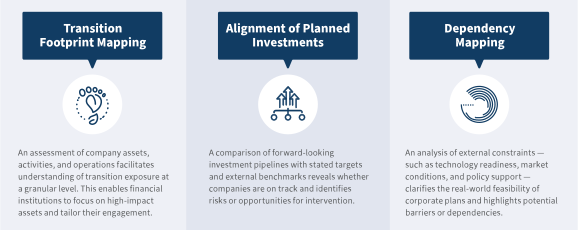
The report concludes that although data availability and resource constraints limit comprehensive assessments across entire portfolios, even partial adoption of these key components for high-priority clients can yield valuable outcomes. Building a community of practice and investing in shared tools and frameworks will be critical for scaling effective assessments.
Acknowledgements: We would like to thank our colleagues at RMI who have contributed to this work. In particular, Hannah Barton, Jacob Kastl, Sam Kooijmans, Antoine Lalechere, Mitchell Luti, Aubrey McKinnon, Christina Pastoria and Thomas White each played a vital role in shaping the research and ideas presented in this report. We also thank our strategic partners and other financial institutions and experts for their ongoing support and thoughtful review. Their guidance and engagement throughout the development of this work have been invaluable, ensuring its relevance and impact.