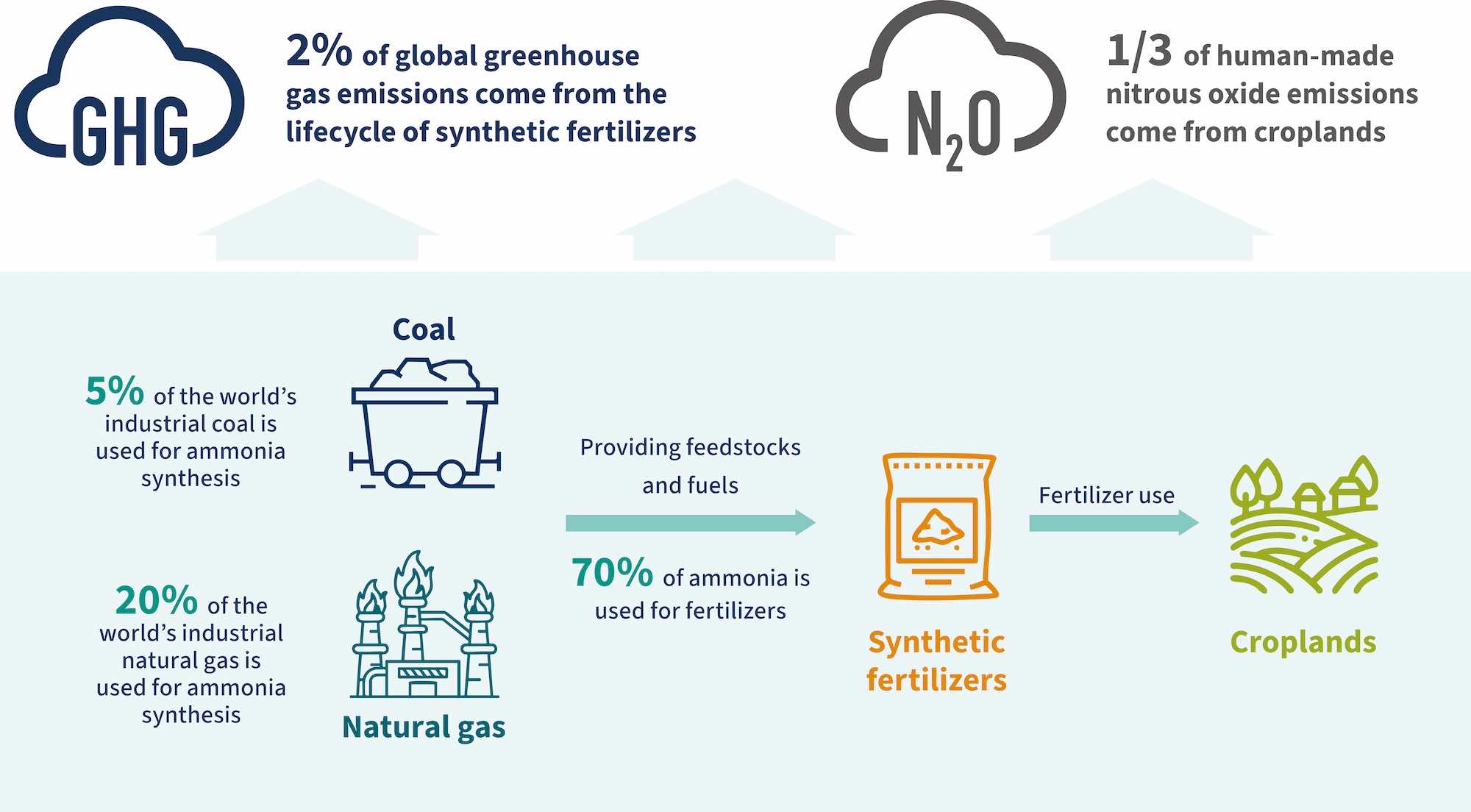
Synthetic fertilizers are crucial chemical inputs in modern agricultural production. The production and application of synthetic fertilizers, however, cause substantial environmental impacts that hinder the sustainable development of both the chemical and agricultural sectors.
Producing nitrogen fertilizers is highly energy and emission intensive, heavily reliant on fossil fuel inputs from coal and natural gas. This makes it one of the most carbon-emitting industrial sectors per unit of product, with carbon intensity surpassing crude steel and cement. Furthermore, when nitrogen fertilizers break down in fields, they release nitrous oxide. This makes croplands a primary human-made source of these emissions, accounting for over one-third of the global total. These dynamics highlight the strategic importance of accelerating low-carbon transition in both the production and application of synthetic fertilizers to reduce fossil fuel dependency, curb industrial and agricultural emissions, and limit pollution.
As a key player in the global fertilizer market, over the past decade China has built an integrated governance framework centered on policy guidance that leverages market mechanisms and is supported by technology. This system enables coordinated efforts in production and application to achieve the low-carbon transition of the fertilizer industry.
This work launches RMI’s report series on low-carbon development in the fertilizer industry by mapping the journey and current landscape of the global synthetic fertilizer sector and spotlighting China’s progress in reducing fertilizer use over the past decade. Building on this foundation, the report outlines the industry’s future opportunities and challenges in the context of the global energy transition.