Learn how we are working to transform how we use and produce energy.
Section 2: Gas Suppliers’ Business Models
Scaling Low-Methane Leakage Gas – A Market Navigator
Why we share this work for free
RMI is an independent nonprofit working to accelerate the clean energy transition. We publish research like this to inform decision-makers and drive real-world impact.
Our work is supported by philanthropy as well as partnerships, including fee-for-service engagements. This support makes it possible for us to share our independent insights for free.
If you find this work valuable, you can support it anytime.
Get more insights like this
Stay up to date with the latest research, analysis, and tools from RMI by opting in to receive occasional emails below. You’ll get new reports, event invitations, and practical insights to help us all accelerate the clean energy transition.
Loading form...
Your download should start automatically. If it doesn’t, click the download button below.
This work is made possible by philanthropy
RMI is a nonprofit supported by donors and partners. Philanthropy enables us to produce independent research and make resources like this freely available.
If you find this report valuable, please consider supporting our work. You can also explore how we partner with organizations to drive impact.
Contents
Company overview
Large integrated company: Integrated oil and gas companies participate in upstream, midstream, and downstream oil and gas operations. They are producers, consumers, and in some cases marketers, of crude oil natural gas, natural gas liquids, petroleum products, and liqueified natural gas (LNG). The upstream segment tends to be the most profitable part of their business, capturing higher rates of return to compensate for the exploration, production, and operational risk involved in oil and gas extraction. While their diverse business lines allow them to benefit from both high and low oil prices, their corporate profitability is still dependent on commodity prices. This group of companies tends to have lower debt-to-equity ratios and capital expenditure budgets up to $25 billion.5
US gas-directed E&P: Independent gas-directed E&Ps focus on the production segment of the oil and gas industry, often concentrating on specific geographies and geologies rich in gas with limited or no oil reserves. In the United States, gas-directed independent E&Ps focus on the dry gas Appalachian and Haynesville basins. Margins are thinner than with oil-directed E&Ps due to relatively lower gas prices and seasonal regional price fluctuations.6
US oil-directed E&P: Independent oil-directed E&Ps focus on the production segment of the oil and gas industry and operate across liquids-rich formations in the Permian, Williston (Bakken formation), Eagle Ford, Denver-Julesburg (Niobrara formation), Anadarko, Powder River, and other smaller basins.
Both oil- and gas-directed independent E&Ps tend to be more leveraged and often rely on reserve-based revolving loans to fund drilling and completion costs. Capital expenditure budgets can vary from $100 million at a smaller E&P to $10 billion at the largest companies. There tend to be fewer gas-only E&Ps and their capital expenditure budgets are often under $2 million.7
Pipeline operator: Midstream oil and gas companies transport and store crude oil, natural gas, and natural gas liquids. They are service providers to buyers and sellers of hydrocarbons that contract capacity on pipelines for the right to transport their commodity from upstream production areas to downstream demand locations. Their business model depends on both the supply and demand sides of the oil and gas value chain. Profitability depends on maintaining flow capacity. Top midstream companies tend to have capital expenditure budgets that can be up to $4 billion, with debt-to-equity ratios above 100%.8
Exhibit 4 illustrates how dependent (or not) each supplier’s gross profit is on commodity price fluctuations. We’ve selected an oil price as a commodity benchmark since even gas-directed companies strategically target liquids-rich areas to realize a revenue uplift.
Exhibit 4
Aggregated indicative gross profit margins versus West Texas Intermediate (WTI) for top operators in each company category
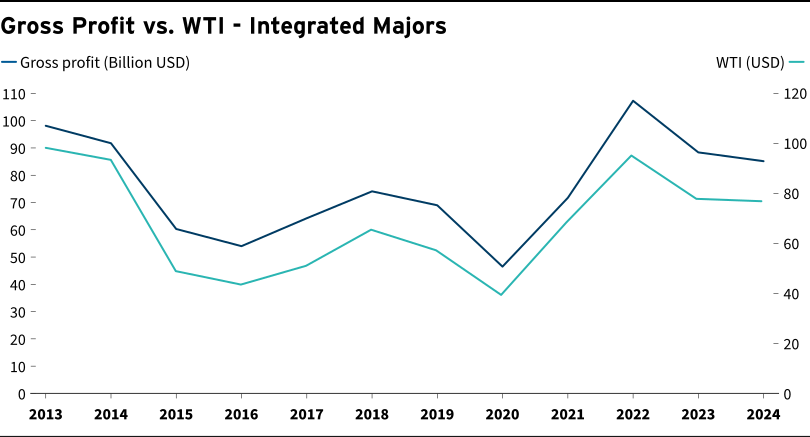

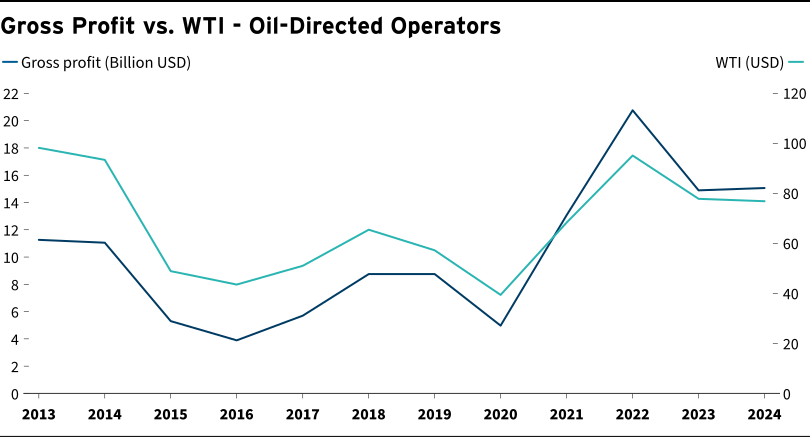
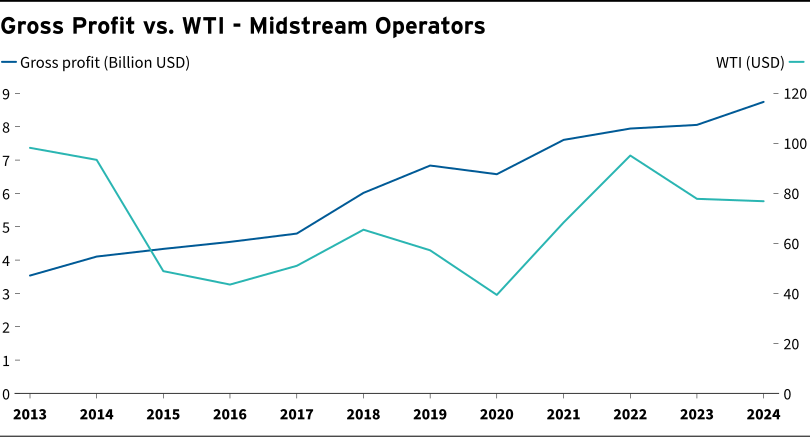
Source: “S&P Capital IQ Pro – Companies,” S&P Global, accessed October 2025, https://www.spglobal.com/market-intelligence/en/solutions/products/sp-capital-iq-pro; “Petroleum & Other Liquids – Cushing, OK WTI Spot Price FOB,” US Energy Information Administration (EIA), Last Updated November 5, 2025, https://www.eia.gov/dnav/pet/hist/LeafHandler.ashx?n=PET&s=RWTC&f=M; RMI Analysis. WTI is the benchmark oil price for oil produced onshore in the United States.
Methodology: Gross profit for large-cap oil-directed E&Ps reflects an average for select companies with a market cap of more than US$20 billion and producing more than 500,000 barrels of oil equivalent per day (500 kboe/d) in US oil basins. Gross profit for large-cap gas-directed E&Ps reflects an average for select companies with a market cap of more than US$5 billion and producing more than 2 Bcf/d of gas in US gas basins. Gross profit for integrated majors reflects an average for select companies with a market cap of more than US$200 billion and producing more than 500 kboe/d of oil and gas in the United States. Gross profit for midstream operators reflects an average for select companies with a market cap of more than US$50 billion whose core business is commodity transport services in the United States.
Asset base and indicative asset-level economics
The assets of an integrated major oil and gas company include the full scope of upstream operations as well as midstream and downstream assets. Midstream and downstream assets include ownership stakes in pipelines, refineries, retail stations, and connective components such as storage and distribution centers. Integrated majors are more globally diversified, with exposure to production and commodity transport inside and outside the United States.
Upstream assets include investments in conventional and unconventional (shale) onshore wells across gas- and oil-focused basins and shallow offshore and deepwater production sites. For the purposes of this analysis, we focus on gas-directed US E&Ps holding predominantly onshore shale gas assets and oil-directed US E&Ps holding predominantly onshore unconventional upstream assets across oil and gas basins. Midstream companies operate pipelines.
Exhibit 5
The differences in payback periods and economics inform how each type of company approaches planning, business risk, and competitiveness. Onshore US E&Ps tend to have shorter planning horizons since their assets return positive cashflow in a matter of a couple of years. Some of the best US lower 48 tight oil wells may even pay back initial investment in 12 months. Onshore operators, therefore, need clear visibility to quick commercialization.
In the medium term, operators constantly need to replenish their inventory to compensate for the characteristically steep decline rates of shale wells. To stay competitive beyond the next couple of years, strategic E&Ps need to ensure continued market access for their product, which means implementing methane and emissions abatement strategies today. At the same time, they need a clear business case for investing in methane abatement technologies and certification protocols by receiving a gas price premium to offset those costs.
How does each gas supplier secure revenue?
For all types of upstream suppliers, a large share of revenues comes from oil and liquids sales. This is true even for gas-directed E&Ps that selectively target liquids-rich gas acreage where they can achieve a revenue uplift. Oil is more fungible and easier to transport and store than gas and is therefore more easily monetized both domestically and across borders. Producers of oil and gas develop oil and gas assets without up-front price guarantees. Oil and gas price volatility presents a material financial risk — the commodity price at the time an asset begins development may be significantly different than the price the commodity can sell for when the asset is producing. This means that not only do upstream companies take on exploration and production risks, but they also take on pricing risk by producing oil and gas without a fixed price.
Gas-directed operators prioritize capturing gas, and their systems are built around optimizing its production. For this reason, dry gas assets and their operators tend to have lower methane intensity. Although natural gas is still part of the portfolio of oil-directed players, they tend to treat it as a byproduct, often venting or flaring the gas, as it is not a revenue driver.
Pipeline operators generate revenue through highly regulated transport tariffs as well as through commodity trading. Transport services generate revenue through tariff fees charged to customers under long-term contracts, while commodity trading generates revenue by using transport services to capitalize on regional price differentials in the spot market. Both business segments are similarly cost-effective. With a pre-determined transportation cost, pipeline operators are able to sign long-term contracts with both producers and end-users of hydrocarbons, resulting in a stable revenue profile.
Exhibit 6
What do suppliers need to scale low-leakage gas?
While some companies are motivated solely to meet the minimum standard for regulatory compliance, many companies could be motivated by market-based incentives to provide a premium, low-emissions product and ensure medium and long-term global market access.
Large integrated companies have a responsibility to shareholders to maximize efficiency and capital investment while minimizing costs. They are also the most visible actors in the oil and gas industry and have the capacity to meet high regulatory, safety, and reputational expectations. If the market develops a premium for low-leakage gas that meets credible emission reduction claims, large integrated companies could be enticed to produce it. Providing credible, validated low-leakage gas could add to these producers’ reputation as responsible, industry-leading companies without compromising their responsibility to maximize efficiency and cost-effectiveness. Large integrated companies also have a long-term planning horizon and aspire to be a competitive gas supplier of choice today and for the coming decades.
Gas-directed E&Ps are set up to maximize profit from every gas molecule they produce. If demand for a premium low-leakage gas product materializes, gas-directed E&Ps could be incentivized to produce low-leakage gas to realize a price premium on their core commodity. These companies tend to be best placed in terms of infrastructure and supply chain to profit from captured methane.
Oil-directed operators need more incentives to invest materially in managing their gas production, as their revenue is driven almost wholly by oil sales. Methane abatement projects need to compete for internal capital with oil-revenue-generating capital expenditure projects. A price premium is the core market motivator for an oil-directed E&P looking to exceed regulatory compliance requirements. The opportunity to supply low-leakage gas and demonstrate significant emissions reductions from an initial baseline help position the operator as a leading supplier of choice for domestic and international markets.
Given the short payback period of their assets, independent E&Ps need to see a clear path to a gas price premium. Additionally, independent E&Ps and their workers are often embedded in the communities where they operate. The company is seen as a key community stakeholder. Producing low-leakage gas adds to their reputation as responsible operators committed to reducing energy waste.
Midstream oil and gas companies don’t yet benefit from low-leakage gas, as they do not buy or sell gas but rather operate as a servicer to the industry. If buyers start requiring full upstream and midstream low-leakage standards, pipeline operators could offer a premium tariff for buyers seeking to receive low-leakage gas for full Scope 3 reduction attribution.
5“S&P Capital IQ Pro – Companies,” S&P Global, accessed October 2025, https://www.spglobal.com/market-intelligence/en/solutions/products/sp-capital-iq-pro.↩︎
6Ryan Duman and Lydia Walker, US shale gas is back: new demand signals underpin upstream opportunity, WoodMackenzie, October 9, 2025, https://www.woodmac.com/news/opinion/us-shale-gas-is-back-new-demand-signals-underpin-upstream-opportunity/ .↩︎
7“S&P Capital IQ Pro – Companies,” S&P Global, 2025; and Nicholas Cacchione, “Let’s Wait Awhile – E&Ps Worried About Oil Prices Keep Spending in Check as Acquisitions Boost Output” RBN Energy, September 17, 2025, https://rbnenergy.com/daily-posts/blog/eps-worried-about-oil-prices-keep-spending-check-acquisitions-boost-output.↩︎
8“S&P Capital IQ Pro – Companies,” S&P Global, 2025.↩︎
Related Insights
The World Wastes More Gas Each Year Than the Strait of Hormuz Supplies
Help build the clean energy future. Donate today.
Independent research. Real-world solutions. Supported by donors.
RMI can pursue the highest-impact climate and energy solutions because we’re supported by people who believe change is possible. Every gift helps advance the work needed to make clean energy the default choice worldwide.
For other ways to give to RMI, including checks or gifts of stock, please visit Other Ways to Give.