
Drilling Down on Methane Loss
A framework for correcting self-reported oil and gas data finds that, in Texas, significantly more methane is wasted than is currently recorded — and this may be common practice elsewhere
- Texas is estimated to have wasted 3–4.5 times more gas than operators reported over the 12 months ending November 2024, with most of it vented directly to the atmosphere.
- Wells not selling gas at all are a major source of unreported methane waste, especially through venting. These emissions are known to operators and can be identified without special equipment or services.
- Wells that sell mainly gas waste little methane, while oil-dominated production wells waste substantially higher percentages due largely to the fact that liquids are the main commodity and the economics incentivize waste.
- Among oil wells, high-rate wells waste a lower percentage of their associated gas produced while low-rate wells commonly waste larger percentages — and about half of the overall methane emissions — also due largely to existing economic incentives.
- Major methane emissions reductions and more tax revenue could be collected by addressing wells with low-rate oil production and wells in Texas’s mature oil basins.
Introduction
Methane is the main component of natural gas. Oil and gas are typically comingled underground and extracted together. Gas is valuable when captured and sold—but harmful when released into the air, heating the planet, impacting health, and damaging property. Methane is a powerful greenhouse gas, trapping 80 times more heat than carbon dioxide in the short term.
In oil and gas production, methane can escape in many ways. Some releases are accidental. Others happen during maintenance and repair. But two major sources — venting (releasing gas directly into the air) and flaring (burning gas at the well site) — are largely under an operator’s control. Because these releases are intentional, they should be among the easiest emissions to measure and report accurately — and ultimately prevent.
Texas requires oil and gas operators to report information about how much gas they vent and flare each month. These self-reported figures form the official record of how much gas is wasted in the state. But when we analyzed a 12-month subset of data in Texas ending late 2024, we found that the reported numbers did not add up. Operators self-reported about 120 billion cubic feet (Bcf) of gas vented and flared during our study period. However, our analysis suggests the true total may be as high as 551 Bcf — four and a half times higher. Most of the difference appears to come from underreported venting of gas.
This gap represents both environmental harm and economic loss. If up to 551 Bcf of gas was wasted, that translates to 7.6 million metric tons of methane emissions. To put this in perspective, the natural gas wasted in Texas in a single year had greenhouse gas emissions equivalent to 100 million cars, SUVs, and pickups — 40% of the light-duty vehicles driven in the US in 2024.
At the same time, the gas released into the air had significant market value. In 2022 alone, officially self-reported waste was valued at about $700 million, which amounted to $50 million in lost tax revenue. If the 2024 gas waste estimated in this study is monetized, over $1 billion in Texas’s gas value was forgone, with associated lost tax revenue of nearly $100 million. And with highly volatile and recently rising natural gas prices economic loss to the State is mounting. These industry losses also correspond to lost taxes for the state. In other words, Texas may be allowing billions of dollars of its natural resources to be wasted with attendant tax revenue loss while causing harm by increasing methane pollution.
Our analysis also reveals three important trends:
-
First, most of the difference is from underreported venting rather than underreported flaring. There is a NASA satellite (VIIRS) that measures flaring, making it harder to underreport these volumes.
-
Second, methane releases are much higher from oil wells than from gas wells. When gas is the primary product, operators tend to conserve it. When oil is the primary product, any associated gas is more likely to be treated as disposable.
-
Finally, low-producing wells show much higher release rates than high-producing wells. When all wells are averaged together, these high-emission sources can be hidden by better-performing operations.
Underreported gas loss is unlikely to be unique to Texas. Many states rely on similar self-reporting systems with limited verification. In the methodology, which is presented here, we present a framework for identifying missing or implausible data and estimating more realistic volumes. Applying this approach more widely could improve methane inventories, reduce economic waste, increase state revenues, and support stronger, more transparent energy management.
Overview of Texas’s Venting and Flaring Regulations
Texas regulations and industry are intended to preserve state resources
Texas currently supplies over 40% of the crude oil and nearly 30% of the gas produced in the United States. As stewards of these resources, the Texas Railroad Commission (RRC) is required by statute to conserve resources and prevent energy waste. Texas regulations mandate that oil and gas operators report their gas releases — both vented and flared — during production to requisite agencies, including the RRC. As the most fundamental forms of energy waste, venting and flaring are counter to the agency's mission of “stewardship of natural resources and the environment, concern for personal and community safety, and support of enhanced development and economic vitality for the benefit of Texans.”
For its part, the state’s oil and gas industry association has identified science-based regulation as a key factor to carefully manage resources and propel continued industry innovation. Major oil and gas companies, like ExxonMobil and Oxy, have pledged support to lower their methane emissions by eliminating routine flaring and minimizing venting.
However, Texas is fairly permissive when it comes to allowing operators to vent and flare gas
In the pursuit of these goals, operators document gas releases during production operations in monthly reports to the RRC. These reports are then used as the baseline for understanding how much gas is lost to venting and flaring in the state. Most attention to date has focused on flaring, perhaps because the RRC is required to approve flaring applications — making it easy to identify the thousands of flaring applications that have been affirmatively approved. However, these releases are not the whole story. The Texas Commission on Environmental Quality also grants exemptions for any releases that are voluntarily self-reported. In other situations, limited temporary exemptions exist for safety, during drilling, or initial well testing, and these have garnered limited attention. Finally, in some cases, the rules also allow continuous, routine venting without a permit.
Whether it is burned or just released into the air, gas that is squandered cannot be marketed. Yet different rules and permissions extend to venting and flaring, as outlined in the graphic below.
Exhibit 1

Venting is often allowed in Texas. In some circumstances, venting is permitted without the need for any paperwork; no application is required, and no reporting is needed, especially for low lost gas volumes. In other circumstances, venting is automatically allowed by rule without the need for an application, but volumes must be reported. However, when volumes are required to be reported, volumes can be estimated instead of measured.
Flaring is allowed when no pipeline is available or when available pipelines do not have capacity. Initial requests to flare are approved administratively, and so are the first extensions. A second extension requires a hearing, but no such application has been denied by the RRC in recent years. Among the self-reported volumes, a supermajority of flaring is permitted by rule and does not require an explicit exception to be granted by the RRC. In other words, companies generally have a green light to flare their unwanted gas.
Whether flared or vented, both of these methods of gas disposal pose environmental, health, and safety risks. Venting can cause fires and explosions, and asphyxiation. In addition to methane, which powerfully warms Earth, gas can also contain hazardous air toxins such as carcinogenic benzene and deadly hydrogen sulfide. Flares release dangerous air emissions, including particulates, nitrogen oxides, volatile organic compounds, carbon monoxide, and methane.
Economics control operators’ decisions to intentionally release gas more than policy
While Texas’s rules govern flaring and venting, economics also play a role. As plotted in Exhibit 2 below, when gas prices are high, as they were in the first decade of the millennium, waste gas volumes in Texas remained low. But as gas prices fell in response to increasing supplies from horizontal drilling, reported volumes of wasted gas shot up. The same inverse relationship holds between wasted gas and WTI crude oil prices or drilling rig counts. Market dynamics can exacerbate loss when the gas price drops just as companies are rushing to drill more wells. The less financially valuable gas is, the more unwanted and disposable it is. As a result of low prices and active drilling, Texas became and remains one of the highest flaring jurisdictions in the world on an absolute basis.
Exhibit 2
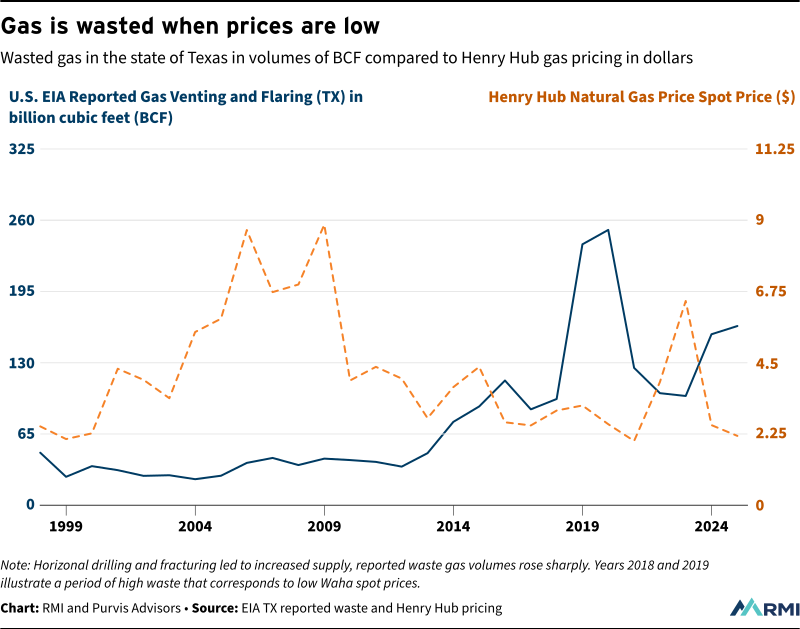
Such loss imposes economic opportunity costs for Texas. Using existing reports and monitoring, the US Energy Information Administration (EIA) reports that Texas has wasted some 1.4 trillion cubic feet of gas over the past decade by venting and flaring. The 100 Bcf reported lost in 2022 alone meant Texas wasted nearly $700 million in lost resources. In 2024, with gas prices down significantly, EIA reported that 163 Bcf of gas vented and flared, valued at $370 million in lost resources when priced at Henry Hub yearly average. By accepting operators’ self-reported gas loss, in 2022 and 2024, Texas passed up $50 million and $28 million, respectively, in tax revenues. And this analysis suggests that the lost tax revenue may be as much as 3-4x greater — at least a quarter of a billion dollars in just two years.
Even though there are few restrictions on total venting and flaring, Texas does require operators to report the total amount of vented and flared gas
Even if the RRC isn’t quick to act to reverse the state’s losses, global efforts are underway to reverse this wasteful trend. In 2023, over 50 global oil and gas producers, responsible for 40% of the world’s production, signed the Oil and Gas Decarbonization Charter (OGDC) aimed at achieving near-zero upstream methane emissions and zero routine flaring by 2030, significantly reduced methane intensities, and net-zero operations by or before 2050. Many of the companies that signed OGDC operate in Texas. In order to compete in the global marketplace with international producers that have committed to greater transparency and verification, Texas will need to follow suit to verify self-reported gas loss and methane emissions and meet the 0.2% methane intensity threshold operationalized by insurers, companies, and in scientific studies.
Analysis of self-reported venting and flaring
Self-reporting still has limitations
Understanding how reported gas volumes are structured — and where that structure limits visibility —provides the context needed for the accounting approach used to estimate total gas loss below.
Operating companies in Texas report to the regulator the volume of oil and gas produced on each lease every month.1 Companies also report what they did with the produced volumes, namely the “disposition” of the oil and gas — including venting, flaring, and other uses such as re-injection.
Current RRC data forms separate flaring and venting rules in Texas to organize reported gas releases into a limited set of explicit categories, each with defined paperwork, if any, and approval pathways. Releases that fall cleanly within rule boundaries and require regulatory approval are more likely to be documented, while releases that fall outside — or straddle multiple operational steps — face greater ambiguity in how, or whether, they are reported.
As a result, the structure of the rules creates challenges that result in underreporting. If the state wanted more accountability in gas loss volumes — especially when gas is released outside or between specified categories — it could require measurement, quantification, and verification in lieu of insufficient estimation when a permit is required.
Our experience and observations, including the history, content, and discrepancies between reported and inferred volumes of the current dataset suggest the RRC does not rigorously enforce reporting and seems not to test the validity of the gas volumes that are reported. Failure to report gas disposition by venting or flaring carries limited operational or economic downside for operators.
Self-reporting shows shortcomings and patterns significant to reducing methane emissions
Our quantitative statewide analysis demonstrated venting patterns based on lease type that should affect how methane targets are set and monitored. We also found large gaps in self-reported waste, particularly from low-producing oil wells. Our analysis led us to two major observations, which we discuss in more detail below. The first: More than a third of the oil wells in Texas report some oil production without any associated gas produced or disposed. This is an impossibility; some amount of gas is always co-produced with oil, no matter where it is extracted. This suggests a systemic level of underreporting. Our second observation: There exists a strong relationship between production rate and gas disposition. We found that high-producing oil wells had a correspondingly high level of methane disposal reported. The opposite was the case with low-producing wells.
In Exhibit 3 below, the reported disposition of flaring and venting only is separated into oil leases (in the first bar) and as gas leases (in the second bar). Each bar is then subdivided based on the self-reported proportions of gas vented or flared. The length of each segment is determined by the relative number of wells associated with the leases in each category. Low proportions of emissions are shown in green, while higher proportions are shown in red. The darkest green represents cases which did report gas production but no venting or flaring.
Exhibit 3
Exhibit 3 illustrates two of the patterns. The teal segment represents the first major observation: The implied wasted gas shows that more than a third of the oil wells in the state report some oil production without any associated gas produced or disposed.2 This situation does not exist in real-world operations. While associated gas production can be relatively small for some reservoir fluids or stages of life, some associated gas is always produced with crude oil. The fact that none is reported does not mean that none was produced. Absence instead means that the associated gas was not measured and sold. This could be because selling this gas would require measurement and the payment of severance taxes. This implies a systematic pattern of incomplete or implausible reporting.3
As a second pattern, with or without consideration of unreported gas releases, the exhibit above demonstrates the large and inherent discrepancy between the economically driven treatment of methane loss from oil wells and gas wells. When gas is the primary product of commerce, much less of it is wasted. Among wells that produce more oil, gas is more disposable. Consequently, it is not a measure of progress to say that gas-dominated operations more regularly meet waste targets. Combining oil and gas wells together to measure overall performance can distort the outcome as intrinsically low-emission production dilutes and obscures a high methane emissions subset.
If the segments in the exhibit above were measured by produced oil volume instead of wells, then the segment measuring implied waste would show 3.4% of oil produced in the state comes from leases without any reported gas production. This implies a strong dependence of emissions on oil production rate, and Exhibit 4 below demonstrates this major observation by breaking down the emissions intensity of oil leases by their daily oil production rate.
Each bar in the graph below represents a different range of oil and gas production rates, and the ranges scale exponentially. The color-coding and segment proportions are the same as Exhibit 3. It demonstrates that the incomplete and geologically implausible production of gas becomes more prevalent as lease production rate decreases. Below about 10 barrels of oil per day (bopd), more than half of the wells in the state are not selling gas.
Exhibit 4
This strong relationship between production rate and gas disposition represents the second major observation. Like the inherent, economically driven conservation in gas wells compared to oil wells, high-producing oil wells produce more associated gas volume and thus have more economic incentive to gather and sell it, possibly contributing to a demonstrated pattern of low emissions. Consequently, it is not a measure of success to reduce overall emissions intensity by drilling new, high-production wells. As before, combining high- and low-rate oil wells together to measure overall performance can distort the outcome as intrinsically low-emission production dilutes and obscures a high-emissions subset.
Exhibit 5 below shows the same analyses for the Permian basin region of Texas. As the Permian Basin produces most hydrocarbons out of Texas and close to half of US crude oil production, trends in the Permian are an important consideration in any statewide analysis. In the last decade, this legacy region with older vertically-drilled wells has been rapidly and intensely redeveloped with high-producing horizontal wells. Still, the same patterns persist. A significant proportion of wells reside on leases reporting zero gas disposition, oil leases report or imply much greater emissions than gas leases, and high-rate leases report or imply much lower emissions than low-rate ones.
Exhibit 5
Exhibit 6
Unreliable data can be replaced by analogy or reliable data
To address the issue of incomplete or implausible gas disposition, this analysis first identified reported volumes that appeared implausible. Then, for each operation with implausible reporting, an analogous operation (based on features like daily output and geography) was identified that did report credible data. Missing or implausible entries were then replaced with estimates based on this analogous data. Each of these steps is discussed in greater detail below and explored more fully in our accompanying methodology.
First, we identify anomalous patterns such as sustained oil production with zero reported gas, repeated identical gas values over time, or internal inconsistencies between production and disposition, and we estimate more reliable figures by analogy to reported figures without these patterns.
For records identified as incomplete, expected associated-gas volumes are estimated using gas-to-oil ratios (GORs) of large sets of analog data derived from geologically and operationally similar wells where gas reporting is more complete. This approach reflects a basic physical constraint: sustained oil production implies the co-production of some amount of gas.
We start by assuming that the reports of oil production are reliable even when gas production is not, and we apply an analogous GOR. Starting with the nearest producers and expanding to larger groups as necessary, this analysis achieves a representative average gas-to-oil ratio, which is then applied as a proxy to leases with unreliable self-reported figures. We look first for geologic similarity based on the field, reservoir, and region of the producer, and we choose the most precise analog that has a sufficient number of leases producing about the same oil rate. The analog GOR is thus chosen algorithmically on these three dimensions: geologic similarity and oil rate similarity with a minimum number of analog data points available. 4
We also ran the calculations with two alternative populations of analogs to choose from. In the first, we included only leases designated and regulated as oil leases. In the second, higher scenario, we included all leases that reported non-zero oil production regardless of classification.
The result is an alternative, inferred gas production volume for every lease in the state, including those self-reporting no volumes. Knowing that the gas was not sold, we assume it was most likely vented or flared upstream of an erstwhile sales point. In doing so, it complements reported flaring and venting figures by providing a more complete system-level view of gas loss that is otherwise obscured in the public record.
Key finding: Unreported waste is estimated to be significantly greater than self-reported volumes
Permissive rules and non-compliance with reporting requirements in Texas translate to under-reported oil and gas flaring and venting volumes. As described above, practically all wasted gas self-reported by operators to the RRC is reported to have been flared rather than vented, 118 billion cubic feet reportedly flared versus 2 billion cubic feet reportedly vented. Our study quantified an additional 255 to 431 Bcf of gas produced but not sold, depending on whether gas leases are included among analogs.
The exhibit below plots our results. The column on the left shows the self-reported flaring and venting during our study window, and the bar on the right shows the additional gas we have identified as likely wasted, color-coded by possible disposition. In total, the figure of wasted gas ranges up to 551 Bcf rather than the 120 Bcf self-reported. The methane waste associated with this gas loss is estimated at 7.6 million metric tons (Mt) methane (assuming an average methane content of 74% and methane density of 0.657 kilograms per cubic meter).
Exhibit 7
The bar on the right shows the possibility that up to 101 Bcf of our unreported gas went to flares based on statewide flare volume remaining after self-reported data is accounted for. The flares and volumes were identified with data from NOAA’s Visible Infrared Imaging Radiometer Suite (VIIRS) satellite instrumentation to detect flares and estimate flare volume. We have not attempted to reconcile the location and flared volumes observed by third parties with those reported by oil companies. It is possible that the difference pertains to unreliable (but not obviously implausible) reporting by companies. In this case, the discrepancy in flared volumes would add another category to the grand total of wasted gas in the state. It is also possible that operators did not report gas production at all when it was, in fact, flared. Thus, our accounting could quantify some of the same unreported waste.
Excluding this untested possibility, unreported gas production is most likely to have been vented. The dark segment of the right-side bar presents the remainder of our low-side scenario as vented gas, and the third segment shows the incremental to the high-side scenario which uses as analogs all leases that produce some oil. We tested our conclusions by comparison to remote measurement studies and semi-empirical estimates across and within the state, and we found that our results fell within the range of previously reported figures.
Satellite measurements and flyover studies find that, in the United States broadly, methane leakage from oil and gas well operations is undercounted by at least two to over three times, directionally confirming our results. Another comprehensive emissions inventory platform, Climate TRACE, uses an independent, hybrid model (OCI+) to estimate Texas’s methane emissions from venting and flaring. It concludes that a relatively comparable 6.8 Mt methane per year (compared to 7.6 Mt in this study) was released by either venting or flaring by oil and gas operations in Texas in 2024.
This is not an upper bound of oil and gas sector methane emissions in Texas. This study considers only emissions from upstream production operations and not methane emissions that also occur in subsequent parts of the supply chain, including transport, gas plants, petrochemical processing, and refining. This study also does not attempt to measure small-scale fugitive emission in production operations. System-wide leakage could increase as the gas value chain lengthens and LNG ships globally. These factors are beyond the scope of production reporting to the RRC.
What this means for slashing methane waste in Texas and beyond
Understanding the methane problem begins with accurate, complete, and detailed reporting that can be readily verified. But solving self-reporting problems requires a systematic change in rules to fit that understanding. This study attempts to infer a more reliable, statewide inventory of releases in a relatively simple manner. We underscore the need for reliable reporting. But even reliable reporting alone is unlikely to change the behavior of operators who are wasting gas and emitting methane. Given the weakness of inherent economic incentives, stringent rules will be required, and those must be tailored to fit the problem.
Validate the results of this analysis and consider how it could be leveraged for short-term action in Texas
Our study is the first of its kind and deserves inspection or corroboration by others. We have already undertaken multiple lines of validation against top-down measurements of methane physically present in the atmosphere and against recent semi-empirical studies, both from independent sources. Aerial and satellite studies have long found much more methane in the atmosphere than is currently being self-reported. Our study of continuous, intentional emissions largely closes the measured gap. Still, testing and reproduction of our methodology would increase confidence and make the methodology useful in other geographies.
Once any additional validations have been performed, this study and its corroborations can provide the basis for increased accountability. The results can be used to identify operators and locations identified as major sources, first for confirmation, and second for mitigation. As discussed more in our methodology, our work can be accurate on the whole and still widely off point for some individual cases. It would be prudent to ensure that operators are given the chance to provide substantiated alternatives if they do not agree with values calculated by our methods. In this way, regulators, tax agencies, and others can begin to take informed steps to address emissions and reduce economic and environmental consequences.
Tailor reporting and regulation to fit key problem areas, particularly venting and low-producing wells
If states wish to improve the quality of their reported data, they could consider subjecting oil producers to more scrutiny when reporting their gas disposition. Quality assurance may be required when operators of oil wells report zero or repeated values for venting and flaring. Given the nearly 600,000 marginal wells in the United States — one in three in Texas alone — carefully tracking venting from these assets can reduce safety and waste concerns. Specific reporting requirements could be imposed on these low-production volume wells, especially marginal assets with less than 15 barrels of oil equivalent per day (boed).
However, better reporting is a weak prescription. The existing data set, with all its shortcomings, is the outcome of renewed and expanded reporting requirements. Further expanding reporting requirements still leaves regulators without the ability to validate those self-reported figures. Regulators would also need to adopt a less permissive stance towards reporting and executing the rules if they want to reduce waste.
Most importantly, though, the rules as they exist are inherently permissive. The rules were meant to support the economic viability of low-producing wells at a time when the effects of venting were not as well understood. Thirty years later, the landscape has changed, both in the significance of low producers and the need to reduce emissions. Other states, such as Colorado, have already piloted successful programs to reduce venting, and those models could be considered for application to Texas.
In addition, given the high degree of acquisitions in the oil and gas industry, regulators may want to consider rules that prevent responsibility for leaky assets from being transferred until they are repaired. As assets deplete, they can change hands frequently, and maintenance can lapse, causing gas loss that can be dangerous to individuals and communities.
Extend this kind of study to other jurisdictions
Beyond Texas, this analysis can be extended to assess whether a similar analysis can be performed in other US states and worldwide to test the completeness and reliability of reported methane waste volumes. Our analysis of a 2019 review of states’ rules on venting and flaring by the Department of Energy found similarly permissive rules in many other states, including Oklahoma, Wyoming, Montana, Utah, Kansas, and West Virginia. Replicating this study would be the fastest way to improve emissions inventories in other jurisdictions and thus to begin mitigating the financial, energy, health, safety, and climate change losses.
Disaggregate the reporting of methane loss across different types of assets
There is no standard oil or gas, and much less commonality between oil and gas wells. As such, emissions reporting merits disaggregation by the primary resource type and by production rate in addition to reporting by company and subbasin.
For example, we find that high-rate oil wells and all natural gas wells emit less methane, though flaring is most prevalent among high-rate oil wells. Disaggregating reporting can help tease this out because by combining discrepant categories and using the same standard, this obscures the sources of emissions that can be controlled. Standards and performance measures should separate qualitatively different categories of wells.
Companies that tend to sign emissions pledges and to self-report their performance are also ones that tend to operate mostly high-rate producing wells, though they can also have legacy producers in the mix. Plus, it is possible and indeed common for companies to sell older fields, often to smaller companies, and remove them from their reporting. This means that smaller companies often end up operating low-volume producing wells without emissions pledges and outside of public view.
Combining heterogenous groups of wells obscures avoidably high emissions. In general, regulators will collect higher quality data when oil wells are not aggregated with gas wells, and when high production volume wells are not aggregated with low ones.
The findings of this analysis not only underscore the need for more accurate inventories but showcase the opportunity for additional resource stewardship with potential economic public safety, and environmental gains. Texas has the scale, technical capacity, and market influence to lead in methane transparency and mitigation; doing so would strengthen its competitiveness. Similar analysis and opportunities likely exist in other jurisdictions for better reduced resource waste.