

Learn how we are working to transform how we use and produce energy.
The Time Is Now to Reconsider Planned Generation Projects
Future proofing electricity affordability, reliability, and security in a rapidly changing world
Why we share this work for free
RMI is an independent nonprofit working to accelerate the clean energy transition. We publish research like this to inform decision-makers and drive real-world impact.
Our work is supported by philanthropy as well as partnerships, including fee-for-service engagements. This support makes it possible for us to share our independent insights for free.
If you find this work valuable, you can support it anytime.
Get more insights like this
Stay up to date with the latest research, analysis, and tools from RMI by opting in to receive occasional emails below. You’ll get new reports, event invitations, and practical insights to help us all accelerate the clean energy transition.
Loading form...
Your download should start automatically. If it doesn’t, click the download button below.
This work is made possible by philanthropy
RMI is a nonprofit supported by donors and partners. Philanthropy enables us to produce independent research and make resources like this freely available.
If you find this report valuable, please consider supporting our work. You can also explore how we partner with organizations to drive impact.
Jump to Section
Power sector leaders around the world have taken their jobs at a time of unprecedented change. Demand is growing rapidly, grids are evolving to require more flexibility, extreme weather events are increasing in frequency and severity, and geopolitical disruptions to energy markets are becoming more common. But this is also a time of tremendous opportunity. The past decade has seen solar and wind become the cheapest sources of energy on much of the planet, battery costs to firm those variable resources have fallen 90%, and virtual power plants and distributed resources are scaling rapidly.
This is a critical time for power sector leaders to reconsider their planned generation investments to ensure they deliver affordable, reliable, and secure electricity that strengthens their countries’ economic competitiveness. RMI’s insight brief, Reconsidering Planned Generation, is designed to help leaders and stakeholders confront these trends, based on experience directly supporting developers and decision makers in reassessing these investments. We have seen that reconsidering planned plants can lead to win-win outcomes for both plant owners and customers.
Where possible, updating system-level plans to reflect these dynamics will be important. But in the immediate term, there is an acute need to reconsider specific planned projects. More than 640 GW of grid-connected coal plants are still under development globally, 630 GW of which are planned in low-and-middle-income countries (LMICs).
Historically, coal-fired generation has played a critical role in many countries — affordably electrifying economies, heating homes, enabling major industries, and providing stable jobs. But is locking in these coal plants still the best option for these power systems? The world has changed dramatically since many of these plants were planned and they may operate into the 2060s or longer. Do alternatives exist that would better meet nations’ goals of power sector affordability, reliability, energy security, and economic competitiveness?
There is a long list of candidate plants that may be worth reconsidering
Per Global Energy Monitor (GEM), planned grid-connected coal capacity is spread across more than 1,000 units, 31 countries, and five continents. Much is in India and China, but a range of other LMICs are continuing to develop plants as well (see Exhibits 1 and 2). If built, these planned plants could represent a 33% increase in the world’s grid-connected coal-fired capacity even after accounting for expected retirements. Many of these plants stand out as candidates to reconsider. Take, for example, the quarter of planned plants (170 GW) that were initiated more than a decade ago under very different circumstances and assumptions. Over 100 GW of these were previously canceled or shelved but later revived. At the same time, more than half of planned plants (370 GW) have not yet begun construction and have limited sunk costs.
Exhibit 1
Exhibit 2
A simple framework can help decision makers identify plants to reconsider
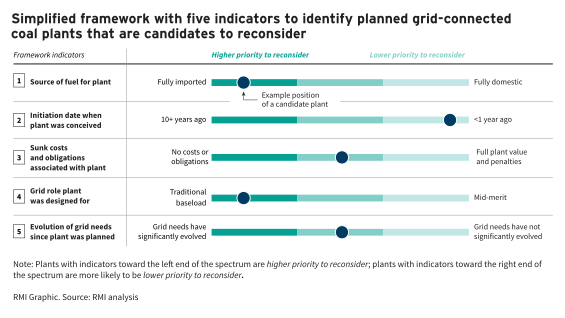
Within these many candidates, how can a power sector planner or a developer with new coal in their plans decide whether a plant should be reconsidered? Below, we provide a simple framework for power sector leaders to evaluate whether a given plant is a good candidate to reconsider against alternatives in the context of evolving grid needs (Exhibit 3). Applying the framework to a plant only requires approximate answers to each of five questions:
- What is the source of fuel for the coal plant?
- When was the plant originally conceived?
- What sunk costs, value, and contractual obligations are attached to the plant?
- What role was the coal plant designed to play on the grid?
- How have grid needs evolved since the coal plant was planned?
Exhibit 3
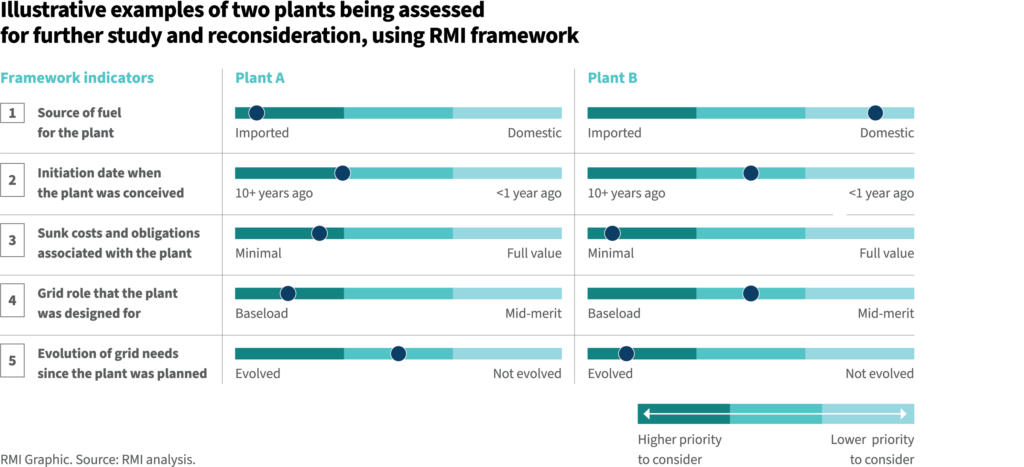
For example, the two planned plants in Exhibit 4 are anonymized but based on actual projects in two Asian countries. Plant A was conceived in 2019 and would rely on imported coal. It is permitted, its only sunk costs are acquired land, it was designed to play a baseload role, and the country’s grid has moderately evolved with more reserve capacity and an increasingly peaky system load profile. Plant B was conceived in 2022 and would utilize domestic coal. It is in pre-permit stages with negligible sunk costs, it was designed to play a baseload role with some flexibility, and this country’s grid has evolved dramatically with a large amount of wind and solar development that has reshaped the net load profile.
Based on this initial first step, plant A is a clear candidate to further study and potentially reconsider. Plant B is likely also a strong candidate for reconsideration despite its fuel source likely enabling lower operating costs. Even though this plant is being designed for more flexible operation, the grid’s evolving needs likely require more flexibility than it can cost-effectively provide.
Exhibit 4
Next, a simple levelized cost of energy (LCOE) assessment can provide an initial estimate of the economic competitiveness of alternatives. As an example, Exhibit 5 below compares the LCOE across a range of scenarios for a new ultra-supercritical coal plant against an alternative that includes solar generation paired with either four-hour or eight-hour battery energy storage (BESS).
Based on these projections, the alternative to a coal plant planned in 2026 would result in significant savings in all but the most extreme scenarios. This differential will only grow over time and further increase the savings of alternatives like solar and storage that can be built faster and in smaller, more modular capacity tranches that align with grid needs and reduce the risk of overbuilding.
Where the economics are marginal, concessional finance may be able to bridge the gap. For example, low-cost debt could offset increasing the storage included in the alternative. Or it could help overcome a viability gap in regions with suboptimal renewable resources or due to sunk costs already incurred in a coal plant’s development.
Exhibit 5
Further study of priority plants can confirm detailed technical and financial viability
Plants with viable alternatives can then move to a detailed pre-feasibility study. This would include detailed technical analysis of the grid’s and offtaker’s needs, design of alternative options to optimally meet those needs, and the financial viability of those alternatives. This would also surface regulatory and policy alignment with changing the planned plant (e.g., a process to modify the power purchase agreement underpinning the plant).
Reconsidering planned plants may help avoid locking in assets that become cost burdens
These trends — continued planned coal development, evolving grid needs, and a rapidly transforming landscape of energy generation technologies — create both opportunities and risks for power sector leaders. With the development clock ticking for generation projects, there is a clear window to reexamine planned capacity, particularly coal, to determine whether these projects still provide the best outcomes for electricity customers and taxpayers. Even if planning assumptions and decisions were well-vetted and logical five or ten years ago, these analyses may no longer be credible under today’s realities.
We encourage regulators, planners, owners, and other stakeholders to use the framework above as a starting point for identifying planned plants that should be reconsidered in their jurisdiction. Not all planned coal plants will necessarily become cost burdens, and there may be plants that remain the best solution for their situation. However, the risk of locking in customers and taxpayers to higher costs for decades is significant, and warrants investigation. Alternatives to these projects may provide cost savings to customers, better returns for developers, and potentially greater energy security at a national level.
Reconsidering Planned Generation offers additional detail on how to approach this process, beyond the first steps outlined here. RMI and partners can help provide support to apply this framework or to conduct detailed pre-feasibility analysis. If interested, please contact plannedpower@rmi.org.
In subsequent insight briefs, RMI will share illustrative technoeconomic analyses into the viability of transitioning specific plants and explore regulatory strategies to support implementation. These resources will provide a detailed look into the technical and economic considerations for alternatives to specific plants, and pathways for executing a transition.



Related Insights
For Clean Energy Projects, How Community Benefits Are Delivered Matters
Tracking WestTEC: Where 100+ Transmission Projects Stand and What Comes Next

Help build the clean energy future. Donate today.
Independent research. Real-world solutions. Supported by donors.
RMI can pursue the highest-impact climate and energy solutions because we’re supported by people who believe change is possible. Every gift helps advance the work needed to make clean energy the default choice worldwide.
For other ways to give to RMI, including checks or gifts of stock, please visit Other Ways to Give.