

Learn how we are working to transform how we use and produce energy.
Can Your On-Demand Deliveries Be Emissions Free?
New RMI report shows that decarbonizing on-demand last-mile deliveries globally requires electrifying modes locally.
Why we share this work for free
RMI is an independent nonprofit working to accelerate the clean energy transition. We publish research like this to inform decision-makers and drive real-world impact.
Our work is supported by philanthropy as well as partnerships, including fee-for-service engagements. This support makes it possible for us to share our independent insights for free.
If you find this work valuable, you can support it anytime.
Get more insights like this
Stay up to date with the latest research, analysis, and tools from RMI by opting in to receive occasional emails below. You’ll get new reports, event invitations, and practical insights to help us all accelerate the clean energy transition.
Loading form...
Your download should start automatically. If it doesn’t, click the download button below.
This work is made possible by philanthropy
RMI is a nonprofit supported by donors and partners. Philanthropy enables us to produce independent research and make resources like this freely available.
If you find this report valuable, please consider supporting our work. You can also explore how we partner with organizations to drive impact.
Jump to Section
The global on-demand last-mile delivery service, which includes companies such as Uber Eats, Door Dash, JustEat, and Deliveroo, has a value of more than $150 billion and continues to grow. But what are the climate impacts of these deliveries? And how can we decrease the climate impacts by helping the sector encourage modal shift and transitioning to zero-emissions vehicles?
RMI tackled those questions by engaging directly with the delivery couriers themselves. Talking with couriers, city officials, and community-based organizations in London, Mexico City, and Seattle helped us understand the barriers to zero-emissions last-mile delivery and develop recommendations to accelerate the shift to zero-emissions last-mile deliveries.
The insights we gained are detailed in our latest report, Decarbonizing Last Mile Delivery: A Courier-Centered Modal Shift Study, which provides city officials, app-based delivery platforms, community-based organizations, and other stakeholders with a framework to electrify and reduce emissions from on-demand last-mile deliveries globally. The report was commissioned and created in partnership with Uber to inform their efforts to reduce delivery emissions worldwide.
Challenges
Electrifying the cars, motorcycles, mopeds, and scooters couriers use to make last-mile deliveries can significantly reduce emissions while at the same time improving air quality and public health outcomes. However, many couriers are reluctant to make the shift to electric. Many cited the higher up-front costs of electric modes and limited access to conveniently located, fast, and reliable charging infrastructure as challenges to transitioning. They also noted a lack of used zero-emissions vehicles and maintenance options and a lack of investment in separate, safe road infrastructure for two- and three-wheeled vehicles as barriers.
Ultimately, couriers are worried about the impact to their net earnings and how the challenges outlined above could affect their bottom line. However, an active approach to promoting the shift to zero-emissions delivery modes from a multisector group of stakeholders — including local governments, app-based delivery platforms, and community-based organizations — could reduce purchase and operating costs for couriers, while improving local air quality, mitigating emissions-related public health concerns, and promoting an industry-wide change for public good.
Solutions
This multi-stakeholder approach means that all stakeholders must work together in pursuing safety and infrastructure best practices, investing in zero-emissions last-mile delivery, and designing policy mechanisms to drive change.
City officials can implement key policies and financial tools to incentivize the shift to electric, while private stakeholders, including app-based delivery platforms, can complement these efforts by investing in infrastructure and developing partnerships to make zero-emissions delivery modes more accessible to couriers. Public-private partnerships can also be created between stakeholder groups to increase the reach and impact of programs and investments, capitalizing on local context, engagement expertise, and communication channels that community-based organizations have to offer.
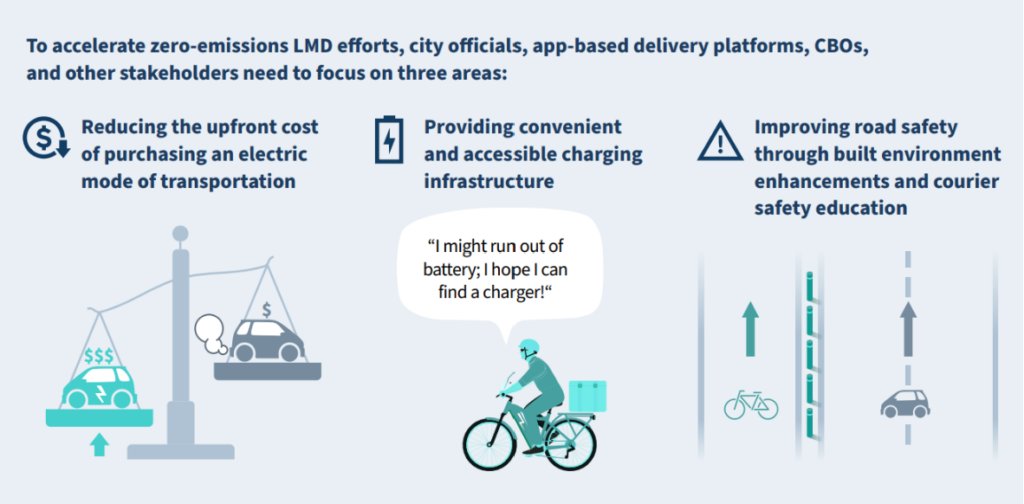
The main findings in our analysis suggest that to drive the shift to zero-emissions last-mile delivery modes, stakeholders should focus solution efforts on:
Reducing upfront cost
- Local governments can provide financial incentives directly to couriers that can be used for transport mode, associated gear, and charging.
- App-based delivery platforms can partner with local vendors and dealers to offer couriers discounted prices or leases on low- and zero-emissions transport modes.
Increasing access to charging and battery swapping
- Local governments can develop infrastructure plans with charging (including fast charging) and battery swapping stations placed along convenient delivery routes and high-volume corridors to maintain delivery efficiency and courier earnings.
- Public- and private-sectors can invest in charging infrastructure through partnerships between cities, app-based delivery platforms, and charging infrastructure providers to create accessible, convenient charging for a variety of modes.
Addressing road safety concerns
- Local governments can develop dedicated, protected, and connected lanes and paths for e-bikes and e-motorcycles/mopeds.
- App-based delivery platforms can partner with local governments and CBOs to provide couriers with safety education and equipment.
Zero-Emissions Last-Mile Deliveries Are Possible
Although significant challenges still exist, particularly because of charging accessibility issues and high up-front vehicle costs, many solutions are available to decrease the barriers couriers face in adopting zero-emissions modes. By centering this report on courier perspectives, RMI has created a unique frame for presenting on-the-ground experiences and concerns that need to help inform policy and incentive structures, infrastructure investments, safety programs, and partnerships to best address barriers to transportation electrification.
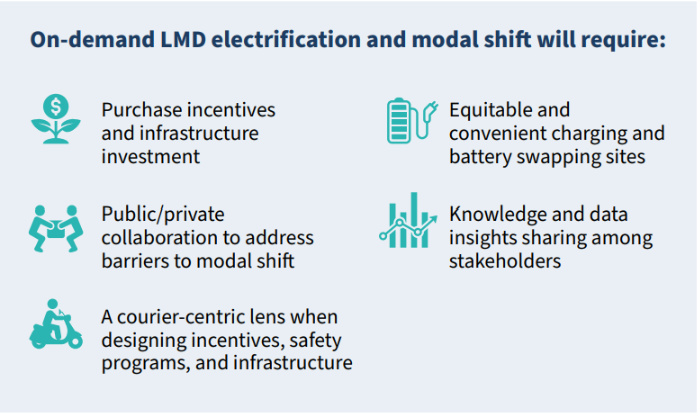
The courier voice should continue to be centered in the discussion of last-mile and zero-emissions delivery to ensure the whole of their experience is considered when designing incentives, safety programs, infrastructure, and the other recommendations in our report.
Zero-emissions transportation will continue to expand globally as local, state, and national governments and other stakeholders make aggressive commitments to cut transportation sector emissions and invest in necessary infrastructure. On-demand last-mile delivery may be a small segment of the transportation sector, but its potential impact is big when it comes to broader transport policies and consumer zero-emissions adoption decisions, as well as helping cities achieve their emissions reduction goals.
We would like to thank Uber for commissioning this report and acting as a key adviser and partner.



Related Insights
The Opportunity for Heat Pumps to Put Downward Pressure on Electricity Rates

Gas Utility Depreciation: Recommendations for an Uncertain Future
Help build the clean energy future. Donate today.
Independent research. Real-world solutions. Supported by donors.
RMI can pursue the highest-impact climate and energy solutions because we’re supported by people who believe change is possible. Every gift helps advance the work needed to make clean energy the default choice worldwide.
For other ways to give to RMI, including checks or gifts of stock, please visit Other Ways to Give.
