

Learn how we are working to transform how we use and produce energy.
Inside the Race to the Top
The race for cleantech among Chinese provinces, US states, and European countries
Why we share this work for free
RMI is an independent nonprofit working to accelerate the clean energy transition. We publish research like this to inform decision-makers and drive real-world impact.
Our work is supported by philanthropy as well as partnerships, including fee-for-service engagements. This support makes it possible for us to share our independent insights for free.
If you find this work valuable, you can support it anytime.
Get more insights like this
Stay up to date with the latest research, analysis, and tools from RMI by opting in to receive occasional emails below. You’ll get new reports, event invitations, and practical insights to help us all accelerate the clean energy transition.
Loading form...
Your download should start automatically. If it doesn’t, click the download button below.
This work is made possible by philanthropy
RMI is a nonprofit supported by donors and partners. Philanthropy enables us to produce independent research and make resources like this freely available.
If you find this report valuable, please consider supporting our work. You can also explore how we partner with organizations to drive impact.
Jump to Section
Cleantech has unleashed a global revolution, driven from the bottom up. Three major blocs — Europe, the United States, and China — are in a race to the top on cleantech. Yet, the real frontier of change lies within — at the country, state, and province level inside each bloc.
In a new report, Inside the Race to the Top, RMI looks at the energy transition across more than 110 territories across the three blocs. It is a follow up to a previous report on cleantech progress in the United States, China, and Europe. It digs deeper into the local trends, looking at regional differences within each bloc on renewable energy deployment, electric vehicle adoption, electrification, and cleantech manufacturing.
From Iowa to California, Qinghai to Zhejiang, and Norway to Greece, new global cleantech leaders are rising fast. There is a wide variation in cleantech uptake within each bloc today. A few trailblazing territories raise the global ceiling of the possible while, for example, some 20 percent still lag the Global South average in wind and solar uptake and electrification. Nevertheless, across all regions, cleantech appears to grow rapidly along a remarkably uniform S-curve. The majority of growth up this S-curve in the coming decade can be achieved by the laggards simply copying today’s leaders.
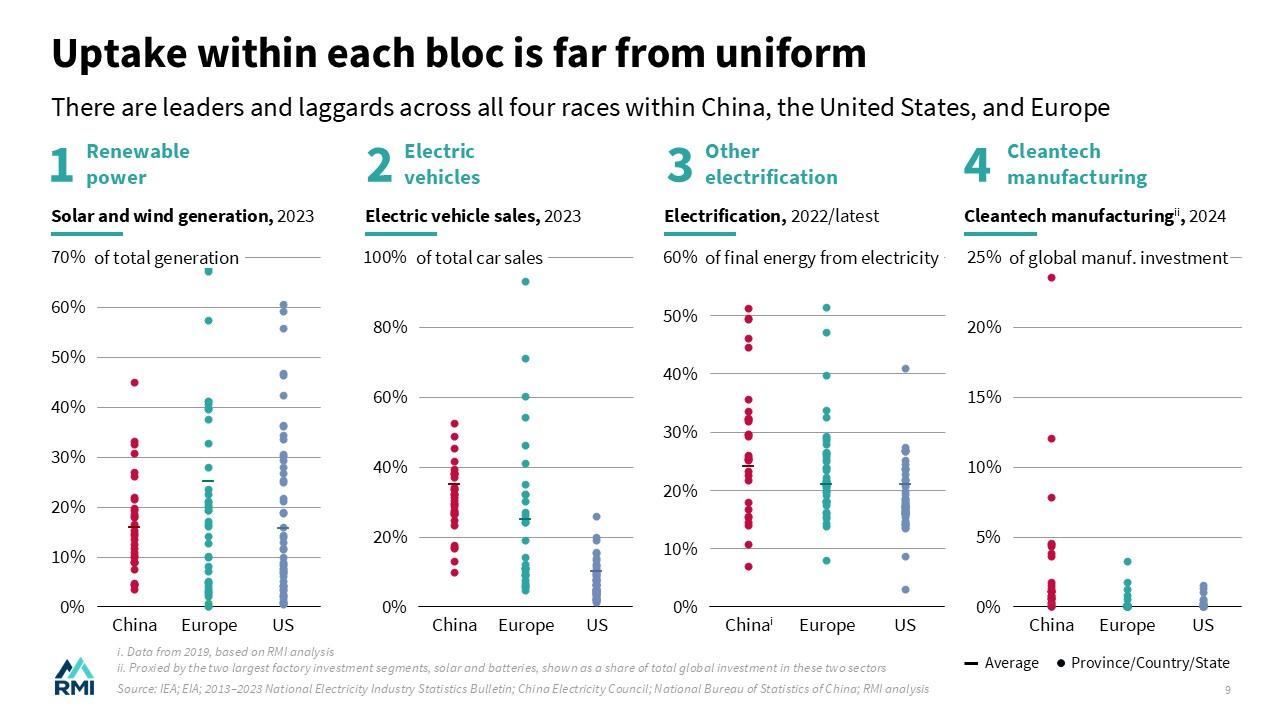
The cleantech revolution is a technology revolution, and early movers benefit from a virtuous cycle of market power, lower prices, and rising economic activity. The benefits of cleantech are primarily local — stimulating growth, creating jobs, lowering energy costs, improving energy security, and boosting public health. Change, therefore, is likely to be driven from the ground up. As the race intensifies, the regions that invest decisively in this future will secure their position as leaders in growth, innovation, and resilience.
Authors

Daan Walter
Kingsmill Bond
Sam Butler-Sloss
Related Insights


Help build the clean energy future. Donate today.
Independent research. Real-world solutions. Supported by donors.
RMI can pursue the highest-impact climate and energy solutions because we’re supported by people who believe change is possible. Every gift helps advance the work needed to make clean energy the default choice worldwide.
For other ways to give to RMI, including checks or gifts of stock, please visit Other Ways to Give.
