

Learn how we are working to transform how we use and produce energy.
Unlocking the Potential of Green Public Procurement in the Indian Economy
Why we share this work for free
RMI is an independent nonprofit working to accelerate the clean energy transition. We publish research like this to inform decision-makers and drive real-world impact.
Our work is supported by philanthropy as well as partnerships, including fee-for-service engagements. This support makes it possible for us to share our independent insights for free.
If you find this work valuable, you can support it anytime.
Get more insights like this
Stay up to date with the latest research, analysis, and tools from RMI by opting in to receive occasional emails below. You’ll get new reports, event invitations, and practical insights to help us all accelerate the clean energy transition.
Loading form...
Your download should start automatically. If it doesn’t, click the download button below.
This work is made possible by philanthropy
RMI is a nonprofit supported by donors and partners. Philanthropy enables us to produce independent research and make resources like this freely available.
If you find this report valuable, please consider supporting our work. You can also explore how we partner with organizations to drive impact.
Jump to Section
Globally, government agencies are one of the largest procurers of steel and cement, primarily for large-scale construction projects. Similarly, in India, public procurement accounts for at least 20% of gross domestic product (GDP). To leverage this significant market size and promote synergies between sustainability and procurement, India has already implemented measures such as the Ecomark Scheme and the Standards and Labelling Scheme. Most of these existing initiatives have a limited scope, focusing on white goods like large home appliances. Green public procurement (GPP) has the potential to align producer and consumer expectations for more low-carbon materials, particularly cement and steel, and support industries in overcoming the associated green premium these materials often have when transitioning to a low-carbon economy.
This report aims to bridge the identified gaps and contribute to the ongoing discussion around GPP for low-carbon steel and cement in India. The study presents the business case for green public procurement policies. Since more than 70% of steel and cement in India is consumed in housing and infrastructure development projects, we analyze the implications of GPP on emissions reductions and green premiums for public housing, railway, and highway construction projects in India, detailed in the exhibit above.
Finally, the report explores global case studies and offers an actionable roadmap for integrating GPP characteristics into India’s current procurement framework. The action plan includes six phases, starting with a pre-announcement phase followed by determining emissions limits and compliance, piloting at project and policy levels, announcing the policy, engaging the market, scaling, and monitoring and evaluating.
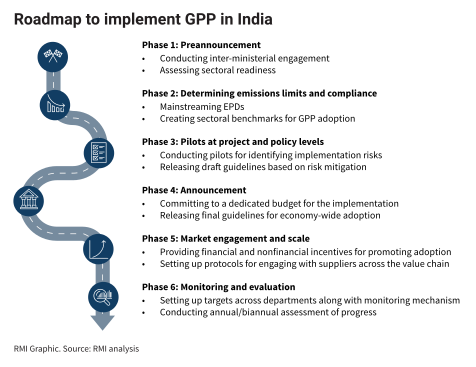
A systematic approach is proposed to advance construction projects through targeted initiatives. Some recommendations in our report include:
- Initially, detailed construction project deep dives and assessments are recommended, involving comprehensive analysis of the procurement process, identification of challenges, assessment of opportunities, and development of strategies to integrate GPP principles.
- Concurrently, efforts should focus on devising innovative business models to promote GPP adoption, exploring implications of associated green premiums, and formulating policy frameworks to mainstream these models effectively.
- Additionally, establishing an expert working group composed of key state officials and stakeholders will facilitate ongoing deliberation to drive sustainable practices.
- Furthermore, emphasis should be on subnational policy deep dives and implementation, suggesting enhancements to existing policies and institutional mechanisms to actively promote GPP initiatives.
For more, download our report below.
Authors

Related Insights

India’s Used EV Battery Market Needs Trust. Battery Aadhaar Can Help.
Help build the clean energy future. Donate today.
Independent research. Real-world solutions. Supported by donors.
RMI can pursue the highest-impact climate and energy solutions because we’re supported by people who believe change is possible. Every gift helps advance the work needed to make clean energy the default choice worldwide.
For other ways to give to RMI, including checks or gifts of stock, please visit Other Ways to Give.
