

Learn how we are working to transform how we use and produce energy.
How To Retire Early
Why we share this work for free
RMI is an independent nonprofit working to accelerate the clean energy transition. We publish research like this to inform decision-makers and drive real-world impact.
Our work is supported by philanthropy as well as partnerships, including fee-for-service engagements. This support makes it possible for us to share our independent insights for free.
If you find this work valuable, you can support it anytime.
Get more insights like this
Stay up to date with the latest research, analysis, and tools from RMI by opting in to receive occasional emails below. You’ll get new reports, event invitations, and practical insights to help us all accelerate the clean energy transition.
Loading form...
Your download should start automatically. If it doesn’t, click the download button below.
This work is made possible by philanthropy
RMI is a nonprofit supported by donors and partners. Philanthropy enables us to produce independent research and make resources like this freely available.
If you find this report valuable, please consider supporting our work. You can also explore how we partner with organizations to drive impact.
Jump to Section
As the urgency of the climate crisis grows, new analysis reveals that coal is no longer the cheapest way to power the global economy. The cost of clean energy has fallen so far that new renewables are now cheaper than new coal plants virtually everywhere, and there are specific financial strategies that utilities and policymakers can use to engineer a faster phaseout of coal in various regions of the world.
How to Retire Early: Making Accelerated Coal Phaseout Feasible and Just estimates that replacing the entire fleet of global coal plants with clean energy plus battery storage could be done at a net annual savings as early as 2022. The rapidly declining costs of renewables push net annual savings to $105 billion in 2025. All this is before considering coal’s dire health, climate, and environmental impacts, or accounting for the social and environmental benefits of reducing pollutants. Currently, coal phaseout hasn’t kept pace with eroding economics.
Cost Competitiveness of Existing Coal vs. New Renewables and Storage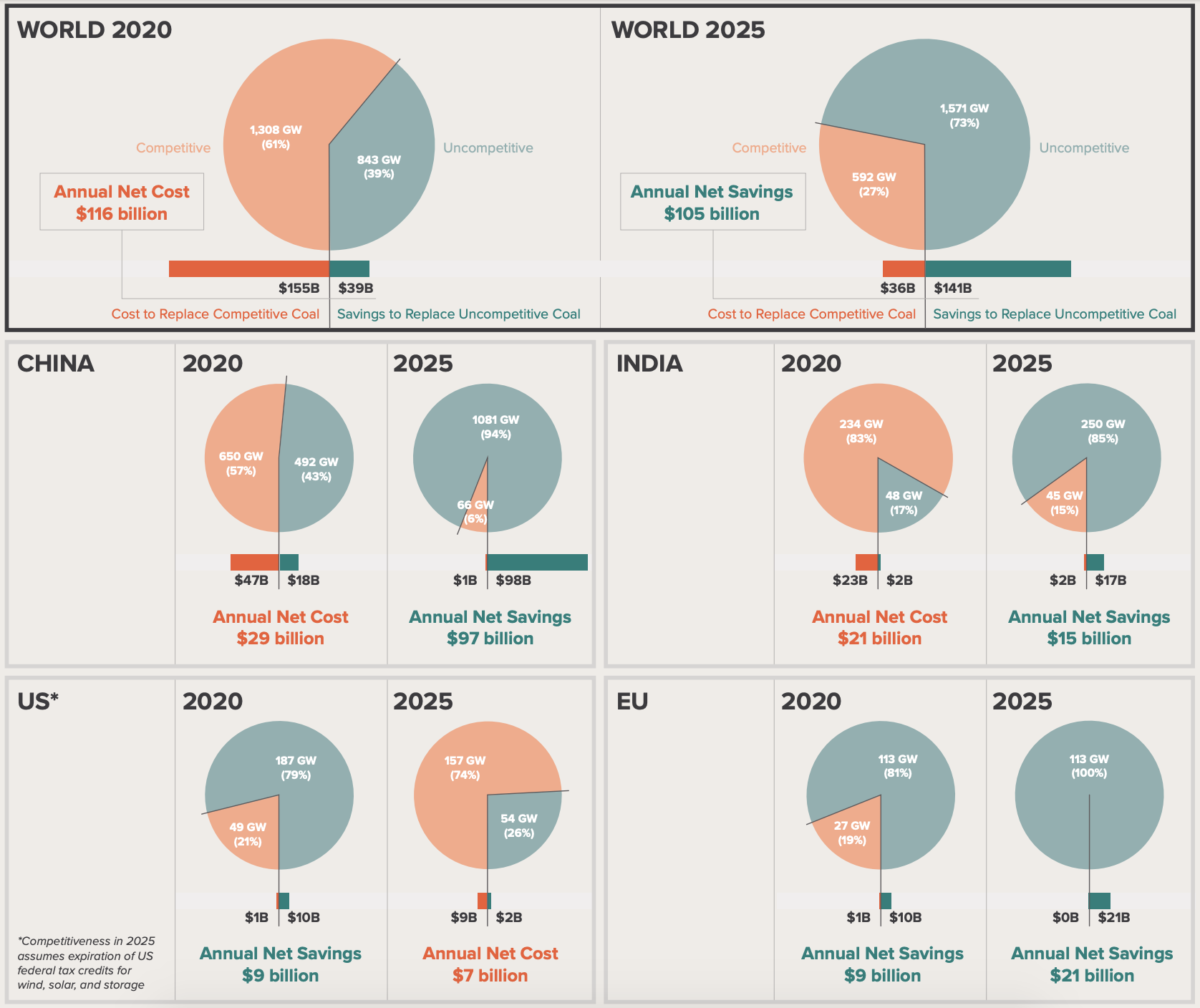
To keep the Paris Agreement’s temperature targets within reach, global coal use must decline by 80 percent below 2010 levels by 2030, requiring rapid transition in OECD countries over the next decade and phase-out in the rest of the world by 2040.
This report lays out options for governments and public finance institutions to accelerate coal phase-out via integrated three-part approach: 1) refinancing to fund the coal transition and save customers money on day one, 2) reinvesting in clean energy, and 3) providing transition financing for workers and communities.
In 2020, U.S. policymakers could help customers save up to $10 billion annually using the three-part approach to phase out the 79 percent of the 236 GW coal fleet that is uncompetitive today. Meanwhile, outside the United States, a third of the global coal fleet is already more costly to continue operating than building new renewables with storage today.
Authors

Related Insights

The Opportunity for Heat Pumps to Put Downward Pressure on Electricity Rates

Gas Utility Depreciation: Recommendations for an Uncertain Future
Help build the clean energy future. Donate today.
Independent research. Real-world solutions. Supported by donors.
RMI can pursue the highest-impact climate and energy solutions because we’re supported by people who believe change is possible. Every gift helps advance the work needed to make clean energy the default choice worldwide.
For other ways to give to RMI, including checks or gifts of stock, please visit Other Ways to Give.
