Learn how we are working to transform how we use and produce energy.
Transmission 101: Network Upgrades
What are network upgrades, why are they necessary, and how can we speed them up?
Why we share this work for free
RMI is an independent nonprofit working to accelerate the clean energy transition. We publish research like this to inform decision-makers and drive real-world impact.
Our work is supported by philanthropy as well as partnerships, including fee-for-service engagements. This support makes it possible for us to share our independent insights for free.
If you find this work valuable, you can support it anytime.
Get more insights like this
Stay up to date with the latest research, analysis, and tools from RMI by opting in to receive occasional emails below. You’ll get new reports, event invitations, and practical insights to help us all accelerate the clean energy transition.
Loading form...
Your download should start automatically. If it doesn’t, click the download button below.
This work is made possible by philanthropy
RMI is a nonprofit supported by donors and partners. Philanthropy enables us to produce independent research and make resources like this freely available.
If you find this report valuable, please consider supporting our work. You can also explore how we partner with organizations to drive impact.
Jump to Section
Electricity demand is soaring across the United States. Meeting that demand while maintaining a reliable power system will require building substantial amounts of new electricity generation and storage resources. But building it is only part of the challenge; those resources also need to connect to the high-voltage transmission grid so the electricity can get to its end-users.
Before a new generation or storage project can connect to the grid, the relevant transmission provider must determine whether the existing transmission system can handle the additional electricity coming online. [1] If it can’t, the provider deems that changes to the transmission system, known as network upgrades, are necessary before that project can connect.
As more generation and storage projects connect to the grid, finding ways to deliver necessary network upgrades more efficiently will become increasingly important. This includes:
- More transparent network upgrade construction timelines
- Implementing a connect and manage interconnection approach
- Conducting more proactive transmission planning
- Strengthening supply chains for critical grid equipment
- Strengthening workforce development programs
But first, it helps to understand how network upgrades work.
What are network upgrades?
Network upgrades ensure the future grid can accommodate a project’s additional power. Not everything built to connect a new project is a network upgrade. “Interconnection facilities” connect the project to a local point on the transmission system, while “network upgrades” modify the broader transmission system, potentially miles or even states away from the local connection point. Network upgrades may include rebuilding or reconductoring existing transmission lines to expand their capacity, upgrading substations or transformers, or building new transmission lines. In some cases, advanced transmission technologies can increase the capacity of existing infrastructure, potentially reducing the need for more extensive network upgrades.
Some network upgrades are needed to address constraints that emerge primarily during peak or other stressed system conditions, which may occur during a limited number of hours per year. Others may address reliability issues that arise under different system conditions or situations.
If needed, network upgrades must be completed before new generation and storage projects can connect to the grid. A project may be fully constructed but find itself unable to connect to the grid without its network upgrades. Therefore, completing network upgrades in a timely manner is critical to bringing new generation and storage projects online and avoiding unnecessary costs that may ultimately be borne by ratepayers.
Who designs and builds network upgrades?
The transmission provider, including regional transmission organizations (RTOs), independent system operators (ISOs), and local utilities, identify needed network upgrades through the interconnection study process. The utilities are then generally responsible for the design, engineering, and construction of those upgrades. In some cases, generation and storage project developers may have an “option to build,” which allows them to construct certain eligible stand-alone network upgrades themselves, subject to utility oversight and applicable requirements. In all cases, network upgrades must be completed before projects can connect to the grid and begin commercial operation.
Who pays for network upgrades?
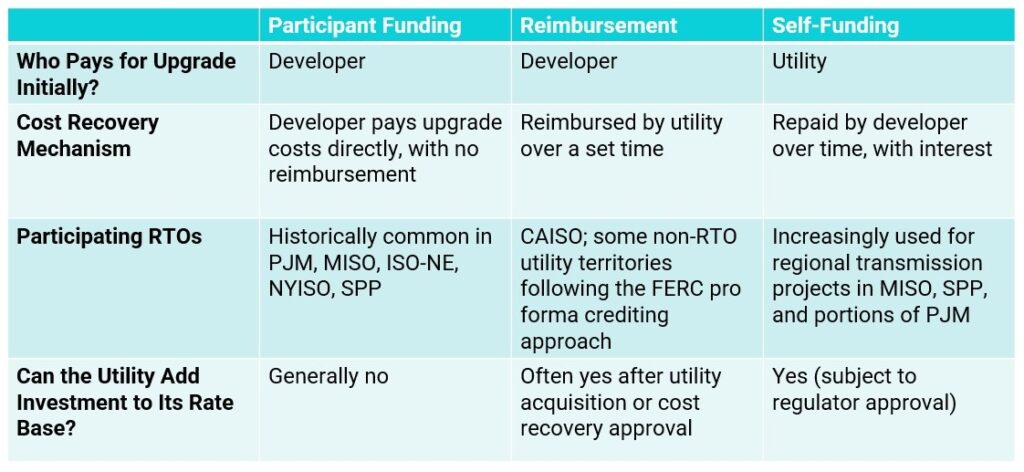
The specific funding mechanism for network upgrades varies by region (Exhibit 1). In some regions, the project developer pays the upgrade costs directly without reimbursement (the “participant funding” approach). The utility does not earn a rate of return on these projects, even though the utility still owns and operates the upgrade.
In other regions, the project developer pays for the upgrade up front and is reimbursed by the utility over time (the “reimbursement” approach). Once the utility reimburses the project developer for the network upgrade, the eligible investment can be included in the utility’s rate base, allowing it to recover the cost from ratepayers and earn an authorized rate of return.
A third approach allows the utility to fund the upgrade up front and recover those costs, with interest, from the project developer over time (the “self-funding” approach). Regardless of the approach used, it is important to note that in today’s cluster study approach to interconnection, required by FERC in Order No. 2023, costs may be shared among different projects in the same cluster.
Exhibit 1. Comparison of the three main methods for paying for network upgrades.
What challenges are network upgrades facing today?
Network upgrades face two main challenges: delays and increased costs.
Project delays
As the number of new generation and storage projects seeking to interconnect to the grid surges, network upgrades are facing significant construction delays, often exceeding five years. Many new load projects also need the same network upgrades as new generation or storage, straining already constrained supply chains for key grid components like transformers and conductors. Other causes of delay include labor shortages, siting and permitting processes, and the time required to negotiate contracts between utilities and project developers.
Our research (Exhibit 2) shows that, across the three regional grids analyzed, average network upgrade construction delays increased from approximately two months in 2015 to nearly two years in 2025. These growing delays can contribute to higher electricity costs by making it more difficult to promptly bring new low-cost generation and storage projects online.
Exhibit 2
Increased costs
Network upgrades are also growing in cost and scope, with some upgrades resembling the large high-voltage transmission projects that are traditionally developed through regional transmission planning processes. The Lawrence Berkeley National Laboratory analyzed more than 2,500 project-level interconnection cost estimates across five regional electricity markets and found that interconnection costs have grown substantially over time in all five regions, with upgrades to the broader transmission system representing the primary cost driver.
Exhibit 3. Network upgrade costs have been rising over time across grid regions
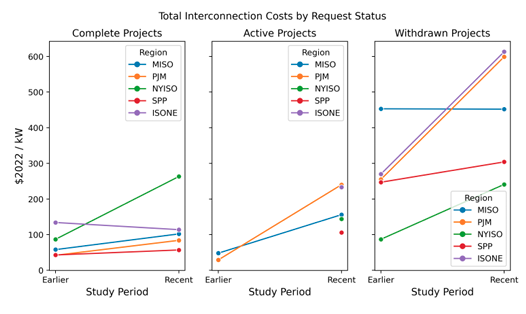
This can significantly impact project economics. For example, if an interconnection study identifies substantial network upgrades, the high cost can reduce the chance that a proposed project remains financially viable. A developer may ultimately decide not to go through with the project if its network upgrade costs are too high.
Beyond creating a financial barrier for individual generation and storage projects, large and costly network upgrades can also point to a broader planning challenge. As network upgrades grow in scale, some may be better suited for regional transmission planning and cost allocation rather than being triggered through the interconnection process. The interconnection process was not designed to identify larger regional transmission needs, and addressing these needs project by project can miss potential efficiencies and streamlining opportunities that come from regional planning. More proactively identifying these larger needs through transmission planning could reduce reliance on large and costly network upgrades triggered through the interconnection process.
How can we accelerate network upgrades?
To keep costs low for ratepayers, it is essential to accelerate network upgrade construction timelines. The following ideas can help.
- More transparent network upgrade construction timelines: Network upgrades often lack clearly defined construction schedules and expected completion dates and may be deprioritized relative to locally or regionally planned transmission projects. Utilities should be required to consistently post public data on network upgrade construction timelines, including expected in-service dates and any explanations for potential delays. State legislatures could require this of their state’s utilities, and FERC could also impose these requirements on a national level.
- Implement a connect and manage interconnection approach: Connect and manage, used by Texas (ERCOT) today, prioritizes rapid processing of new interconnection requests while minimizing assigned network upgrade size and cost. In exchange, new generation and storage projects are subjected to higher levels of curtailment to manage congestion and maintain grid reliability until larger system-wide transmission projects can be built to mitigate this curtailment. As a result of this approach, Texas has interconnected more new generation and storage faster than any other state or grid region in the United States today. Other grid regions can consider adopting this approach, or FERC or Congress could mandate it nationwide. Notably, this approach still needs proactive transmission planning (see recommendation #3) to function properly, as without it, system-wide curtailment can increase to untenable levels for generation and storage projects.
- Conduct more proactive transmission planning: Network upgrades are largely identified reactively; these projects are only considered after generators request to connect to the grid. More proactive transmission planning, such as the planning required by FERC Order No. 1920, could help identify recurring constraints and address upgrades that could potentially serve multiple generators as well as new loads. It can also help reduce the volume of network upgrades identified through the interconnection process, helping to speed this process up. SPP’s Consolidated Planning Process is another example of streamlined, proactive transmission planning that incorporates interconnection requests in action.
- Strengthen supply chains for critical grid equipment: Long lead times for critical grid components, such as transformers, can delay network upgrade construction. Utilities can work together to coordinate equipment procurement and improve demand forecasting to reduce supply chain bottlenecks. Congress can also take action — for more information, see RMI’s Solving the Gridlock: America’s Electric Supply Chain Opportunity.
- Strengthen workforce development programs: A larger skilled workforce will be needed to address existing labor shortages and meet growing transmission needs driven by load growth and the energy transition. State legislatures or Congress can help expand and fund workforce training and development programs for electrical workers needed to construct network upgrades and other grid infrastructure.
Accelerating the development of network upgrades will be essential to maintaining a reliable grid as electricity demand and new generation and storage projects continue to grow. By proactively and holistically planning network upgrades, providing more transparent construction timelines, and strengthening supply chains and workforce development projects, we as a nation can enable more generation and storage projects to connect to the grid efficiently while reducing delays and uncertainty throughout the interconnection process.
[1] Transmission providers include regional transmission organizations (RTOs) and independent system operators (ISOs) where they are present. In areas without RTOs or ISOs, this is typically the balancing authority.


Related Insights


Exploring Energy Affordability Across Income, Time, and Geography

The National Transmission Data We’ve Never Had (and Why We Desperately Need It)

Help build the clean energy future. Donate today.
Independent research. Real-world solutions. Supported by donors.
RMI can pursue the highest-impact climate and energy solutions because we’re supported by people who believe change is possible. Every gift helps advance the work needed to make clean energy the default choice worldwide.
And right now, your impact goes twice as far. Thanks to generous donors and our special match, every $1 you give becomes $2, up to $150,000, through December 31, 2026.