Learn how we are working to transform how we use and produce energy.
Scaling Markets for Distributed Energy Resources
How replicable deal structures and tailored financing can open the door to more distributed energy and virtual power plants
Why we share this work for free
RMI is an independent nonprofit working to accelerate the clean energy transition. We publish research like this to inform decision-makers and drive real-world impact.
Our work is supported by philanthropy as well as partnerships, including fee-for-service engagements. This support makes it possible for us to share our independent insights for free.
If you find this work valuable, you can support it anytime.
Get more insights like this
Stay up to date with the latest research, analysis, and tools from RMI by opting in to receive occasional emails below. You’ll get new reports, event invitations, and practical insights to help us all accelerate the clean energy transition.
Loading form...
Your download should start automatically. If it doesn’t, click the download button below.
This work is made possible by philanthropy
RMI is a nonprofit supported by donors and partners. Philanthropy enables us to produce independent research and make resources like this freely available.
If you find this report valuable, please consider supporting our work. You can also explore how we partner with organizations to drive impact.
Jump to Section
Acknowledgements: The views presented in this piece are the author’s own. RMI thanks Ohm Analytics for providing supporting market data.
The US electricity grid is struggling to meet rising demand while staying reliable, and affordable for ratepayers.1,2,3 Flexible distributed energy resources (DERs), such as batteries, smart thermostats, and heat pumps, offer one potential solution. By shifting demand and supply power where and when the grid needs it most, DERs can add capacity quickly, increase grid utilization, and reduce rising electricity rates.4,5,6
Over the past several months, RMI’s Deal Lab team has engaged DER developers, virtual power plant (VPP) operators, financial institutions, data center operators, and policymakers to understand the current commercial landscape, including a range of bilateral discussions and a convening cohosted with Goldman Sachs Sustainable Finance Group in July 2026.7 These engagements highlight an emerging consensus on the value of flexible DERs in meeting current grid demands, with two major opportunities to expand their scale and impact.
First, the market must develop replicable transaction structures that let new big electricity users — especially data centers — invest directly in new distributed capacity (aggregated DERs that can reliably deliver power or reduce demand when the grid is stretched). Early deals show the major potential for distributed capacity procurement, most notably Voltus’s recent gigawatt-scale Bring Your Own Capacity (BYOC) announcement with Google in PJM.
Despite these promising signs, the market still has a long path to full maturity. Transactions to date have relied on a single hyperscaler anchor, Google, and none has yet publicly shown how the grid benefits of DERs turn into direct benefits for specific data center projects. To keep scaling, the market will need replicable deal structures that work across jurisdictions, a wider pool of counterparties, and access to project-specific energy procurement budgets.
The second opportunity is for financiers and developers to find effective ways to build flexibility-based value into financing structures. Developers cannot reliably borrow against revenue from grid services to finance DERs, and so cannot deploy assets where they would help the grid most. Transactions with creditworthy hyperscalers offer one near-term solution and potential for market learning. Over the medium and long term, however, DER deployment will depend on developing tailored financial products that capture flexibility-based value across the full DER lifecycle.
This article explores both opportunities and the potential for coordination across power system stakeholders to catalyze a more efficient and effective market for power flexibility.
Large Loads are Starting to Fund Distributed Capacity
Large load growth contributes to many of the grid’s current needs, but it also offers a significant pool of potential investment. Large loads face significant delays to interconnection due to lack of grid headroom and concerns about impacts on electricity rates.8,9 Flexible DERs can help mitigate both challenges by quickly creating capacity to alleviate peak- and location-specific grid congestion and by placing downward pressure on electricity rates.
Recent work by the Brattle Group on behalf of Everyday Electric shows that achievable expansions in residential VPP participation have major rate benefits for both participating and non-participating households,10 while detailed grid modeling by Piq Energy on Base Power assets indicates the potential for distributed capacity to relieve major transmission constraints in ERCOT.11 These benefits can enable win-win transactions, with large loads sponsoring new distributed capacity deployment to alleviate grid impacts from their interconnection.
Early deals show promise, with limits
The market is undergoing a period of rapid experimentation in transaction structures to realize this value. Three recent deals show early “bring your own distributed capacity” transactions: Google’s procurement of aggregated resources from Voltus in PJM, Xcel’s “Capacity*Connect” procurement of distributed storage with Sparkfund in Minnesota, and the SHARE VPP partnership in PG&E’s service territory in Northern California. Of these, the Google-Voltus transaction is by far the largest, with both parties having recently announced an expansion to more than a gigawatt of aggregated resources in PJM.12,13
While these transactions are a promising signal, exhibit 1 illustrates some of the remaining limitations for scaling and replication. Google is the only hyperscaler participant across all three transactions, and each uses a different commercial template: a privately funded pilot, a contribution to a utility program, and a bilateral capacity contract. None yet publicly demonstrates a mechanism translating the system-level benefits of DER capacity into project-specific benefits for a sponsor, such as accelerated interconnection or protection from curtailment.14
Public comments by Voltus CEO Dana Guernsey highlighting the value of long-duration contracts in demonstrating durable capacity to regulators are suggestive of potential site-specific accreditation or benefits, but these details are not yet publicly disclosed. 15 Without such mechanisms, future transactions may struggle to access the project-level energy procurement budgets that offer the most direct route to continued scale.
Exhibit 1: Hyperscaler-sponsored distributed capacity transactions
| SHARE VPP | Capacity*Connect | Voltus BYOC | |
| Structure | Privately funded utility proof-of-concept VPP | Rate-based utility procurement of distribution asset, with large-load contribution | Bilateral portfolio capacity contract |
| Resource | ~21,000 existing residential devices and new battery-enabled heat pumps | Utility-owned 1–3 MW front-of-meter batteries | Aggregated demand response, batteries, and other DERs |
| Scale | ~12 MW target | Up to 200 MW program authorization ($430 million budget) | ~1,170 MW contracted (100 MW & 1,070 MW tranches) |
| DER deployment funding | Google (via direct incentives), homeowners | Ratepayers, plus $50 million Google contribution through Clean Energy Accelerator Charge (CEAC) | Google (via Voltus contracting), host sites (via equipment purchase) |
| Ownership and dispatch | Host owns, PG&E dispatches | Xcel owns and dispatches | Host owns, Voltus dispatches |
| Disclosed return to hyperscaler funder | None | Included in CEAC bundle, no direct attributed benefit disclosed | Accredited PJM capacity, site-level benefits (if any) not yet disclosed |
| Status | Announced September 2026 for 2026/2027 operations | Program approved April 2026, associated electric service agreement contested | Announced June 2026 for 2027 onward delivery; expanded to 1+ GW October 2026, contracted through 2040 |
Source: RMI analysis, drawing on Pacific Gas and Electric Company for SHARE VPP16; Xcel Energy17 and Minnesota PUC Docket No. E-002/M-25-37818 for Capacity*Connect; and Voltus,19 and Energy-Storage News20 for Voltus BYOC, with the October 2026 expansion as cited in note 11. On disclosed returns, see note 13. Scale figures are not directly comparable: a pilot target, a program authorization, and contracted capacity, respectively.
Value transfer mechanisms connect grid benefits to buyers
Flexible DERs can create grid services that are a good match for large-load-created demands, but individual transactions are primarily determined by value transfer mechanisms: contractual or regulatory devices that convert system-level DER value into a benefit assignable to the specific entity paying for it. These mechanisms vary significantly by jurisdiction and transaction structure and will determine the ultimate value delivered to the sponsoring large load (see non-exhaustive examples in exhibit 2). While distributed resources create value, the transfer mechanism is what will define specific products that large loads may be willing to pay for.
Exhibit 2: Example value transfer mechanisms linking distributed capacity to large load requirements
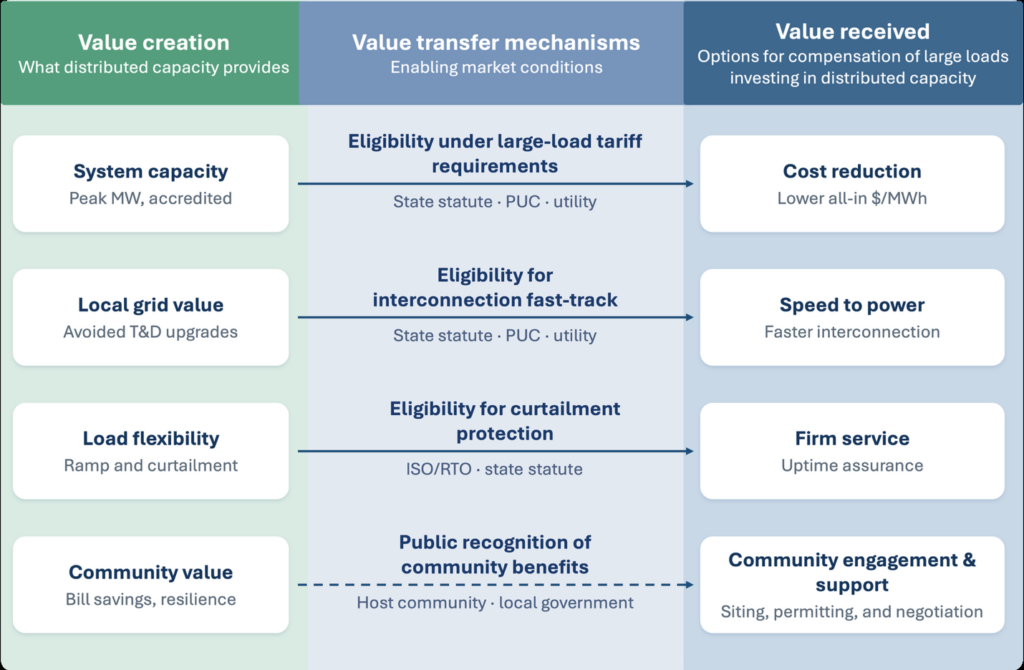
Source: RMI analysis, from “States Are Opening the Door to Data Center Investment in Virtual Power Plants,” RMI, September 2026. Mechanisms differ significantly by jurisdiction; examples are non-exhaustive.
With limited public reporting and a rapidly evolving deal landscape, it is not possible to catalogue with certainty which transfer mechanisms have been successfully deployed, but for the market to mature, it will need clear product categories with differentiated pricing based on that value transfer. Of the transactions to date, the Google-Voltus PJM agreement has most clearly signaled the potential for clear transfer mechanisms, and any further public disclosure would be a major development for the market.
Four example product structures that could make deals replicable
- Bilateral hedge (cost reduction): In regions with forward capacity markets in which large loads are exposed to capacity prices, purely bilateral contract-for-differences structures can provide hyperscalers with cost hedging against future price changes, but these transactions in isolation do not impact interconnection speed or service reliability.
- Trilateral interconnection (speed to power): In trilateral structures with a load-serving entity (LSE), an LSE may offer accelerated interconnection in return for delivered accredited capacity or other grid services, but this relies on individual contract terms, for which there is not yet a public demonstration project.
- ISO compliance purchase (firm service): In markets with Bring Your Own New Capacity (BYONC) mandates for which aggregated DERs are eligible, hyperscalers may pay DER developers for regulatory compliance, with the direct value depending on the regulatory incentive or cost. PJM’s interim resource adequacy service (IRAS) proposal contained such a mechanism, with aggregated DERs qualifying to protect large loads from priority curtailment, allowing hyperscalers to effectively purchase service reliability as a product from DER aggregators. IRAS was rejected on primarily jurisdictional grounds, but similar structures may emerge from ongoing regulatory proceedings around the US.21,22,23
- State compliance purchase (firm service/speed to power): In states with large load tariffs or other regulatory requirements, DERs may qualify for conditions on interconnection, curtailment protection, or other regulatorily imposed requirements. RMI recently catalogued advancements in state-level regulations that establish clear value transfer mechanisms.24 One notable example is New Jersey’s Data Center Fair Share law, enacted in July 2026, which directs the creation of a flexibility trading mechanism by which large loads could pay other actors to provide flexibility in lieu of direct data center curtailment.25 As with the defunct IRAS proposal, this would effectively allow DER aggregators to sell service reliability as a product to large loads.
Due to the speed and scale of digital infrastructure development, the distributed capacity procurement discussion has focused on alleviating data center grid impacts through hyperscaler-sponsored deployment. Beyond data centers, however, these mechanisms offer an opportunity to establish effective market-based approaches for valuing the grid services created by flexible DERs, and with modification, could help facilitate future sources of load growth such as advanced manufacturing, industrial electrification, and electric mobility.
Financing Needs to Catch Up to Grid Value
As flexibility-based value becomes increasingly important to the US electricity market, whether through defined utility programs, direct wholesale market participation, or large-load-sponsored transactions, it is exposing limitations in current financing approaches for DERs.
DERs have traditionally been financed against their value to the host site (households and commercial or industrial facilities), whether as direct owners or through third-party ownership (TPO) structures. In this model, deployment is financed based on household credit or contracted cashflows from a lease or PPA structure. This model has successfully scaled in residential solar and increasingly for attached storage, with more than $16 billion in solar-based asset-backed security (ABS) issuances rated by Kroll Bond Rating Agency (KBRA) through mid-2025.26
Grid services, however, make up an increasing portion of the value proposition for distributed energy resources. Defined-payout utility VPP programs offer one transparent benchmark for grid services value, and in some jurisdictions, payments could now cover a significant portion of total system cost for battery-based systems (exhibit 3).27,28
As operational advances allow for better quantification of local distribution-system value and grid demands continue to rise, these values are likely to increase.
Exhibit 3: Annualized battery costs and VPP payment magnitudes, $/kW-yr
Currently, these revenue streams are effectively excluded from up-front and takeout financing. This exclusion reflects significant challenges around grid services revenues, from merchant-like revenue from market-based programs to binary risks around program duration and cancelation,29 which lead to compounding steep discounts by actors along the value chain. In contrast to the billions raised in DER-based ABS issuances to date, no grid services revenues have been directly credited in rated ABS cashflows. However, as grid services revenues continue to grow as a portion of system value, VPP programs become better integrated into utility planning, and data availability improves, this exclusion will become an increasing source of capital inefficiency for the market. Conversely, developers and financiers who can capitalize grid services revenues will have business model flexibility to rapidly respond to demand signals from large loads, accelerate deployment, and strengthen return profiles.
This exclusion hampers the availability of capital for DER deployment, especially behind-the-meter battery systems in locations where grid value is especially high, but household incomes or credit do not support traditional lease-based deployment and financing. Early programs converting long-term grid services value into discounted customer leases, such as Tesla’s Powerwall discounts for Energy Storage Solutions participants in Connecticut,30 show the potential for this model, but will need to move beyond developer equity to scale.
Most immediately, demand for capital may be met through bilateral procurements with creditworthy hyperscaler offtakers. Google and Voltus’s recently announced agreement opened the door for 10+ year contracted revenues that can replace merchant-like cashflows from grid services, allowing effective up-front financing for behind-the-meter C&I battery installations.31 In the medium and long term, however, the sector will benefit from incorporating grid services revenues from transactions beyond hyperscaler-anchored procurement.
This integration opportunity will extend to a broad category of financial instruments across the DER deployment and monetization lifecycle (exhibit 4). These instruments are not fundamentally new: warehouse facilities for asset deployment, price floors for firming merchant revenue, and securitization for capital recycling are well-established instruments across multiple sectors.
Exhibit 4: Financial products across the DER lifecycle
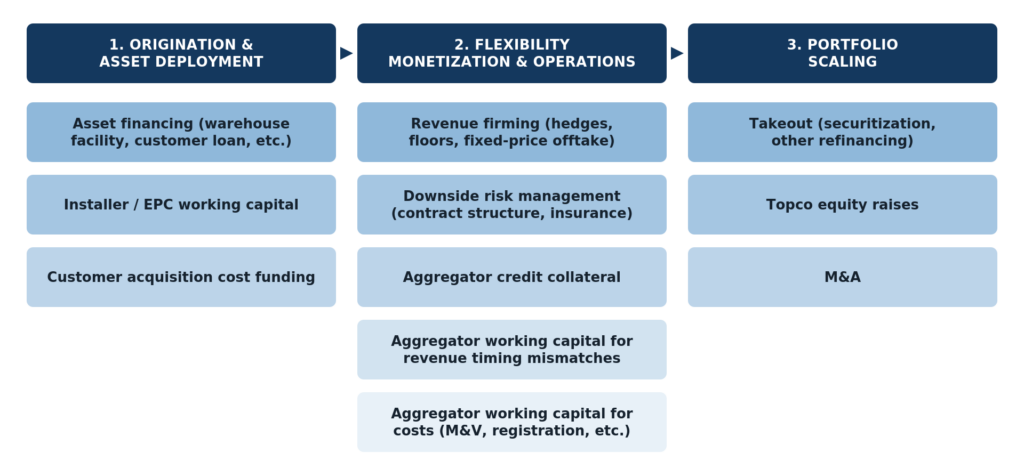
Source: RMI analysis.
Each, however, will require tailoring to incorporate the value of flexibility-based revenues, whether including grid services revenues in ABS cashflows or valuing credited distributed capacity in support of M&A activity. Development of these fit-for-purpose instruments represents a significant opportunity for financial institutions to develop new customers and product lines, and the emergence of better-tailored financial products will in turn reduce how much flexibility-based value goes unrealized.
Conclusion: Scaling Depends on Replicable Deals and Financing Models
Flexible DERs have the potential to fill a large and valuable role in the US power sector, both in managing the near-term impacts of data center development and in developing cost-effective models for sustained load growth in the coming decades.
While technological and regulatory developments will each play a major role in facilitating this growth, the emergence of effective, replicable transaction and financing models will be critical to realizing the full potential of flexible DERs.
Recent transactions, most notably the Google-Voltus expansion in PJM, demonstrate that distributed capacity can be contracted at gigawatt scale and over long tenors. What remains to be proven is whether transactions can scale to more than one buyer, through replicable structures, and with clear and well-priced value transfer mechanisms.
These opportunities are interlinked, with hyperscaler-anchored contracts offering a near-term route to making flexibility revenue financeable and creating an opportunity for market experimentation. In the medium term, however, financing for flexibility-based revenues should expand beyond reliance on hyperscalers as a credit backstop and create new opportunities for deploying flexible DERs where the grid benefits are greatest.
RMI’s Deal Lab is actively working to support the development and dissemination of these models. In our upcoming small-group technical workshops and public research, we will explore the key open questions the market needs to answer to mature, including:
- What value transfer mechanisms between aggregated DERs and large loads can markets currently facilitate, and how will large loads value them?
- What generalizable transaction structures best support bilateral distributed capacity procurement, and which elements can be effectively templatized?
- What are the enabling conditions, including regulatory policy, market structure, and utility partnerships, required for each transaction structure, and what are the most efficient ways to adapt transactions to function across jurisdictions?
- What financial instruments, including revenue firming, capacity pre-pays, and alternative credit structures, can most efficiently begin to capitalize flexibility-based value for DERs?
- As standardized products develop, what role can market-making balance sheets and secondary market trading play in providing liquidity, price discovery, and risk transfer, and how can they help scale the market and improve bankability?
If you are a DER or large load developer, utility, financier, policymaker, or other power system stakeholder interested in participating in Deal Lab, please reach out.
Notes
1. Shah, S. 5 Big Reasons Why Electricity Prices Are So High Right Now. TIME. https://time.com/7355839/why-are-electricity-prices-high-2026/. ↩
2. 2026 State of Reliability: Overview; North American Electric Reliability Corporation, 2026. https://www.nerc.com/globalassets/programs/rapa/pa/nerc_sor_2026_overview.pdf. ↩
3. Rand, J.; Cheyette, A.; Talley, C.; Zhang, S.; Gorman, W.; Wiser, R.; Seel, J.; Jeong, S.; Kahrl, F. Queued Up: 2026 Edition, Characteristics of Power Plants Seeking Transmission Interconnection As of the End of 2025; Lawrence Berkeley National Laboratory, 2026. https://emp.lbl.gov/publications/us-interconnection-queue-data-0. ↩
4. Hledik, R.; Lam, L.; Peters, K. The Untapped Grid: How Better Utilization of the Power System Can Improve Energy Affordability; The Brattle Group, prepared for GridLab and the Utilize Coalition, 2026. https://www.brattle.com/wp-content/uploads/2026/03/The-Untapped-Grid-Mar-2026.pdf. ↩
5. Razdan, S.; Downing, J.; White, L. Pathways to Commercial Liftoff: Virtual Power Plants 2025 Update; US Department of Energy, 2025. https://liftoff.energy.gov/vpp/. ↩
6. Cohen, J.; Shwisberg, L.; Dyson, M. How Virtual Power Plants Can Help the United States Win the AI Race; RMI, 2025. https://rmi.org/resources/how-virtual-power-plants-can-help-the-united-states-win-the-ai-race/. ↩
7. This piece is not intended to represent the views of any specific workshop participants or Goldman Sachs Sustainable Finance Group. ↩
8. Thomas, M. Bypassing the Grid: How Data Center Developers Are Building Their Own Power Plants; Cleanview, 2026. https://cleanview.co/reports/behind-the-meter-data-centers. ↩
9. PJM Capacity Auction Procures 138,318 MW of Generation Resources as Work Continues To Address Growing Electricity Demand; PJM Interconnection, July 14, 2026. https://www.pjm.com/-/media/DotCom/about-pjm/newsroom/2026-releases/20260714-pjm-capacity-auction-procures-138318-mw-of-generation-resources.pdf. ↩
10. Hledik, R.; Graham, K. The Affordability Advantage: How Virtual Power Plants Can Alleviate Household Electricity Bill Pressure; The Brattle Group, October 13, 2026. https://www.brattle.com/the-affordability-advantage/. ↩
11. Marmaras, B.; Stamatiadis, D.; Nudell, T.; Dowling, C. Flexibility without Curtailment: Aggregate DER Dispatch to Support Additional Firm Large Load Service; Piq Energy, September 1, 2026. https://www.piqenergy.com/research/piq-energy-base-power---flexibility-without-curtailment.pdf. ↩
12. Google and Voltus Announce One Gigawatt Bring Your Own Capacity Agreement in PJM; Voltus, October 22, 2026. https://www.voltus.co/press/google-voltus-1gw. ↩
13. We are working with Voltus to build a 1-gigawatt virtual power plant; Google, October 22, 2026. https://blog.google/innovation-and-ai/infrastructure-and-cloud/global-network/virtual-power-plant-1-gigawatt/. ↩
14. Cohen, J.; Halterman, N.; Shwisberg, L. States Are Opening the Door to Data Center Investment in Virtual Power Plants; RMI, September 10, 2026. https://rmi.org/resources/states-are-opening-the-door-to-data-center-investment-in-virtual-power-plants/. As of publication there is no disclosed tie between Google’s Capacity*Connect contribution and accelerated interconnection or other nontraditional grid benefits; the associated electric service agreement remains pending before the Minnesota PUC in Docket No. E-002/M-26-170. ↩
15. St. John, J. Google plans big virtual power plant in energy-strapped PJM grid. Canary Media, October 22, 2026. https://www.canarymedia.com/articles/virtual-power-plants/google-plans-big-virtual-power-plant-in-energy-strapped-pjm-grid. ↩
16. PG&E, Rewiring America and Google Launch First-of-its-Kind Virtual Power Plant to Help Lower Costs for All Customers; Pacific Gas and Electric Company, September 3, 2026. https://investor.pgecorp.com/news-events/press-releases/press-release-details/2026/PGE-Rewiring-America-and-Google-Launch-First-of-its-Kind-Virtual-Power-Plant-to-Help-Lower-Costs-for-All-Customers/default.aspx. ↩
17. Xcel Energy to Power New Google Data Center in Minnesota; Xcel Energy, February 24, 2026. https://newsroom.xcelenergy.com/news/xcel-energy-to-power-new-google-data-center-in-minnesota. ↩
18. In the Matter of the Petition of Northern States Power Company for Approval of Capacity*Connect, a Distributed Capacity Procurement Program; Minnesota Public Utilities Commission Docket No. E-002/M-25-378 (approved April 2, 2026). ↩
19. Voltus and Google to Deliver Grid Capacity and Local Economic Benefits Through Bring Your Own Capacity Agreement; Voltus, June 2, 2026. https://www.voltus.co/press/voltus-google-bring-your-own-capacity-pjm. ↩
20. Bonner, A. Google signs 100MW distributed energy resource VPP agreement with Voltus for PJM. Energy-Storage.News. https://www.energy-storage.news/google-signs-100mw-distributed-energy-resource-vpp-agreement-with-voltus-for-pjm/. ↩
21. CIFP Framework for Service During Periods of Insufficient Resource Adequacy – PJM Proposal; PJM Interconnection, July 27, 2026. https://www.pjm.com/-/media/DotCom/about-pjm/who-we-are/public-disclosures/2026/20260727-cifp-framework-for-service-during-periods-of-insufficient-resource-adequacy-executive-summary.pdf. ↩
22. Order, Docket No. ER26-3515-000; Federal Energy Regulatory Commission, October 9, 2026. FERC rejected IRAS and BYONC while accepting PJM’s Large Load definition and Large Load Registry. ↩
23. Understanding FERC’s Large Load Orders; RMI, July 6, 2026. https://rmi.org/resources/understanding-fercs-large-load-orders/. ↩
24. Cohen, J.; Halterman, N.; Shwisberg, L. States Are Opening the Door to Data Center Investment in Virtual Power Plants; RMI, September 10, 2026 (see note 14). ↩
25. State of New Jersey. An Act Concerning the Provision of Electricity to Certain Data Centers and Supplementing Title 48 of the Revised Statutes (S731/A796), enacted July 7, 2026. https://pub.njleg.state.nj.us/Bills/2026/A1000/796_R4.PDF. ↩
26. Global ABS 2025: Day 1 Recap. KBRA. https://www.kbra.com/publications/zbCLCScz. ↩
27. Storrs, E.; Turner, M.; Kaldenbaugh, M.; McKeon, J.; Humphrey, R.; Collins, C. Ohm Analytics 2025 VPP Market Report; Ohm Analytics, 2026. ↩
28. Cost Projections for Utility-Scale Battery Storage: 2025 Update; National Renewable Energy Laboratory, 2025. https://docs.nrel.gov/docs/fy25osti/93281.pdf. See exhibit 3 for cost-annualization assumptions. ↩
29. St. John, J. Did California just screw up the largest virtual power plant in the US? Canary Media. https://www.canarymedia.com/articles/virtual-power-plants/california-dsgs-funding-2025-legislation. ↩
30. St. John, J. Tesla offers discounted home batteries in New England VPP push. Canary Media, June 18, 2026. https://www.canarymedia.com/articles/batteries/tesla-home-batteries-new-england-vpp. ↩
31. Allsup, M. Google is purchasing a gigawatt of distributed capacity in PJM. Latitude Media, October 22, 2026. https://www.latitudemedia.com/news/google-is-purchasing-1-gw-of-distributed-capacity-in-pjm/. ↩
Authors

Nicholas Halterman
ManagerRelated Insights




Improving Energy Transition Assessments with Regional Pathways
Help build the clean energy future. Donate today.
Independent research. Real-world solutions. Supported by donors.
RMI can pursue the highest-impact climate and energy solutions because we’re supported by people who believe change is possible. Every gift helps advance the work needed to make clean energy the default choice worldwide.
For other ways to give to RMI, including checks or gifts of stock, please visit Other Ways to Give.