

Learn how we are working to transform how we use and produce energy.
Reducing EV Charging Infrastructure Costs
Why we share this work for free
RMI is an independent nonprofit working to accelerate the clean energy transition. We publish research like this to inform decision-makers and drive real-world impact.
Our work is supported by philanthropy as well as partnerships, including fee-for-service engagements. This support makes it possible for us to share our independent insights for free.
If you find this work valuable, you can support it anytime.
Get more insights like this
Stay up to date with the latest research, analysis, and tools from RMI by opting in to receive occasional emails below. You’ll get new reports, event invitations, and practical insights to help us all accelerate the clean energy transition.
Loading form...
Your download should start automatically. If it doesn’t, click the download button below.
This work is made possible by philanthropy
RMI is a nonprofit supported by donors and partners. Philanthropy enables us to produce independent research and make resources like this freely available.
If you find this report valuable, please consider supporting our work. You can also explore how we partner with organizations to drive impact.
Jump to Section
RMI’s groundbreaking report Reducing EV Charging Infrastructure Costs finds that the electric vehicle (EV) charging industry needs to do what the solar industry did about a decade ago: streamline and de-bottleneck installation.
The report draws on numerous sources, including literature, publicly available information on utility procurements, and two dozen original interviews conducted under nondisclosure agreements with utilities, hardware providers, software providers, operators of charging networks, transit agencies, states, laboratories, contractors, and consultancies.
The authors find that while the cost of hardware components is already falling as manufacturers gradually find ways to squeeze costs out of their processes, there are significant “soft costs” that need to be reduced. The costs of permitting delays, utility interconnection requests, compliance with a balkanized framework of regulations, and the reengineering of projects because they were based on incorrect information, among others, were frequently cited as more significant cost drivers than charging station hardware in the United States. The authors strongly suspect that these soft costs are a major reason why installation costs are a much larger share of the cost of installing EV chargers in the United States than they are in Europe.
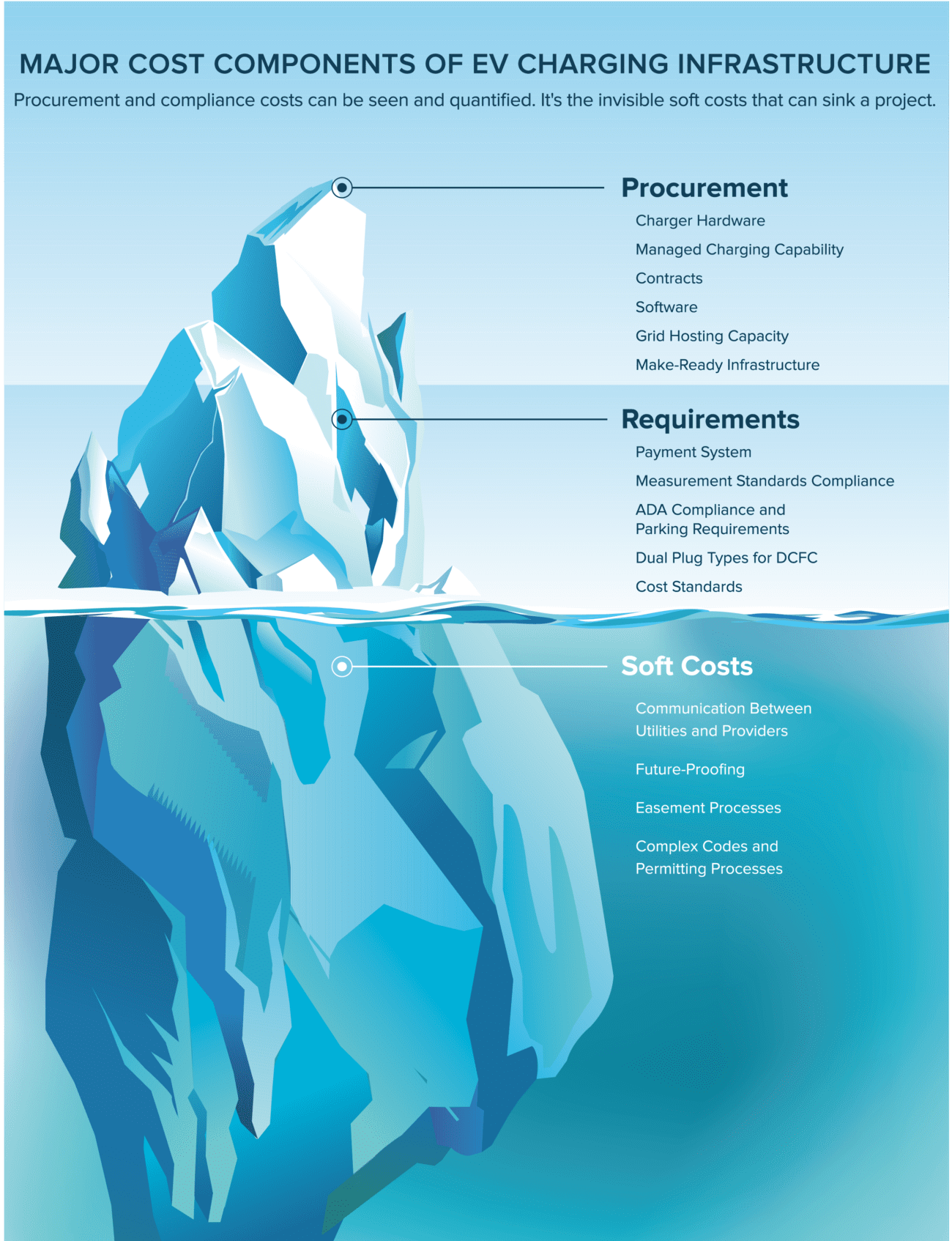
These costs are poorly understood, very hard to quantify, and almost entirely undocumented in the literature. The authors argue that just as it took the combined and sustained efforts of the US Department of Energy, multiple US national laboratories, and nongovernmental organizations, including RMI, to discover and present comprehensive findings on solar projects’ soft costs and how they can be reduced, it will take a similar level of effort to understand the soft costs of EV charging infrastructure and how they can be reduced.
Once the problem areas are identified, the efforts of a wide variety of actors—including regulatory agencies, civic officials, staff of local building and planning departments, utilities, private-sector charging network operators, and legislators—will be needed to solve them.
If transportation electrification is to proceed at a pace commensurate with meeting the challenge of climate change, we must ensure that recharging an EV at a public charger is no more expensive than refueling a conventional vehicle. Getting there will require particular attention to the cost of every element involved in charging infrastructure and squeezing out costs wherever possible. This report is a constructive contribution to that effort.
Authors

Chris Nelder
Emily Rogers
Related Insights



EVs Are Coming to Island Nations. What Happens When They Retire?
Help build the clean energy future. Donate today.
Independent research. Real-world solutions. Supported by donors.
RMI can pursue the highest-impact climate and energy solutions because we’re supported by people who believe change is possible. Every gift helps advance the work needed to make clean energy the default choice worldwide.
For other ways to give to RMI, including checks or gifts of stock, please visit Other Ways to Give.
