

Learn how we are working to transform how we use and produce energy.
Power Sector Growth without Liquefied Natural Gas
How to Leverage Clean Energy for Grid Expansion in the Global South
Why we share this work for free
RMI is an independent nonprofit working to accelerate the clean energy transition. We publish research like this to inform decision-makers and drive real-world impact.
Our work is supported by philanthropy as well as partnerships, including fee-for-service engagements. This support makes it possible for us to share our independent insights for free.
If you find this work valuable, you can support it anytime.
Get more insights like this
Stay up to date with the latest research, analysis, and tools from RMI by opting in to receive occasional emails below. You’ll get new reports, event invitations, and practical insights to help us all accelerate the clean energy transition.
Loading form...
Your download should start automatically. If it doesn’t, click the download button below.
This work is made possible by philanthropy
RMI is a nonprofit supported by donors and partners. Philanthropy enables us to produce independent research and make resources like this freely available.
If you find this report valuable, please consider supporting our work. You can also explore how we partner with organizations to drive impact.
Jump to Section
Countries globally face a need to invest significantly in their electricity systems to achieve diverse goals including energy access, reliable and resilient supply, affordability, and economic growth. Natural gas, seen in recent years as a priority solution for least-cost generation expansion to meet these growing needs globally, faces increasing headwinds driven by the ongoing global energy crisis and the increasing competitiveness of renewable energy.
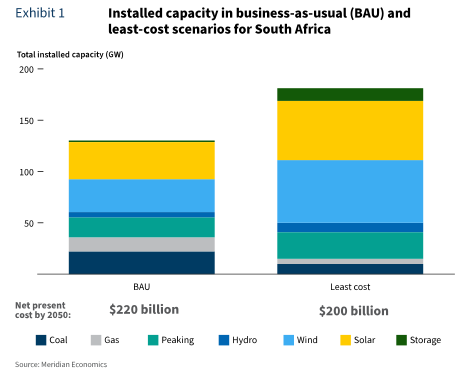
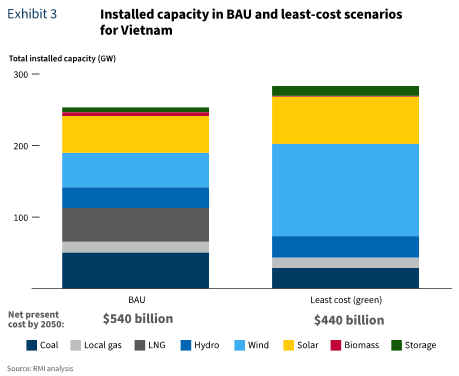
This research brief summarizes options for electricity resource investment from two countries with distinct starting conditions and future trajectories — South Africa and Vietnam — that illustrate how prioritizing near-term investment in renewable energy can lower both costs and risks compared with heavy reliance on new gas power plants that require new liquefied natural gas (LNG) import capacity.
While individual countries’ investment pathways should be informed by country-specific needs and national priorities, these case studies suggest gas power plants supplied by imported LNG will have a far smaller role to play in affordable grid expansion globally than commonly assumed just a few years ago. In order to deliver an affordable grid expansion strategy that can support energy access and economic development, country-level decision makers have a pressing opportunity to reassess planned investment in gas power and LNG capacity.
Authors

TJ Conway
Principal
Mark Dyson
Managing Director
Thanh Ha
Manager
Sakhi Shah
Senior Associate
Vikram Singh
Senior DirectorRelated Insights


States Are Opening the Door to Data Center Investment in Virtual Power Plants

Help build the clean energy future. Donate today.
Independent research. Real-world solutions. Supported by donors.
RMI can pursue the highest-impact climate and energy solutions because we’re supported by people who believe change is possible. Every gift helps advance the work needed to make clean energy the default choice worldwide.
For other ways to give to RMI, including checks or gifts of stock, please visit Other Ways to Give.
